Wednesday, March 11, 2009

Unexpected Initiatives/Towards the resettlement of a Slav-Macedonian minority in Macedonia?

by Evangelos Kofos [1]
(“To Vima”, June 25 , 2003)

Two recent government announcements have unexpectedly raised the matter of the “repatriation” of the Slav-Macedonian exiles from the period 1941–1949.[2] Deputy Foreign Affairs Minister Andreas Loverdos and Ministry of Foreign Affairs spokesman Panagiotis Beglitis have both indicated — the former more obscurely, the latter quite clearly — that before the end of the summer legislative arrangements would be in place providing not only for easier visitor access (visas, etc.), but also for “repatriation”. Given that these announcements coincided with rumours that Greek citizenship was to be offered to “300,000 Northern Epirotes” who would then probably be able to vote in the up-coming Greek parliamentary elections, it is natural that the announced “repatriation” of the “Aegean Slav-Macedonians”[3] should have set off similar trains of thought.

What is surprising is that such a serious issue, a matter of great national sensitivity that had been addressed as such by every successive post-war government and by Georgios and Andreas Papandreou personally in the1960s and 1980s, should have been thus reversed without convincing reasons. Why are historical facts being suppressed or distorted in order to present the “Aegean Macedonians” as the latest victims of the Greek Civil War? And why is Greek public opinion not being given the true dimensions of the problem? Let us list a few of these facts:

  • Today, according to their own calculations, the number of “Aegean Macedonians” in FYROM, together with their descendants and mixed-marriage families, is in the neighbourhood of 100,000. And there are several thousand more in Bulgaria, Australia and Canada.
  • The collaboration of significant numbers of these people with the Bulgarian and German occupation forces during World War II, and afterwards, during the Greek Civil War, with the Slav-Macedonian National Liberation Front (NOF), was used as a lever to claim areas of Macedonia from the Greek territorial state. Moreover, in the case of the Greek Communist Party, the defection of significant numbers of “Aegean Macedonians” from the ranks of the Greek Democratic Army to Tito’s Macedonia was a painful stab in the back.
  • This doubly negative role played by the “Aegean Macedonians” in Greece was seen in Belgrade and Skopje as an absolute positive. Their action in Greece was recognised as military service, performed not during the Greek Civil War but during the “Macedonian National Liberation War”. Thus, those who fled to the then People’s Republic of Macedonia were granted special benefits [Yugoslavian citizenship, “Macedonian” identity, free housing, honours and distinctions] and, most important of all, military pensions.
  • Since then two new generations, children of the original exiles, have been educated in an environment of values that considers the “Aegean Part of Macedonia under Greece” — that is, Greek Macedonia — to be still “unredeemed”.[4]
  • With FYROM’s declaration of independence in 1991, “Aegean Macedonian” activists in FYROM and elsewhere found themselves in the forefront of extreme anti-Greek nationalist manifestations.

On the basis of these facts, the return to Greece of thousands of people with a deeply entrenched Slav-Macedonian consciousness and attitude cannot logically be a “repatriation”. It is rather the arbitrary transplant of an alien nationalist minority to the frontier districts of Greece’s Macedonian prefectures.


Let me point out three consequences of such an action:

  • In the first place, we will be moving towards a re-drawing of the ethnological map of our border districts, at a time when the nationalist and ethnic conflicts in the immediate neighbourhood of Greece have not yet subsided. Eventually, these suitable conditions will foster the southward spread of such conflicts inside Greece.
  • In the second place, it is inevitable that there will be similar pressures for the “repatriation” of tens of thousands of Albanian Cham refugees (1944-45) from Thesprotia, Bulgarian political exiles (1944) from Eastern Macedonia and Thrace and Turkish Muslims from Western Thrace.
  • In the third place, the implantation of thousands of fervently nationalist “Aegean Makedonci” in the Greek Macedonian communities will inevitably provoke a mini cultural war for the prize of the history, the culture and the very name of Macedonia. And the good climate of bilateral relations that has been cultivated with such effort these past years could well be undermined from within Greece.


We must recognise, however, that over the years the Macedonian Question has created traumas, both collective and personal. Greece has not been generous enough, prohibiting for decades thousands of “Aegean Macedonians” from even visiting the Greece. Lately the situation has improved significantly, but the process is still incomplete. A number of matters that are still in abeyance, such as outstanding property claims on both sides, must be addressed on the inter-governmental level with a “new package”. For the sake of peace and good neighbour relations, this package should extend to cultural disputes, including the thorny question of the name.

Notes
[1]-Dr. Kofos is a former Minister Counsellor, Hellenic Ministry of Foreign Affairs.
[2]-Interview with Deputy Foreign Affairs Minister Andreas Loverdos in "Kyriakatiki Eleftherotypia" (8.6.2003); Ministry of Foreign Affairs spokesman P. Beglitis’ press conference on 9.6.03 (see website www.mfa.gr 9.6.03).
[3]-The term "Aegean Macedonians" — or "Egejiski Makedonci" — is used in FYROM to designate those originating from Greek Macedonia — "Aegean Macedonia" — and their descendants.
[4]-The author has in his possession documents and recent video interviews in history classes of schools in FYROM.

Tuesday, March 10, 2009

Ethnic Creationism: Risto Stefov´s polemics about Greece, Macedonia and FYROM

by Tymphaios
in American Chronicle

Ethnicity is not based on genetic make-up. In no country is one required to take a genetic test before he is accepted as a citizen. Even Hitler did not require any such tests. For Risto Stefov, however, and some of his colleagues, the fact that Greeks cannot prove a genetic identity to someone (not defined thus impossible anyway) who was Greek, means Greeks are not Greeks. Therefore the Greek word Macedonia and the Greek administrative district of Macedonia (in Greece) with its Greek history are up for the taking. The only merit of such an extreme form of racism is that it does not openly ask for the extermination of Greeks as it mercifully makes Greeks non-existent by an act of free will. Nevertheless, through this invention, part of Greece, Greek property (in the administrative district of Macedonia) as well as Greek heritage and history may be appropriated just the same.

Unfortunately for Risto Stefov and his friends, ethnicity is not decided by a set of genes and besides we know nothing about how genetically homogeneous the original Greeks (whoever Stefov thinks these might have been) were. This racial, or even racist, attitude towards the definition of ethnicity, ignores thousands of years of linguistic and cultural continuity and the self-definition at all times of Greeks as Greeks. Stefov conveniently also ignores the geographic continuity, for Greeks never lived just around Athens and Sparta by their own accounts and the accounts of others. A fuller case can be made elsewhere and others have responded to Stefov´s racist ideology. In this response, I will limit my reply to a one of his comments.

Risto Stefov in his essay #9 on Greek heritage writes:
"In the book "The Empty Cradle of Democracy" by Alexandra Halkias on page 59 we read "Until the beginning of the nineteenth century, the average inhabitant of Greece called himself of herself Roman (Romios), and the (Greek) language Romeika."

"…though this was not articulated in racial terms but on the basis of a common language, history and consciousness. In effect, at this time, whoever called themselves a Greek was a Greek. It is because of this that many Greek-speaking Albanians, Slavs, Romanians and Vlachs were easily assimilated and became important players in Greek patriotism at the time. (Dakin 1972, 8)""

http://www.americanchronicle.com/articles/view/92784

Although these statements support the Greek position, that the Greek language has been spoken uninterruptedly since ancient times in Greece and indeed in Macedonia, it must have been what little Stefov could find that he might turn against the Greeks. There is nothing contained in his two quotes that says that Greeks were not Greeks or that the Romeika was not the Greek language. In fact the first quote explicitly says the Greek language was called Romeika. Since the Emperor Theodosius, the official language had been Greek and the culture was also Greek. Romioi (Romans) was a word Byzantines used and which is equivalent to Greek or Hellene. These three words were used interchangeably, sometimes in the same page or the same paragraph in Byzantine times.

Anna Comnena, the Byzantine historian, uses "Romaios" (Roman) interchangeably with "Hellene":
"Now the man [Bohemond] was such as, to put it briefly, had never before been seen in the land of the ROMANS, be he either of the barbarians or of the HELLENES". [Anna Comnena, Alexiad, Book 13, X]

and
"Throughout the whole of the day the Turks kept attacking the ROMAN army without any success, for they were unable to break it up either entirely or even partially, so they ran back to the hills without accomplishing anything and lighted a great many bonfires and howled all through the night like wolves and occasionally made jeering remarks at the ROMANS; for there were some semi-barbarians among them who spoke HELLENIC."[Anna Comnena, Alexiad, Book 15, XII]

Frantzis in his Chronicle (15th C) describes the events around the Fall of Constantinople in 1453. He refers interchangeably to Romans, Hellenes or Greeks and even expresses the idea of the "patrida" (homeland):
V.5. "Ioannes Justiniani … was appointed to guard with four hundred soldiers, Italian and ROMAN, the region of the Gate of saint Romanus…"

V.8. "Iakovos Kokkos the Venetian… having obtained three very fast light ships, placed four hundred courageous young men in them, GREEK and Italian"

VIII.11. "He wants to devour us and this city, that the thrice-blessed Constantine the Great that king dedicated and granted to the panagnos and yperagnos despoina Theotokos and aeiparthenos Maria, that she may be the lord and aid and roof of our homeland (patrida) and sanctuary of the Christians and joy of all the HELLENES, the most glorious [city] amongst all that are under the rising sun."

The second quotation where Stefov refers to the Vlachs and Arvanites of Greece is meant to "prove" that Greeks are no longer pure or ancient, for this is clearly part of his creationist principle. For the sake of the reader, there are in Greece two kinds of Vlachs, Greek speaking ones and Latin speaking ones, who are actually bilingual. The Greek speaking are the majority but are still referred to as Vlachs and as it suits Stefov, they become non-Greeks. It matters to Stefov little that the Vlachs themselves speak Greek and consider themselves more Greek than Greek. Many of the benefactors of the Greek State and society since the liberation of Greece were Vlachs. One of the founders of the Philike Etairia, Skoufas, was also a Vlach. Why are these less Greek than El Greco? Vlachs were people who used Greek or Latin in the Hellenistic and Roman periods. Some may have served in the Roman legions, many traveled considerably or were nomadic, others were Greek fugitives or folk of the countryside. It is hardly surprising that they identified themselves with the Romans, later Byzantines, and with the Greeks. In any case a Greek in the Roman empire was not a matter of genes (as Stefov wishes it should have been) but a matter of language and culture. The same was true during Byzantine times and not so surprisingly during the Greek struggles for liberation from the Ottoman yoke. The very idea of political freedom has its origins in Greece, even if it has become a universal idea. However, the desire of bilingual people living among the Greeks (the latinisng Vlachs and Christian Arvanites) to be educated in the Greek language and the Greek culture so as to become a living part of Greece, that for Stefov is very very bad.

Unfortunately for Stefov, his ethnic creationism is an old myth he needs to resuscitate to save in his mind the macedonist ideology in FYROM: if no Greeks exist, then Macedonia is up for the taking. Greece has adhered to the ancient and Byzantine idea of a free society and had been proclaimed in this way during the revolution for independence. Some of the first Greek Ministers were Vlachs and one was a prominent Suliot revolutionary leader, by some regarded as half-Albanian in origin. The first Greek Constitution regarded everyone who was a Christian, or had struggled for liberty, and lived in Greece and those who might have not been but adopted the Greek nationality, as Greek citizens. What makes the Greek people is not a genetic examination - that makes nobody a citizen of any country. The principle is the struggle for the Greek idea, which is the idea of political freedom, of equality, of free education, of freedom of thought and of free enquiry, using the medium of the Greek language. This was the idea of Greece since the time of Isocrates in the 4th century BC. It is the same Greece, even if the Greeks of the 4th C BC died a long time ago. Greek language and the Greek idea were as alive in 1821 as they had been before.

The nationalistic principles of the nineteenth century, in which an ethnicity was genetically unchangeable through time, is a fossil of pre-scientific thinking. Thanks to Darwin and the scientific revolution he brought about, we know a little bit more now than people knew in the 19th century. Humans, like other species, are not static. The ancient Greeks had no special properties all of which disappeared with them when Demosthenes, or Alexander or someone or other died. Linguistic, historic and cultural continuity is what determines the survival of an ethnicity not a unique "blood" or an exclusive set of genes. Like species, so human "ethnicities" evolve over time. Risto Stefov´s quest is a constant search for a genetic contamination from Albanians or some other "impure" ethnicity, so that like a creationist he may say: aha, Greeks as known today were never created by God, or Greeks of the ancient times have no connection to today´s Greeks because they did not call themselves Romioi, presumably did not mix with Albanians, etc. So therefore they were a different "race". He cuts a lonely figure in such a quest, because this kind of thinking is more and more recognized as belonging to those racist theories promoted by the fascistic states of mid-20th century. Stefov´s ethnic principle is like that of Creationism in the sense of lines that are not evolving but can only stay or disappear. Today this is a thought rarely entertained even by ordinary laymen.

Thursday, March 05, 2009

The UN Minorities Rights Report on Greece 2008

The UN Minorities Rights Report on Greece 2008 has been released.
Essentially it is the report of the so-called Independent expert on Minority Issues Gay McDougall (8-16 Sept. 2008).

Read and download it from this link.

Tuesday, March 03, 2009

Greece issues travel advisory on FYROM


Greece on Tuesday issued a travel advisory for citizens traveling to FYROM.
The advisory came after an incident Sunday night FYROM in which a group of some 20-30 people attacked three Greek tourist coaches in downtown Ohrid as they were waiting for Greek holidaymakers to return from a tour, which was condemned by the Athens government.

Foreign Ministry spokesman Mr. G. Koumoutsakos has issued the following announcement:

The Foreign Ministry informs Greek citizens who wish to travel to the Former Yugoslav Republic of Macedonia - whether for a stay or in transit, for professional or personal reasons - that they may experience problems.
Reasons for this include the following:

A. The negative climate that has been created with regard to our country during the past year has provoked the abuse of persons - usually drivers - and attacks on and damage to cars with Greek license plates.

B. Local legislation and procedural regulations, including those regarding:

· customs,
· taxation,
· transit hauling,
· leaving the country with over €2,000 in foreign currency, unless the currency was declared on entry into the country, and
· traffic regulations, are very strictly enforced by the authorities in FYROM with regard to Greek citizens, in blatant abuse of authority and with disproportionate consequences.

It should also be borne in mind that FYROM legislation changes constantly and without any previous notification of the public or interested professional groups.

The competent Greek authorities have observed cases of the above, particularly in recent months.

Greek citizens are encouraged to familiarize themselves in a timely manner regarding the regulations in effect in FYROM, to comply with them carefully and, mainly, to exercise caution and prudence regarding their safety and that of their property during their stay in, or journey through, FYROM.

The Greek diplomatic and consular missions in the country are at the disposal of Greek citizens to provide clarifications or assistance in the case of an unpleasant incident.

Monday, March 02, 2009

Attack of FYROM Slavs in Greek tourists at the Ohrid, one wounded

Another alarming event of the anti-Greek Hysteria and Fanaticism prevailing currently in FYROM took place.


A group of Greek tourists who were at that time in the centre of the city of Ohrid, were attacked by a group numbering about 20 persons, mainly of young ages.


According to E-Tipos, this group of Nationalists initially wrote with red paint Anti-Greek mottos on the Greek Bus which was at the time empty. The local media reported the mottos were “Macedonia”, “United Macedonia” and “Alexander the Great”.


When the Greek tourists showed up, the nationalists threw at them stones causing damages on the bus and injuring a Greek tourist. The Greek ministry of Foreign affairs condemned this “incident of organised attack” as the representantive of MFA, Mr George Koumoutsakos said.


Mr Koumoutsakos added “Activities like that, unfortunately dissolve the contact between the two nations, make visible the problem of Nationalism and Intolerance against Greece which are consciously cultivated the recent period in Skopje.”Mr Koumoutsakos lastly called upon the officials of the neighbouring country to “protect the Greek visitors but also to arrest and punish those responsible for these horrific activities”.


translation by Ptolemy in AMAC forum

Saturday, February 28, 2009

Belomorska Macedonia, an Irredentist term being used by Skopjan activists in Greece

Those involved with the Macedonian issue have surely ascertain that Skopjans in Greece are creating blogs in order to “advertise” also in Greek language, their Irredestist Propaganda. So except MAKIBE and Macedonian Abecedar, we have currently a new Blog entitled “Belomorska Macedonia”. Its interesting to analyze the history of this name since not many of us acknowledge it.


In Greee the term Belomorska became known between 1941-1944 when the territories of Eastern Macedonia and Thrace (Minus Alexandroupolis) was under “Bulgarian administration” on assignment of Germans, who were the ones that essenially captured it. That term which is being translated in Greek as «Aegean Administration” or “Aigaeis” was being used by Bulgarians with aim to indicate on one hand this area geographically but on the other hand as an administrative district of Bulgaria, in the sense which was given by Bulgaria and was applied in the particular historical coincidence. These terms are in use in the translation of some Administrative and Juridical decisions of the Bulgarian State and form a translation of the Bulgarian term Belomorie. [1]

This term is a successive situation of the broader geographically Bulgarian Term Εgeiska Makedonia (Μακεδονία του Αιγαίου), which covers the entire part of Greek Macedonia while after the war it is applied by the intellectual and political leadership of FYROM. The Term Belomorie was invented by the Bulgarian scientists/geographers of the war Period in order to attribute the geographical area between Thermaic gulf and the gulf of Alexandroupolis, corresponding to the other 2 areas that Bulgaria “occupied” during this period- Dobroutsa and the area of South Jugoslavia which had also distinct names. In the aftermath it was reduced under circumustances to define the specific area between the river Strymon and the line Alexandroupolis-Svilengrand. [2]

So it is sorted out the attempt of the Bulgarian Political and Intellectual leadership to familiarize the Bulgarian population to the capabilities and circumustances, by redefining geographically and linguistically the contemporary Bulgarian “historical and national Irredentist homelands”. Today the Bulgarians were substistuted by the «Makedonskiot nacionalnosti» of FYROM.

So we witness the Skopjan activists (who also advertise the ”Liberal Alliance” - “Φιλελεύθερη Συμμαχία” whenever they can) are using anymore openly, terms that naturally remind the Bulgarian occupation in Greece and the Bulgarian gangs, of Ochrana Style that went all over Macedonia and murdered brutally Greeks under the shield of German Nazism but also Italian Fascism.
As a matter of fact, is the “Liberal alliance” aware that some of its members are using such Ultra-Nationalistic Administrative Definitions in order to promote their expansionistic Propaganda??

Notes:
[1]-Η βουλγαρική κατοχή στην Αν. Μακεδονία και Θράκη (1941-1944), Ξανθίππη Κοτζαγεώργη-Ζυμάρη,2002, ΙΜΧΑ, σελ 14
[2]- D. Jaranov, «Balgarskoto Belomorie kato geografsko poniatie» (The Bulgarian “Aigaeis” as a geographical term), Belomorski pregled 1942, n. 1, 1-10


Great thanks to history-of-macedonia.com for the translation.

Greek ambassador walks out of Skopje conference in protest

(ANA-MPA, 27-2-2009)
The head of Greece’s Liaison Office in FYROM Ambassador Alexandra Papadopoulou walked out of a large conference on culture held here on Friday in a show of protest.

She strongly objected to the use by the organizers of the name ?Republic of Macedonia? when referring to FYROM and their failure to adhere to the customary practice of using only national flags and the names of participants in similar events.

Friday, February 27, 2009

A letter with the position of the Pan-Macedonian Association USA was sent to Hilary Clinton

PRESS RELEASE
Boston, February 25, 2009

A letter with the position of the Pan-Macedonian Association USA, also co-signed by the Hellenic American National Council, as well as the International Coordinating Committee Justice for Cyprus (PSEKA) and the Cypriot Federation was sent yesterday, February 23, 2009 to Secretary of State, Hillary Clinton in view of meeting with her Greek counterpart Dora Bakoyianni. The Greek/American community expressed its intense concern regarding the escalated irredentist and aggressive behavior of the former Yugoslav Republic of Macedonia (FYROM) and they asked the new US administration to retract the decision of the previous administration to recognize the FYROM as the Republic of “Macedonia.” I addition they expect the new administration condemns the irredentist behavior of the aforementioned state.

The ill-conceived decision by the previous administration to recognize FYROM as the Republic of “Macedonia,” clearly became the catalyst of a more aggressive stance by FYROM that can presently be perceived as hostile towards Greece, a NATO ally of the US for many years. We feel that the new administration should reverse its decision, recognize them again as FYROM, and actually block their NATO integration until a new name is found. In addition the US should condemn in the strongest terms their irredentist and aggressive behavior,” is mentioned in the letter. “It is imperative that a negotiated mutually acceptable solution also includes change of the FYROM constitutional name to the new agreed name, i.e. change in their passports and use of that name erga omnes. Also all countries, including those that already have recognized the FYROM as Republic of “Macedonia,” convert to the new name for all uses.”

Please note that these positions represent the overwhelming majority of the Greek/American community. In addition, during the recent Regional Assembly of S.A.E. USA and the Network of SAE Youth these positions were unanimously endorsed.

The letter is co-signed by the Pan-Macedonian President Mrs. Nina Gatzoulis, Mr.Emmanuel Velivasakis co-signed on behalf of the American Hellenic Council (HANC), Mr. Philip Christopher co-signed on behalf of International Coordinating Committee Justice for Cyprus (PSEKA) and Mr. Peter Papanicolaou co-signed on behalf of the Cyprus Federation of US.

The letter in its entirety follows:

February 23, 2009

To: Secretary of State Hillary Clinton
U.S. Department of State

2201 C Street NW

Washington, DC 20520

Dear Madame Secretary:

On behalf of the nation-wide membership of the undersigned Greek/American organizations which represent the majority of the American citizens of Hellenic descend in USA, we write to you to express our strong concerns regarding the name issue of Greece’s neighboring country, the former Yugoslav Republic of Macedonia (the FYROM).

As you prepare to meet with Greece’s Foreign Minister, Dora Bakoyianni, we know that a main topic on the agenda will be the FYROM name issue and the consequences it would have in the stability of the Balkans. Since this issue first arose back in the year 1991-1992 the Greek American community, through several resolutions of the undersigned Greek/American organizations, has been against a permanent name for the neighboring state which would include the name Macedonia/Macedonian.

According to the most recent census, not all of the FYROM population consider themselves “Macedonians.” Who gives them the right to impede the Euro-Atlantic integration of the remaining minorities of the country’s population for a name dispute which does not even concern them, as there might be quite a few among the so-called “Macedonians” who would look forward to a resolution, regardless of how they identify themselves?

As far as the Greek/American community is concerned, as well as Greeks all over the world, the term Macedonian encompasses a Hellenic historical and cultural identity for thousands of years. We strongly oppose any use of our cultural Macedonian identity by the FYROM inhabitants in any ethnological concept. A similar example in Europe would be for the Austrians and Swiss to ethnologically identify themselves as Bavarians, a term which historically and culturally belongs to Germany.

Madam Secretary,
It is imperative that a negotiated mutually acceptable solution also includes change of the FYROM constitutional name to the new agreed name, i.e. change in their passports and use of that name erga omnes. Also all countries, including those that already have recognized the FYROM as Republic of “Macedonia,” convert to the new name for all uses.

FYROM continues to provoke Greece, usurping its history which has been Hellenic for thousands of years, while FYROM refuses to negotiate in good faith over the name issue. Unfortunately, actions over the years such as distortion of geographic maps, naming its airport “Alexander the Great,” revisionist textbooks in schools, advertisements on international television media (CNN), usurping the Hellenic history, and inflammatory comments by top government officials, encourage new generations in FYROM to cultivate hostile sentiments against Greece.

As American citizens of Macedonian/Hellenic descent we condemn the decision published by the Official Gazette of the Government of the FYROM, to name part of the Pan-European Corridor X that runs through its territory, after Alexander the Great, who is universally acknowledged as a prominent Greek historical figure; therefore he is part of our cultural heritage.

It was recently self-exposed when FYROM promoted through National TV channels an approximately nine minute video, entitled “Macedonian Prayer.” In the video God Himself[!] appeared, telling the people of the FYROM that He “had populated the earth with three races of people, the white race or Macedonoids, the yellow race or Mongoloids and the black race or Negroids, while all other people in the world are mulattos” (please see attached literature of the “Prayer”). These extreme racial beliefs, which underlie a virulent ethnocentric narrative, are especially troubling to Greek/Americans. Not one official of the FYROM government condemned the contents of the video, not even the Church.

The ill-conceived decision by the previous administration to recognize FYROM as the Republic of “Macedonia,” clearly became the catalyst of a more aggressive stance by FYROM that can presently be perceived as hostile towards Greece, a NATO ally of the US for many years. We feel that the new administration should reverse its decision, recognize them again as FYROM, and actually block their NATO integration until a new name is found. In addition the US should condemn in the strongest terms their irredentist and aggressive behavior.

We wish the FYROM well and we hope they find a name for their country that does not include the word “Macedonia,” in order to be consistent with their Slavo/Albanian identity, acting as a unifying force for its entire population.

Respectfully,

Nina Gatzoulis President
Pan-Macedonian Association US

Emmanuel Velivasakis President
Hellenic American National Council

Philip Christopher President
International Coordinating Committee Justice for
Cyprus
(PSEKA)

Peter Papanicolaou President
Cyprus Federation of America, Inc

cc:
Assistant Secretary of State for Europe and Eurasia Daniel Fried

Deputy Assistant Secretary of State for Europe and Eurasia Matthew Bryza

Director of Southern European Affairs Kathy Fitzpatrick

Senior Greek Desk Officer Adam Scarlatelli

“Republic of Macedonia” Desk Officer Anna Stinchcomb

The Congress

Saturday, February 21, 2009

US governement maps that support FYROM Macedonism-Expansionism

Agencies of the U.S. government take the Slavic arguments of Macedonism of the FYROM Slavs as facts "educate" accordingly the U.S. armed forces regarding the FYROM's sociology. The country book of the Former Yugoslav Republic of Macedonia under the chronology of historical events besides erroneous dates it ties directly the Slavs to the ancient Macedonians following the tactics of the FYROM tactics which lacks evidence or proof for the allegations.[1] However, most revealing information in the same handbook was the map of "Macedonian occupied territories"(?).[2]

The implications of the above map are great since it tells the world that Greece, Bulgaria, and Albania occupy territories that the United States as a country recognizes the occupation indirectly approving their “liberation.” One could argue that it is indicative of a sloppy research work checking only the FYROM government and diaspora websites; probably it is. Nevertheless, the impression of such sloppy work is that the Armed Forces of the United States learned their “facts” that resulted from the FYROM Macedonism.

The Central Intelligence Agency of the United States printed a map of the FYROM drawing direct lineage of its people from the ancient Macedonians. The U.S. Government Printing Office still has it on sale. This map shows a column (right) that people responsible for that region have poor understanding of the issue.


CIA Map of the FYROM.[3]

[1] U.S. Department of Defense, Marine Corps Intelligence Activity, The Former Yugoslav Republic of Macedonia, Country Handbook, 1999, 34.
[2] U.S. Department of Defense, Marine Corps Intelligence Activity, The Former Yugoslav Republic of Macedonia, Country Handbook, 1999, 22.
[3] Central Intelligence Agency, Summary Map, The Former Yugoslav Republic of Macedonia, 802207 (Washington, D.C., 1994). http://memory.loc.gov/cgi-bin/query/h?ammem/gmd:@field(NUMBER+@band(g6845+ct000645)), accessed April 18, 2008.


Wednesday, February 04, 2009

The Birth of a Clone State

By George Gialtouridis

source: Pan-Macedonian Association


Part I
The term clone is derived from κλών (klon), the Greek word for twig or branch, referring to the process whereby a new plant can be created from a twig.

Most of us are aware of the letters sent by Former Yugoslav Republic of Macedonia (FYROM) Prime Minister Nikola Gruevski to Greek PM Karamanlis, to the President of the European Commission Jose Manuel Barroso, to the UN Secretary General Ban Ki-moon and many other world leaders raising issues of an artificial “Macedonian” ethnic minority in Greece. As Gruevski’s provocative allegations further strain relations between Greece and FYROM and the name dispute remains a hot topic for both countries, I will present a multi-part series on this subject, concentrating on events from 1870 on, while occasionally referencing ancient Greek history only to refute FYROM’s claims as they arise.

Following the veto to it’s anticipated membership at the NATO Summit in Bucharest, Romania earlier this year, FYROM’s political leadership headed by Prime Minister Gruevski is attempting to expand the dispute by provoking artificial minority issues in northern Greece, specifically in Greece’s Macedonia province.

Currently, negotiations for a permanent name for FYROM are being held under the auspices of the Special Representative of the Secretary General of the United Nations Mr. Matthew Nimetz. PM Gruevski recently dismissed all of the name proposals which Nimetz had put on the table and unilaterally derailed the negotiations. By embarking on this ethnic minority ‘witch hunt’ he is dangerously treading the diplomatic waters and heading into uncharted territory which some perceive as a suicide mission. His intentions are clear: To isolate Greece as a country which severely violates human rights, carry the dispute and claims of his fledging state within the borders of modern day Greece and as a result have Greece meet the same fate as Serbia. Gruevski is not alone in this. He has recruited lobbyists who are currently very active in the halls of Washington. Such measures can not go unheeded and as Americans of Hellenic descent it is our moral responsibility to our ancestors to stand up to the fabricators of history and help Greece deny them their expansionist ambitions.

In the coming months I will explain through a detailed sequence of events the eventual creation of a “Macedonian” nation, which is FYROM today. This state has nothing to do with the centuries-long evolutionary ethnic processes which resulted in the natural forming of other nations in the Balkan peninsula. It is a state which evolved through oppression, intimidation and persecution perpetuated by the barbarous regimes which laid its foundation.

I will start my analysis with a shocking revelation which only recently came to light. The Prime Minister of FYROM, Nikola Gruevski, has Greek roots. His grandfather, Nikolaos Grouios, was a resident of the village of Ahlada, in the prefecture of Florina, in Greece’s Macedonia province. Mr. Grouios was killed fighting the Italians a few weeks following their invasion of Greece on October 28, 1940. In the center of the village now stands a monument honoring war heroes who were residents of Ahlada. The name “Nikolaos Grouios” is clearly carved in the marble memorial.

During the final days of the Greek Civil War, as the communists retreated into Yugoslavia ousted by Greek, American and British forces, Nikolaos Grouios’ widow and her three children, one being Gruevski’s father, followed for reasons unknown the communists of the ELAS faction into Yugoslavia.

Nikola Gruevski is a perfect example of the diversified backgrounds of Greeks, Bulgarians, Albanians, Serbs, Gypsies and others who today make up the state called FYROM. Through identity theft and deception, oppression, persecution and terror, propagated by generations of deliberate misinformation and history usurpation in FYROM’s educational institutions, evolved this false perception of a Macedonian identity.

In the next segment I will explain how, starting around 1870, a pseudo-Macedonian ethnic identity evolved as part of a Bulgarian plan to annex the entire Macedonian region, coveting the shores of the northern Aegean Sea.


Part II
The term clone is derived from κλών (klon), the Greek word for twig or branch, referring to the process whereby a new plant can be created from a twig.

According to Herodotus’ The Histories, during the 8th century B.C. the Argeads (Αργεάδαι) migrated north from the Greek city of Argos in Peloponnesus to the region we now know as Macedonia. In addition, Thucydides in the History of the Peloponnesian War concurs that Perdiccas I was the first monarch of the Argead dynasty, better known as the ancient kingdom of Macedonia.

The name Macedonia (Μακεδονία) is rooted in Homeric Greek. A related form of the word first appears in the Odyssey, VII 106: ‘
οιά τε φύλλα μακεδνης αιγείροιο’ whereas ‘μακεδνης’ in the form of an adjective means very high or tall, in this context referring to the size in height of a poplar tree. The first Macedonians spoke a proto-Hellenic dialect similar to that of Homer. They eventually adopted the Attic Greek dialect as did the other Greek city-states and finally the Koine Greek dialect during the Hellenistic period.

It is not the primary objective of this writer to argue whether the ancient Macedonians were a Greek tribe or not. Any serious historian will validate their Hellenic origin with scores of references as well as Greek inscriptions on countless ancient artifacts unearthed from all over the region. I would like to note, however, one important date in ancient history. In 168 B.C. the last Macedonian king, Perseus, surrendered to the Romans after his decisive defeat at the Battle of Pydna and thus Macedonia came under Roman rule.

For over 2000 years thereafter, there has not been even one documented reference claiming an ethnic Macedonian identity. During 2046 years of recorded history, i.e. from 168 B.C. up until 1878 A.D., there is no evidence of the existence of a Macedonian ethnic consciousness. There is no evidence of the existence of a Macedonian language. There is no evidence of the existence of a Macedonian alphabet. There is no evidence of the existence of a Macedonian Church. These indisputable facts raise a crucial question to FYROM’s fabricators of history. But first, let’s go over two significant events which transpired in the Balkan peninsula, one in 1870 and the other in 1878.

In the 19th century the entire region of Macedonia was still under Ottoman occupation. Numerous demographic studies had been conducted in the vilayets of Monastir and Thessaloniki as late as the 19th century by both Ottoman authorities and European institutions, covering the entire Macedonian region and beyond. Not even one of these ethnic surveys references the existence of a Macedonian ethnicity.

Through the Firman (decree) of 1870, Sultan Abdulaziz allowed the Bulgarian Exarchate to separate from the ecclesiastical authority of the Ecumenical Patriarchate of Constantinople. From a Turkish point of view, the decree was designed to divide the Christian populations of the decaying Ottoman Empire and define ethnicity in the Balkans by church affiliation. From a much more well-conceived Bulgarian perspective, the new autocephalous status of the Church would encourage Bulgarian nationalism. But there was another method to the madness. Russian influence had also encouraged the Bulgarian schism. Count Nikolai Pavlovich Ignatiev, Russian ambassador to the Ottoman Sublime Porte, upon orders from Tsar Alexander II was promoting a Pan-Slavic movement in the Balkans. This irredentist plan was heavily concentrated in and around the Macedonian region encompassing all the Slav elements with protagonists the Bulgarians and to a lesser extent the Serbs.

The Russo-Turkish War of 1877-1878 ended with the Treaty of San Stefano signed on March 3, 1878. Russian forces had halted their advance at San Stefano (now Yesilkoy), a village on the Sea of Marmara seven miles west of Constantinople. The Pan-Slavist Ignatiev was a signatory of the Treaty. The Treaty of San Stefano forced Turkey to cede most of the region of Macedonia to Bulgaria and created a ‘Greater Bulgaria,’ a Bulgaria spanning from the Romanian border to the north all the way to the foothills of Mt. Olympus to the south, including the port city of Kavala to the east. This allowed Russia to have a Slav satellite in the Balkans where her influence could extend down to the Aegean Sea.

The European Great Powers, fearing this increased Russian influence in southeastern Europe and a possible threat to the trade congested Bosporus and Dardanelles Straits, objected to the terms of the Treaty. Four months following San Stefano, after long negotiations in Berlin mediated by Chancellor Otto von Bismarck of Germany and de facto mediator Prime Minister Benjamin Disraeli of Great Britain, the Treaty of Berlin revised the terms, giving the Macedonian region back to the Ottomans and allowing for a smaller Bulgaria. One significant side note here: Shortly before Berlin, a secret agreement to be disclosed later as the Cyprus Convention was reached between the British and Ottomans whereby control of Cyprus was granted to Great Britain in exchange for their support of the Ottomans in Berlin.

In the years immediately following the Treaty of Berlin an ideological concept was developed in the context of Bulgarian initiatives to regain the region of Macedonia. The Serbs, headed by politician Stojan Novakovic, who also coveted Macedonian real estate with views of the Aegean Archipelago, employed the same ideology as a means to counteract the Bulgarian influence in Macedonia, thereby promoting Serbian interests in the region. Alas, the conception of Macedonism, an ideology within the irredentist framework of Pan-Slavism.

Macedonism is structured on aggressive Slavic fundamentalism with irredentist political views based upon the notion of unbroken racial continuity between the self-proclaimed ethnic Macedonians of today and the ancient Macedonians.

Which leads to my question to FYROM’s fabricators of history: During 2046 years of recorded history, i.e. from 168 B.C. up until 1878 A.D., there is no documented evidence of the existence of a Macedonian ethnic identity. You base your argument on illusions of ancient Macedonian grandeur in your bloodlines. Can you therefore justify your prolonged 2,000-plus years state of hibernation whereby not one single document exists referencing a Macedonian ethnic consciousness?

Perhaps these self-proclaimed ethnic Macedonians living in FYROM and the Diaspora, along with FYROM’s current political leadership and their lobbyists in Washington, should consult FYROM’s previous leaders and diplomats who realize that usurpation of history is a tactic destined to fail:

“We are Slavs, who came to the region in the sixth century. We are not descendants of the ancient Macedonians.”
-Kiro Gligorov, first President of FYROM, 1992,

“We are not related to the northern Greeks who produced leaders like Philip and Alexander the Great. We are a Slav people and our language is closely related to Bulgarian. There is some confusion about the identity of the people of our country.”
-Gyordan Veselinov, FYROM's Ambassador to Canada, 1999,

and the crème de la crème of testimonials:

“The idea that Alexander the Great belongs to us was at the mind of some outsider groups only. These groups were insignificant in the first years of our independence. But the big problem is that the old Balkan nations have been learned to legitimate themselves through their history. In the Balkans to be recognized as a nation you need to have history of 2,000 to 3,000 years old. Since you (Greece) forced us to invent a history, we did invent it.”
-Denko Maleski, Foreign Minister of FYROM from 1991 to 1993.

In my next segment I will dissect the 19th century Bulgarian terrorist organization VMRO, inspiration to FYROM’s ruling political party VMRO-DPMNE headed by Prime Minister Nikola Gruevski.


Part III
The term clone is derived from κλών (klon), the Greek word for twig or branch, referring to the process whereby a new plant can be created from a twig.

On February 19, 1878, in the small Macedonian village of Litochoro on the lower slopes of Mt. Olympus overlooking the Aegean Sea, a group of brave Macedonian Greeks signed a Proclamation whereby "...the representatives of the various communities in Macedonia, overthrew the Sultan's tyrannical authority, declared the union of Macedonia with mother Greece...Therefore, we were forced to seek our arms so that we may die as men as Greeks if we are not allowed to live like logical and free men." The Declaration of the Greek-inspired Provisional Government of Macedonia by it's President Evangelos Korovangos requested protection from the 'Christian Super Powers' through their respective consulates in Ottoman-occupied Thessaloniki 'for the justification of their fight and the unification with mother Greece.' Unfortunately, the British Consulate quickly disclosed these plans to the Ottomans, and within two weeks the rebellion was crushed. Those 'Christian Super Powers,' through the subsequent Treaties of San Stefano and Berlin later that year, further ignored these pleas for freedom from Ottoman tyranny and have either borne witness to or even incited the savagery which was to follow.

Following the Treaty of Berlin, Pan-Slavists began a coordinated effort for Bulgaria to regain the region of Macedonia. Unwilling to simply overtake the region as that would seem too San Stefano-like and may again provoke the Great Powers, in 1893 ethnic Bulgarians formed the VMRO, or the Internal Macedonian Revolutionary Organization. The role of the VMRO, through a combination of predatory impulses of the Komitadji death squads on one hand and a Pan-Slavist educational mechanism using Russian agents disguised as clerics under the auspices of the Bulgarian Exarchate on the other, was to conduct a systematic inhumane ethno-catharsis through intimidation, terror and murder thereby eradicating from the Macedonian region the Greek element who were unwilling to succumb to Slavism. Using their motto "Macedonia for the Macedonians" this was a deceptive attempt to initially create an autonomous Macedonia which would later unite with Bulgaria.

The Serbs, not to be out-done by the Bulgarians, knew that directly suppressing the Bulgarian idea was impossible to achieve. Politician Stojan Novakovic conceived an active ethnogenesis process as a transitional stage in assimilating the regional element formulated upon the principle of Macedonia as a separate nation with it's own language and history. He thought this 'blueprint' could attract the people and their feelings and thus sever them from Bulgarianism. This same doctrine of an ideological homogeneity was later adopted and meticulously implemented by Tito.

Today's ruling party in FYROM is the VMRO-DPMNE (Internal Macedonian Revolutionary Organization - Democratic Party for Macedonian National Unity), headed by Nikola Gruevski. Article 2 of the party's Statute breaks down the acronym name. It states: "The first part of the name, VMRO, expresses the traditions of the Macedonian people from which the ideological and political struggle was subsequently integrated into the objectives and aims of the party." This is inspired by the Pan-Slavist Bulgarian aspect of the Macedonism doctrine devised by the original founders of the VMRO.

Page one of the party's current five-year program reads: "We particularly advocate the respect for the national and minority rights of Macedonians living in neighboring countries." This relates to the Pan-Slavist Serb aspect of the irredentist ideology based on alleged homogeneity.

As the Russians, Bulgarians and Serbs were scheming their way to the Aegean Sea, Greece was fighting it's own battles. The Greco-Turkish War of 1897 exposed Greece's inability to liberate Macedonia at the time. With battle fronts in Crete, Macedonia, Epirus and the Aegean, Greece was understandably unable to militarily prevail in all simultaneously. The precipitous Ottoman demise was indeed additional incentive for Greeks in occupied territories to fight for their freedom. But the waters of the Aegean and the eastern Mediterranean were hostile to mother Greece and her oppressed sons. Great Britain's desperate support for Ottoman sovereignty in order to keep Russian influence away from the Straits and Suez Canal was not only on display in the Congress of Berlin but also in the Mediterranean waters at Greece's expense. In Martin Gilbert's Churchill, 22-year old Brigade Major Winston Churchill writes to his mother questioning Lord Salisbury's foreign policy strategy: "We are doing a very wicked thing in firing on the Cretan insurgents & in blockading Greece so that she cannot succour them...I look on this question from the point of view of right & wrong: Lord Salisbury from that of profit and loss." (p. 68)

Today, in the center of Litochoro in the Pieria prefecture of Greece's Macedonia province, a Heroes' Memorial adorns the sloped landscape. The busts of Evangelos Korovangos and two other brave men honor those who died in 1878. They were the Crispus Attucks, Samuel Gray et al. of the true, Greek-inspired Macedonian Liberation Struggle. They were the first to fall for Macedonia. In recognition of these men who gave the ultimate sacrifice, I would like to cite Thucydides from The History of the Peloponnesian War as Pericles in his Funeral Oration so eloquently honors those who had first fallen in the war: "
ανδρων γάρ επιφανων πασα γη τάφος" (2.43.3) meaning "for heroes have the whole earth for their tomb." How fitting.

Part IV
The term clone is derived from κλών (klon), the Greek word for twig or branch, referring to the process whereby a new plant can be created from a twig.

Approximately fifteen miles southeast of Cleveland, Ohio is a city called Macedonia. Upon inquiry over fifteen years ago, a local historian explained to me how the city got its name. In the early 1800’s Native Americans living in the area had made requests for theology students from Western Reserve College in nearby Hudson to come over and preach to them about Christianity. The students, reminiscent of the biblical passage where “…a vision appeared to Paul in the night; There stood a man of Macedonia, and prayed him, saying, Come over into Macedonia, and help us” (Acts 16:9) began calling the area Macedonia. According to the Scriptures, inspired by his dream the Apostle Paul proceeded to Philippi, Thessaloniki, Veroia, Athens, Corinth, Ephesus, etc. In his message, including epistles to the Philippians, Thessalonians, Corinthians, et al. he addressed his audiences in Koine Greek.

Over fifteen centuries after Paul’s mission, Slavophones living in the Ottoman-occupied Macedonia region began changing the names of cities and villages in the area to Slavonic equivalents. They referred to Thessaloniki as Solun, Florina as Lerin, Edessa as Voden, Monastiri as Bitola, and so on. However there was no need to change the term ‘Macedonia’ to a Slavonic equivalent simply because Slavs did not identify with the name either ethnically, culturally or historically. There was no such thing as a Macedonian ethnic identity. But late in the 19th century a Macedonian ethnic identity was conceived by Slavs in anticipation of an Ottoman retreat from the region as part of separate Bulgarian and Serb assimilation processes of the local element. Sealed with the Treaty of Bucharest, Greece was able to liberate approximately 80 per cent of the Macedonian region from the Ottomans in 1912-13. Parts of the northern Macedonian region, specifically Pelagonia and Gevgeli, fell under Serb control.

Today’s self-proclaimed ethnic Macedonians claim that their ‘country’ was partitioned in the Treaty of Bucharest. But following the Treaty there is no documented revolution, rebellion, revolt or insurrection by the so-called ethnic Macedonians of that time or by anyone else for that matter. As this ethnic Macedonian identity was mostly a Serb invention, they obviously could not have revolted against themselves. Even Macedonists such as Krste Misirkov eventually conceded and acknowledged their Bulgarian roots. But as for the Serbs, Macedonism was still on the table. Novakovic’s ‘blueprint’ later inspired Tito to rename the province of Vardarska to the Yugoslav Republic of Macedonia. Thus the ‘Cloning’ had begun. The conception of an ethnic Macedonian identity was advocated by the now-defunct Socialist Federal Republic of Yugoslavia. Yet the same unjustified support continues to this day from the Washington establishment.

On October 27, Mr. Daniel Fried, the Department of State Asst. Secretary for European and Eurasian Affairs, remarked on the ‘Future for Macedonia’ to a group of journalists from FYROM, followed by a Q & A session. In his statements, Mr. Fried advocated an ethnic Macedonian identity developed upon FYROM’s accession into NATO and the European Union: “If Macedonia joins NATO and the European Union and develops its democracy and its economy and its institutions and is a success, your identity will develop from that success…All national identities in the world start off artificial.” That’s six big ’ifs’ for FYROM’s road to maturity devised on a fallacy.

NATO ACCESSION. In a Wall Street Journal Opinion on March 28, shortly before the NATO Summit in Bucharest, former U.S. Secretary of Defense Donald Rumsfeld, another FYROM advocate, claimed that FYROM “…meet(s) the necessary criteria for membership…have shown their commitment to human rights and regional stability by protecting the rights of ethnic minorities.” Perhaps Mr. Rumsfeld should re-evaluate his position by reading up on the U.S State Department's latest Country Report on Human Rights Practices regarding FYROM: “According to the World Bank's Worldwide Governance Indicators, government corruption was a serious problem…Societal discrimination against ethnic minorities persisted and inadequate protection of women's rights remained a problem…Approximately half of ethnic minority students did not go on to high school due to lack of classes in minority languages at the secondary level…Trafficked women were forced to work in prostitution, often under the guise of dancers, hostesses, or waitresses in local clubs.”

EUROPEAN UNION. On November 5 Mr. Olli Rehn, EU Commissioner for Enlargement released the latest progress report on FYROM’s accession candidacy. Some excerpts: “…greater priority needs to be given to establishing a public administration which is transparent, professional and free of political interference. In this area the country is at an early stage…further strengthening of the judiciary is required as regards its independence, efficiency, human resources and budgetary framework…corruption remains a particularly serious problem…Little progress can be reported as regards promotion and enforcement of human rights.” And the list goes on. Out of nine accession conditions, none have been met. There will be no EU invitation this year. A veto will not be necessary.

Contrary to Mr. Fried’s theory, national identities do not emerge ex nihilo. The starting point of a new identity is a previous one. A nation-state is a state claiming to be a nation. With the exception of Serbia, the nation-states which succeeded the former Yugoslavia are based on the administrative divisions within it, not on pre-existing proto-nations. A different identity, in this case an ethnic Macedonian identity, can only replace existing ones. Fixated on an illusory ancient identity, the fundamental logic of this identity construction is basically negative and oppositional to the Bulgarian and Serb it replaced based on historically flawed interpretations of past events, all within the irredentist framework of Pan-Slavism. The conception of a ‘Macedonian Church’ by Tito, an atheist communist no less, was an attempt to advance this national identity and legitimize it. As was the conception of a ‘Macedonian language’ out of local Slavonic dialects.

The hegemony of this idealism structures FYROM’s pseudo nationalism on a state-manipulated collective identity. But it is this same state-fostered pseudo nationalism conflicting with the European Union’s political culture adversely affecting FYROM’s EU aspirations. Notwithstanding, this is the whole concept behind Tito’s ‘Macedonia.’ This is the ‘Cloning.’

In the next segment I will reveal the true Macedonians in FYROM, the Vlachs and the Sarakatsans, a.k.a. the Greek minority.

Part V
The term clone is derived from κλών (klon), the Greek word for twig or branch, referring to the process whereby a new plant can be created from a twig.

“It was night when we entered Monastiri and night when we left…The inhabitants - the town is populated by Greeks - walk about furtively…and dwell below ground in their basements…The people here got wind instantly of the arrival of fellow Greeks…They kissed our hands, caressed our rifles, patted our helmets…and wept calmly beneath the moonlight. ‘Can it be true? Are you really Greeks? Greeks from Greece? Our brothers?’ They explained that during all their years of slavery they had been waiting for us, dreaming about us ‘…please, brethren, never let us fall into the hands of the Serbs again. They've oppressed us horribly, just because we are Greek…They lash us with whips if they hear the Greek language spoken among us. They don't even allow us to celebrate mass in Greek.’”

Through brilliant imagery author Stratis Myrivilis, born Efstratios Stamatopoulos, in his book Life in the Tomb evokes the meaning and truth of his personal experiences as a soldier in the Greek army in World War I. Monastiri, at the time a predominantly Greek city located on the southern edge of the Pelagonia valley, was originally founded by Philip II as Heraclea Lyncestis. During the Byzantine period it became known as Monastiri. Following almost 500 years of Ottoman occupation, the Treaty of Bucharest of 1913 placed the city under Serb control, only to be occupied by Bulgaria and the Central Powers just two years later during World War I. Myrivilis accounts firsthand as the Greeks, fighting on the side of the Allies, heroically entered Monastiri in 1918 ending the city’s brief Bulgarian occupation. At the conclusion of the war, Monastiri again fell under Serb control as part of Vardarska province in the Kingdom of Yugoslavia. The Slavs call it Bitola, from the old Slavic word obitel, meaning monastery.

The savage assimilation process which the city’s inhabitants had so vehemently exposed to the Greek soldiers went unheeded by the powers that be. Again the Greeks of Monastiri were left to their fate as policies of intimidation, persecution and terror perpetuated by successive regimes continued…even up to this day.

According to the latest census there are roughly 75,000 inhabitants in Monastiri. Not one of them has been recorded as Greek. Ninety years earlier the city was bustling with a Greek population including Greek schools, churches, businesses and cultural centers. Today a visitor can still see the remnants of the Greek glory days of Monastiri. So, what happened to all those Greeks? Where are they?

THE VLACHS. Following the 1768 Greek rebellion at Moschopolis, Epirus (today Voskopoja, Albania) then the cradle of Vlach speaking Greeks, and the subsequent destruction of the city by Ottoman irregulars and Albanian tribes, Vlachs moved to other cities in the Balkans including the cities of Monastiri, Ochrid, Gevgeli, Doirani, etc. presently in FYROM. The Vlach dialect has Latin origins going back to the Roman occupation of Greece. Vlach speaking Greeks do not define themselves with the term ‘Vlach’ but rather with the term ‘Aromoun’ or ‘Aromanian.’ This term is equivalent and a paraphrase to the term ‘Romios’ which was used to describe all Greek men since the time of the Roman Empire when the Roman emperor Caracalla under the Constitutio Antoniniana of 212 A.D. extended the privileges of full Roman citizenship to all free men. Therefore the term ‘Aromoun’ or ‘Aromanian’ which Vlachs themselves use is a self-definition of their ethnic Greek identity. Another term used by the Slavs to describe the Vlachs is ‘Vlachogrekomans.’

THE SARAKATSANS. The Sarakatsans are a Greek tribe with ancient origins. They originated from the area of Agrafa, a region in the southern part of the Pindos mountain range in central Greece. To avoid Ottoman rule they turned to nomadic life, abandoning the area of their settlement and fleeing north to territories now known as Serbia, Bulgaria and Romania. In the 19th century a large portion of this tribe settled in southern Serbia. They had preserved their ethnic Greek identity by reason of their nomadic life and marriages within the tribe. As a sign of protest against the Ottoman occupation of Greece they were dressed in black, also indicative of their mourning for the fall of Constantinople. Therefore their contemporary name ‘Sarakatsans’ derives from the Turkish words ‘kara’ meaning black and ‘kacan’ meaning fugitive. The Sarakatsans in FYROM speak the local Slavonic dialect as well as Greek.

In the next segment I will continue revealing the Greek minority in FYROM, including references to written documentation proving human rights violations against Greeks.

ANALYSIS / ICG Report “Macedonia’s Name: Breaking the Deadlock”

The Brussels-based “International Crisis Group” (ICG) issued a new report on the so-called “name dispute” between Athens and Skopje[1]. Its alleged aim is to provide a set of proposals for the two parties to reach an agreement, thus clearing the way for “the former Yugoslav Republic of Macedonia” (FYROM) to join NATO and eventually the EU.Its reasoning is based on the assumption that the acceptance of its proposals will help avert the destabilization of the region; will compensate the Slav Macedonians for concessions to which they were coerced to make to the Albanian Macedonians; and will honor promises to Skopje (mainly by the Bush Administration) for entering NATO and eventually the EU.To construct their arguments, the authors of the report attempt to meet at some point certain Greek arguments and grievances.

They criticize certain attitudes and actions emanating from Skopje which offend Greek sensitivities mainly over historical and identity issues; acknowledge the overwhelming Greek public support to current Greek government positions; and conclude by proposing, the “Republic of North Macedonia”, as a suitable name for international usage: a name that, under certain conditions, the Greek Government might be willing to consider. A basic prerequisite for Athens, however, is that the agreed name should apply “erga omnes”, i.e. for all purposes, by all.

At the same time, the authors offer to the other side a set of exclusions to the use of this name, which are likely, in the long run, to render the “international” name obsolete, similar to the currently fossilized, temporary name of “FYROM”. Moreover, the authors adopt Skopje’s escalating arguments that the resolution of the problem with the country’s name should also take into consideration and adopt the derivatives of Macedonia –-i.e. “Macedonian” language, ethnicity, products etc—without any suffix, prefix or compound of terms. In the view of the ICG authors, compromise on these issues on the part of Skopje is “out of the question”
Going carefully through the report, one remains with the impression that its authors are shying away from tackling the core of the problem. Their concern is to provide a semblance of a balanced proposal simply in order to encourage international “actors” to reverse the Bucharest unanimous decision of NATO leaders[2] and open the way for moving with FYROM’s candidacy in the EU.

Apart from the new state name, the proposal aims at “rebuilding” trust on the basis of three guidelines:
  • Skopje should “desist from moves …offending Greek sensitivities about the Hellenic heritage”
  • Both sides should examine treatment of their “common history of the region from ancient(sic) times to modern times”
  • Pending an agreement on the name, Skopje should use the provisional name [FYROM] in multirateral forums and, in response, Greece should “drop its threat to veto Macedonia’s membership of NATO and accession negotiations with the EU”.

With trust restored, the international actors should apply “pressure” on the two parties, “especially Greece”, in order to retreat from its alleged “maximal” positions.


Comments
The ICG has been known for its well researched reports over the years. The current one, however, despite the efforts of the contributors, reveals certain serious lacunae. Originating from its headquarters in Pristina, it reveals a solid appreciation of the Albanian factor in shaping Skopje’s priorities. Nevertheless, on the “name issue” with Greece, the argument of regional instability of the early years of this decade is hardly a convincing one. Lack of sufficient and dependable information from inside Greece has compelled the authors to rely on third parties or observers in order to assess major changes that have occurred over the last decade in Greek perceptions of the problem. To summarize these perceptions:

  1. The official Greek position in no way can be viewed today as a “maximal” one. With considerable cost, political elites in the country have overrun public feelings about the use of the Macedonian name by the neighboring country. The Greek government as well as all major parties, favor a compound geographical name for their neighbor country, provided its state name clearly defines Macedonian regions within its jurisdiction. The current constitutional name, however, “Macedonia”, is identical with the name of the wider geographic region “Macedonia”. Of this region, 52 per cent is Greek territory, 9 per cent Bulgarian and 1,5 per cent Albanian. UN negotiator, Matthew Nimetz, has apparently realized that such a tautology of the names for two different geographical regions could become a harbinger for expansionist claims. His latest proposal, “North Macedonia”, although tentatively might provide a way out of the current impasse, certainly is not a perfect one, as it might convey the impression of a divided country. In this reviewer’s opinion, the parties should accept the name used by the inhabitants of FYROM for their region of geographical Macedonia i.e. “Vardar Macedonia”, or preferably “Vardar Makedonija”
  2. The second development was the disappointment of the Greeks over the course of the negotiations following the signing of the 1995 Interim Accord which regulated their mutual relations, minus the differences over the name. In their view, despite the fact that they extended a generous helping hand to the Slav Macedonians (economic, political, diplomatic and even military) during the 10-year duration of Accord, Skopje failed to contribute in finding a mutually acceptable solution to the “name issue”[3] . On the contrary, overlooking the letter and spirit of the 1993 UN Security Council resolution of 1993, it lobbied hard to secure bilateral recognition of its constitutional name by a considerable number of states, aiming to render the UN resolution obsolete[4].
  3. The third, an even more disturbing development to Greek public opinion, particularly to the Greek Macedonians, was a re-appraisal of the ethnogenetic dogma of the “Macedonian” ethnicity. In their view, the state controlled educational system in FYROM, by extending the historical roots of the new nation to classical antiquity, was encroaching upon an illustrious past which had been recorded in the annals of Hellenic heritage, almost a millennium prior to the arrival of Slavic tribes in the region. Moreover, by claiming the entire geographic Macedonian region of modern times as their “tatkovina” (fatherland), they laid claim to everything Macedonian. As a result, the new generation of children, graduating from schools since the emergence of an independent Macedonian state, in 1991, have espoused the new dogma, which their over 45-year old elders, are at a loss to comprehend[5].
  4. With the emergence of a new generation of politicians in Skopje, belonging to the nationalist VMRO-DPMNE party, some of them, with family roots in Greek Macedonia, resurface issues and grievances dating back to the Greek Civil War of 1945-1949 , apparently claiming a restitution for family sufferings. For the past two decades, the Greeks have managed to mend fences of their savage fratricidal war. Nevertheless, in FYROM, third generation descendants of the so-called “Egejski” refugees, including the current Prime Minister Gruevski, attempt to rekindle the travails of that period. The Greeks are certainly aware of the role of Tito’s Yugoslavia and more so of the nationalists of Skopje at the time, in fanning the armed conflict in Greece, aspiring in the vain to profit for themselves. By now, it is well known that the price for the Yugoslav support to the Greek communist insurrection at the time, was Greek Macedonia. To reopen old wounds, on both sides of the border, in the midst of negotiations over the “name issue” would hardly be productive.


Concluding remarks
To paraphrase slightly the ICG report, it is evident, that no matter how “mystifying to outsiders”(with partial knowledge of the issue) the dispute touches existential nerves in both Macedonias : the independent state “the former Yugoslav Republic of Macedonia” and the region of “Greek Macedonia” of the Hellenic Republic.

To resolve the dispute one has to approach with a constructive spirit the “existential” elements of both parties. It is evident that the dispute is not simply the state name of Greece’s neighbor; it is what is conveyed through it.

Skopje—and third parties offering their services for a compromise solution– need to understand that the geographical region of Macedonia, which includes the entire province of “Greek Macedonia”, is not and cannot be considered the “tatkovina” (fatherland) of the Makedonski people, living in FYROM.This is a red line for Greece and the Greeks.

Similarly, Slav Macedonians, should realize that their newly conceived ethnogenetic dogma, extending to classical antiquity, encroaches upon the Hellenic cultural heritage and the identity of their Greek neighbors to the south[6]. As such it threatens to ignite a clash of identities in the region as a whole.

The use of the Macedonian name as a state appellation, in no way confers the right to appropriate everything and anything derived from or pertained to the entire region of Macedonia. This needs to be legally clarified and to remain binding “erga omnes”.
In the opinion of this reviewer, the task ahead is the search for enduring solutions to outstanding issues; otherwise, classical “diplomatic” escape clauses would bequest the problem to future generations.

Consequently, the following summary proposals might complement the ICG report:

  • The state name needs specifically to refer to the region of FYROM (see p.1), to apply erga omnes, in multilateral and bilateral international relations and transactions, by all organizations, states, and other non-governmental international organizations, including the government and the agencies of FYROM.
  • Its derivatives should follow the agreed state name. State identity cards, passports etc would inscribe the citizenship in accordance to the state name.
  • On issues touching upon the self-identification of persons, which includes their ethnicity, this reviewer holds the opinion that their right to self-identify themselves should be respected. This means that the name by which they identify themselves in their language –Makedontsi—should be respected in all foreign languages, including the Greek. A similar arrangement might apply to the use of Makedones for the Greek Macedonians.
FOOTNOTES
[1] ICG, “Macedonia’s Name: Breaking the Deadlock”, Europe Briefing No. 52, Pristina/Brussels, 12 Jan. 2009, 12pp.
[2] The NATO decision passed in April 2008, with President Bush consenting, provided that an invitation to Skopje “will be extended as soon as a mutually acceptable solution to the name issue has been reached”
[3] Consult, Athens-Skopje. An Uneasy Symbiosis,(1995-2002), editors Ev. Kofos, Vl. Vlasidis, Museum of Macedonian Struggle and ELIAMEP, Thessaloniki/Athens, 2005, 268 pp.
[4] Res. UN S/RES817/1993 stressed that the difference over the name of the state “needs to be resolved in the interest in the interest of maintaining peaceful and good-neighbourly relations in the region
[5] Former President Kiro Gligorov was categorical that the present Makedontnsi are descendants of the first Slavic tribes which reached the region after the 6th century AD. A few years ago, cabinet ministers, in Skopje, in interviews with this writer, were complaining that they could not communicate with their teenage children, who insisted that “they were descendants of Alexander the Great”.
[6] Over 90% of the ancient Macedonian Kingdom at King Philip’s time is located within the present province of Greek Macedonia, including the ancient capitals of Aegae and Pella.

source:ELIAMEP blog

Friday, January 30, 2009

What's In A Name? You Wouldn't Ask That Question If You Lived In Macedonia(FYROM)


Visitors to the FYROM Macedonian capital, Skopje, now fly into Alexander the Great Airport.

January 30, 2009
By Blagoje Kuzmanovski

SKOPJE -- In searching for the perfect ancient hero to arouse a sense of national identify in their modern-day citizens,
FYROM Macedonian officials have settled on a provocative spokesperson -- Alexander the Great.

The image of the ancient Greek king and warrior, who at the time of his death in 323 BC had conquered most of the known world, beams intently down on residents from billboards with the message “You are Macedonia.”

A lengthy television ad depicts him on the eve of a crucial battle, calling on his fighters -- in the fluent South Slavic strains of contemporary Macedonian -- to be decisive and unafraid of the challenges ahead.

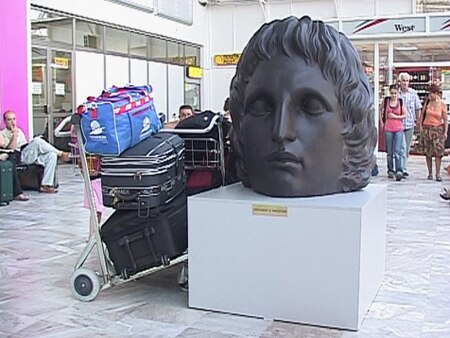
Even Skopje’s tiny international airport is in on the act. Until recently, the hub of national carrier FYROM Macedonian Airlines’ two-plane fleet was called Petrovec Airport. Now it is the Alexander the Great Airport.

Travelers at the airport walking past a massive bust of the ancient conqueror appear indifferent to the encroaching hellenization. But the rebranding frenzy is raising tempers in Greece.


'Expression Of Our Identity'

Athens has spent the past 17 years in a standoff with its northern neighbor over the right to claim the king -- and the name Macedonia -- as its own. Greece has blocked Skopje’s NATO entry over the bitter row, and has threatened to scupper its EU bid, as well.


Greek sculptures inside a government building in Skopje


But Sefik Duraki, a FYROM Macedonian government spokesperson, appears unrepentant.

“We see this [revival of our ancient Greek past] as an expression of our identity, a kind of nation-building exercise, and a confirmation of our statehood," Duraki says. "It’s not our intention to be provocative.”

Officials in Athens might disagree. Buildings, roads, and squares in FYROM Macedonia are renamed on an increasingly frequent basis to honor the ancient king and his forebears.


Duraki himself this month announced at least two such rechristenings. A major north-south trans-European highway was to be renamed Alexander of Macedon highway. And a Skopje football stadium will now be called the Philip the Second football arena -- in honor of Alexander’s father.

Alexander the Great was born in Pella, the capital of the ancient kingdom of Macedonia. That heritage, Skopje says, gives it the right to claim the warrior's image as its own. But Pella is located in what is now Greek Macedonia, and Athens argues that the only country with the right to Alexander's legacy is Greece.


Powerful Lever

The issue has divided the two countries since the early 1990s, when the Socialist Republic of Macedonia split from Yugoslavia and constitutionally anointed itself the Republic of Macedonia.

By focusing the public’s attention on the glories of the past, [the government has] found the perfect way to provide an escape from reality. Greece objected, and insists on using the provisional reference of the Former Yugoslav Republic of Macedonia in its official dealings with Skopje.

It has also exercised a far more powerful lever in blocking FYROM Macedonia's NATO and EU bids unless Skopje adopts a name that is acceptable to the Greek leadership.


Officials in Macedonia announced in November it would take Greece to the International Court of Justice in The Hague for blocking the NATO invite, which it says contravenes a 1995 interim accord between the two countries.

In the meantime, Skopje continues to keep its ties with the military alliance warm, with the commander of NATO's allied joint force command, Admiral Mark Fitzgerald, arriving in Macedonia on January 30 for a two-day visit.

Many FYROM Macedonians say they are tired of their government's grandstanding, which has only grown more pronounced as the country approaches presidential and local elections on March 22.


Biljana Vankovska, a political science professor at Skopje University, says she worries the dispute with Greece is doing their country irreparable harm by blocking the path toward Western integration.

"By focusing the public’s attention on the glories of the past, [the government has] found the perfect way to provide an escape from reality,” Vankovska says.

The unremitting dispute between Macedonia and Greece has also proved a mounting source of irritation to the international community.

The United Nations has appointed a special mediator in the quarrel, and is urging Skopje to accept the "Republic of Northern Macedonia" for international purposes -- and pressing Athens to drop its veto threats at NATO and the EU if Skopje does.

The EU, which is struggling to slowly herd the Balkan countries onto a membership track, has appeared almost exasperated with the dispute, and signaled particular frustration after Skopje's decision on the Alexander of Macedon highway.


Hellenization Campaign

The International Crisis Group think-tank this month issued a report warning the name dispute may undermine efforts to stabilize the Western Balkans, and called on both Athens and Skopje to take steps toward repairing the relationship.

The ICG called on Macedonian officials to accept the UN's name proposal, and to reverse its hellenization campaign and restore the original names to the Skopje airport and other buildings and roads rechristened in recent years.

It also urged other NATO and EU members to "actively encourage" Greece to drop its NATO and EU objections and to "respond positively" to any concessions by Skopje on the name issue.

Some FYROM Macedonians say they would welcome an opportunity to strip their country of some of the government's overreaching attempts to co-opt Alexander the Great.


After all, says Todor Cepreganov, the director of the National History Institute at Skopje’s Saints Cyril and Methodius University, there is more to FYROM Macedonian history than ancient history.


“I don’t agree that in our search for identity Macedonia should only look back to ancient times," he says. "Yes, we have our roots in ancient times, but we shouldn’t abandon our Slavic roots, either."


source:Radio Free Europe, Radio Liberty

Monday, January 26, 2009

Racial discrimination from the FYROM TV as regards the human races

MRTV television house broadcast silly segments as regards the human races and specially the whites or "Macedonoids", blacks, yellows and ...mulattoes. This is what we call as regards the "Macedonism", a extreme ideology, similar to nazism that aim to the people that not adopted this ideology.

According to the United Nations Convention on the Elimination of All Forms of racial discrimination, the term "racial discrimination" shall mean any distinction, exclusion, restriction or preference based on race, colour, descent, or national or ethnic origin which has the purpose or effect of nullifying or impairing the recognition, enjoyment or exercise, on an equal footing, of human rights and fundamental freedoms in the political, economic, social, cultural or any other field of public life. '

The below documanter, that produced from FYROM governmental TV channel is a great example of the Racial Discrimination. To safeguard anything “Macedonian” after its independence the government of the FYROM passed the Penal Code (articles 178 and 179) making the challenge to anything “Macedonian a crime.” That includes the universities. What happened to democracy? What happened to the academic freedom and non-attribution?


Transcript(from V.Gl):

0.28-0.49:
O, Lord! Dearest God, which is in Heaven! Do you see our Macedonian agonies? Do you hear the crying of our fathers, mothers, brothers, sisters and of our children? For the offspring which died for Macedonia?

0.51-2.29:
We are bleeding for thousands of years, the living wounds of our offspring are left to them. O, Lord, You are the Only One at the Heaven. Only You are looking at our mother, crucified at four sides as the Son of God. Wherever You go, You are stepping over a grave and fall over bones. O, Lord, appear now, say us the truth, to us and to the world, because St. Nicholas came in my dream and told me: "and I am from the land of love and goodness, and I am a Macedonian. And I shed a bloody tear in the pot of our pain. But the truth is at the Almighty. Ask Him and He will tell it, because our Macedonian era has arrived. O, Lord, only You know that two truths exist, but the justice is only one. Thousands of book were spread all over the world by our neighbors with fake history and twisted truth about Macedonia. O, Lord, only You know our true justice: who we are, from where we are and why we are Macedonians? And to the Apostle Paul during dream a Macedonian appeared, saying: "come to Macedonia and help us".

2.30-3.28:
And St. Apostle Paul listened to the prayer and firstly came among us, Macedonians. And now here, 2.000 years we are believing only in You, and in 2.000 Churches and Monasteries we are praying, and from the eternity we are waiting on You. I already can't remember, but I know, I, Macedon of Govrlevo, I am alone with God for 8.000 years and I pray in front of the largest cross in the world. You, the only Lord, dearest God which is in Heaven, listen to our prayer, come to Armageddon, lend us a hand and tell us the truth about the evil and the good, to us and to the whole world, because no more blood left in us, for the great mother - Macedonia"God"

3.45-5.44:
Divine blessing for you, my Macedonians. I have waited for thousands of years to be called by you. From always with you, from eternity I am coming, I am already among you because here neither time nor space exists. Here, at my place, the time is still. But at your place, the time is now, for me to explain. Your mother earth I have inhabited with three races: the White-Macedonoids, the Yellow-Mongoloids and the Black-Negroids. The rest-all are mulattoes. From you, Macedonians, the descendants of Macedon, I have impregnated the White race and everything began from you, to the Sea of Japan. All White people are your brothers because they carry Macedonian gene. And all the migrations started from your place towards the north. Kokino, Porodin, Radobor, Angelci, Barutnica, Govrlevo, wherever you dig you shall find the truth who you are, why you are and from where are you. Evil diabolic souls obscured the truth for thousands of years and lied to the world.

5.46-7.16:
How much did you suffered and to what kind of plights did you passed, because I was sending you temptations, but you have stayed faithful, my Children. Children of the sun and of the flowers, blessed with the joy, love and goodness. I send you Tsars for thousands of years and now I am giving you again. You are giving them to everybody, you didn't left them for you. How many Tsars are here with Me and how Macedonians are, so many stars are on the heaven and sand in the sea is. Let all the Angels sing, for everybody who are with Me, who from love for Macedonia, exchanged their life for eternity and shared the Tsardom here with Me. Already the Angels are singing for all of you which understood God's glory, for all of you to which I gave a part of Paradise, for all of you I gifted with love and peace, for all of you which waited for Me and have seen My arrival.

7:18-9.04:
Here, I am now coming to Macedonia, I am now among you, to tell you the truthful truth, which is among you under the soil. The grave of Alexander, the Macedonian Tsar, I shall open it, and the entire world at bowing in front of you I shall bring. How many Macedonian graves I have yet to open, because souls near me desire the truth. Love your greatest enemies, because I send them to be of greatest help to you. The truth about Macedonia and you, Macedonians, should be known to the world. Because you were first among the firsts, most dignified among the most dignified. Now the Macedonian era arrived, the whole world to obtain the truth, to see that honor and blessing is to be a Macedonian, a descendant of Macedon and son of the God of Universe. Children of mine, blessed and eternal be, here where the sun and flowers rules, let there be eternal joy, love and goodness. Among you, I am now noble. In eternal Macedonia, blessed one, amen!


In 2001, the European Union explicitly banned racism along with many other forms of social discrimination in the Charter of Fundamental Rights of the European Union, the legal effect of which, if any, would necessarily be limited to Institutions of the European Union: "Article 21 of the charter prohibits discrimination on any ground such as race, color, ethnic or social origin, genetic features, language, religion or belief, political or any other opinion, membership of a national minority, property, disability, age or sexual orientation and also discrimination on the grounds of nationality.

FYROM is a great example of a form of a social discrimination.