Showing posts with label FYROM. Show all posts

Sunday, September 18, 2011

Pau Gasol receives Death Threats in his FB page by Ultra-Nationalists from FYROM

Pau Gasol, the famous Spanish Basketball player receives death threats by FYROM’s Ultra-Nationalists in his Facebook Page.
Its surely the most pathetic News Story related to the Eurobasket 2011 of Lithuania. Pau Gasol, the ace of the Spanish National Team and LA Lakers, is receiving numerous abuses and even Death threats by Slavic Ultra-Nationalists of FYROM after commiting the… “crime” to call their country FYROM. In other words, the name that FYROM’s governments have agreed to use in ALL the International Organizations.


The Spanish player published in his FB page last Thursday, the following:

Monday, July 11, 2011

FYROM Statues: From ethno-cultural nationalism to National Chauvinism

With the collapse of communism in Eastern Europe, the ruling ideology of Marxism-Leninism was replaced by different ideological forces. One of them was nationalism. In FYROM, gradually and with the "withdrawal" of the Socialists in the various state power positions, the far right through the VMRO began to take their places. So we have from the late 90's a gradual transformation of rampant ethno-cultural nationalism, into an explosion of national chauvinism (see Andrew Heynwood, political ideologies, 2007).

The extreme nationalist hysteria that exists on these days between the Slavmacedonians, because of the erection of two statues (one is giant) at the center of Skopje is a typical example. The far-right Prime Minister Gruevski, continuing the "antiquisation policy" of the Slavic population, made the next step and the Slavmacedonism enfold the "national chauvinism".

National chauvinism breeds from a feeling of intense, even hysterical nationalist enthusiasm. The individual as a separate, rational being is swept away on a tide of patriotic emotion, expressed in the desire for aggression, expansion and war. The right-wing French nationalist Charles Maurras (1868-1952) called such intense patriotism “integral nationalism”: individuals and independent groups lose their identity within an all-powerful 'nation', which has an existence and meaning beyond the life of any single individual. (Heynwood:165) Such militant nationalism is often accompanied by...

Monday, May 02, 2011

The Myth of Modern Macedonia - inventing an identity

By Professor John Melville-Jones

Last year I learned that a statue of Alexander the Great was to be erected in Skopje. I knew enough about modern history to be sure that the choice of this subject was not simply, as in some places (for example in Edinburgh), the result of a desire to commemorate a heroic figure of the past. I realised that it was part of an attempt that has been made during the last few generations to create an identity for the Former Yugoslav Republic of Macedonia which can stretch back to distant antiquity. So what we have here is a myth in the making.

A myth is a story which can be told, retold, and modified. It survives because it gives pleasure, or satisfies a human need. It may be based on a fact, but it is not a historical account of something that happened, because even if an event took place that led to the birth of the myth, the story has been so changed for artistic or other reasons that it takes a form that is different from the form that it had when it was born. So a raid that might have been made on a city in Asia Minor by men who sailed from Greece in the second millennium B.C. turns into the story of the abduction of Helen and the Trojan War.

To take another example, among....

Thursday, April 14, 2011

Ongoing Ethnogenesis in 21st Century Balkans: FYROM and the ethnic Slav majority

April 04, 2011, John James Smith

The Former Yugoslav Republic of Macedonia (FYROM) is one of the world´s newest nations established towards the end of the 20th century. In September, 1991 the mixed population of ethnic Slavs (majority ca. 64%), Albanians (largest minority ca. 27%), Vlachs, Roma, Turks, and Greeks of this former Yugoslav state voted for independence in a referendum. From the outset, however, the constitutional name (e.g. Republic of Macedonia) and ethnic identity (Makedonski) of this young fledgling state have been at the centre of an intra-regional dispute spanning nearly two decades.

On the one hand, Greece, FYROM´s southern neighbour disputes any reference to the name Macedonia without a geographic qualifier. According to Greek arguments, FYROM´s constitutional name has...

Sunday, March 27, 2011

Slavmacedonian people: is a “ethnic category” ?

An interesting comment took place from Pr. Loring Danforth regarding the ethnicity of the Slavmacedonians at the history-of-macedonia.com
Here is the abstract:


I have always stated, and I repeat here, that modern Macedonians[1] (people who have a Macedonian and not a Greek national identity) are not descendants of the ancient Macedonians; they are Slavs.[….] In my opinion, Macedonian nationalists who deny they are Slavs and claim they are direct descendants of Alexander the Great and the ancient Macedonians are extremists. They are making inaccurate statements that are bad scholarship and bad politics. Building a statue of Alexander the Great in Skopje and naming the Skopje airport after Alexander the Great are in my opinion irresponsible acts that are not in the best interests of the Republic of Macedonia.

Also Pr. Danforth in his controversial book [4] claims that:

Tuesday, December 28, 2010

THE LOBOTOMY OF LIBERTY IN FYROM: THE CASE OF DESTRUCTION OF ANTI-GRUEVISTIC A1 TV THROUGH MASS ARREST OF ITS JOURNALISTS

by Vasko Gligorijević

Nikola Gruevski, the Prime Minister of Former Yugoslav Republic of Macedonia (FYROM) demonstrated, encouraged by absence of proper, tough approach from legitimate factors that represent values of European civilization, by far the most extreme form of his crackdown of opposition, exacerbating his stamina and reputation of FYROM's autocratic tyrant.

This time, this manifestation of Gruevski's totalitarianism, exercised through the FYROMian political party VMRO-DPMNE, in particular by the Special Security Agencies led by his first cousin Sašo Mijalkov, came through blitz storming of A1 Television House in Skoplje by dozens of members of “Alfa”'s (24/7 patrolling/monitoring secret, plain-clothed police strike-force constituted on basis of VMRO-DPMNE party affiliation). The event of the transition ofrom 23th to 24th of December 2010, inwhich disproportional force was used in relation to what police was technically able toknow regarding the assessment of situation, together with subsequent video presentation* by pro-VMRO channels (KANAL 5 TV and more pronouncedly, SITEL TV), constitute the gravest act of.....

Wednesday, December 09, 2009

FYROM President insults EU's vision


Australian Macedonian Advisory Council
December 9

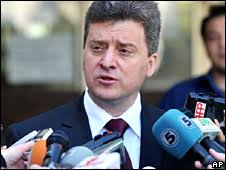
The Australian Macedonian Advisory Council (AMAC) is appalled by the latest statements made from FYROM´s President Gjorge Ivanov. According to MINA news, President Ivanov controversially stated "We will not cave under any pressure to change our name or identity just to be a part of the European Union. We've lived this (hi)story many times before, not again. Whatever the outcome of the talks in Brussels, Macedonia (FYROM) will stay right here" threatening to remain outside the EU as the ´Republic of Macedonia´.

Ivanov continues: "Europe unfortunately still has leaders who allow to be carried away by someone's petty interests and hidden agenda.. We see the absence of vision at the EU". These statements have revealed FYROM´s ongoing disregard for reaching a compromise to the name dispute with Greece, that has disallowed it entry into the EU and NATO.

AMAC hopes FYROM will change its current hardline policy, and not continue to insult the European Union and its member states, but instead to tackle the real issue at hand.

Australian Macedonian Advisory Council (AMAC)

Thursday, December 03, 2009

Krste Crvenkovski : we were Bulgarians until 1940


Krste Crvenkovski (President of the Central Committee of the Union of Communists in the Socialist Republic of Macedonia) to Todor Zhivkov (First Secretary of the Central Committee of the Communist Party of Bulgaria) – May 19, 1967 said:

“And whether bulgarian consciousness exists in Macedonia, this is a historical legacy. We’re now writing our history. We can’t write that until 1940 we were Bulgarians and after 1940 Macedonians.”

Friday, October 23, 2009

Treatment of Slav Macedonian history : to de-Bulgarize the Slav Macedonians *

The treatment of Slav Macedonian history has the same primary goal as the creation of the Slav Macedonian language-to de-Bulgarize the Slav Macedonians and create a separate national consciousness. Since Marx claimed to have discovered the immutable laws of history. Communists have considered the "correct interpretation of history as the foundation of all social science and a Key element of nationality. In the Balkans, history is a primary ingredient in the development of national consciousness which possesses a current relevance that extends beyond mere academic interest. Hence, the Yugoslav Communists were most anxious to mold Macedonian history to fit their conception of Slav Macedonian consciousness.

In setting the tone for the new interpretation of history, Communist experts found past Slav Macedonian history to suffer from two defects. First, "bourgeois historians, although they may have certain merits for the elaboration of the material facts of history, suffer from the weakness of their idealistic theoretic basis."[16] Hence, new historical works must be based on a correct Marxist-Leninist interpretation of history. Second, and perhaps more important, Slav Macedonian history had to sever the umbilical cord to Bulgaria. It was advanced as a principle of Slav Macedonian historiography that key aspects of Slav Macedonian culture had origins separate from Bulgaria, that Slav Macedonian history was distinctively different from Bulgarian history.

Lazar Kolisevski gave the initial clues as to the correct interpretation of Slav Macedonian history in his report to the First Congress of the CPM in 1948. The resolution adopted by the First Congress stressed the importance of ideological conformity and emphasized the use of history to re-educate the Slav Macedonian masses:

Great interest should be created [in history] and there should be a systematic approach, with a materialistic elucidation of the historical past of our people in general, and special elaboration of the socialist movement in our country. The history of the people's liberation struggle should be particularly elaborated. A struggle should be carried out for systematic studies of our past among the broad masses as well as among party members. This is a necessary condition for the ideological uplift of party cadres and for the education of the masses in the spirit of socialism. [17]

Slav Macedonian historians, however, apparently had some difficulty in adjusting to the new guidelines for Slav Macedonian history-particularly in distinguishing Slav Macedonian from Bulgarian history. In an article in Komunist in January 1950, Vidoe Smilevski gave a summary of the correct interpretation of Slav Macedonian history. [18] Another article by Kiro Miljovski appeared about the same time but went farther, specifically criticizing Slav Macedonian historians and setting out in more detail the party guidelines for interpreting history. Miljovski was particularly critical of the failure to eliminate Bulgarian influences:

Some of our people fail to understand correctly Kuzman Sapkarov's cultural activity in the struggle for the Macedonian language, and they are suspicious about the national character of our entire early national movement simply because Sapkarov or others in the movement were not clearly, explicitly and to the very end nationally inclined, because some of them felt "now a Macedonian, now a Bulgarian." In the same way, some people fall into uncertainty about the Macedonian character of the national liberation movement in Deltev's time simply because Goce Deltev wrote in Bulgarian, because he did not say definitely that Macedonia is one nation and that Bulgaria is another. [19]

To avoid future uncertainty, Miljovski listed a number of expressions (most of them frequently used in Bulgarian historical writing) which were to be banned from Slav Macedonian history.

Although Macedonian historical works began to appear, historians found that research on Slav Macedonia was "complex and difficult" because existing literature "is still permeated with Great Bulgarian spirit, with omissions, distortioqs and falsifications of many historical facts." [20] The Scientific Institute for National History of the Slav Macedonian Nation was established "to eliminate the influence" of the Slav Macedonian Scientific Institute in Sofia which during the interwar period "published most of the documentary and propaganda materials about Macedonia." [21] The Institute, which had indeed published a great deal of material on Slav Macedonia (including its periodical Makedonski pregled), was the principal scholarly advocate during the interwar period of the thesis that the Macedonian Slavs are' Bulgarians.

The question of Bulgarian influence on Slav Macedonian history was the thorniest problem of the new historiography. Obviously it was impossible for the Yugoslav Communists to deny completely the role of Bulgaria in the Macedonian revolutionary movement. One of the early attempts to cope with Bulgarian influence utilized the device of "contradictions." According to this explanation Slav Macedonia's national revival developed as " Macedonian its inner content and Bulgarian in its outer forms," although late in the process some Macedonian national forms were used along with the Bulgarian forms. The "contradiction" between content and forms extended throughout the entire historical process of the Slav Macedonian revival; it was because of this conflict that Macedonian forms took shape, and it was through the development of these forms that Slav Macedonia "categorically proved its individual national character."[22]

Reconciling progressive Marxist historiography with Slav Macedonian national history has proved to be especially difficult. The Slav Macedonian revolutionaries were generally not socialists and the Balkan socialists did not recognize the Macedonian nationality. To walk such a tightrope required great historical agility and the party was frequently called upon to restore balance for historians who went too far in one direction. A Nova Makedonija article for example, counselled historians to avoid errors of the epoch of bourgeois idealization, as there is"no reason for interpreting past events with a romantic pathos." The article explained that in approaching the past, all positive traditions should be included as the inheritance of the proletariat, but conservative tendencies should be rejected. The approach toward historical personalities was criticized as being idealized. For example, although Delcev was a forerunner of Marx in Macedonia, it would be mistaken to call him and others like him real Marxists. [23] In dealing with the Balkan socialist movement, writers had to exercise caution:

Our socialists did not have a clear idea of the national belonging of the Macedonian people, nor of the need to establish it as a separate unit, and they adopted the stand that the population in Macedonia was composed of members of the Bulgarian, Serbian, and Greek nations and of the minorities.[24]

Although the socialists were wrong on the Macedonian question, they were socialists - hence, progressive and instrumental in the eventual triumph of socialism in Vardar Macedonia. The socialist movement was an approved topic for history, but its treatment required delicate handling.

In order to conform to the standards of Yugoslav Marxist historiography and at the same time degrade Bulgarian influence and affirm the Slav Macedonian nationality, Slav Macedonian historical writing has stressed certain themes. In order to create a continuous record of Macedonia as a nation, there is constant re-analysis and rediscovery of probable and improbable historical fragments. The medieval empire of Samuelo with its capital at Ohrid has been designated as a "Macedonian" empire (despite the fact that the empire was destroyed by Basil II who earned the title "Bulgar-slayer", for his campaigns against Samuelo). The "Slavic" missionaries Cyril and Methodius are treated with greatest respect and emphasis is placed on their IMacedonian birthplace (Salonika) and on their use of a "Macedonian" dialect ,as the first Slavic literary language. Macedonian revolutionary heroes are carefully treated. In addition to appropriating the historical legacies of the , key founders of the original IMRO-Goce Delcev, Damian Gruev and Pere Tosev-Macedonian historians play up lesser figures who might have given the slightest indication of "socialist" inclination or who were not openly Bulgarophiles. Thus there is glorification of men like Jane Sandansky, Dimo Hadji-Dimov, Petar Peparsev and Nikola Karev, who, because they defected from the IMRO or lost out in internecine organizational fights, have long been forgotten by chroniclers of the IMRO. The more recent IMRO leaders - Aleksandrov, Protogerov and Mihailov - are excluded from the ranks of the progressive for having been tools of Sofia. Besides, they are symbols which are too dangerous and too recent to attempt to manipulate. Pre-World War II Macedonian history orients events of the past towards the final successful climax of the liberation struggle during the war. However, it is emphasized that victory was possible only because of the fraternal assistance of the other Yugoslav nationalities under guidance of the Communist party.

Despite the difficulties of dealing with the national history, in the beginning Slav Macedonian writers enjoyed a relatively larger degree of permissive action with regard to the employment of nationalist symbols than historians of the other Yugoslav republics. In Slav Macedonian history, the main concentration is on genuine national heroes like Delcev and on their nationalistic character, regardless of their attitudes toward the Serbs and socialism. The accepted heroes of other Yugoslav national groups are portrayed almost exclusively from the point of view of their progressive, anti-religious or anti-Hapsburg attitudes. In the case of Croatia and Slovenia, the heroes selected by the Communists are those who favored union with Serbia. However, Belgrade permitted Vardar Macedonia to treat the role of the Serbs rather negatively, usually as Serbian imperiahsm. But, to balance these concessions, Slav Macedonian historians are required to give special emphasis to the role of the CPY in their liberation from Bulgariuans and Serbs. The struggle in the twenties and thirties for the correct party line on the nationality question is often stressed. The Party's efforts to liberate the Slav Macedonians from the Bulgarian occupiers are combined in historical treatises with attacks against old Great Serbism.[25]

Although the party had some difficulty in establishing a historiography to suit its political needs, numerous works on Slav Macedonian history were published by the Scientific Institute for the National History of the Macedonian People (since shorte'ned to the Institute for National History). The early institute publications include a large number of document collections and writings of early Macedonian revolutionaries. Though some monographs were published they were usually limited in scope. [26] In addition to publications of scholarly interest frequent historical articles and programs are carried in the newspapers and mass media of the Macedonian republic. In the campaign of inspiring a Macedonian consciousness among the population, the Communist approved interpretation of history was used as one of the primary tools.

The first serious challenge to the new Slav Macedonian historiography came in 1958. Yugoslavia and the Soviet Union, which had re-established close ties after 1955, had a second era of unfriendly relations beginning in Fall 1957 and Spring 1958. As part of the anti-Yugoslav program of the bloc, Bulgaria launched a vigorous campaign to deny the Slav Macedonian language, culture, and nationality and to reassert Slav Bulgarian claims to Macedonia. The Slav Macedonian Communist leadership countered by emphasizing more forcefully the elements of Slav Macedonian culture. Evidencing concern with Macedonian history, Lazar Kolisevski delivered a long speech on Slav Macedonian history at Titov Veles in November 1958. He explained at the beginning that his purpose in dealing with the Slav Macedonian past was "to contribute to the forming of trends towards a correct, scientific understanding of historical events and their underlying social processes," because "we are still faced with many major tasks in the field of clarification of our national history."

The thrust of Kolisevski's treatment of history was two-fold-first, to reduce even further the significance of Bulgaria in Slav Macedonian history, and second, to stress positive treatment of Serb- Slav Macedonian relations. Although earlier Slav Macedonian historians had explain ned Bu1garian influence-by means of a contradiction with Macedonian inner forms and Bulgarian external forms, Kolisevski degraded Bulgarian influence even further. He argued

the (Slav)Macedonian nation did not emerge as a result of political manipulations in the twentieth century, but it emerged from the general struggle, resistance and awareness of the people, which began early in the 19th century.

Kolisevski went on to explain that from the very beginning of the 19th century Macedonian national consciousness grew independently and distinctively from Bulgarian consciousness. But with the development of Slav Macedonian consciousness, the Bulgarians developed imperialist ambitions towards Macedonia. The last part of his speech was particularly critical of the most recent Bulgarian denial of the Slav Macedonian nationality.

The role of the Serbs in Macedonian history, however, he treated much more favorably than Slav Macedonian historians had been doing up to that time. Though admitting that the Serbian bourgeoisie intended to establish its hegemony over Macedonia, Kolisevski quoted extensively from Serbian diplomatic correspondence to show that some Serbs acknowledged a Slav Macedonian nationality and opposed the negation of Slav Macedonian consciousness by Bulgaria. The Serbian bourgeoisie came to deny the Slav Macedonian nationality, Kolisevski claimed, when they entered into a tacit agreement with the Bulgarian and Greek bourgeoisie that only Serbs, Greeks and Bulgarians lived in Macedonia "with their respective number to depend on the manner in which Macedonia was carved up." He asserted that nations can only be created by powerful forces at work among the people and never by the actions of politicians.

Although Kolisevski's speech. placed new emphasis on the anti-Bulgarian aspects and softened the anti-Serbian aspects of Slav Macedonian history it did not represent a real departure for Slav Macedonian historiography. The same ideological line adopted after the Communist consolidation in Slav Macedonia is still the historical guideline. In recent years the quality and volume of Slav Macedonian historical writing has increased, but the themes and their treatment, although more sophisticated are much the same as before. The national - liberation struggle, the socialist movement in Yugoslavia and the Balkans, and the Slav Macedonian revolutionary tradition dominate historical works. There is still some reticence to treat Slav Macedonian relations with Yugoslavia and Serbia between the wars, but there is greater emphasis on Serb- Slav Macedonian relations during earlier periods.[28]

The goals of the national history are unchanged-to reduce the Bulgarian role in Slav Macedonian history and to stress Slav Macedonian national development at the same time emphasizing the importance of close ties with other Yugoslav peoples. However, Slav Macedonian national history has not developed in a vacuum and external problems have affected its course. Since 1956 Bulgaria has not recognized the Slav Macedonian nationality and her historians have been permitted to reassert Bulgarian historical claims to the Macedonian territory and population. Even in periods when Bulgarian-Yugoslav relations have been very good, academic historical controversies have continued, frequently developing political repercussions. The Slav Macedonian historians have thus been forced to defend their dubious historical claims, with the result that their history has become even more polemical and political. The rising nationalism of the Yugoslav peoples has also had its effect in Vardar Macedonia. Although increased nationalism first reappeared as the result of economic problems in the late 1950's, it has since spread throughout Yugoslavia's cultural life. The problem reached the point that Tito denounced "nationalistic manifestations" in the field of history at the Eighth Party Congress.[29] The problem was as much present in Vardar Macedonia as the other republics. Crvenkovski, at the Fourth Congress of the LCM, just before the Eighth all-party congress, criticized "the still present phenomenon of national romanticism [i.e., over-glorification] in uncovering our national past." Although acknowledging the difficulties of dealing with Macedonian history, Crvenkovski called on historians to adopt the approach which would "contribute to the national consciousness of our people freeing itself of nationalist deviations [pro-Bulgarian and anti-Serb sentiments], to building respect for everything that is positive and common in the struggle of our neighbors [i.e., Serbs and other Yugoslav peoples] and which is a component part of our own national history." [30]

*This text is from the book of “Yugoslav Communism and the Macedonian Question” by Stephen E. Palmer, Jr. Robert R. King, 1971. In order to segregate the Greek Macedonian cultural identity from the Slav one, I add for understating purposes the words “Slav and Vardar” in the front of the Greek adjective “Macedonia (n)” at the text. Also in the book you can find the original notes and bibliography that used in the specific article.

**For fair use only

Friday, October 02, 2009

Slavmacedonians are not related with the ancient Macedonians that were Greek, German scholar says

Mannheim, Germany -
The head of a German museum which is set to show an exhibition about Alexander the Great weighed into a dispute between Skopje and Athens on Friday, saying the ancient leader had been predominantly Greek.

The modern state of Macedonia, where the main language is a Slavic one, claims the heritage of ancient Macedonia.

'Alexander was predominantly Greek and definitely not an ancestor of contemporary Slavic Macedonians,' said Alfried Wieczorek, head of the Reiss-Engelhorn Museums in the southern German city of Mannheim.

The exhibition devoted to the ancient general and ruler, who lived from 356 to 323 BC, opens on Saturday and runs till February 21.

For two decades, Athens has been objecting to its northern neighbour calling itself Macedonia. Skopje has named its airport after Alexander and insists on having Alexander's 'star of Vergina' symbol on its coat of arms.

In an interview with the German Press Agency dpa, Wieczorek said, 'The latest research shows very clearly yet again that the Macedonians in the days of Alexander were closely related to the contemporary Greeks.'

He added, 'In antiquity, Greeks and Macedonians could interact because they spoke the same language.'

Athens has been insisting that the name Macedonia can only been applied to a province in its own north.

The country of Macedonia became independent in 1991 when Yugoslavia split up. The name issue has held up efforts to bring the new country into NATO and into formal assocation with the European Union.

The museum director referred to findings that its population of 2 million, one quarter of them Albanian speakers and three quarters Slavic speakers, are descended from people who immigrated in the 6th century of the modern era, long after Alexander's death.

http://www.monstersandcritics.com/news/europe/news/article_1504631.php/German-museum-man-says-Alexander-the-Great-was-mainly-Greek

Monday, September 28, 2009

FYROM academy and Gruevski administration: Greeks are black Africans, Parthenon and Homer are part Slavic!!!!

As revealed yesterday, the "Thema" newspaper, the new incredible provocation contained in the so-called "Macedonians Encyclopedia, which have written, at the behest of the extreme-right Prime Minister Gruevski, the historians of the Academy of Sciences and Arts of Skopje and presented himself with all solemnity on 16 September . The two-volume work of 1671 pages, the version of which was financed by public funds of the neighbouring country, according to Mr. Gruevski is absolutely express “the cultural and political past and our present”, the Skopje government not only tries to rewrite history region at will, but consciously alter key elements of our national Greek status.

Specifically, on page 67 of the encyclopaedia and under the word "Greek" states that "recent research has shown that the Greek nation as having been descended from black African tribes of the Sahara desert!"

The 260 Skopjans historians, bringing out the government arranged the shipment was, they note that the Greeks, coming from the continent, with virtually cultural backgrounds, "settled by the local appropriating Balkan cultures, which were advanced and shown as its own achievements.

The unprecedented provocation of Skopje government reaches in the point to characterize the Greek culture as result of counterfeiting and intercepting other cultures, while not hesitating to seize the historic Parthenon and even the Homeric epics! "Even the epics of Homer and the Parthenon is not the result of Greek culture, but as result of counterfeiting, adoption and even interception of these local indigenous cultures such as ours, the Macedonia!"

The new methodology of Skopje unacceptable, has not been any reaction from the Greek Foreign Ministry, this time not as a result of political unacceptable compliance applied systematically to national issues in recent years, but because apparently not even noticed! At the same time when the particular case has received international dimension with the involvement of the United States, Great Britain, Albania and Bulgaria.

Of course as I said Greek administration is absent in this new provocation from the ultranationalists.

Friday, September 25, 2009

Flawed FYROM encyclopedia sparks row over ethnic past


AP
Ethnic Albanians are seen fleeing the village of Lojane in the Former Yugoslav Republic of Macedonia (FYROM), during a standoff between ethnic Albanians and FYROM police back in 2003. A new encyclopedia has fueled controversy in the multiethnic country.

By Kole Casule - Reuters

SKOPJE – The leading academic institution in the Former Yugoslav Republic of Macedonia (FYROM) said yesterday it would revise a new encyclopedia after protests by the Balkan country’s ethnic Albanian minority as well as in neighboring Kosovo and Albania.

The row has highlighted the still fragile ethnic balance that led to fighting in FYROM in 2001 and wars during the 1990s elsewhere in the former Yugoslavia.

The encyclopedia sparked outrage by recounting that ethnic Albanians settled the region in 16th century. Albanians say they were present long before Slavic tribes arrived centuries ago.

It also refers to Ali Ahmeti, leader of country’s 2001 ethnic Albanian insurgency, as a war crimes suspect.

Ahmeti now heads the Democratic Union for Integration, DUI, which is a junior partner in the government. The Netherlands-based UN war crimes court has investigated atrocities in the conflict but never implicated Ahmeti.

“While [the encyclopedia] will be partly rewritten, the edition will not be withdrawn,” Georgi Stardelov, head of the editorial committee of FYROM’s Academy of Sciences and Arts, said in a statement.

The book was first promoted last week as a key national document at an event attended by Prime Minister Nikola Gruevski.

Albanian media quoted Albanian Prime Minister Sali Berisha as saying the encyclopedia was “absurd and unacceptable” and said he warned FYROM President Georgi Ivanov that no one can build “identity based on the forgery of history.”

In Kosovo, which has unresolved border issues with FYROM, parliament leader Jakup Krasniqi said that Skopje was “isolating itself and making enemies.” Ethnic Albanians account for a quarter of the population in the country of 2 million which peacefully seceded from Yugoslavia in 1992.

In 2001, ethnic Albanians launched an insurgency which ended after a Western-brokered peace deal disarmed rebels in exchange for broader Albanian rights and their inclusion in the society, something that riles many Slav-Macedonians.

Some academics in FYROM criticized the book as hastily prepared and politically motivated.

“Any encyclopedia cannot be written under the influence of politicians,” said Milan Gjurcinov, an Academy of Arts and Sciences member. “It is a book teeming with politics and that’s not good.”

Gjurcinov warned that a similar dispute between Serb and Croat academics in the 1980s contributed to the rise in nationalism that led to the bloody breakup of the former Yugoslavia.


Friday, September 18, 2009

Let’s stop discrimination and torture against people with Bulgarian self-consciousness in FYROM


PRESS-RELEASE
Peaceful Citizen’s Protest in Support of Spaska Mitrova
ibox.bg
The Citizens' Initiative Committee “Spaska Mitrova” is organising a peaceful, non-partisan, civil protest in support of Ms. Spaska Mitrova (an academic graduate who holds both
Bulgarian and Macedonian citizenships), jailed behind the bars of the infamous communist prison “Idrizovo”, near Skopje, because of her Bulgarian self-consciousness. This protest is born of the dismay of free Bulgarians and Europeans from both the Republic of Bulgaria and the former Yugoslav Republic of Macedonia (FYROM). The draconian middle-age sentence of the 23 year-old mother of a little child brings back horrible old-gone times and methods, which the democratic World endeavours to forget. We insist for Spaska’s immediate release as well as for public apologies and compensations on behalf of the Macedonian authorities for their ill-minded reading of the Law and the politically motivated repression over a seriously ailing young mother with a sick baby girl. We are deeply concerned whether the EU could recommend starting accession negotiations with a country holding political prisoners (thereby breaching the Copenhagen political criteria for EU membership) and whether the Republic of Bulgaria could support the accession attempts of such a country?

We feel obliged to stress that the “Spaska” case is not at all unique and forms integral part of a centrally planned, permanent and ubiquitous anti-Bulgarian campaign in FYROM and beyond, which is totally incompatible with the country’s aspirations to join a democratic, law-ruled and tolerant Europe. We want to alert that anyone, who dares to declare Bulgarian self-consciousness in FYROM, is subject to brutal repressions – sacking from work, jailing after absurd convictions, severe economic and moral deprivation, malicious ridiculing by authorities and media and even physical tortures. Europe and the democratic world cannot just observe and tolerate such a policy.

Spaska does not conceal her Bulgarian self-consciousness originating from her predeces-sors. She is among the key founders of the non-government association “Radko”, which brings together FYROM's citizens of Bulgarian nationality. Spaska Mirova has the basic human right to freely raise and educate her child in the tradition of her Bulgarian predecessors from Macedonia, who remained outside the modern Bulgaria's borders and spent their life as Ottoman, Serbian and Yugoslav citizens. But we have today another Europe !

Everyone is welcome to the protest. It will be a peaceful, non-political and mass event of free European citizens for defending principal human rights in FYROM. Please forget your political affiliations and join us to raise our common voice and to express prominently our solidarity in a civilized way – by singing and dancing, without threats and demonstration of power. Let us show that we love and cherish Vardar Macedonia, since not very long time ago (just before 1944) to be a Macedonian from the Vardar region simply meant to be a decent Bulgarian.

Wednesday, June 03, 2009

The Struggle for the Liberation of the Former Yugoslav Republic of Macedonia (FYROM)

Australian Macedonian Advisory Council
June 03, 2009

What can be said about the present day situation in the Former Yugoslav Republic of Macedonia which could encourage a goal-oriented initiative towards deconstruction of its ultranationalist, parochial and irredentist ethos? The well-know state of affairs created by the overwhelming influence of the ideology of Pseudomacedonism, a patchwork of ideas establishing a several millenia old frame of reference within all levels of domestic discourse has been and still is a phenomenon not noticed by social anthropologists and other relevant thinkers. In the Balkans, where historicism often takes precedence over future-oriented pragmatism, FYROMian oppositional defiance to Greece is one of the key incentives that threatens escalation of conflict of the type typical for the region for much of the 1990´s. While Pseudomacedonian politics, with all of its core component: Hellenophobia and Slavophobia, formulation of "Macedonian exceptionalism" with common leitmotivs of mental and moral superiority based on biological determinism certainly deserves recognition as an academic question, preferably treated on multidisciplinary grounds, the objective of establishment of practical policy, both in form of general principles and practically applied methodology, has failed on multiple grounds. The problem is exacerbated by attempt to analyze the social and ethnopsychological reality of present-day FYROM in terms of "objective", quantifiable parameters, an approach used by such international organization as the European Union and NATO, among others.


While systematic research and cross-comparison of the institutionalized, faceless type may create an illusion of "objectivity" and rationality and while there is no doubt that to a large extent (but with limited potential to portray the situation in all of its picturesque colorfulness) some of these data display accurate parameters of socio-economic affairs in FYROM, these are not much usefulness in deconstruction of the sheer anti-human dimension of the present-day political vector of FYROM. With a strong reflection on the daily, mundane lives of citizen of that small statelet, with a profound impact on psychological links among its citizen and culmination in the construction of a small, isolated world, cut from both the mainstream of trends in Europe and from infusion of alternativeness, the postmodern "nation building" of fascistoid intensity in FYROM is a phenomena with no precedent in the realm of modern politics.
The main premises of the plot are as follows: FYROM, a country which inherited colonial borders set in a mixture of arbitrary decision, de facto post-conflict situations and more than 4 decades of Communist totalitarian rule, is not a product of a natural, usual nation-building in which elite-imposed foresight provides selective continuity and discontinuity with the tradition. Instead, the concrete set of circumstances in which FYROM or "Republika Makedonija" emerged as an established subject of international politics (the Balkan wars 1912-1913, the post-1943 reestablishment of "Yugoslavia" and the bloody dissolution of the later in 1990´s) is indicative of conformism , coupled with dissonance among its elite, which inherited a premodern population, bypassed by the Enlightenment and Rationalism. For the early founding fathers of Pseudomacedonian nationalism, the revolutionaries of the so-called VMRO, the ultimate goal, in whose name much grandiloquence and pathos has been expressed and much blood was shed, was the emancipation of the "Macedonian Bulgarian". The fact of their declared Bulgarian character, which is in harmony with enormous number of testimonies of outsiders intimately acquainted with the ethnological situation on the ground is not an obstacle to local historians-the clergy of current FYROMian ultranationalism, to enlist them into the rank of symbolic figures of alleged "Macedonian ethnicity". This "ethnicity", completely unbeknown to history, is one of the last enduring legacies of the Cold War, having grown in Tito´s Yugoslavia as an organ of the Communist empire specialized in Anti-Greek predatory geopolitics. The choice of the new nation´s name was an adaptation of VMRO nurtured idea that the inhabitants of the geographic region of Macedonia, the form of which is a recent construct unrelated with historic Macedonia in strict sense, while having a Bulgarian ethnic affinity are nevertheless also the only true "Macedonians" in some mystically superior sense excluding other inhabitants of the region, even bordering on parallel ethnicity, non-exclusive and synonymous with the wider Bulgarian one. The Commintern in 1934 and the Communist Yugoslavia took this absurd proposition to its logical extreme, severing the consciousness of the Slavic population of the wider Macedonian region from its Bulgarian core. The massive allocation of funds to creating national institutions: schools, press, universities, museums, academic centers by Belgrade to the southern Yugoslav province in order to sustain the new national narratives provided Yugoslavia safety against Bulgaria, Serbian unitarianism and provided a pretext for expansion into Northern Greece, the most serious attempt of which was the Yugoslav support for Communist combatants in Greek Macedonia (or Macedonia proper, as the present-day north Greek region is nearly identical geographically to Ancient Macedonia) during the Greek Civil War (1946-1949).
The entire social development of the FYROM, as a nominal "Republic" in Yugoslavia, while heavily influenced by application of local version of Communism in political, economic and legal practice, was – quite unlike the situation in other Republics where traditional ethnohistorical narratives were viewed as dangerous to the concept of unitary Yugoslavia - characterized by vivid expression of nationalistic sentiments encouraged by the local leadership and methodically carried through all conventional means of propaganda. TV and radio broadcasts, including documentaries, docudramas, songs of various genres with nationalistic overtones were prevalent form of public entertainment. Maps of "Greater Macedonian Homeland" incorporating Northern Greece and large section of Bulgaria were regular fixture in thousands school classrooms. Impressive body of government-subsidized and obligatory belletristic literature dealing with "national" themes, "national tragedies" in which the image of the "exploited Macedonian" as a tragic hero was central in a social-realist imagery imprinted a sense of victimization and deprivation in generation of Pseudomacedonians. With the complete independence from Yugoslavia in 1992 and inheritance of intact – although quite obsolete – infrastructure, as a result of avoiding inclusion into the series of Yugoslav wars, the young and small Balkan nation would perhaps had promising start if it was not for the fact that in those times of change it was left without national intelligentsia, in terms of intellectuals of non-Communist affiliation. The extermination of the Bulgarian leading strata immediately after the World War II, the expulsion of pre-war Serb colonists and the brain-drain from 1960´s onwards via emigration mostly in the Angloshpere countries depleted the nation from the existence of transitional elite which would redefine and reestablish suitable values and set dynamics of social recovery.
In the presence of such spiritual vacuum, what initially started as an imported speculation – that the origin of the "Macedonian" nation should be sought in unbroken racial, linguistic and cultural continuity with the Macedonians of Philip II and Alexander the Great – became throughout the 1990´s the main integrative trend which unified folklore, pop-culture, the ubiquitous "coffee-shop politics", academia and the public education system. In the image of Ancient Macedonians, a Greek entity which created brief global empire as a substratum of Hellenistic civilization, suddenly the entire nation found itself. No more the colloquial "little Macedonian" ( "Makedončeto") was a passive observer to his destiny as created by his (demonized) neighbors. No more the "Macedonians" just an aggregate of impoverished people in a poor, landlocked Balkan country undistinguished culturally, technologically, being outside the realm of the global trends at the eve of Third millennium. Now they could boast a tradition old thousands of years, not only as a historical narrative, but more importantly – in a naïve, popular biodeterministic wisdom – as an evidence of what may became of his group: a great, mighty people of first-rank international relevance.
From 2006, when the Government of VMRO-DPMNE led by Nikola Gruevski, a man mostly thought of as a obscure economic technocrat, won the popular vote, the entire revolt of people defeated so often in conflicts and competitions in modern times escalated, looking for a symbolic compensation. While it would be impractical to list the protagonists, the chronology, and more importantly, to analyze the causes of enormous popularity the fascist reorganization of society and the complete consolidation of a tribalist, xenophobic, collectivist FYROMian nation guided by pseudohistorical delusions, it is sufficient to say that the very precedent left the international community helpless, since no norms which would be used to extrapolate solution to the problem of this kind exist. There is no known instance that an ethnic group, on apparently voluntary and almost unanimous basis, completely rejected its ethnological nature – in this case of being a Slavic ethnic group originating in medieval times from the boreal regions of Eastern Europe, a fact held in consensus in global academia – and based it entire cultural, economical, educational policies, its "reason of being" on outrageous claims on continuity with an unrelated Greek ancient people with whose territory it has a very tiny overlap. Consequently, for now, Europe is left powerless in dealing with Nikola Gruevski, a brutal, authoritarian dictator who mesmerizes his nation with fables of "ancient imperial glory" in light of total inability to solve real problems faced by FYROM: 40% unemployment, 300 USD salaries, scientific and educational decay, the threat by the Albanian-led Islamic separatist block which accounts for 38% of FYROM´s population. What initially started as – undoubtedly clever in Machiavellian sense – Gruevski´s idea to provoke Greece in order to gain some negative diplomatic feedback and portray itself as the "savior of the endangered nation", galvanizing people around "collective virtues" is now an elaborate fascist ideology, with its thinkers, institutions, manners of manifestation, unwritten codes, popular electoral and activist base and symbolism.
It is certain that this criminal situation won´t resolve out of itself. The manner in which global bureaucracy can act is limited by the aforementioned idiosyncrasy of the way of rule of VMRO gang. As North Korea exemplified, tyranny based on ignorance and fear may propagate itself for a considerable period. The opposition in FYROM itself is relatively negligible and very much bellow the critical mass needed for ignition of a popular revolt. Insofar, the organized political opposition did not offered the most needed solution to the problem: radical rejection of Pseudomacedonism in it´s fabricated entirety. The internal identity debate is on the marginal position outside the spotlight of the wider audience and is being sustained by informal networks loyal to central authorities. In terms of productivity, capability of potential maverick scholars to change the discourse from within is limited due to total financial dependency and certain ostracization. Sustained pressures from outside are necessary in order to implement long-term solution for a prosperous Balkan without VMRO, without Gruevski. While the issue should be reviewed with the scrutiny typical of serious scholarship, such effort cannot culminate in the much needed change in short-term. Politics should follow and align itself with science and practical activism should be supported by external factors in order to bring down the Pseudomacedonism, an ideology that threatens to plunge South-Eastern Europe into war and to help liberate the Slavs of FYROM from the cult of state-imposed grandomania and paranoia.


Vasko Gligorijević
03-VI-2009
Skoplje, FYROM

Saturday, April 18, 2009

FYROM Travel advise: Don't go to Macedonia and other Greek places

The Ministry of Foreign Affairs of FYROM has advised FYROM citizens to refrain from travelling or stay for longer periods in larger Greek cities.If the journey or stay are necessary, MoFa advises careful behavior, safe parking space if travelling by own vehicle, avoiding city centers and locations used for protests and unrest, as well as avoiding facilities and institutions, which have been the most common targets of violent attacks.MoFA says that Greece has been hit by a wave of internal unrest, violent protests and armed incidents in the past few months, resulting in endangerment to private property and personal safety of many people."

Such incidents, which unfortunately have still not been put under control, occur especially in larger cities (Athens, Thessaloniki etc), demonstrated by attacks with Molotov cocktails at car dealerships and banks, attacks of police patrols and foreign offices, taking over university centers by anarchist groups, bomb threats to churches, as well as protests at main streets and squares that often obtain violent dimensions.

Moreover, dozens of FYROM citizens, especially transporters, have notified competent FYROM authorities in the past few months on problems related to damage to vehicles during their stay or transit in Greece", reads the recommendation.

The Ministry of Foreign Affairs urges FYROM citizens to follow regularly the situation in Greece, as well as contact the Ministry and the country's diplomatic offices in Athens and Thessaloniki (Macedonia).

The Greek foreign ministry spokesman on Wednesday said fYRoM Foreign Minister Antonio Milososki is "obviously confused", when asked about "travel advice" for citizens of the landlocked neighbouring country interested in visiting Greece over during the Orthodox Easter season, advice posted on the fYRoM foreign ministry's website.The foreign ministry in Skopje urged fYRoM citizens to avoid extended stays EU and NATO member-state Greece as well as visits to large urban areas in the country. "

On April 10, Mr. Milososki released a letter toward the (Greek) Foreign Minister [Dora Bakoyannis], in which he requested that we strengthen communication between the two peoples and bilateral tourist cooperation. Five days later, for reasons known only to himself, he deliberately misinforms the citizens of his country and urges them not to visit Greece. Mr. Milososki is obviously confused," Koumoutsakos stated in response to press questions.

"The only serious conclusion that could be drawn from this action was that those governing the neighbouring country had not yet tired of showing their worst selves and had once again damaged relations with Greece," the spokesman added. In a recent announcement, the FYROM foreign ministry warns its citizens to avoid visits to Greece unless this was unavoidable, citing domestic upheavals last December, among others.

It also advised those having to travel to Greece to avoid urban centres and areas where demonstrations might take place and to park their cars in safe places, while claiming that transporters have also had vehicles vandalised.The only verifiable instance of violence directed at tourists occurred in early March 2009 in the lakeside town of Ohrid, in south-western fYRoM, when three tourist coaches carrying Greek tourists had nationalist graffiti written on them, while a handful of local youths also confronted the group of mostly elderly tourists.Athens responded with a verbal protest by its liaison office head in Skopje and issued a travel advisory.

http://www.ana-mpa.gr/anaweb/user/showplain?maindoc=7508521&maindocimg=5313525&service=98

Sunday, April 12, 2009

Antifascist, Anti-VMRO Demonstrations by Liberal Youth in Skoplje [11-IV-2009]

A display of opposition by antifascist youth composed of moderate, centrist, liberal and libertarian intellectuals in defiance of Pseudomacedonian fascist policies of the regime of VMRO-DPMNE.


by Vasko
Словенска Филхеленска Мрежа - Σλαβικό Φιλελληνικό Δίκτυο - Slavic Philhellenic Network

Monday, March 30, 2009

Athens reply to fYRoM FM

Greece on Monday announced that the country's foreign minister again emphasised to her counterpart in the former Yugoslav Republic of Macedonia (fYRoM) that Athens considers the "name issue" as the paramount problem standing in the way of fully normalised bilateral relations.

In her reply, dated March 24, Greek Foreign Dora Bakoyannis reminded that Athens has demonstrated a sincere volition over recent years to develop normal and productive bilateral relations.

"Let me remind you in this respect that Greece has demonstrated, in practice, her willingness and preparedness to settle the issues that divide our two countries, as well as to build good neighbourly relations and to establish close cooperation in all fields with the former Yugoslav Republic of Macedonia," Bakoyannis states.

Moreover, in broaching the eyebrow-raising proposal by fYRoM FM Antonio Milososki earlier this month for the establishment of a bilateral committee to "examine" historical issues, Bakoyannis was crystal clear:

"... I would like to emphasize that history is a science that establishes historical truth through scientific methods. It cannot and should not be subject to political expediency or any other political considerations. In this sense, history is not negotiable. The history of the ancient world has already been written and documented, over the centuries, through laborious scientific research by acclaimed international historians and archaeologists. It cannot be rewritten by a bilateral committee."
In concluding her letter, Bakoyannis focuses directly on the resolution of the 19-year-old "name issue", noting that "...the catalyst for the improvement of the relations between our two countries is the long overdue definitive settlement of the 'name issue', in all its aspects. This would pave the way for the fulfilment of the European and the Euro-Atlantic perspective of your country, in accordance with the collective and unanimous decisions taken by the member-states of NATO and the EU," she said, citing the 2008 Bucharest summit joint communiqué and a European Council decision in June 2008.
Additionally, she said improvement of bilateral relations and increasing bilateral cooperation between the two neighbouring states necessitates "...respect of the fundamental principles on which good neighbourliness is based, as provided by the Interim Agreement."

Moreover, Bakoyannis pointed to the significant level of Greek private sector investments and business activity in the landlocked one-time Yugoslav republic while at the same time decrying what she called "numerous difficulties and obstacles (faced by Greek businesses and entrepreneurs there), including discriminatory and 'red tape' practices, acts of harassment and intimidation, even a boycott against their products..."

source:ANA-MPA

Thursday, March 26, 2009

OSCE : FYROM has too Many Voters!!!!


“It is impossible for a country of 2 millions to have ,,,,,1.8 million voters. That has to be addressed,” said the Pia Christmas Muller, the Vice-President of the Organization for Security and Cooperation in the Europe Parliamentary Assembly and the Coordinator of short-term observers in FYROM’s local and presidential poll said on Monday, just one day after Sunday’s first round of presidential and local election.
FYROM officials in responce said diffrent comical things such as :
  • this is a 15 year-old issue and we still have not heard a concrete idea about which methodology to apply
  • the problem lies in about 300,000 voters.

More in balkaninsight.com

Wednesday, March 18, 2009

RADKO demands crackdown on Macedonism

RADKO, the right-wing Bulgarian organization in FYROM demanded end to the Pseudomacedonism by sending a 28 page petition to the Government, President’s office, Constitutional Court in which a historical and political argument is given.
RADKO demands inclusion of the categories “Bulgarian people” and “Bulgarian language” in Constitution’s preamble.
Vladimir Pankov of RADKO stated: “To us, Bulgarians, a state carrying a name of ‘Republic of Macedonia’ in which Bulgarian population suffers from repression, police observation and maltreatment, discrimination and genocide, is not needed“.

edited by Vasko Gligorijevic

source : kanal5