Showing posts with label History. Show all posts

Thursday, July 24, 2008

The Macedonian Dispute as a Yugoslav-Bulgarian conflict


Dr. George Voskopoulos in American Chronicle
July 22, 2008

The name dispute between Greece and FYROM has been seen primarily as a conflict between Greece and FYROM. Yet historically the third factor of the dispute was Bulgarian policy and its aim to annex Yugoslav and Greek Macedonia. This very aim gave Belgrade a powerful motive in creating and cementing a distinct, artificial "Macedonian" identity in order to deal with Bulgarophilia. In essence it was an intra-Slav dispute over domination in geographical Macedonia.

The constructed "Macedonian" identity meant to alienate local populations from Bulgaria. Originally the aim was built on a Marxist platform and class consciousness. Indicative of the feud between Bulgaria and the Serbian government is the reported tensions between the two countries. As pointed out by The New York Times reporter Walter Littlefield in March 1924 "the Serbian Government blames the Bulgarian Government for its own inability to establish a stable administration in Macedonia, which includes the territory around the meeting place of the frontiers of these two countries and of Greece. [1]

The two parties expressed their incompatible attitudes during the meetings of the Institute of Politics in the US two years later (1926) when "vigorous differences of opinion on the question of minorities in Macedonia between Dr. Ante Tresioh Pavichich, Yugoslav Minister to the United States, and Dr. Stephen Panaretoff, former Bulgarian Minister to the United States, disturbed the hitherto peaceful meetings of the Institute of Politics".[2]

It is worth pointing out that the reports of the time do not refer to a single "Macedonian" people but an amalgam of peoples residing in geographical Macedonia. Navarre Atkinson, of the New York Times reports in 1927 that "the restless peoples who inhabit the rocky mountains and dry plains of Macedonia want another Balkan war. These Macedonians, who caused the two Balkan conflicts which preceded the World War, from which they emerged without any benefits, last week made another attempt to throw Yugoslavia and Bulgaria into war".[3]

Bulgaria supported the idea of establishing a Balkan Communist Federation thus expressing the orthodox Communist view. In 1924 Bulgarian leader Peter Tchaulev suggested that, "there will be no peace in the Balkans so long as the greater part of that area remains unwillingly under Yugoslav domination. He is one of the three heads of the Central Macedonian Revolutionary Committee, which declares it has virtually the entire population of Macedonia organized and ready to strike for its demands when the moment arrives". [4]

The aim of containing Bulgarophilia led to the adoption of extreme policies and mass suppression of those who identified as Bulgarians or those who formulated a Bulgarian national consciousness. Actually the same policy was adopted at a very late stage by FYROM after the dissolution of Yugoslavia and the mass persecution of those who identified themselves as Bulgarian-Macedonians.

In the 1940s Yugoslav-Bulgarian rivalry intensified further. As noted by M. S. Handler, "the Yugoslav Ministry of Foreign Affairs replied today to the Bulgarian note of Oct. 1, abrogating the Bulgarian-Yugoslav treaty of alliance, by accusing the Bulgarian Government of having plotted to annex Yugoslav Macedonia.[5] This aim perplexed the political situation in the region since propaganda was targeted at both Yugoslav and Greek Macedonia [6], a fact that led Mark F. Ethridge, United States delegate on the United Nations Balkans Investigating Commission to call upon the Bulgarian liaison officer, George Koulishev to explain an article in a Communist newspaper of Sofia that said Bulgarians would welcome "the creation of a Macedonian State within the framework" of Yugoslavia" [7]. Still Bulgarophilia was the main threat to Belgrade´s expansionist plans. Yugoslav irredentist plans had to be redrawn and focus on the cohesion of its territory against Bulgarian national consciousness spreading at an alarming rate.

Those in Yugoslavia who identified as Bulgarians, had to be suppressed at any cost. At the same time Belgrade actively assisted those who would like to establish an autonomous state within Bulgarian Macedonia [8]. As noted, "Yugoslav Macedonian leaders followed yesterday's attack by Lieut. Gen. Svetozar Vukmanovitch on Bulgaria by taking today an even more aggressive stand on the question of the control of Macedonia"[9]. A year later, tensions rose on the occasion of a trial in Sofia of eleven people accused of "Yugoslav activities against Bulgaria" [10]. In the meantime the Soviet Union fully endorsed Bulgarian policy against Yugoslavia that slowly but steadily distanced itself form the Soviet block eventually becoming a non-aligned state.

In 1950 a report on "troop and supply movements in Bulgaria" gave the impression that "a new Communist offensive aimed at Yugoslav and Greek Macedonia may be in the wind" [11]. Sofia still accused Belgrade of a suppressive policy towards pro-Bulgarians and Bulgarian-Macedonians [12] while the Yugoslav government established the semi-independent Orthodox Church in Yugoslav Macedonia under the Serbian Patriarchate. The move was another means of distancing local Slav populations from Bulgarian influence [13] and the need to cement Yugoslavia against Soviet policy. As reported, "Yugoslavia today formally linked the mounting Bulgarian propaganda campaign over Yugoslav Macedonia, with the recent Soviet doctrines of "limited sovereignty" and of the Communist "right of intervention".[14]

Inside Yugoslavia the issue had alarmed the public opinion but also government officials. A report by the New York Times in 1966 exposed this uneasiness since "a leading Yugoslav weekly charged this week that "certain Bulgarian circles" had again stirred up the Macedonian issue, which has plagued the politics of the Balkans intermittently since the beginning of this century".[15]

Yugoslav views and tit for tat policies were formulated on the grounds of Bulgarian expansionism and Sofia being a stern pro-Soviet Union country. In September 1968 a leading figure of the Yugoslav Communist Party rejected what he termed as "greater-Bulgarian chauvinism" [16]. This explains why the official establishment of a "Macedonian" national identity in mid-1940s was a sine qua non against Bulgarian influence. The reports of the time (1966) made clear reference to "Yugoslav Macedonia, which acquired nationhood and its own language during the last 20 years" [17].

The struggle between the two countries intensified and was attributed to "an upsurge of Bulgarian nationalism that has reintroduced a long - submerged element into the dispute over Yugoslav Macedonia, which Bulgaria claims on ethnic grounds" [18]. It led to a Bulgarian-Yugoslav bilateral meeting (1969) that "aimed at settling deep-rooted differences over Macedonia and other vital issues". The meeting led to an impasse thus "leaving the two neighboring countries at a deadlock". [19]

The above are an abridged only description of the "Macedonian dispute" between Yugoslavia and Bulgaria. Greece constitutes the third parameter of the issue, yet what is less known today is the usurpation of Bulgarian history by nationalists in FYROM and the clash of the constructed "Macedonian identity" as opposed to pro-Bulgarian feelings and national consciousness in Yugoslav Macedonia. To this day Bulgarian-Macedonians have been heavily oppressed in FYROM, particularly members of the pro-Bulgarian Macedonian Patriotic Organization (see 2007 incidents), a policy aiming at purging national identity from those elements that link it to Bulgaria and points to the Bulgarian national consciousness of a number of its citizens.

================================================== ===========

[1] The New York Times, March 23, 1924
[2] "Clash on Balkans at Williamstown; Yugoslav and Bulgar Diplomats Differ Sharply Concerning Rule in Macedonia", The New York Times, August 15, 1926.
[3] "Macedonia puzzles Balkan statesmen; Failure of Latest Attempt to Embroil Sofia and Belgrade Puts States on Guard", The New York Times October 16, 1927.
[4] "Asserts Macedonia is ready to strike; Tchaulev, Bulgarian Leader, Tells of Aims of the "Balkan Federation", 1924, The New York Times, August 15, 1924.
[5] "Yugoslavs Accuse Bulgaria of plot, Belgrade Holds Sofia Seeks Part of Macedonia", The New York Times, October 14, 1949.
[6] "Propaganda Flood's Macedonia, Bulgarophiles and Pan-Slavs Active in Yugoslavia", The New York Times, July 30, 1940.
[7] "Bulgarian Red Aim Asked by Ethridge", The New York Times, April 1, 1947
[8] "Macedonians Seek Autonomy in Pirin; Yugoslav Communist Congress Hears Demand on Bulgaria for a 'Special Regime', The New York Times, July 25, 1948
[9] Ibid.
[10] "Deception by Tito Charged at Sofia; Spy Trial Hears His Aide Said Bulgar Reds Agreed He Should Direct Macedonia Operation", The New York Times, December 12, 1949.
[11] "Macedonia Thrust by Sofia is Feared; Reports of Troop Movements in Border Zone Are Sifted -- Threat to Yugoslavia Seen", The New York Times, July 6, 1950.
[12] "Ancient Specter Rises in Balkans; Macedonia Question Revived by Bulgarians, Who Charge Oppression by Yugoslavs", The New York Times, September 28, 1958
[13] "Yugoslavs Avoid Church Division; Macedonians Restore Old Diocese, but Recognize Serbian Patriarch", The New York Times, October 6, 1958
[14] "Belgrade Blames Soviet Policy For Sofia's Macedonia Claims, The New York Times, February 28, 1969
[15] "Macedonia issue stirs new clash; Yugoslavs Lay Irredentist Moves to Bulgarians", The New York Times, September 18, 1966
[16] Belgrade-Sofia Tension Rises", The New York Times, September 23, 1968.
[17] "Macedonia Stirred by Beauty Contest", The New York Times August 8, 1966.[18] "Bulgarian Nationalism Colors Macedonian Issue; Sofia Marks 1878 Treaty That Assigned Area to It Celebrations Appear Aimed at Yugoslav Control", The New York Times, July 11, 1968[19] "Macedonia talks end in deadlock; Bulgarian Minister Leaves Belgrade After Visit, The New York Times, December 14, 1969

Saturday, July 19, 2008

Ideology as a causational pattern for state behavior: the case of the Macedonian dispute

Dr. George Voskopoulos in American Chronicle
July 15, 2008

Samuel Huntington must have been rather optimistic when he talked about the end of history. That was the end of history of the bipolar world. Yet, in the case of the Balkans, history and perceived or misperceived historical grievances have long provided the motivational axis for state behavior thus setting the conceptual and interactive framework of inter-Balkan relations. Hindsight and scrutiny of past events may provide aspects of those qualitative elements that affect nominally and in essence the co-operation-conflict ratio among local actors.

The Macedonian Issue emerged with the desire of Balkan peoples and ethnic groups to liberate from the Ottoman rule. The oppressed peoples engaged in a liberating war against the Ottomans, a struggle that added to the creation of structural and surrealis-tic elements (factual and non-factual) of historical narratives. Indicative is the evalua-tion of Duncan Perry vis-à-vis the Ilinden rising. "In 1903 an uprising broke out on Ilinden, the effort of a liberation / terrorist group best known as the Internal Macedo-nian Revolutionary Organization (IMRO). It failed to yield the desired goal of auton-omy for Macedonia, but it subsequently proved to be an organization around which Macedonian national myth-makers crafted a national history and from which they as-sembled a pantheon of national heroes. Nationalists argue that both IMRO and the revolt demonstrated the national will for the recognition of a Macedonian nation and the plea for a Macedonian homeland. Neither was true as no widespread Macedonian national identity existed and there was no discrete homeland"[1]. Yet, this was the first decisive step of the ethnogenesis process. Duncan Perry underpins that "the Macedonian national identity was first recognized by the Comintern in 1934 and then was promoted by Tito in 1942 at a congress held in Bihac, Bosnia"[2].

Although during this liberation process Balkan peoples faced a common enemy, the Ottoman conqueror, this did not prevent them from fighting one another. The Two Balkan Wars illustrated the desire for national liberation but also the degree of lack of cohesiveness of the Balkan subordinate system and the ephemeral nature of alliances in the Balkans. In the first Balkan War Greece, Serbia and Bulgaria faced the Otto-mans, in an effort to be free and create their own nation-states. Yet, this was not only difficult but also complicated, having in mind the ethnological map of the Balkans, where ethnic groups were scattered geographically and taking into account the expansionist dreams of the Balkan peoples. The First Balkan War had scarcely ended when Bulgaria confronted Greece and Serbia, resulting in its defeat in 1913. This put aside Bulgarian dreams for a Greater Bulgaria that would include Greek Macedonia, in order to expand to the Aegean. The changing of camps may be attributed first to regional strategic considerations and second to the influence of the intrusive system in the Balkans.

A less known aspect of the Macedonian issue is its Marxist element that turned it into a major class struggle. The ideological cleavage in the Balkans between pro-communists and anti-communists intensified the struggle for control over the territory where Greek Macedonia lies today. The main axis of this attempt was through imposing ideological homogeneity, a strategy that put ideology and class consciousness above ethnicity and national identity. The Greek communist party adopted this policy and tried to give it an anti-bourgeois character, emphasizing that emotional attachments to specific regions, as well as national ideals were "bourgeois ideology" and thus ought to be discarded. The ideological cleavage into bourgeois and communist blocks gave birth to an ideological polarisation between two conflicting blocks, which made geographical Macedonia the apple of discord. Balkan communists attempted to advance their ideology at the expense of regional security and stability and by means of eliminating national consciousness, in order to create a Balkan Communist Federation.

Dimiter Vlahov, editor of the Federation Balcanique, a journal funded by "partisans and friends" and Slav-Macedonians in the US, was the main proponent of a Balkan Communist Federation. It is speculated that Tito himself was contributor to the first issue of Federation Balcanique of 15-7-1924, as it contained an article entitled "The Salvation of the Balkans Lies in Federation" signed by a certain "M. Walter". It has been reported that "Tito´s earlier nom de guerre was Walter or Valter", therefore he may have been the writer of this article, which dealt with the issue of creating a fed-eration that would include Greece, Bulgaria, Albania, Montenegro, Croatia, Serbia, Macedonia and Montenegro. On 1 April 1926, Vlahov founded the United I.M.R.O, whose founding declaration was published in the Federation Balcanique on the same day and set the ideological, political and intellectual framework for the creation of a "united and independent Macedonia", which was to become the "Switzerland of the Balkans". The main statures of United I.M.R.O were the following:

Article 1. "United I.M.R.O has the task of conquering the liberty and independence of Macedonia in its geographical and economic frontiers and of forming of it an autonomous political unit belonging as a member with equal rights, to the future Balkan Federation".

Article 2. "The free and independent Macedonian state will be established on the basis of the entire equality of national, political, civil, and cultural rights for all the na-tionalities which inhabit it".

Article 3."To attain this the United IMRO will work for the formation of an organization of the revolutionary masses embracing the popular masses of the three parts of Macedonia, divided between Serbia, Greece and Bulgaria, and also all the Macedonian emigrants now outside Macedonia´s frontiers, and the preparation of these masses for a general popular insurrection…To unite all the Macedonian popular forces by attracting to its ranks all the groups, organizations, and persons of all social classes without distinction of nationality, citizenship, religion, or sex, who sincerely accept the aim, principles, ideas, and methods of action of United IMRO…To enter in close relations with all organizations and all national-revolutionary and social-revolutionary parties in the Balkans which support the principle of self-determination of the peoples and which are ready to collaborate in action for the creation of an independent Macedonian political unit…United IMRO takes it as its essential task to fight for the conquest of liberty of language and cultural instruction for all the nationalities in Macedonia, for the conquest political liberties and equality of rights, and to give land to the peasants and broad support to the economically weak classes".

Article 4. "The Organization declares itself, given these aims and this task, to be revolutionary in character. It acts conspiratorially. But it does not exclude the legal struggle in all its possible manifestations, according to place and circumstances. The legal struggle will contribute to the broad development of the propaganda and organizational activity of United IMRO, and will strengthen and deepen its ties with the popular masses".


As Communism was becoming the leading ideology of the more radical, militant and less privileged members of the local Balkan societies, Georgi Dimitrov, a stern proponent of the Communist Federation in the Balkans published an article on Federation Balcanique stating: "In the Balkans, just as in Russia, the very complicated national question can only be solved, territorial feuds settled, imperialist pressure overcome, and real peace among the Balkan peoples ensured, by the creation of a federation of Balkan peoples, after their liberation from capitalism. That is why the Balkan proletariat…is carrying on its fight for the Balkan Federation, for the Federation of the Balkan Workers´ and Peasants Republic…". This article set the ideological framework of the ambitious communist plan for a united Macedonia, resulting from the collapse of capitalism and "fascism" [3] and the political and ideological homogeneity of the Balkans.

Although Vlahovs´s relations to the Balkan Communists were turbulent, yet, the Stature of United IMRO corresponded closely and bore close ideological affiliation with the resolution of the Balkan Communist Federation (March 1924) that provided for the creation of a united communist Macedonia. If one compares Articles 2 and 3, there seems to be a contradiction between what IMRO was suggesting for the disputed issue of "Macedonian people". In Article 2 Vlahov refers to the "nationalities" that inhabit Macedonia, thus excluding the meaning of a single Macedonian identity within the borders of geographical Macedonia. This seems to contradict with Article 3 (paragraph d), where he first refers to the "Macedonian people", while later he refers to "all the nationalities in Macedonia". From this inconsistency, it may be inferred that the term "Macedonian people" had a geographical meaning, referring to those peoples living within geographical Macedonia, namely Greeks, Bulgarians, Slavs, Roma, Pomaks and Turks. [4]

According to the declaration, "United IMRO would fight against the Governments of Sofia, Belgrade, and Athens", as this would allow it to overthrow the bourgeoisie, re-sulting in the final victory of the revolution, which would materialise Stalin´s plans for the Balkans and the ideological homogeneity of the peninsula through borders changes, or rather border elimination, in order to provide a single "geographical setting", a geographical base to accommodate Balkan Communists. As noted, Stalin, in his Bolshevik article, seemed decidedly opposed to Yugoslavia´s existing frontiers". However, as noted, "there is no evidence that United IMRO had any real success in winning over the Macedonian popular masses, a fact that alarmed Comintern and proved that its plans for a Communist Balkan Federation were impossible to materialise", since, to control a territory, "it is not enough to dismiss a man´s own ethnic ideas". Yet, as the Party officials found it difficult to impose the Communist Macedonian policy on all its members, the Communist Federation was forced to make an attempt in 1929 "to enforce discipline, through the Comintern, on the member parties-that is probably the Greek and the Yugoslav parties". By default Macedonism became a revisionist ideology, a feature that depicts today´s logic of uniting geographical Macedonia.

To achieve this the decisions of "the Executive Bureau of the Balkan Communist Federation on Balkan questions were binding on all the Communist Parties of the Balkans. If there was to arise any difference between the Executive Bureau and the Individual Communist Parties, the Enlarged Committee of the Comintern would make a final decision". The Comintern did not fully trust Greek and Yugoslav communist leaders, some of whom eventually proved themselves unfaithful to Comintern´s line, as the Yugoslav communists wished to create a united Macedonia as a means of dominating in the Balkans outside Comintern´s framework, a policy enhanced by Yugoslavia´s gradual emancipation from the Soviet Union. On their part, Greek communists were rather reluctant to endorse the plan and allow their comrades to annex Greek Macedonia, yet, this policy found supporters even within the Greek communist party.

The reports of the time do not refer to a single "Macedonian" people but an amalgam of peoples residing in geographical Macedonia while pinpointing the destabilising ef-fects of the adopted policies. Navarre Atkinson, of the New York Times, reports in 1927 that, "the restless peoples who inhabit the rocky mountains and dry plains of Macedonia want another Balkan war. These Macedonians, who caused the two Balkan conflicts which preceded the World War, from which they emerged without any benefits, last week made another attempt to throw Yugoslavia and Bulgaria into war" [6]. His descriptive approach is clear about the ethnography of the region, as it makes reference to "peoples", while underpinning the threat to regional stability set by a militant nomenclature wishing to advance a cause to justify their leadership and political aims.

In 1929 the Balkan Communist Federation came up with the following resolution: "The national revolutionary movement in the Balkans remains one of the main streams of the general revolutionary movement. The Communist Parties of the Balkans stand for the right of self-determination for the oppressed nations up to their separation into independent states. Simultaneously with this they raise the slogan of a Balkan Federation as an alliance of the Workers´ and Peasants´ Republics of all Balkan countries, including the subjugated territories. With regard to Macedonia, which is divided between Yugoslavia, Greece, and Bulgaria, the Communist Parties raise the slogan of "independent and united Macedonia". The Balkan Communist Federation must formulate concretely for the Communist Parties of the Balkans appropriate slogans for the national self-determination of all oppressed nations in the Balkans and connect them with the general slogan of the Balkan Federation of Workers´ and Peasants´ Republics. These slogans, however, will remain simply words if the Com-munist Parties of the Balkans do not accord real support to the oppressed nations. The Balkan Communist Federation has the special task of coordinating the activity of the Communist parties of the Balkans in the sphere of the national revolutionary movement, of securing the connection and cooperation of the Communist Parties of the Balkans with the national revolutionary organizations which, as the Macedonian I.M.R.O, the Dobrudjan revolutionary organization, the Thracian revolutionary or-ganization, the Bessarabian League of Revolutionary Peasants, etc., stand for the cooperation of the oppressed nations with the revolutionary proletariat…Imperialist war will create in the Balkans favourable conditions for unchaining the national revolution in the rear of the ruling bourgeoisie".

From this resolution depicting an aspect of the ideological framework of the Macedonian dispute, it appears that the Macedonian Question had been a symbol for those non-privileged, who fought against the few privileged bourgeois. From this point of view, the creation of Macedonia would probably have been considered a victory over the fascists and the upper social classes, a fact that gave it a strongly ideological character, not making it simply a matter of territorial dispute. The methods used by IMRO were actually terrorist activities as described in Article 4 and its "revolutionary" character and conspiracy practices. This appears to be also the case with a communiqué, issued by United I.M.R.O on 3-11-1934, stating that "the overwhelming majority of the Macedonian people is convinced that its freedom can only be won in mass action in concert with the other victims of oppression and exploitation in Yugoslavia, Greece, and Bulgaria, the three countries which oppress Macedonia, and with the victims of exploitation and oppression all over the world. The masses in Macedonia are therefore rallying more and more round their real organization, United I.M.R.O., which is working for the overthrow of oppression by means of a mass insurrection…for the secession of Macedonia, and for the establishment of an independent republic of the working people".

An interpretative analysis of the communiqué, based on the semantics of the language used (victims of oppression and exploitation, overthrow of the oppression, mass insur-rection, self-determination, an independent republic of the working people) suggest that it was the communist ideology and the Marxist clash struggle that made the creation of a "united Macedonia" a must, in order to provide territorial base for the creation of a Balkan communist federation. The clash of the social classes became the common ground for the Balkan internationalists (communists) against the imperialist forces. Moreover, "the Balkan Communist Parties had in fact consistently opposed all attempts at collaboration between the Balkan bourgeois", who did not support wish territorial changes, that could become a threat to their privileged social status

The above constitute an indicative only approach to the Marxist foundation of the Macedonian dispute. Yet, it clearly depicts the ideological motives behind the establishment of a distinct but artificial Macedonian identity.

============================================================

[1] Duncan Perry, "The Republic of Macedonia: finding its way" in Karen Dawisha and Bruce Parrot (eds.), Politics, power and the struggle for Democracy in South-Eastern Europe, Cambridge University Press, 1997, p. 228
[2] Duncan Perry, p. 229.

[3] Fascism in those days was often defined in Marxist terms referring to the few privileged landowners in local societies.

[4] As noted by D. Perry, "the idea of a Macedonian nationality spread during the 20th century, but did not find official expression or acceptance anywhere until the creation of the second Yugoslavia", See D. Perry, p. 278 and his reference to Loris M. Danforth, The Macedonian Conflict, Princeton University Press, 1995, pp. 56-69.

[5] "Macedonia puzzles Balkan statesmen; Failure of Latest Attempt to Embroil Sofia and Belgrade Puts States on Guard", The New York Times October 16, 1927.

[6] Greece officially referred to the people living in Greek and Bulgarian Macedonia as Slav-Macedonians in 1918, in an ethnological map issued by the then Prime Minister E. Venizelos. According to the Carloff-Politi Protocol of 1924 they were acknowledged as Bulgarians, while the 1926 Greek-Yugoslav Protocol recognised them as Serbs.Excerpts in inverted commas are fully referenced in George Voskopoulos, Greek Foreign Policy, from the 20th to the 21st Century, Papazisis, Athens, 2005.

Wednesday, June 25, 2008

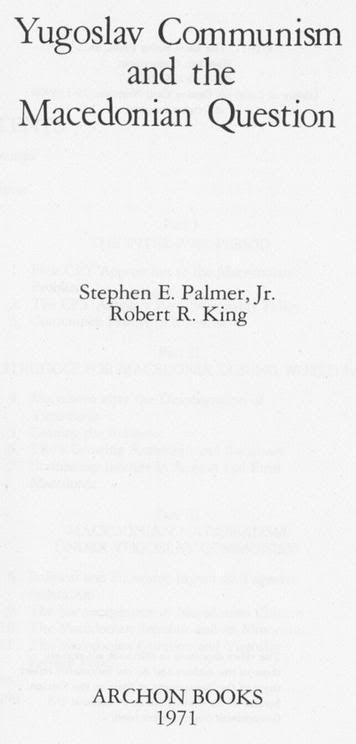
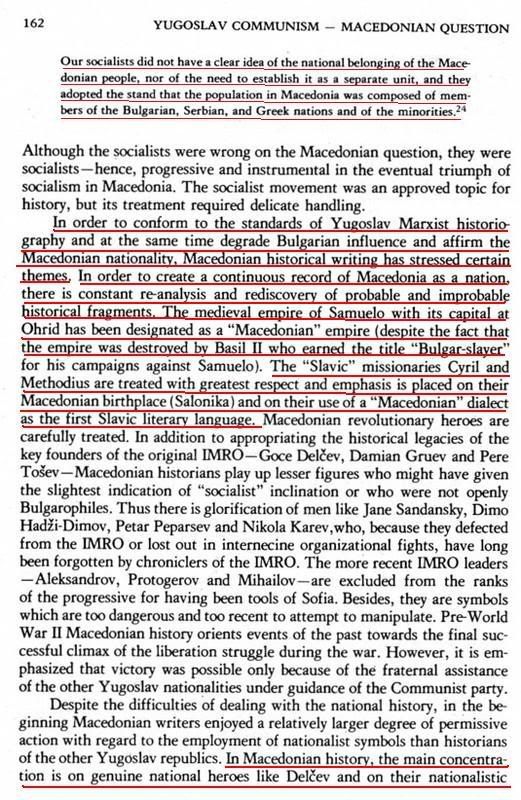
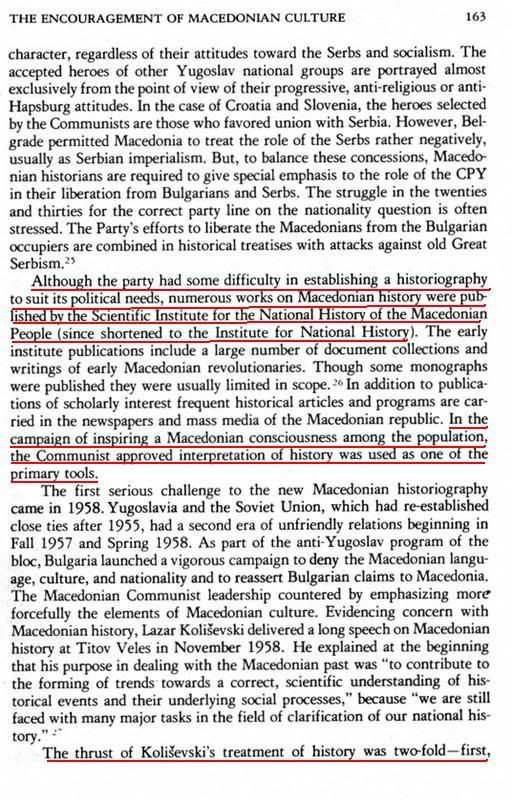
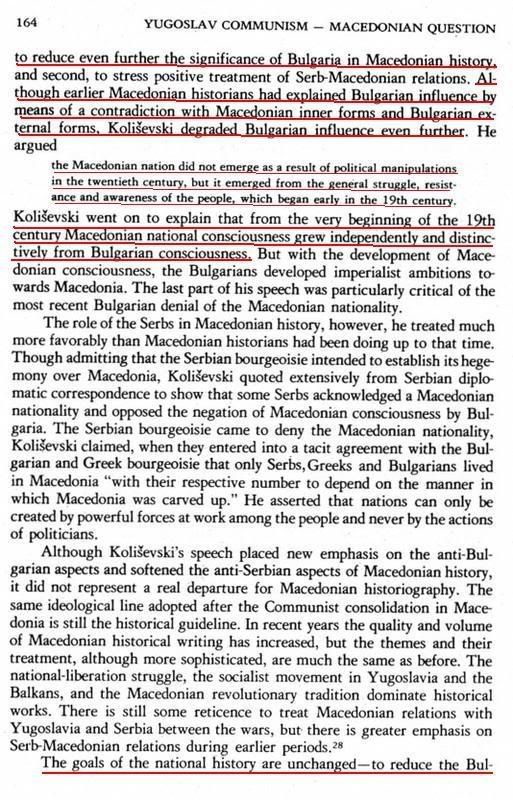
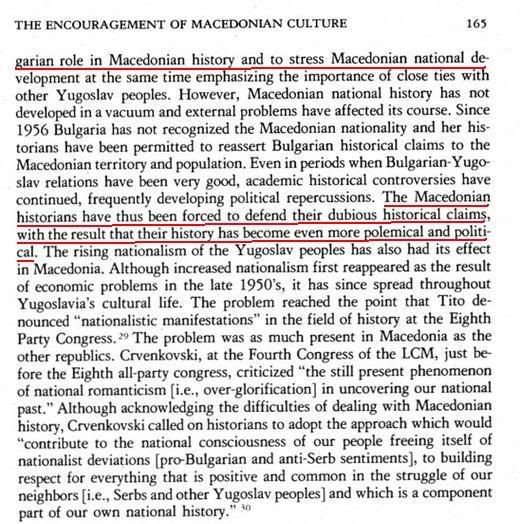
Yugoslav Communism and the Macedonian Question


Nationalists from the Former Yugoslav Republic of Macedonia (F.Y.R.O.M) and her diaspora exert great efforts in promoting an "ethnic Macedonian" historiography which encompasses a genealogical and cultural continuity that literally spans thousands of years. In reality practically every objective and qualified scholar who has studied the history of the region describes the "Macedonian" ethno/national identity as being a mid to late 19th century construct.
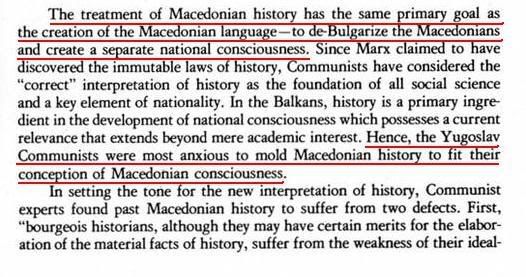
The concoction of a "Macedonian" historiography has been an ongoing process largely instigated and influenced by the Yugoslav communists during the years immediately following World War II. Tito and the Yugoslav communists capitalized on the late 19th/early 20th century politically motivated notion that the South Balkan Slavs were a distinct ethnic group by developing the Socialist Republic of Macedonia and the so called "Macedonian" ethnicity for political purposes including the pretense for future territorial expansion. By fostering a "Macedonian" consciousness amongst the largely illiterate and peasant populace the communists could secure their territory from the Bulgarians and set their sight on the Greek region of Macedonia due to their implicit implication that Macedonia should belong to the "Macedonians".
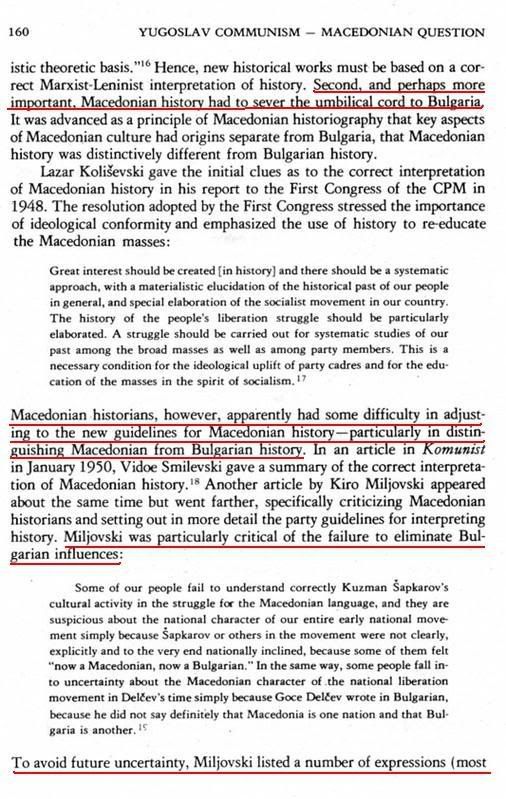
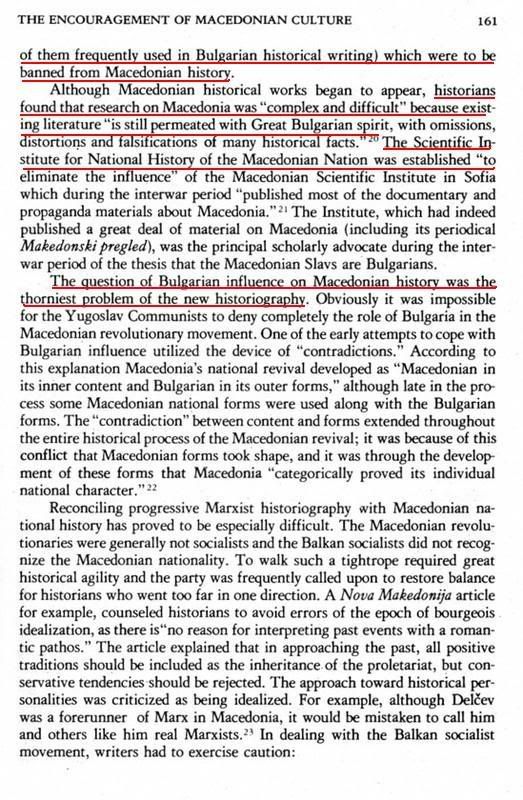
The Yugoslav communists developed and imposed numerous cultural measures in order to de-Bulgarize the region and to foster a "Macedonian" consciousness amongst the populace. An excellent book describing these cultural implementations is "Yugoslav Communism and the Macedonian Question" authored by Palmer and King. This is an important source because it was written by non-Greeks during the late 60's and published in 1971.
The following are excerpts from the book that describe the process in which the Yugoslav communists sanatized and manufactured "Macedonian" historiography in order to lend the "Macedonian nation" a historical legitimacy that was distinct from the Bulgarian nation.
It is important to note that the communist architects behind the "Macedonian" historiography argued that the "Macedonian" nation diverged from the Bulgarian populace as the result of a 'natural' process that unfolded during the 19th century. They were not so bold and so unrealist to claim that the "Macedonian" nation is rooted in ancient Macedonia! The mythical historiography encompassing ancient Macedonia was largely developed by F.Y.R.O.M nationalists, mostly from the diaspora, during the past 25 years.
While you read these excerpts ask yourself this: if the "Macedonian" ethnicity is over 2000 years old and is the product of natural processes why would the communists have to sanatize the history of the region and why wouldn't they include the history of ancient Macedonia when they were developing the "correct interpretation" of history for the "Macedonian nation"?


by Chris Philipou in maktruth.blogspot.com

Sunday, June 01, 2008

FYROM ACADEMICIANS CONTINUOUSLY AVOID HONEST DIALOGUE

PAN-MACEDONIAN ASSOCIATION, Inc.

The historically, linguistically and archeologically incorrect challenges to Greece emanating from Skopje that ancient Macedonian was not a part of the ancient Greek world, but today’s FYROM’s inhabitants are the direct descendents of the ancient Macedonians, has been exacerbated by systematic and relentless propaganda for quite some time now.

On April 25, 2008 the prestigious Smithsonian Residence Association Program presented “A Glimpse into Macedonia, Past and Present” by art historian and “Macedonian” native, Aneta Georgievska-Shine. The electronic advertisement for this stated that Dr. Georgievska-Shine will speak about her native, “Macedonia”: “Home to exquisite Byzantine churches with beautifully preserved frescoes and valuable icons, the Republic of Macedonia is a country of rich and complex cultural identity. From antiquity, when Alexander the Great created an empire that reached as far away as India, to the first decades of the 20th century, when this country finally gained its present-day borders, Macedonia has been one of the most contested geopolitical prizes in southeastern Europe”.
We were somewhat pleasantly pleased that Dr. Georgievska-Shine presented a rather generous Hellenistic view to the Ancient Macedonians and the later Byzantine era, however, at numerous instances her subtle, well planed, remarks and arguments left room for dispute. These remarks and arguments that to the general audience appear as benign acceptable conditions actually hide behind dangerous malignant propaganda. Dr. Georgievska-Shine did refer to the FYROM inhabitants as “Slav-Macedonians” for most of her presentation but she subtly mentioned: “Alexander I of Macedon was the first Macedonian king to promote the adoption of the Attic culture.” In addition, alluding to Alexander the Great’s conquests, she mentioned: “Philip’s son Alexander the Great created an even bigger empire, not only conquering the rest of Greece but also seizing control of the Persian Empire, Egypt and lands as far east as the fringes of India. He adopted and spread the Greek culture in these territories.”
If this claim of “adoption” of the Greek language is true, thus eluding that the Macedonians spoke something other that Greek and therefore were not part of the then Greek world, then, at what point in his life did he “adopt” the Greek name Alexander meaning “defender of man” and what was his name prior to this point?
If his father Phillip was not Greek, why did he also have a Greek name meaning “friend of the horse”?
At what point did Alexander also “adopt” the Hellenic culture and religion the he spread to all ends of the then known world?
Why were the Macedonians allowed to take part in the ancient Olympic games that only Hellenes?

At the end of the presentation the Smithsonian Residence Association organizers of the conference allowed time for only one question and one comment. The question asked was: If the Macedonians were Greek, as you mentioned during your presentation, what is the relationship of today’s inhabitants of the FYROM with the ancient Macedonians? On what historical and ethno-cultural basis do you make the link of the modern day Slavs to Alexander?” Dr. Georgievska-Shine’s reply was that “…since the Macedonians were one of the most powerful peoples in the region, the Slavs adopted elements of the most dominant populace…in addition numerous conquerors overtook the region that those peoples did not exist any more.”

Someone from the audience then replied “Perhaps a lot of conquerors had settled on the area for a while, but they came and went… Greeks can claim that they have uninterruptedly been living in the same area, they talk a language that linguistically derives from the same Greek language and have preserved customs and features in the culture which come from antiquity,” adding “I find Dr Georgievka Shine’s comments on the “adoption of the Attic Greek dialect” by Alexander I the Macedon and by Alexander the Great fallacious, as the ancient Macedonians had their own Greek-Doric (North-West Doric) dialect, which can be attested by the Pella Katadesmos.”

Record note: In 1986 a scroll was found in the area of Pella and published in the Hellenic Dialectology Journal in 1993. It is known as the Pella katadesmos or the curse of Pella. It was written in the mid 4th century BC. According to the Journal “It is a magic spell or love charm written by a woman, named Dagina, whose lover Dionysophōn is apparently about to marry Thetima.” She invokes "Makron and the demons"to cause Dionysophon to marry her rather than Thetima. Professors Olivier Masson in the Oxford Classical Dictionary and James L. O’Neils from the University of Sidney, both concur that “The language is a harsh but distinctly recognizable form of North-West or Doric Greek, and the low social status of its writer, as evidenced by her vocabulary and belief in magic, strongly hint that a unique form of Doric Greek was spoken by lay people in Pella at the time the tab was written.

We were not afforded the opportunity to ask and discuss many other questions/arguments with Dr. Georgievska Shine’s as it is traditionally done in any academic environment, especially of the caliber as that of the Smithsonian Institute, as the program coordinators of the aforementioned institute cut us off with the excuse that the hall had to be readied for a different event. Furthermore, the speaker appeared to have been rushed off through an unseen exit, not event giving us the chance to have a few minutes of casual conversation with her. We met with a few of the Smithsonian coordinators just outside of the lecture hall for some time and expressed our concerns but during this time we did not see anyone making any sorts of preparation in the lecture hall.

Dr. Georgievska Shine during her presentation mentioned: “The Slavs of the Ottoman Macedonia were members of the Orthodox millet according to the Ottoman administration system that recognized religious and not national identities. They declared themselves largely as Christians.”

Record note: Even though we were not given the opportunity to reply to Dr. Georgievska-Shine during the question/answer period, we would her to note that the census by Himli Pasha in 1906 refers to various ethnicities in that area; however there is no mention of any “Macedonians.”423,000 41.71% Muslims (Turks and Albanians) 259,000 27.30% Greeks 178,000 18.81% Bulgarians 13,150 1.39% Serbs 73,000 7.72% others
We also like her to note that during the Ottoman era there was no use of the term Macedonia (meaning the boundaries of the geographic or ancient Macedonia). Macedonia was divided in two vilaets; the vilaet of Thessaloniki and the vilaet of Monastiri (Bitola). Skopje, the present capital of FYROM, was in a separate vilaet, the Kossovo vilaet with Skopje as its capital also. The Kossovo vilaet was outside of and was never any part of the so-called geographic Macedonia. Dr. Georgievska-Shine should also note that the percentages she mentioned that were received by the countries that liberated the area from the Ottomans-“Greece received 52%, “Macedonia” 38%, and Bulgaria 10%,” do not correspond to historic Macedonia, but to the area liberated from the Turks by the four allies (Greece, Serbia, Bulgaria and Mavrovounion). That is, the area that was liberated was the area of the Ottoman vilaets of which the geographic Macedonia was a part of and a smaller portion of the whole liberated area. Actually Greece received 70% of the historic geographic Macedonia. About 3/5 of today’s FYROM, never belonged to ancient Macedonia, including its capital, Skopje, as this part was in the Kossovo vilaet which, as mentioned, was outside of the geographic Macedonian area.

Dr. Georgievska-Shine stated: “Vardar Macedonia incorporated into Serbia and referred to as South Serbia. The easternmost part of Macedonia ceded to Bulgaria (Pirin Macedonia). The southern part (Agean Macedonia) incorporated into Greece and referred to as northern Greece.”

Record note: The liberation of present day Greece from the Ottomans did not happen simultaneously in all former Greek territories, but it happened in different stages. In 1912-13, parts of Macedonia and Epirus were liberated. Since then Macedonia has been called as such. In fact, the first administrator in Thessaloniki in 1913 was called “Governor of Macedonia”. The term Northern Greece was ONLY for the Greek Ministry in Thessaloniki, because it included the region of Thrace as well. The Treaty of Bucharest on August 10, 1913 only set the borders of Bulgaria and its neighbors. It did not split “Macedonia,” as many FYROM sources are claiming. It did however split relevant Turkish vilayets.

The area that later comprised of the former Yugoslavia's southern republic was not called Macedonia but it bore the name of Vardarska Banovina (Province -of the river- Vardar). It was in 1944 that Marshal Joseph Broz Tito, the communist dictator ruling Yugoslavia at that time, created Yugoslavia's southern republic and called it "People’s Republic of Macedonia" and in 1963 "Socialist Republic of Macedonia" for purely political and expansionist reasons.

Record note: It is not the first time that American citizens of Macedonian/Greek descent, members of the Pan-Macedonian Association USA, observed their history being falsified, and denied their right to defend their ancestral history in prestigious academic institutions, right in their homeland!! On September 20, 2003, a symposium, titled "The Importance of Ilinden in the Awakening of Macedonian National Consciousness", took place in the School of Journalism, Columbia University, on September 20, 2003 and was sponsored by the Harriman Institute of Columbia Univeristy, the East Central European Center and the Macedonian Arts Council. It had as its main theme the anniversary of the Ilinten revolution against the Turkish rule in the Balkans. Mr. Kiro Gligorov, the former President of the FYROM, was the main speaker.

The theme of Mr. Gligorov's speech was "Macedonia from Ilinten until Now". Other participants in the discussion were Dr. Nadine Akhund, from Columbia University, addressing "1903 Seen Through the Eyes of Europe", Dr. Duncan Perry, "1903-The Ilinden Uprising and its Legacy". Mr. Blaze Ristovski from the Macedonian Academy of Science and Arts (MANU) introduced "Macedonia in 1903" and Dr. Andrew Rossos from the University of Toronto spoke on "Macedonian National Consciousness in 1903".

Dr. Nantine Akhurd, who received her doctorate at the University of Sorbonne, France, spoke first. She addressed the events that occurred in 1903 in Macedonia. She came to certain conclusions from the research she did, based on the correspondence of various European diplomats of that time. She read certain letters of diplomats and at the end she concluded that the Turks did not keep accurate records, "therefore it is difficult to calculate the exact number of the ethnicities that existed in the Turkish-occupied Macedonia. However from the correspondence of the diplomats we can assume the most prevailing nationalities were Slavic, Bulgarian and Serbian. In addition there were French, German and Italian companies in Salonik". No mention at all about the Greek element in the area!!

The rest of the academicians spoke and all of them praised and glorified the Ilinten uprising, which even though was not successful, "Macedonia" emerged as an international issue, which resulted in the awakening of the "Macedonian" national consciousness. No one mentioned that this uprising was staged by the Bulgarians and the Bulgarians were inviting all the nationalities in the area, even the peasant Turkish population, to revolt against the Sultan. No one pointed out that the Manifesto of Krushevo was written in Bulgarian. None of the academicians revealed that during the revolt, with Krushevo as its epicenter, the Turks who had been bribed by the Bulgarians exterminated the Greek population and the Hellenized Vlachs of Krushevo. No one mentioned that 366 Greek homes and 203 Greek shops were destroyed by the vengeance of the Turks and Bulgarians. The Slavs, today's self-proclaimed "Macedonians" were coerced to finance the "revolution", but as soon as they found the chance, they escaped to the mountains (Douglas Dakin).

Dr. Duncan Perry in his book The Politics of Terror: The MacEdonian Liberation Movement, 1893-1904, identified this uprising as an act of terror. It is not known under which circumstances he changed his opinion and why during the deliverance of his theme he concluded that the Ilinten revolution "awakened the "Macedonian" national consciousness".

A translator read Mr. Blaze Ristovski's lecture. King Philip, Alexander the Great, as well as Cyril and Methodius were depicted as "Macedonian" personas. Following a ten-minute break, Mr. Herbert S. Okun, former American Ambassador to UN, introduced the keynote speaker, the former President of the FYROM, Mr. Kiro Gligorov. The American former Ambassador named Mr. Gligorov as the "peace-maker" of the Balkans and "George Washington" of "Macedonia", since under his direction "Macedonia" was able to face various problems such as the problems with the Serbian Church, problems with the Albanians and issues with Greece about the name".

A copy of Mr. Gligorov's translated in English address was distributed to the audience, since the former President spoke in "Macedonian". Some college students, sitting near us, explained that they were Bulgarians, they however could understand everything that Mr. Gligorov was saying (but don't the FYROM people insist that their language is the same language that Alexander the Great and his "Macedonian" soldiers were using to communicate?). Mr. Gligorov's speech lasted for two hours and he continuously was receiving messages from various individuals. In the beginning we thought that individuals in charge of the symposium were trying to urge him to be brief, but as we assumed they were rather urging him to do otherwise. Thus reaching the end of his lecture there was no time for the academically established etiquette of "questions and answer period" between panelists and audience, especially in such an institution of higher learning as the Columbia University.

From various articles written previously there were a number of voices that advocated contradictory theories about the origins of the FYROM inhabitants. Here are some testimonies from The FYROM’s officials:

The former President of The FYROM, Kiro Gligorov said: “We are Slavs who came to this area in the sixth century ... we are not descendants of the ancient Macedonians" (Foreign Information Service Daily Report, Eastern Europe, February 26, 1992, p. 35).
Also, Mr Gligorov declared: "We are Macedonians but we are Slav Macedonians. That's who we are! We have no connection to Alexander the Greek and his Macedonia… Our ancestors came here in the 5th and 6th century" (Toronto Star, March 15, 1992).
On 22 January 1999, Ambassador of the FYROM to USA, Ljubica Achevska gave a speech on the present situation in the Balkans. In answering questions at the end of her speech Mrs. Acevshka said: "We do not claim to be descendants of Alexander the Great … Greece is Macedonia’s second largest trading partner, and its number one investor. Instead of opting for war, we have chosen the mediation of the United Nations, with talks on the ambassadorial level under Mr. Vance and Mr. Nemitz." In reply to another question about the ethnic origin of the people of FYROM, Ambassador Achevska stated that "we are Slavs and we speak a Slav language.”
On 24 February 1999, in an interview with the Ottawa Citizen, Gyordan Veselinov, FYROM'S Ambassador to Canada, admitted, "We are not related to the northern Greeks who produced leaders like Philip and Alexander the Great. We are a Slav people and our language is closely related to Bulgarian." He also commented, “There is some confusion about the identity of the people of my country."
In addition, the Foreign Minister of the FYROM, Slobodan Casule, in an interview to Utrinski Vesnik of Skopje on December 29, 2001, said that he mentioned to the Foreign Minister of Bulgaria, Solomon Pasi that they "belong to the same Slav people.”

Conclusion: Consequently, the plethora of questions, including questions about FYROM’s officials testifying their no-relation to ancient Macedonians that we had, remained unanswered in both prestigious US institutions of higher learning. Both were unacceptable incidents for the caliber of such institutions.

We consider that Columbia University and the prestigious Smithsonian Institute were unknowingly used by the FYROM propagandistic entities to further their quest to legitimize the usurpation of the Macedonian name, history, and culture while negotiations for resolution of these are ongoing between FYROM and Greece. Since we, and the general audience, were not afforded the opportunity to ask questions and to have a full discussion of the subject matter presented by Dr. Georgievska-Shine at the Smithsonian on April 25, 2008, we consider that the Smithsonian Institute should afford the opportunity for a presentation at the institute from the Hellenic perspective.

Cc Barbara Tuceling, Director of Smithsonian Resident Associate Program
Francine C. Berkowitz, Office of International Relations SRAP
Fay Dale Browning, Program Manager-Education and Cultural Program Smithsonian Assoc.
Senator Robert Menendez
Senator Barack Obama
Senator Olympia Snowe
Senator Carl Levin
Senator Debbie Stabenow
Congressman Gus Bilirakis
Congresswoman Carolyn Maloney

Saturday, May 17, 2008

Changing of Place-names in Greek Macedonia

The renaming or, more precisely, the Hellenization, of the majority of toponyms is indicative of the process of homogenization attempted by the Greek state in the context of the modernization of the region and more generally the country. This process was not limited to ethnological homogenization but embraced all spheres of life in the northern provinces(not only in Macedonia but also in Epirus and Thrace).

The geographical area of the Greek nation-state had been inhabited for centuries by populations of different ethnic origins and for centuries had been dominated by different foreign rulers. Political events, ethnic rivalries, dislocation of populations, and resettlement processes over such a long period had, as a consequence, left an indelible imprint on the geographical nomenclature of the region. The great array of Greek, Turkish, Slavic, and Albanian toponyrns bore irrefutable witness to the ethnic multiplicity of the Balkan peninsula under Ottoman rule.

In the light of the instability of the times and the confusion inherent in the mass resettling of populations, this was the cause of considerable concern to the Greek state and led to the foundation, in 1909, of the 'Committee of Place-names' (Epitropi Toponymion), in accordance with the Royal Act of 31 May, 1909.

A policy of Hellenizing toponyrns had actually been set up soon after the establishment of the Greek nation-state in the nineteenth century. Scholars undertook to locate sites of antiquity, place-names that came up in classical geographical texts, and helped in the renaming of villages and cities. No little research was undertaken and the Committee did much delving into antiquity in the quest for historically substantiated, original Hellenic names.

The Committee consisted of academics of renown—among whom Nikolaos Politis and Georgios Chatzidakis played a prominent role, other scholars coming from various disciplines, and state officials. Their primary con*cern was to study all dubious toponyrns, to substantiate their incon*gruity, and subsequently to present their proposals for change to the Ministry of the Interior.

After the Balkan Wars, a more efficient policy for the re-establishment of Greek names in the entire country, and particularly in the recently annexed northern provinces, was required. In response to the need, the Greek government issued the law of 14 February 1914 on the constitution of municipalities and communes, in accordance with which the local councils could decide on the change of name of the municipality or the commune. There arose instances, however, where the names proposed by the local authorities proved to be both inapt and inept. In such cases, and having discussed the issue with the community leaders, the Committee would again undertake to make its proposals to the Ministry. Paradoxically, some of the names proposed for Hellenization may well have been Greek in origin, though long corrupted by Turkish, Slavic, or Albanian influence.

The policy of Hellenizing toponyms was fundamental to the more comprehensive process of establishing a collective ethnic consciousness and a sense of national identity rooted deeply in the profundity of time and history. Affinity with classical antiquity was looked upon as the ultimate proof of ethnic purity, historical continuity, and perpetuation. Characteristic of this attitude is Nikolaos Politis, according to whose view the use of foreign names, or for that matter even cacophonous Greek names, was a sad phenomenon. He found them detrimental to the Greek language itself and believed that they undermined the conviction of local inhabitants. He argued that, because a foreign name may indicate foreign origin, much could be misconstrued as to the ethnic make-up of a region.

The vast majority of the new toponyms are descriptive of the landscape, either natural or cultural aspects of it. The description is often attached to common suffixes such as -chori (village), -komi (large village), -polis (town), -topos (place) -lofos (hill), -vouni (mountain), or prefixes such as kalo-(good), palaio- (old), para- (near), meso- (between), mono- (only). Other village names are indicative of their topographic location.

Renaming was also prompted by a variety of factors of immediate concern to the new inhab*itants and ranged from cultural characteristics of the inhabitants to environ*mental features of the surrounding land. They often indicated either the favourable or even the inhospitable nature of the area, the predominant vegetation, the type or quality of the soil or of the local water supply.

source
[Population Exchange in Greek Macedonia, Elisabeth Kontogiorgi, Oxford University, abstracts from the pages 293-295]

Tuesday, May 13, 2008

Principate of Pindus, Vlach "Roman Legion "

Purpose of this thread is to gather any information regarding the actions of the known as "Principate of Pindus" Italian fascists’ movement. Nazi occupation in Greece as - elsewhere in Europe - led to a complete breakdown of state and society. During the war, the Axis powers had attempted to stir up ethnic discord in Greece, but with relatively little success. Italians had tried to promote a Vlach "Roman Legion" in Central and North Greece Bulgarians had encouraged Macedonian autonomists the known Ochranain the Kastoria area.Italians and Germans in Epiros, in northwestern Greece, both had tried to build up a 5th column among the Muslim Albanians (Chams) around Filiates.

Wartime Italian propaganda had, for its part, talked freely of a Koutsovlach minority and the need to create an autonomous Koutsovlach state. This particular form of propaganda had been stronger in Thessaly, where the notorious Alkibiades Diamandis was active, but it also affected Macedonia after it gained supporters in theprefecture of Grevena. Diamandis, a pro-Italian lawyer from Samarina, had rallied local leaders in 1942 and, in collaboration with the Italians, established a 5th column known as the Roman Legion. His ultimate aim had been to create a so-called Principate of the Pindus.lu On hearing Diamandis's manifesto, and indeed, motivated by the prospect of immediate material gain, a small number of the Vlach-speakers in Grevena had been moved to follow him and declare fealty to the Italian occupiers.

Linguistic affinity, real grievances and opportunism made a nunlber of the northern Pindus Vlachs 5usceptible to Italian propaganda for the establishment of an autonornous Vlach principality under Italian rule.

Greece has died and the Ronian Empire is born,' declared the pro-Italian Vlachs of Grevena where they welcomed the Italian troops in April 1941. The prospect of autonomy, but even more the expectation of satisfying more inmiediate needs, made many Vlachs of the region offer to collaborate with the Italian authorities.

However, the vast majority of the Vlachs had remained loyal to Greece, despite the legionaries' pressure, and this prevented the issue from assuming greater proportions in Macedonia.

Evangelos Averoff ( Greek Former Minister), himself a Vlach and a student of the Vlach question, maintained that the reason for the negligible response of the Pindus Vlachs in Metsovo to the calls of Italian propagandists for the establishment of an independent Vlach principality under Italian protection was their long identification with the modern Greek national state. Averoff was active during the occupation of the region by the Italians in trying to keep prominent Vlach families from associating with the Italian authorities. As a result, he was deported to Italy, where he was kept hostage till the liberation.

The 1st prince of this “Principality” was the Aromanian Alchiviad Diamandi di Samarina, who established his court. He left the state in 1942, and took refuge in Romania, and his successor for a very short time was Nicholas Matoussi, before the title was offered to the Milvanyi family in recognition for their role in supplying the Italian Army with cereals.

Gyula von Milványi-Csesznegi was a Hungarian-Croatian baron of Pecheneg origin and he was convinced that the Vlachs of the Moglena valley were descendants of medieval Pecheneg tribes.

He reigned as Prince Julius between August-September in 1943, did not hold any real power, and his brother Michael never set foot on the territory of the state. Nevertheless, some Aromanian and Slav Macedonian leaders governed in their names.

In 1944 the Nazi German authorities recognized M. Hatzi as leader of their Aromanian supporters.

In 1942 a faction of Bulgarian (VMRO) offered the “Royal” throne of Macedonia to Alkiviadis, but there is no evidence whether he accepted it. Alchibiades was a patron of the arts and an amateur sculptor himself .

Triple Occupatίon swept away old structures αnd changed the entίre landscape. It forced υpon in Greece and generally in whole occupied Europe α regime whose brutality it had ίnflicted οη other contίnents, but had not expected to suffer at home. The shock caused established systems of rule and thought to disintegrate. Ιn this way Nazi-Fasist rule acted as the catalyst for α serίes of unpredictable political and social reactions.That's why we have this Italian Fashist movement and the influence adversely some Vlachs.

As Mazower quoted
Nowhere perhaps were the consequences more tragic than Greece where occupation merged almost imperceptibly with a civil war whίch devastated the country till the end of the 1940s.

Sources
  1. Zambounis, Michael - Kings and Princes of Greece, Athens 2001
  2. Papakonstantinou Michael: Το Χρονικό της μεγάλης νύχτας
  3. Divani Lena: Το θνησιγενές πριγκιπάτο της Πίνδου. Γιατί δεν ανταποκρίθηκαν οι Κουτσόβλαχοι της Ελλάδας, στην Ιταλο-ρουμανική προπαγάνδα.
  4. When the war is over, Mark Mazower
  5. Plundered Loyalities, Ioannis Kolliopoulos, 1999

Sunday, May 11, 2008

Documents and Macedonia

Proclamation 1 of the Anti-Fascist Assembly of the National Liberation of Macedonia (ASNOM), Skopje, August 1944

Macedonians under Bulgaria and Greece,

The unification of the entire Macedonian people depends on your participation in the gigantic anti-Fascist front. Only by fighting the vile Fascist occupier will you gain your right to self-determination and to unification of the entire Macedonian people within the framework of Tito’s Yugoslavia, which has become a free community of emancipated and equal peoples. May the struggle of the Macedonian Piedmont incite you to even bolder combat against the Fascist oppressors!

===============================================

Proclamation 2 of the Anti-Fascist Assembly of the National Liberation of Macedonia (ASNOM), Skopje, August 1944

People of Macedonia!

In the course of three years of combat you have achieved your unity, developed your army and laid the basis for the federal Macedonian state. With the participation of the entire Macedonian nation in the struggle against the Fascist occupiers of Yugoslavia, Bulgaria and Greece you will achieve unification of all parts of Macedonia, divided in 1915 and 1918 by Balkan imperialists.

===============================================
Constitution of the of the former Yugoslav Republic of Macedonia (FYROM)
There is a critical point of concern in their preamble, they define their FYROM state as a departure from the " ...historic decisions of the Anti-Fascist Assembly of the People's Liberation of Macedonia (ASNOM)... ". The problem is that ASNOM had called for the "Macedonians" in Bulgaria and other countries to unite under Tito's rule.. as shown in the proclamations

[Preamble]
Taking as starting points the historical, cultural, spiritual and statehood heritage of the Macedonian people and their struggle over centuries for national and social freedom as well as the creation of their own state, and particularly the traditions of statehood and legality of the Krushevo Republic and the historic decisions of the Anti-Fascist Assembly of the People's Liberation of Macedonia, together with the constitutional and legal continuity of the Macedonian state as a sovereign republic within Federal Yugoslavia and and freely manifested will of the citizens of the Republic of Macedonia in the referendum of 8 Sep 1991, as well as the historical fact that Macedonia is established as a national state of the Macedonian people, in which ..........

==============================================

Declaration of the 6th Balkan Communist Conference (March 1924) issued under the directives of the Comintern for a United Republic of Macedonia and Thrace.
Text in International Press Correspondence, May l, 1924

A united and autonomous Macedonia is now the slogan of the Macedonians in all corners of their Fatherland, which is covered with ruins. It is under this slogan that they are organizing and conducting the struggle…. In setting up the ideal of a workers’ and peasants’ government, the communist parties and the Communist Federation of the Balkans declare that the Federative Republic of the Balkans will assure peace, independence and liberty of development of all the peoples of the Peninsula that it will be a voluntary union of independent Balkan Republics, including the Republic of Macedonia and Thrace.

===============================================

Confidential circular sent by Secretary of State Edward Stettinius to U.S. missions (December 26, 1944) considering talk of a “Macedonian” nation or state to be “unjustified demagoguery” and a cloak for aggressive intentions against Greece.
U.S.State Department, Foreign Relations vol.viii Washington, D.C., Circular Airgram, (868.014/26 Dec.1944)

The Secretary of State to Certain Diplomatic and Consular Officers The following is for your information and general guidance, but not for any positive action at this time. The Department has noted with considerable apprehension increasing propaganda rumors and semi-official statements in favor of an autonomous Macedonia, emanating principally from Bulgaria, but also from Yugoslav Partisan and other sources, with the implication that Greek territory would be included in the projected state. “This Government considers talk of Macedonian “nation”, Macedonian “Fatherland”, or Macedonian “national consciousness” to be unjustified demagoguery representing no ethnic nor political reality, and sees in its present revival a possible cloak for aggressive intentions against Greece”. The approved policy of this Government is to oppose any revival of the Macedonian issue as related to Greece. The Greek section of Macedonia is largely inhabited by Greeks, and the Greek people are almost unanimously opposed to the creation of a Macedonian state. Allegations of serious Greek participation in any such agitation can be assumed to be false. This Government would regard as responsible any Government or group of Governments tolerating or encouraging menacing or aggressive acts of “Macedonian Forces” against Greece. The department would appreciate any information pertinent to this subject which may come to your attention.

Stettinius
================================================

Stalin’s views, for the unification of Macedonia under Tito and the annexation of Greek Thrace by Bulgaria.
The text of these minutes was taken from the Archives of the Central Committee of the Communist Party of Bulgaria. It was published in the Sofia newspaper Otecestven Vestnik, June 19,1990.

Stalin to the Bulgarian delegation (on Macedonia):
“Cultural autonomy must be granted to Pirin Macedonia within the framework of Bulgaria. In view of the present situation no haste should be displayed in this regard…. You do not want to grant autonomy to Pirin Macedonia. The fact that the population has yet to develop a Macedonian consciousness is of no account.
No such consciousness existed in Belorus either when we proclaimed it a Soviet republic.
However, later it was shown that a Belorussian people did in fact exist” …. Stalin to the Bulgarian delegation (on Bulgarian access to the Aegean):
“We and the Americans were not parties to the drawing of the borders [in 1919J and do not recognize them as just. You should demand territorial access to the Aegean, and if this is not accepted, you should demand economie (access). You have the right to demand territorial access, but it is difficult to count upon obtaining it today. Such demand can be fulfilled only through the use of force. But in any case you should préparé yourselves for the future”…

==================================================

FYROM Government Newspaper, No.80 (30 December 1993), Article 196.
Law on Insurance for Pensioners and the Disabled. Though there have repeatedly been amendment to the Law, the provision in question, dating from 1993, is still today in force. Also the "Aegean Macedonia" is a Macedonian Slav nationalist term used to refer to the region of Macedonia in Greece, in the context of a United Macedonia. The origins of the term seem to be rooted in the 1940s but its modern usage is widely considered ambiguous and irredentist. The term has occasionally appeared on maps circulated in the Republic of Macedonia, which envisioned Greek Macedonia (referred to as "Aegean Macedonia") as part of a "Greater Macedonia", and is regarded as a challenge of of the legitimacy of Greek sovereignity over the area

Pensions for combatants in the National Liberation Army who took part in the National Liberation Movement in the Aegean Part of Macedonia, and their families, if in being before the date when this Law came into force, are, by virtue of the Law on fundamental rights of insurance for Pensioners and the Disabled, the Law for those who have received the 1941 Partisan Commemorative Award, and the Law on Pensioners and the Disabled, through-insured even after the date upon which the present Law came into force, as broadly and as deeply as laid down by the previous provisions, on condition that pensions of this kind will amount to no more than the figure of the highest pension laid down by the present Law’.

=====================================================


Saturday, May 10, 2008

Population Exchange in Greek Macedonia: The Rural Settlement of Refugees, 1922-1930


Hardcover: 396 pages , 978-0199278961
Publisher: Oxford University Press, USA (August 17, 2006)

Author: Elisabeth Kontogiorgi, Researcher, Research Centre for the Study of Modern Greek History, Academy of Athens
Language: English
The book...
  • Examines the effects on Greece of the settlement of over 1.2 million refugees during the inter-war period
  • Charts the transformation of the character of Greek Macedonia
  • Examines Greek state policy and the role of the Refugee Settlement Commission
Following the defeat of the Greek Army in 1922 by nationalist Turkish forces, the Convention of Lausanne in 1923 specified the first compulsory exchange of populations ratified by an international organization. The arrival in Greece of over 1.2 million refugees and their settlement proved to be a watershed with far-reaching consequences for the country.
Dr Kontogiorgi examines the exchange of populations and the agricultural settlement in Greek Macedonia of hundreds of thousands of refugees from Asia Minor and the Pontus, Eastern Thrace, the Caucasus, and Bulgaria during the inter-war period. She examines Greek state policy and the role of the Refugee Settlement Commission which, under the auspices of the League of Nations, carried out the refugee resettlement project. Macedonia, a multilingual and ethnically diverse society, experienced a transformation so dramatic that it literally changed its character. Kontogiorgi charts that change and attempts to provide the means of understanding it. The consequences of the settlement of refugees for the ethnological composition of the population, and its political, social, demographic, and economic implications are treated in the light of new archival material. Reality is separated from myth in examining the factors involved in the process of integration of the newcomers and assimilation of the inhabitants - both refugees and indigenous - of the New Lands into the nation-state. Kontogiorgi examines the impact of the agrarian reforms and land distribution and makes an effort to convert the climate of the rural society of Macedonia during the inter-war period. The antagonisms between Slavophone and Vlach-speaking natives and refugee newcomers regarding the reallocation of former Muslim properties had significant ramifications for the political events in the region in the years to come.
Other recurring themes in the book include the geographical distribution of the refugees, changing patterns of settlement and toponyms, the organisation of health services in the countryside, as well as the execution of irrigation and drainage works in marshlands. Kontogiorgi also throws light upon and analyses the puzzling mixture of achievement and failure which characterizes the history of the region during this transitional period. As the first successful refugee resettlement project of its kind, the 'refugee experiment' in Macedonia could provide a template for similar projects involving refugee movements in many parts of the world today.
You can read a sample of the book here.

Friday, April 04, 2008

The Academy of Athens' public position on the Macedonian Issue


The Academy of Athens, conscious of its scholarly mission, considers that a viable solution to the problem of the name of FYROM is possible only on the basis of an accurate evaluation of the facts. The Academy, therefore, is making public its own well-documented views. It also considers it a felicitous circumstance that scientific truth is consistent with reality and ensures the stability and peacefulness of a region that has suffered grievously both in the remote and in the recent past.
  1. Today, Macedonia forms a geographic zone whose borders extend to more than one of the states of Southeastern Europe. A specific region of modern Greece bears the ancient Greek name "Macedonia". One of the federal states that constituted the former Republic of Yugoslavia functioned under the name "Socialist Republic of Macedonia" (SRM). However, for many centuries in Antiquity, the name Macedonia designated an area about 90% of which is coincident with the modern Greek region of Macedonia. If this name were given to an independent state, without further specification that would clearly reflect these geographic and historical realities, it would entail the danger that the state in question might claim, and even claim exclusively, the use of the term "Macedonia" or its derivatives to describe its history, civilization, everyday political and social life, etc.
  2. Specifically, the ancient Macedonian state of Philip and Alexander the Great extended in the north to the lands of the modern Greek Macedonia, as well as a few kilometers into both the modern FYROM and Bulgaria. Every kind of historical source as well as archaeological finds proves that at the time the ancient Macedonians included their state among the other Greek lands. The first Slavic peoples which, obviously, had no relation whatsoever with the previous inhabitants of the region, entered the Balkans ten centuries later, in the seventh century A.D. Their presence in the area from that point on contributed to the gradual formation of various Slavic ethnicities. During the creation and the first development of the Slavic states of the area in the 19th century (Serbia, Montenegro, Bulgaria), there was no reference to a "Macedonian" nation. It is telling that even in the aftermath of the First World War, neither the representatives of the Balkan states, nor those-Woodrow Wilson being primary among them - who constructed the peace, men who, precisely, held the vision of an international community consisting of nation-states, ever hinted at a "Macedonian" nation. The effort to establish the existence of such a nation dates to the time of Marshal Tito, when he was engaged in creating the new federal republic of Yugoslavia in the aftermath of the Second World War. Indeed, the success of the daring endeavor undertaken since that time, that is, the transformation of the ethnicity of the Slav inhabitants of that particular geographic area, would have been impossible without the propaganda disseminated for almost half a century by a totalitarian regime.
  3. The geographic unit of Macedonia is a reality that is independent of any ethnological, political, or administrative division in the Southern Balkans. During the centuries-long Ottoman rule, the geographic area of "Macedonia" included the vilayets of Thessalonike and Monastir, and part of the vilayet of Kossovo to which belonged the sanjak of Skopje. The extension of the geographic borders of "historic" Macedonia towards the north is connected to the mapping of the region by the first European cartographers, after the Renaissance. These maps were composed on the basis of views that had prevailed in Roman times. However, neither then nor in modern times until the Second World War was there an ethnic content to the characterization of the inhabitants as Macedonian. The fact that, in the second half of the 19th century, Serbs and Bulgarians raised claims upon the lands that were inhabited by a majority of Slavic people is doubtless connected to the ethnic make-up of these specific geographic areas. By the same token, it is obvious that the same principle is also applicable to the larger areas of southern Macedonia that are inhabited by Greeks.
  4. The lessons one can draw from the authoritative analysis of the historical past are congruent with the necessity to achieve a solution that promotes peace and stability in the region. The artificial creation of one single "Macedonia" would necessarily be linked to the revival of outdated expansionist designs. To the contrary, scholarly analysis suggests the adoption of a compound name with a geographic content, and with respect for the distinction between ancient Macedonia and the state of FYROM. That would serve both the truth and the present-day needs of the geographic region and of the larger area surrounding it. The profound interest of the Greeks in the matter does not indicate any desire to contest the rights of their northern neighbors, even those rights that were but recently acquired. The position of the government and of the vast majority of the political forces in Greece is clear on this issue. The Greek interest does indicate the concern of public opinion in the face of intransigent provocations on the part of Skopje that tend-as is evident even in the school textbooks-not only to appropriate but even to monopolise the history, the cultural achievements, the symbols--including the ancient ones--, the monuments, and the personalities that were active in the Macedonian area in the past. It is self-evident that the expression of good will on the part of any Greek government is not sufficient to overcome the fact or the effects of nationalist excesses similar to those that were artfully cultivated during the post-war period.


The findings mentioned above argue for a solution to the problem that should not be unilateral. Greece holds firmly a position that leads to the consolidation of peaceful coexistence and cooperation among the peoples of the southern Balkans. On the contrary, the option to protract the impasse surrounding the name of FYROM not only nourishes designs that continue to be expansionist, but also perpetuates or even exacerbates the more general instability on a broader or narrower regional scale. Thus, privileging the current geographic realities, although it does not always satisfy the demands of history, especially the history of Antiquity, does nevertheless provide the basis for an honorable, final, and henceforth uncontested solution of the problem.

press release 28/3/2008

Wednesday, March 05, 2008

Panslavism Penetration in Macedonia and the rise of the Macedonism Ideology(19th century)

Modern Slav-macedonim is the political idea prevalent in the FYROM advocates revising history in order to project an ethnic group that formed in the 20th century - ethnic Macedonians - in the context of the 19th century and even in the middle ages. But who was the element that discovered the Macedonism and teach the Slavic populations in Macedonia that were ancestors from the a ancient tribe that never meet in the route of the Macedonian history ?

Slavic populations (Bulgarians and Slavmcedonias) in Macedonia were in 19th century, a people with confuse sense of distinct national identity, leading a passive existence for centuries in the area between the Danube and the Haemus mountain range. The Russians discov­ered this Slavic people during their drive to Adrianople in 1828—29 and found them similar in language, appearance, religion and character. The most important thing about them, however, was that they did not have an espe­cially strong sense of national identity. Moreover, they did not hold liberal ideas, as did the Serbs, They were very near the much longed for Dardanelles Straits, and away from Austrian influence, to which the Serbs could easily fall because of their proximity. Thus, the Russians preferred the Bulgarians to the Serbs as a check against Greek ambitions and decided to make them a depen­dent satellite state.

In the three sanjaks of Vidin, Nikopolis and Silistria there lived a Bul­garian people, with its distinctive churches, folk songs and folk art. The Bul­garian hajduks even though they did not possess such a high level of national consciousness as their Serb and Greek counterparts, preserved a tradition of hostility towards the Turkish adminis­tration. In these three areas, the Bulgarian expression of Panslavism was main­tained, despite the domination of the Greek element in the European part of the Ottoman Empire.

Limited Bulgarian revolts took place in the sixteenth and seventeenth centuries; however, there was no indication of a national revolt among the Bulgarian populations in the early nineteenth century. When a revolt even­tually did take place, it was the work of Russian Slavophiles, it followed those in Bosnia and Herzegovina, and was planned and funded by the Russians. Somewhat earlier, in 1772, Paisius (Paisi), the Athonite Bulgarian monk had composed, in a crude Slavic idiom, a Slavonic-Bulgarian History of the People, Tsars and Saints of Bulgaria. This compendium aimed to awaken Bulgarians patriotism. It was published in 1844, having circulated for a long time in man­uscript form, but with limited impact either on the Bulgarian people or on Russian foreign policy.

In 1829 the ardent Slavophone Venelin from Lemberg (1802—1839) published in Russian a history titled Ancient and Modern Bulgarians. The book coincided with the Russian drive to Adrianople and gained the attention of the Russian Academy, which invited the author in 1830 to travel through Bulgaria and the European territories of Turkey. Since that time Russian gold began to flow abundantly in Bulgaria, in order to accelerate the awakening of Bulgarian nationalism, and to restrain the growth of dangerous Hellenism. Following his tour in the areas inhabited by Bulgarians, Venelin pub­lished his findings, and the material he had collected, not hesitating to distort it in order to suit his wily purposes. In particular he claimed that Bulgarian Slavs existed in Rumelia, Macedonia, Albania, Thessaly and Asia Minor. He further claimed that the Bulgarians brought the Cyrillic alphabet to the Rus­sians and proselytized them to Christianity. In a study on the origin of the Bulgarians, Veselin's disciple Rakovski (1818-1868) claimed that the Olympian Zeus, Demosthenes, Alexander the Great and the Souliot Markos Botsares, hero of the Greek War of Independence, were all Bulgarians. He also claimed that the ancient Orphic festivals were Bulgarian and that the Apostle Paul spread the Gospel in the Balkans in the Bulgarian language.

Ilija Garashanin (1812-1874) was a distinguished Serbian statesman and the main architect of Serbian state policy between 1843-1868. In 1844 he published a blueprint, known as "Nachertanije" (Outline), describing future Serbian territorial ambitions. A plan modelled directly on Dushan's medieval empire - that is including both Macedonia and Old Serbia. But, at the same time Garashanin also encouraged a diplomatic policy of strong support for Bulgarian revolutionary activity against the Turks. In fact it was 1848 Garashanin who arranged for the Bosnian Croat, Stefan Verkovich (1821-1893), on the pretext of completing Karadjich's linguistic research, to tour Macedonia and covertly collect ethnographic data ultimately be used as support for long- term Serbian hegemony.

After him, Stefan Verkovich (1827-1893), another Bosnian-Croatian nationalist and propagandist, wrote a work in Russian titled On Macedonian Ethnography, and became one of the protagonists of Russian propaganda. He discovered "Slavo-Macedonian folk songs" on Alexander the Great. Animosity against the Greeks was obvious and unrestrained. Whatever was Greek had, at all costs, to be presented as Bulgarian. Hristovich went so far as to claim that Aristo­tle spoke Bulgarian, but wrote in Greek in order to civilize the barbarians to the south. Other Bulgarians included Emperor Constantine the Great, Saints Cyril and Methodius, and Georgios Karaiskakes, another hero of the Greek War of Independence.

However in 1860, when the Serbian Academic Society published Verkovich's first volume of "Folk Songs of the Macedonian Bulgarian" awarding him the Serbian "Uceno Druzestvo" (Scholar's Society), in his preface Verkovich said:

I call these songs Bulgarian and not Slavic, because if someone today should ask the Macedonian Slav "what are you?" he would be immediately be told: "I am Bulgarian" and would call his language 'Bulgarian'.

All these crude fabrications seem laughable today, but during that period their dissemination made a mark upon the simple, illiterate Slavo-phone villagers of Macedonia. Until then, the term "Bulgar" was deemed an insult, however, there appeared those who assured these simple people that they ought to feel proud about this designation and history, since all the great men in history were like them. It followed that those, easily swayed by these lies, would fall prey to Slavic propaganda.

The Russian efforts had a remarkable impact on the Bulgarians before influencing the Slavophone peasants of Macedonia. The first Bulgari­an primer appeared in 1824; in 1828, the New Testament was published in Bulgarian; and, in 1836 Rijlski published a Bulgarian grammar. By 1849, 31 Bulgarian schools operated in present-day Bulgarian territory, 4 in Macedo­nia and 18 in Thrace. At that time, many Bulgarian graduates of Greek schools, who had heretofore appeared Greek, started to become conscious of their ethnicity and to serve the Bulgarian cause efficiently, with the special help of Russian gold. Russian efforts began to bear fruit. More important, they were not limited to the spread of a written Bulgarian language, but were extended to important church matters.

The Eastern Greek Orthodox Church, led by the Patriarchate of Con­stantinople, was the main guardian of the Balkan peoples survival. Had it not been for the existence of Church, Islam would have prevailed in the Balkans and would have eliminated every national identity, except the Turkish one. The Ottoman Empire divided its subjects in the Balkans between Muslims and Christians. The only authority the Ottoman Empire recognized over its Christian subjects, besides its own, was that of the Orthodox Church, a priv­ilege granted by Sultan Mehmet II the Conqueror right after the fall of Con­stantinople (1453). Thus, the Patriarchate enjoyed the boundless respect of the Balkan peoples and its authority was uncontested. It continued to retain its Greek character, and preserved Hellenic culture, despite the fact that the Greek patriarchs did not discriminate among the faithful on the basis of eth­nicity. The Russians were aware of this and considered the Constantinopolitan Patriarchate a great obstacle to their designs. The attacks against the Patriarchate began as soon as the first signs of a resurrection of Bulgarian ethnic identity became apparent.

Since 1840, the Russians advised the Bulgarians to ask the Greek Patriarch to allow the use of the Bulgarian language in churches existing in Bulgarian areas. Their request was rejected and, in 1853, they appealed to the Russian ambassador to Constantinople, Count Mentzikoff, who eagerly undertook to support their claim. Following the Crimean War, the sultanic rescript (Hatt-i-Hiimayiin) of February 1856 promised equality for all Ottoman subjects, regardless of religion. The Bulgarians, supported at that time by the English and the French, requested the consecration of Bulgarian bishops and the use of Bulgarian language in their churches. These requests were not accepted, nor were they after another effort with the Patriarch, in December 1858

It was not only the Russians who noted the power of the Church, as a means of imposing the Ottoman administration on the Christian population. The Church of Rome created the Uniate church after 1555. It was an inven­tion that aimed cunningly to draw into its fold the Orthodox Christians. To entice the Orthodox and convert them into Uniates, that is to persuade them to beak away from the Patriarchate of Constantinople and to recognize the bishop of Rome (pope) as supreme head of the Christian Church. The Roman Catholics thus permitted the converts to retain certain forms of Orthodox worship, showing a measure of respect for their ancestral religious customs.During the time the Russians attempted to create a Bulgarian nation, the French ambassador to Constantinople Lavalette realized the potential usefulness of the Uniate church as a counter to their schemes. Without delay he made use of it in order to undermine Russian influence on the Bulgars.


Biliography

  1. Douglas Dakin, The Greek Struggle in Macedonia, 1897-1913, Thessalonica: Institute of Balkan Studies, 1966
  2. Spyridon Sfetas, Formation of the Slavmacedonian Identity, Vanias, 2003, Greek edition
  3. Hellenic Army History Directorate, The Struggle for the Macedonia and the events in Thrace(1904-1908), 1988, Greek edition
  4. Djoko Slijepcevic, The Macedonian Question-The Struggle for Southern Serbia, 1958
  5. Anna Aggelopoulou, The moovement of the Macedonists, 2006, Greek edition

Saturday, March 01, 2008

Albanian and Serbian activity in Macedonia (1903-1904)

Abstract from the book of Douglas Dakin with the title "Greek Struggle in Macedonia (1897-1913)", pages 170-173, publish in 1966 from IMXA

Although the Internal and Vrchovist Organisations gave the Turks rela­tively little trouble in 1904, in Albania and in the neighbouring regions there was a return to the lawlessness of the previous year. The outlaw Bairam was still active. Murders of Christian gendarmes continued. The new sheep tax aroused great opposition, and in February 1904 a serious disturbance broke out at Jakova. Bairam collected some 5,000 men to defy General Shakir Pasha who had been sent with 19 battalions (including artillery) to reinforce Shemsi Pasha, the local commandant. Fierce fighting took place in the hills at Unico, Bonik and Reka. Other Albanians assembled in the villages between Jakova and Ipek and there was every danger that the Mirdite clans would unite with the rebels of Jakova. But, as in previous year, Shakir acted firmly and by the end of March he had put down the rebellion.

Nevertheless, while the Vali, Shakir Pasha, was absent from Uskub (he did not return until the end of June) a general lawlessness prevailed in his pro­vince. Murders took place almost daily, the majority of the victims being Exarchists and Vlachs. The army at Uskub, which had received no pay for many months, was in a state of unrest. Early in July the officers mutinied and took possession of the telegraph office at Prizrend. Similar action was taken by the troops at Ipek, who demanded, in addition to their arrears of pay, the release of Albanian prisoners in Ipek goal, dismissal of Christian rural police and gen­darmes, exemption from the tax on animals and also a reduction of tithes. Pro­tests against reforms were taken up at Prizrend and there was every danger that the unrest would extend to Jakova where disaffection had continued to smoulder since the spring. Indeed, the situation was on the whole worse than it had been the previous year; and, as previously, the Vali gave way, concluded a 'bessa' or truce with the Albanian chiefs who paid neither sheep tax nor the full amount of tithes. Early in October, Hilmi Pasha, while at Uskub (although he subsequently claimed to have subdued the rebellious tribal leaders) in effect endorsed the concessions of the Vali. In point of fact he had insufficient troops to deal adequately with the situation. Concessions were imperative, for, while he and the Vali were making some show of force against the Alba­nian rebels, the Exarchist bands had been free to molest the villages that lie in a semi-circle among the foothills of the Kara Dagh Mountains. In Decem­ber, however, Lieutenant-General Naser Pasha arrived with reinforcements and he was able to restore order in the area lying in the triangle Kumanovo-Kratovo-Ishtip.

Adding to the confusion that reigned in Northern Macedonia was the ap­pearance in the winter of 1903-4 of Serbian bands or rather of a new kind of Serbian band. Previously Serbians (though often passing under the name of 'Bulgars') had formed units to fight alongside of the Exarchist bands in the name of Macedonian autonomy, but there were many Slavs who felt that they belonged to Serbia and who had no wish to pass under Bulgarian rule by way of Macedonian autonomy. There were also Serbians in the Kingdom who, like the Greeks of the Hellenic Kingdom, saw the need to organise the Serbian interest in Macedonia so as to prevent the villages from passing under Exar­chist control. This movement, like the Greek movement, was ostensibly in­dependent of the Government. Agents, bandsmen and arms were sent to Ma­cedonia. But the new Serbian bands, because of the presence of strong Turkish forces and of Albanian marauders, found it difficult to get a footing. A small Serbian band which crossed the frontier near Yeni-Varosh early in January 1904 was driven back by Turkish pickets; and a somewhat larger unit which crossed a few days later near Rashta was encountered by Turkish forces and obliged to retreat. Later there were several skirmishes between Serbian bands­men and Turks around the villages of Hertnitsa, Dupnista and Propelitsa. Early in March the Turks succeeded in forcing a large Serbian band across the frontier, the survivors being arrested by the Serbian authorities. In May the Turks annihilated almost completely a band of 28 near Kumanovo.

This activity of the Serbian bands so alarmed the Serbian Government, that the Prime Minister, General Grujio, himself went to the Vrania frontier region to make enquiries. (He came to the conclusion that the bandsmen had been induced to cross the frontier by agents who had persuaded them that the Serbian-Bulgarian rapprochement meant that the two countries had de­termined to take common revolutionary action in Macedonia). But the Ser­bian government, even had it wanted to, did not succeed in preventing the flow of bandsmen into Macedonia. Later in the summer several bands crossed the frontier and one of them, led by Mitso Kristic, came into conflict with an Exarchist band under the chief, Sugaroff, first at Topolnitsa and later (1 Octo­ber) at Slatina.

Not only were Serbian bands being sent across the frontier, but bands, acting in the Serbian interest and against the Exarchists, were being formed in the villages of Northern Macedonia. One of these bands was that of Yovan Svetanoff, who, like other local leaders, co-operated closely with the bands which came from Serbia. The result was that by the end of the year the Serbian effort had become a distinct challenge to that of the Exarchists. In Novem­ber a large Serbian unit, said to have been 150 strong, appeared in the Kara Dagh region to the north east of Uskub. It eventually took up a position at Pobazhda and drove away an Exarchist band from Lubantsi to find safety in the Kumanovo district. This band (it was an agglomeration of small bands) began to dominate the region and, like other Serbian bands, intimidated the villages and killed from time to time Exarchist agents.