FYROM will officially revoke the interim agreement, thus it's validity will be annulled, and that the name dispute talks with Greece or any other country will be stopped if Greece puts a veto on 'FYROMs accession to NATO. In that case FYROM will send an official request to the UN on recognising the constitutional name. Given the intention, FYROM will turn to the Security Council of General Assembly, or to both of them, if it evaluates that it's the best option.
FYROM in case of a Greek veto will also organise a referendum for preserving the constitutional name in order to prevent any current or future high-profile politician from changing the name.
Moreover, a procedure on retrieving the old original flag (Vergina sun) will be instigated having in mind that the change of the flag didn't contribute to mitigating the name problem. It is anticipated this idea to be accepted because both Slavmacedonians and Albanians honour Alexander the Great.
Out of the same reasons, a procedure for retrieving the constitutional amendments from 1992 will be started, while appropriate legal procedure regarding the minority issue of the Slavmacedonians in Greece will be launched.
Hundreds of streets, highways, buildings, stadiums, sports halls and squares will be renamed, bearing the names of great ancient Macedonians. Also the Tabanovce-Bogorodica route of Corridor 10 will be named Alexander the Great Highway, whereas the new airport in Stip will bear the name of Philip II.
Closer ties with Turkish Occupied Cyprus will be established, as well as the partnership with USA and Turkey will be reinforced and implementing Ancient Macedonian symbol's in the equipment of Macedonian sports teams.
Thursday, February 28, 2008


Tuesday, February 19, 2008
Nimitz, the Final Proposal in FYROM name dispute
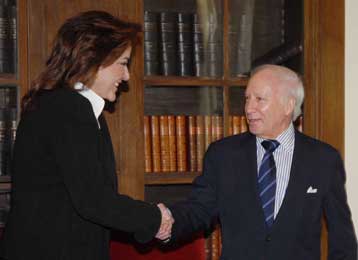
UN envoy Matthew Nimetz submit his final blueprint on the FYROM name dispute . Believing the time has come for a mutually acceptable solution, the Greek side will enter the talks with that goal in mind, Greek Foreign Ministry spokesman Giorgos Koumoutsakos told state-run radio station NET 105.8. He voiced his conviction that Matthew Nimetz will put forward a new and better-processed package of ideas, while he did not rule out a proposal on the name.
Greece will not consent to the creation of ally relations between FYROM and NATO unless the name dispute is settled, concluded Koumoutsakos.
Ambassador Vasilakis thanked Nimitz and the FYROM counterpart and said that Greek government will examine the final proposal.
According Ignatiou and Mega Channel the proposal is
Double formula
- One name for inside FYROM and bilateral usage
- One name for the international usage
- Suggestion to the UN members to following the second solution. USA agree and will following in that as I have already mention.
The names of the second option are
- New Republic of Macedonia
- Republic of New Macedonia...Nova Macedonia
Slavmacedonians has rejected this formula and Greek side probably discuss it with the second option as about the name.One more think is that yesterday night Greek side make clear to Nimitz that want
- One name for all usage
- Name with specific geographical specification
- Solution below the NATO summit
- Failed of the negotiations mean VETO
In my opinion Slavamacedonins is in the corner since Greece will ACCEPT the double formula.
Greek TV corresponded that Greek journalists beaten and in this time Greek Office is under attack and the FYROM Police is .....Invisible.
source
skai.gr
Saturday, February 16, 2008
Modern Macedonian Salad

In Greece the arguments run as follows:
- Ancient Macedonians were Greeks.
- Medieval Slavs and Bulgars were culturally converted to Byzantine Hellenism and were ethnically assimilated.
- Slav-speaking Macedonians were not necessarily Bulgars or Slavs. Considering their loyalty to the Patriarch and their active contribution to Greek 19th century irredentism, it is evident that they were ethnically Greeks beyond doubt.
In Bulgaria they are not concerned with ancient Macedonians but they argue that:
- Medieval Slavs in Macedonia were absorbed by the Bulgarians, but the latter were not assimilated either by the Greeks or by the Serbs.
- Despite allegiance to the Greek dominated Ecumenical Patriarchate, Slav-speaking Macedonian Bulgars were a separate ethnic group, which in the late 19th century inhabited most parts of Macedonia, but failed to be annexed by Bulgaria.
During the last quarter of the 19th century Serbs also developed their own theories about the identity of Macedonia’s population.They sought to demonstrate that:
- Medieval Slavmacedonians were Serbs. In fact Serbs dominated Macedonia after the Bulgarians in the 14th century; thus, they could not have been assimilated by the latter who were swept out in the early 11th century.
- They preserved a distinctive Serbian culture, a language akin to Serbian and were called “Serbs” for centuries.
- Macedonian Slavs were not identified as Bulgarians until the mid 19th century.
Naturally after World War II Serbian views were abandoned. Serbs were replaced ever after by Slavmacedonians historians who assimilated and further enhanced theories which in the past had been supported chiefly by the Communists. Their main task has been to show that:
- Ancient Macedonians were not Greeks but Slavs.
- Medieval Slavs assimilated ancient non-Greek Macedonians, but were absorbed neither by the Bulgarians nor by the Serbs or Greeks.
- In 19th century a dense and distinct Slav-speaking Macedonian ethnic group, overwhelmingly larger than the Greek one, became the vehicle of Macedonian nationalism, but ethnic Macedonia, having failed to get independence in 1903, was divided in 1913.
We have of course and the US views that run as follows
- Until 1990 considered talk of Macedonian "nation", Macedonian "Fatherland", or Macedonian "national consciousness" to be unjustified demagoguery representing no ethnic, nor political reality, and sees in its present revival a possible cloak for aggressive intentions against Greece.
- After 1990 found Macedonian "nation", Macedonian "Fatherland" or Macedonian "national consciousness". Greek thesis is now a unjustified demagoguery representing no ethnic, nor political reality, and sees in its present revival a possible cloak for aggressive intentions against Republic of Macedonia.
Tuesday, February 12, 2008
Greek American Community Charges U.S. Congress on Skopjeʼs Name Issue
Posted on Monday, February 11
Washington, D.C. By Apostolos Zoupaniotis
Leaders of major Greek American organizations gathered at an extraordinary meeting on Thursday, in Washington D.C. to coordinate their efforts in mobilizing the Greek American Community, in promoting the Hellenic positions regarding the name dispute with Skopje. The meeting was initiated by Theodoros Spyropoulos, Regional Coordinator of World Council of Hellenes Abroad, USA. President of the Pan-Macedonian Association of USA, Nina Gatzoulis; the President of the Hellenic American National Council, Em. Velivasakis, Executive Director of AHEPA, Bill Mossaidis; Executive Director of the American Hellenic Institute, Nick Laringakis; Coordinated Effort of Hellenes chairman Andy Manatos; the President of the American Hellenic Congress , Dr. D. Pallas; and staffers of the offices of Representatives Zack Space, Carolyn Maloney, Niki Tsongas, and Albio Sires attended the meeting that was described fruitful and positive by all.The leaders of the organization decided unanimously to intensify lobbying efforts in Congress, promoting HR-356 - proposed by Representatives Carolyn Maloney (D-NY) and Gus Bilirakis (R-FL) - and the Senate resolution SR-300, proposed by Senato Bob Menendez and supported by Senators Barack Obama and Olympia Snowe.
Furthermore, it was agreed that the Greek positions should be voiced in the American press, through advertisements, editorials and letters.
“We have ahead of us six crucial weeks, until the debate on issue of the NATO enlargement in Bucharest. If as Greek American Community we intensify our efforts and at the same time if Greece takes a decisive position, utilizing the NATO process, we can succeed” Ted Spyropoulos told the Greek News.
“There was always a converging collaborative effort between the Pan-Macedonian Association, the World Council of Hellenes Abroad (USA Region), the American Hellenic National Council, the American Hellenic Institute, and other organizations”, stated Ms. Gatzoulis. “ I am very satisfied however that we were given the opportunity for all Greek-American Associations to convene together and discuss this important issue which is not an issue that only concerns the members of the Pan-Macedonian Association, but one that is important to all Hellenes throughout the world.”
Ambassador of Greece to the United States Alexandros Mallias, briefed the participants on the Greek positions and he assured them of the Greek governmentʼs determination in the negotiations, regarding the naming of the FYROM. A pre-requisite for the integration of FYROM into NATO, is the implementation of the good neighbor policy in the process of defining a mutually accepted solution, emphasized the Greek Ambassador. Greece recognizes and expects the assistance of the Greek American Community to promote and protect the issues of national interest.
Ambassador Mallias also referred to the upcoming visit of the Minister of Foreign Affairs, Dora Bakoyiannis to the US on the 13th and 14th of February, 2008. Ms. Bakoyiannis will meet with U.S. Secretary of State Condoleezza Rice and Deputy Secretary of State John Negreponte. During the meeting she will inform them, amongst other things, Athensʼ position regarding the FYROMʼs integration in NATO. The Greek Foreign Minister will also meet with members of the Congressional Hellenic Caucus.
“It was a productive meeting and a coordinated effort by all present. The goal is that the Greek Americans use their capacity as American citizens to encourage their political representatives to support the two resolutions SR300 and HR 356”, Mr. Spyropoulos emphasized. “More than 100 members of the House of Representatives, as well as Senator and Presidential hopeful, Barack Obama, Senator Olympia Snowe, and Senator Robert Menendez, are already consigners of the respective decrees. As American citizens of Greek descent we possess great strength, and we can request from our political representatives to apply pressure and appropriately intervene regarding FYROM, in order to curb their incompliance and to contribute toward a commonly accepted solution for the naming of their nation, before the upcoming NATO conference in April of 2008”.
“It is very important for the entire Greek-American community to promote the Congressional resolution HR-356, which was proposed by Representatives Carolyn Maloney (D-NY) and Gus Bilirakis (R-FL), and the Senate resolution SR-300 which was proposed by Senator Robert Menendez. These resolutions urge the FYROM leadership to bring to an end its pursuits of propaganda against Greece stemming from the governmental domain and the private sector and to focus its initiatives or endeavors in finding a mutually accepted name with Greece, for their country. Furthermore, they urge the FYROM to stop annexing the Greek legacy and history, fanaticizing the youth of their country against Greece”, stressed the Pan-Macedonian President, Ms. Nina Gatzoulis.
The President of the Hellenic American Council Emmanuel Velivasakis also expressed satisfaction, “H.A.N.C. always supports the Pan-Macedonian Association of USA and its positions on the Macedonian issue. It is now time for a coordinated effort by all Greek American organizations. H.A.N.C. will collaborate with AHEPA at the upcoming gathering which will take place some time in March 2008 to inform members of the American government about this issue. This was a very positive meeting, and I am looking forward to the next one,” added Mr. Velivassakis.
http://www.greeknewsonline.com/modules.php?name=News&file=article&sid=8078
Washington, D.C. By Apostolos Zoupaniotis
Leaders of major Greek American organizations gathered at an extraordinary meeting on Thursday, in Washington D.C. to coordinate their efforts in mobilizing the Greek American Community, in promoting the Hellenic positions regarding the name dispute with Skopje. The meeting was initiated by Theodoros Spyropoulos, Regional Coordinator of World Council of Hellenes Abroad, USA. President of the Pan-Macedonian Association of USA, Nina Gatzoulis; the President of the Hellenic American National Council, Em. Velivasakis, Executive Director of AHEPA, Bill Mossaidis; Executive Director of the American Hellenic Institute, Nick Laringakis; Coordinated Effort of Hellenes chairman Andy Manatos; the President of the American Hellenic Congress , Dr. D. Pallas; and staffers of the offices of Representatives Zack Space, Carolyn Maloney, Niki Tsongas, and Albio Sires attended the meeting that was described fruitful and positive by all.The leaders of the organization decided unanimously to intensify lobbying efforts in Congress, promoting HR-356 - proposed by Representatives Carolyn Maloney (D-NY) and Gus Bilirakis (R-FL) - and the Senate resolution SR-300, proposed by Senato Bob Menendez and supported by Senators Barack Obama and Olympia Snowe.
Furthermore, it was agreed that the Greek positions should be voiced in the American press, through advertisements, editorials and letters.
“We have ahead of us six crucial weeks, until the debate on issue of the NATO enlargement in Bucharest. If as Greek American Community we intensify our efforts and at the same time if Greece takes a decisive position, utilizing the NATO process, we can succeed” Ted Spyropoulos told the Greek News.
“There was always a converging collaborative effort between the Pan-Macedonian Association, the World Council of Hellenes Abroad (USA Region), the American Hellenic National Council, the American Hellenic Institute, and other organizations”, stated Ms. Gatzoulis. “ I am very satisfied however that we were given the opportunity for all Greek-American Associations to convene together and discuss this important issue which is not an issue that only concerns the members of the Pan-Macedonian Association, but one that is important to all Hellenes throughout the world.”
Ambassador of Greece to the United States Alexandros Mallias, briefed the participants on the Greek positions and he assured them of the Greek governmentʼs determination in the negotiations, regarding the naming of the FYROM. A pre-requisite for the integration of FYROM into NATO, is the implementation of the good neighbor policy in the process of defining a mutually accepted solution, emphasized the Greek Ambassador. Greece recognizes and expects the assistance of the Greek American Community to promote and protect the issues of national interest.
Ambassador Mallias also referred to the upcoming visit of the Minister of Foreign Affairs, Dora Bakoyiannis to the US on the 13th and 14th of February, 2008. Ms. Bakoyiannis will meet with U.S. Secretary of State Condoleezza Rice and Deputy Secretary of State John Negreponte. During the meeting she will inform them, amongst other things, Athensʼ position regarding the FYROMʼs integration in NATO. The Greek Foreign Minister will also meet with members of the Congressional Hellenic Caucus.
“It was a productive meeting and a coordinated effort by all present. The goal is that the Greek Americans use their capacity as American citizens to encourage their political representatives to support the two resolutions SR300 and HR 356”, Mr. Spyropoulos emphasized. “More than 100 members of the House of Representatives, as well as Senator and Presidential hopeful, Barack Obama, Senator Olympia Snowe, and Senator Robert Menendez, are already consigners of the respective decrees. As American citizens of Greek descent we possess great strength, and we can request from our political representatives to apply pressure and appropriately intervene regarding FYROM, in order to curb their incompliance and to contribute toward a commonly accepted solution for the naming of their nation, before the upcoming NATO conference in April of 2008”.
“It is very important for the entire Greek-American community to promote the Congressional resolution HR-356, which was proposed by Representatives Carolyn Maloney (D-NY) and Gus Bilirakis (R-FL), and the Senate resolution SR-300 which was proposed by Senator Robert Menendez. These resolutions urge the FYROM leadership to bring to an end its pursuits of propaganda against Greece stemming from the governmental domain and the private sector and to focus its initiatives or endeavors in finding a mutually accepted name with Greece, for their country. Furthermore, they urge the FYROM to stop annexing the Greek legacy and history, fanaticizing the youth of their country against Greece”, stressed the Pan-Macedonian President, Ms. Nina Gatzoulis.
The President of the Hellenic American Council Emmanuel Velivasakis also expressed satisfaction, “H.A.N.C. always supports the Pan-Macedonian Association of USA and its positions on the Macedonian issue. It is now time for a coordinated effort by all Greek American organizations. H.A.N.C. will collaborate with AHEPA at the upcoming gathering which will take place some time in March 2008 to inform members of the American government about this issue. This was a very positive meeting, and I am looking forward to the next one,” added Mr. Velivassakis.
http://www.greeknewsonline.com/modules.php?name=News&file=article&sid=8078
Monday, February 11, 2008
Please take action !!!
 Dear All,
Please take a look at the lecture that will take place at the Smithsonian Resident Associated program and take the proper action:
http://residentassociates.org/ticketing/tickets/reserve.aspx?performanceNumber=178528
Please call, fax or email.
Contact information:
Tel: 202-633-3030
Fax: 202-786-2034
email: CustomerService@ResidentAssociates.org
Below is the Pan-Macedonian responce.....
Barbara Tuceling
Director of Smithsonian Resident Associate Program
On behalf of the members of the Pan-Macedonian Association, USA, one of the largest Greek-American organizations, we wish to express our profound disappointment that such a respected institutions as the Smithsonian Resident Associate Program, is ready to embrace historic inaccuracies.
It came to our attention through your advertisement that art historian and “Macedonian” native, Aneta Georgievska-Shine “...explores the multi-layered cultural heritage of this dynamic history...Home to exquisite Byzantine churches with beautifully preserved frescos and valuable icons, the Republic of Macedonia is a country or rich and complex cultural identity. Form antiquity, when Alexander the Great created an empire that reached as far away as India...”
Even though President George Bush erroneously recognized the FYROM as Republic of “Macedonia,” back in 2004, Macedonia is a province of Greece since time immemorial. The Slavs, who are Ms Shine’s ancestors, cannot be ethnically, linguistically or culturally Macedonians simply because they did not exist in this area until the 6th century AD, when they descended from Siberia and settled there.
The Hellenic name Macedonia, which had always identified the northern area of Greece, preceded the introduction of the majority Slavic population of The FYROM in the Balkans by well over 2000 years. Therefore when they arrived in the area, the Byzantine Empire was already in existence.
In addition Ms Tuceling two wrongs, our President’s in 2004 and your institute’s embracing historic inaccuracies, do not make a right. In addition Alexander the Great the Macedonian, spoke Greek, used the Hellenic alphabet, carried Homer’s works with him and spread the Hellenic language and civilization throughout the then known world. He did not speak the Bulgarian dialect that The FYROM people speak; he did not use the Cyrillic alphabet, which had not even appeared till about one thousand years after his death. Alexander the Great is our Abraham Lincoln, as he united the North and the South of the Hellenic World under Hellas.
The historians in your esteemed institute should know that during the ancient Olympic Games, only Greeks could participate. The Macedonians therefore participated for the very fact that they too were Greeks.
With this letter we formally request that you desist from engaging in promoting falsified and revised history through your institution.
We would appreciate an answer.
Saturday, February 09, 2008
WE NEED YOUR HELP TO PASS A RESOLUTION ON FYROM

CONTACT THE COMMITTEE ON FOREIGN AFFAIRS TODAY!ASK THEM TO TAKE ACTION ON FEBRUARY 14
Background on the Issue
The FYROM issue will come to the forefront in 2008, because the United States is advocating for FYROM's inclusion into NATO and the European Union. Greece, a key NATO ally and EU member, will oppose FYROM's membership into NATO unless a mutually agreeable solution is found by the time of the NATO Summit this April. It will become increasingly difficult for Greece to negotiate a mutually acceptable name with FYROM should the latter become a NATO member and eventually an EU member.
On May 1, 2007, Representative Carolyn Maloney (D-NY) introduced H.Res. 356, which urges FYROM to stop utilizing materials that violate provisions of the UN-brokered Interim Agreement between FYROM and Greece regarding "hostile activities or propaganda" and should work with the United Nations and Greece to achieve longstanding US and UN policy goals to find a mutually-acceptable official name for FYROM.
Status
Currently, the bill sits with the House of Representatives Committee on Foreign Affairs. Rep. Tom Lantos is the chairman of the committee.
Action Needed Today
The bill has not been taken up by the Committee on Foreign Affairs.
AHEPA Supreme President Ike Gulas has requested a meeting with Chairman Lantos on this issue.
AHEPA Supreme President Ike Gulas has requested a meeting with Chairman Lantos on this issue.
Now it is your turn. As American citizens of Hellenic descent, we must have a collective voice.
Contact Representative Lantos through the Committee on Foreign Affairs Today!
Telephone or write to Robert King, who is Rep. Lantos' Staff Director for the Committee on Foreign Affairs.
Contact Representative Lantos through the Committee on Foreign Affairs Today!
Telephone or write to Robert King, who is Rep. Lantos' Staff Director for the Committee on Foreign Affairs.
Request that Chairman Lantos bring H.Res.356 up for debate and consideration by the House Committee on Foreign Affairs.
Present the reasons why the Resolution merits debate (you can utilize these talking points).
more in AHEPA.org
FYROM irredentism .....
The below picture show the FYROM Prime Minister Gruevski when put flowers on the grave of the revolutionary Goce Delchev on the anniversary of its 136th birth day. On the grave has been put a map of Greater Macedonia that includes what is nowadays Greek Macedonia and Bulgarian Macedonia.

FYROM’s irredentist policy towards Greece from 1944 to the present, a policy that is in flagrant breach of the Interim Agreement signed by the two parties in 1995 expressly calling on
them to put an end to any mutual expressions of irredentism.

Now tell me dear neutral observer ?
Do you really beleive that this tiny State has fairly policy against Greece and the Greek people. Mant times I have wrote taht cause of this ultra-nationalist behaviour is a ideology that flourish and in FYROM borders and grow dynamically in diaspora Slavmacedonians.This ideology call as Macedonism.
FYROM main headings were, are and will be...
- Renaming Greek Macedonia as ‘Aegean Macedonia’, and representing
it as terra irredenta, as an integral part of FYROM. - Claiming the existence of an oppressed ‘Macedonian minority’ within
Greece. - Appropriating emblems and symbols, and the Greek cultural legacy in
general (with Ancient Macedonia as the focal point).
FYROM’s irredentist policy towards Greece from 1944 to the present, a policy that is in flagrant breach of the Interim Agreement signed by the two parties in 1995 expressly calling on
them to put an end to any mutual expressions of irredentism.
Sunday, February 03, 2008
AHI Sends Letter to Secretary of State Condoleezza Rice Regarding FYROM

WASHINGTON, DC-
On January 31st, AHI sent a letter to Secretary of State Condoleezza Rice regarding the administration's failure to properly address the name issue regarding the former Yugoslav Republic of Macedonia (FYROM) as it relates to U.S. interests and that of our most important ally in the Balkans - Greece. The text of the letter follows:
January 31, 2008
The Honorable Condoleezza Rice
Secretary of State
2201 C Street, N.W.
Department of State
Washington, D.C. 20520
Re: Former Yugoslav Republic of Macedonia
Dear Madame Secretary:
On behalf of the nation-wide membership of the American Hellenic Institute (AHI) we write to express our strong disapproval concerning the administration's continuing failure to properly address the name issue regarding the Former Yugoslav Republic of Macedonia (FYROM) as it relates to our interests and that of our most important ally in the Balkans-Greece.
The U.S. has important interests in Southeast Europe and the Eastern Mediterranean. The projection of U.S. interests in the region depends heavily on the stability of the region. Therefore, the U.S. has an important stake in fostering good relations among neighboring countries in the region.
Greece is of vital importance for the projection of U.S. strategic interests in the region by virtue of among other factors, its geographic location and by being home to the most important naval base in the Mediterranean Sea, Souda Bay, Crete. There are thousands of visits by U.S. military ships and planes to Souda Bay and its adjacent air base annually.
This sentiment has been expressed several times by our government in the past few years, by President Bush and by you, Madame Secretary.
Stability in the Balkans is not only critical for overall U.S. interests, but also because it serves the interests of every country in the Balkans.
Greece is by far the most economic and politically stable country in the Balkans. By contrast, FYROM is of limited significance to the national security interests of the United States.
However, the continuing intransigent and provocative actions by the government of the FYROM against its neighbor, Greece, poses a potential threat to stability in the Balkans, to the detriment of U.S. interests.
However, the continuing intransigent and provocative actions by the government of the FYROM against its neighbor, Greece, poses a potential threat to stability in the Balkans, to the detriment of U.S. interests.
Yet, it would seem that Greece has been taken for granted. The sensitivities and concerns of our most important ally in the Balkans and one of our most loyal and long-time ally have not been considered.
Successive administrations from President Clinton to the present Bush administration, have had a habit of taking Greece for granted. These administrations have looked upon Greece as a Western nation and ally that will not rock-the-boat and will follow what the U.S. and the major NATO nations desire. That has been unfortunate and has created unnecessary problems- such as the FYROM name issue.
As you very well know, the FYROM name issue is coming to a head soon. As you are further aware, it is expected that the application of FYROM to join NATO will be discussed at the March 6, 2008 NATO foreign minister's meeting in Brussels. The U.S. supports FYROM's admission to NATO. Greece obviously objects to admission without a resolution to the name issue, and has stated it will use their veto, if necessary, which Greece is within her right to exercise.
If the United wishes to avert this veto, we encourage you to strongly use your influence to bring the proper pressure to bear on FYROM to negotiate in good faith the name issue that satisfies both countries and to cease its provocative actions against Greece. Only in this way will the interests of all parties be satisfied.
To this effect, Greece has recently made a major compromise by proposing "a compound name for the country; a name that will distinguish it from both the Greek and Bulgarian part." Greece's position is unambiguous. It has gone the extra mile. It wants a negotiated, mutually acceptable solution that will be valid internationally, in accordance with the United Nations Security Council Resolutions. Foreign Minister Bakoyannis publicly expressed Greece's readiness to accept a composite name. This is a serious shift of tremendous importance from Greece's initial position. Unfortunately, this gesture was not reciprocated from the FYROM. The time is ripe for FYROM to demonstrate the maturity and the responsibility that a state needs in order to become a member of the Alliance.
The U.S. can easily turn the situation around by informing FYROM that the U.S. supports the Greek government's major compromise of accepting "a compound name for their country, a name that will distinguish it from both the Greek and Bulgarian" part.
Greece is determined to settle this difference before the NATO Summit in April of this year. However, if FYROM remains unwilling to engage in good faith negotiations, then the issue will remain unresolved. Such a situation will perpetuate the problem.
The immediate settlement of the name issue, in a way that is acceptable to Greece, will allow the United States' strongest ally in the Balkans to be the driving force for FYROM's membership to NATO and ultimately to the European Union.
FYROM's "passport" to NATO and the European Union is Greece. It is however, FYROM, that is the intransigent party in this regard, and not Greece. FYROM must realize that in order to join NATO, it must focus on the fulfillment of NATO's good neighborly relations principle and the immediate settlement of the difference over the name. Greece is the biggest investor in FYROM and literally helps to sustain FYROM's precarious economy and reduce its large unemployment. Greece is also a leader in investment and economic development in Southeastern Europe, with over 22 billion dollars invested.
Yet, FYROM continues to provoke Greece and who refuses to negotiate in good faith over the name issue. Unfortunately, actions over the years such as distortion of geographic maps, naming its airport "Alexander the Great," revisionist textbooks in schools, and inflammatory comments by top government officials, encourages new generations in FYROM to cultivate hostile sentiments against Greece. Further, this continuing systematic government policy will hinder FYROM's accession to both the EU and NATO. This is the real threat to stability in the Balkans.
Unfortunately, the irresponsible decision by the administration in the fall of 2004 to recognize FYROM as the "Republic of Macedonia" has contributed greatly to FYROM's increasing intransigent stance.
In our view, and many others, U.S. actions since 1992 regarding the FYROM name dispute has constituted an American foreign policy blunder which has damaged U.S. interests in the Western Balkans and damaged Greece, our key ally in the Balkans and Eastern Mediterranean, for no sound reason.
I emphasize that there is no sound reason for the U.S. to have supported FYROM on the name issue. Further, for the U.S. to support FYROM against Greece, a loyal ally, a member of NATO and the European Union (EU) and the key nation in the Balkans and Eastern Mediterranean for the projection of U.S. power and U.S. diplomatic, economic and political initiatives, is gross diplomatic negligence.
For the record, there is no unqualified universally accepted rule of international law that authorizes a state to name itself anything it wants.
It is not proper for a country which is part of a region to define itself in an official manner as representing the whole region. Macedonia, like the Americas and Europe, is a region. Just as no country in North and South America would call itself the "American Republic," and no European country would call itself the "Republic of Europe," FYROM in naming itself cannot assume the mantle of all of Macedonia.
Tito changed the name of this area in 1944 from Vardar Banovina to Macedonia. The usage of Macedonian as a nationality was an invention of Tito in 1944. Tito, the communist dictator of Yugoslavia, created a false Macedonian ethnic consciousness among his south Slavic citizens for a number of reasons, including his campaign against Greece to gain control of Greece's province of Macedonia and the major port city of Salonika. (See article by C.M. Woodhouse, a noted historian, in the Christian Science Monitor, October 28, 1992, p. 19.)
The United States opposed the use of the name Macedonia by Tito in 1944 and we should continue to oppose it now. In a Circular Airgram (Dec. 26, 1944) Secretary of State Edward R. Stettinius, Jr., stated:
This government considers talk of Macedonian "nation," Macedonian "Fatherland," or Macedonian "national consciousness" to be unjustified demagoguery representing no ethnic nor political reality, and sees in its present revival a possible cloak for aggressive intentions against Greece.
The United States opposed the use of the name Macedonia by Tito in 1944 and we should continue to oppose it now. In a Circular Airgram (Dec. 26, 1944) Secretary of State Edward R. Stettinius, Jr., stated:
This government considers talk of Macedonian "nation," Macedonian "Fatherland," or Macedonian "national consciousness" to be unjustified demagoguery representing no ethnic nor political reality, and sees in its present revival a possible cloak for aggressive intentions against Greece.
Stettinius' airgram was prophetic because Tito and Stalin did initiate aggressive action against Greece. Therefore, we call upon you, Madame Secretary, to please use your influence with FYROM to impress upon them to negotiate in good faith with Greece to resolve the name issue and to cease immediately their irredentist propaganda against Greece, which violates the UN-brokered Interim Accord, as stated in Article 7 paragraph 1 of the Accord, signed in New York on September 13 1995 between FYROM and Greece.
It is useful to recall President Bush's words and yours regarding U.S. relations with Greece. On March 20, 2005, during the occasion of Prime Minister of Greece, Constantine Karamanlis' visit to the White House, President Bush stated, "America and Greece have got a strategic partnership. That's important. It's important for our respective peoples, and it's important we work together to spread freedom and peace."
On March 24, 2005, you stated, after meeting with then Greek Foreign Minister Petros Molyviatis, that, "...the Balkans, a place in which we believe great progress has been made but, of course, there are many challenges yet to meet. ... we have no better friend in these challenges than our friends in Greece." And in reference to Kosovo and Greece's role there, you stated, "We believe that this is an area that is ripe for cooperation between Greece and the United States..."
And once again, on March 23, 2006, when welcoming the then new Foreign Minister of Greece, Dora Bakoyianni to the State Department, you said, "We've had a great opportunity to discuss our strategic partnership with Greece. This is a relationship that is first and foremost, of course, based on values. It is a relationship that recognizes the seminal role of Greece as a cradle of those values and recognizes that in the modern era in which we find ourselves now with so many challenges that Greece is a stalwart partner in the spread of democratic values, whether it be in Greece's work in the Broader Middle East Initiative, in which we've all been involved, promoting stability and prosperity in the Balkans, fighting terrorism and, of course, seeking the reunification of Cyprus on the basis of democratic values."
And once again, on March 23, 2006, when welcoming the then new Foreign Minister of Greece, Dora Bakoyianni to the State Department, you said, "We've had a great opportunity to discuss our strategic partnership with Greece. This is a relationship that is first and foremost, of course, based on values. It is a relationship that recognizes the seminal role of Greece as a cradle of those values and recognizes that in the modern era in which we find ourselves now with so many challenges that Greece is a stalwart partner in the spread of democratic values, whether it be in Greece's work in the Broader Middle East Initiative, in which we've all been involved, promoting stability and prosperity in the Balkans, fighting terrorism and, of course, seeking the reunification of Cyprus on the basis of democratic values."
We write this in the interests of the United States and for the support of our long-time and loyal ally, Greece, who is our most important strategic partner in the region and the key country for stability in the region.
Respectfully yours,
Gene Rossides
President
Nick Larigakis
Executive Director
cc:
cc:
Deputy Secretary of State John Negroponte
Under Secretary of State for Political Affairs R. Nicholas Burns
Assistant Secretary of State for Europe and Eurasia Daniel Fried
Deputy Assistant Secretary of State for Europe and Eurasia Matthew Bryza
Director of Southern European Affairs Kathy Fitzpatrick
Greek Desk Officer Gabrielle Cowan
The Congress
Saturday, February 02, 2008
Slavmacedonian Embassador Nikola Dimitrov
In the talks between Greece and FYROM to settle their dispute over the use of the name 'Macedonia' by FYROM we have hear the name of Nikola Dimitrov, the Slavmacedonian negotiator.
 In this picture you can see the 37 year old Slavmacedonian politician with the Greek Embassador Vasilakis in Ochrid.

Major M. Nasrullah, Senior Captain M. Rüşdü, First Lieutenant M. Eşref; Osmanlı Atlası XX. Yüzyıl Başları; Osmanlı Araştırmaları Vakfı; İstanbul 2003; ISBN 975-7268-34-8
Let's read the article........
 In this picture you can see the 37 year old Slavmacedonian politician with the Greek Embassador Vasilakis in Ochrid.
Two years ago the present Slavmacedonian politician Nikola Dimitrov was in stationed in USA as Ambassador of the FYROM. On March 9th, 2006 organized by the FYROM Embassy in the U.S. House of Representatives with the help and support of the Office of Congressman Mark Souder.
Slavmacedonian Dimitrov as FYROM Ammbassador briefed various Congressional staffers, members of the media, and Greek and Macedonian émigré organizations, respectively on the topic of The right to an identity: Republic of Macedonia and Resolutions H. Res. 521 and H. Con. Res. 306. .His arguments follow the known nationalistic and un-historical thesis of the FYROM State such as Greece discover Macedonia in 1988 and several other thinks that you can read it in this link .
As I said one from the biggest lier of the Slavmacedonian politician was that Greece discover Macedonia in 1988. With the First Balkan War of the Balkan states against the Turks in 1912, when the Greek army liberated Thessaloniki, the Governorate- General of Macedonia (ΓΕΝΙΚΗ ΔΙΟΙΚΗΣΗ ΜΑΚΕΔΟΝΙΑΣ) was established immediately, with its headquarters in Thessaloniki. It was well known that Greece had the right to do this and no one objected. Until 1944, no one ever conceived of the existence of any other Macedonia.and the first General Governor was Stefanos Dragoumis.
Also one from the FYROMian propaganda sources was the famous Rossos article with title The British Foreign Office and Macedonian National Identity, 1918-1941 In this article there is a quote that mention
1923: "In the course of conversation, Mr. Lambros [Governor General of Macedonia], actually said that the present was a good opportunity to get rid of the Bulgars [sic] who remained in this area and who had always been a source of trouble for Greece.
Also proffessor Marcus Alexander Templar gave a great answer with some intrestings historical facts such the Ottoman map that you can see below...

Major M. Nasrullah, Senior Captain M. Rüşdü, First Lieutenant M. Eşref; Osmanlı Atlası XX. Yüzyıl Başları; Osmanlı Araştırmaları Vakfı; İstanbul 2003; ISBN 975-7268-34-8
Let's read the article........
At the end they present the map of the present-day FYROM as the map of “ancient Macedonia,” an ancient Macedonia that NEVER existed. It is “their” version of Macedonia. Fifty years under the communist rule taught them to revise their history as it suits them.
On the other hand, the Greek maps display Macedonia in any website and any book, present only the Macedonian part of Greece, as Macedonia. Only historical maps show some parts that belong to The FYROM, as part of Lyngistis, Pelagonia, and the Macedonian Paeonia[1]. It is therefore evident that these maps demonstrate in a subtle, but clear manner that The FYROM Slavs do not recognize Hellenic sovereignty over the Greek part of Macedonia, Macedonia Proper; this is the reason they insist on calling it Aegean Macedonia and not Greek or Hellenic Macedonia. It also violates the Interim Agreement signed by both Greece and The FYROM and the Constitution of The FYROM itself – amendment replacing and clarifying article 49 of the said Constitution. The dream and the goal of The FYROM Slavs are the incorporation of the Hellenic part of Macedonia into their newly independent country with the city of Thessaloniki as the first prize.
This goal began in the 1800’s and not by the Slavs of The FYROM, but by a Bulgarian, aspiring to make the Bulgarian dream come true. This dream began with Georgi Stoykov Popovich or better known as Georgi Sava Rakovski of Kotel, Bulgaria, who dedicated his life for the liberation of geographic Macedonia for the Bulgarians.
On August 2-3 every year since its establishment, The FYROM celebrates the establishment of the ephemeral Krushevo Republic, a “republic” that started by Bulgarians and victimized the Greeks of the area of the villages of Krushevo. The Manifesto of Krushevo treated the term Macedonia geographically, calling for all Macedonians “regardless of faith, nationality, sex or conviction, not being able to endure any more the tyranny of bloodthirsty converts” to rise up against the Ottomans. For the first time in history Tito named his Slavs of the People’s Republic of Macedonia, “Macedonians” Stalin’s suggestion, and only recently, the self-proclaimed “Macedonian” Patriotic Organization, admitted they are actually Slavs[2]. Of course, he simultaneously declared his ignorance about the origin of the alphabet of his own old country.
The view that when the territories of Macedonia were divided into three areas, awarding Greece 51.57%, Serbia 38.32% and Bulgaria 10.11% of the total Macedonian territory, is based on erroneous discernment, which leads to miscalculations. These percentages are incorrect because they correspond to the area of Greek Macedonia (34,603 km2) and Bulgarian Macedonia (6,789 km2), but not to the actual section of the former Serbian Macedonia.
The territory of the present day FYROM (25,713 km2) was not totally part of Serbian Macedonia. Namely, the calculations mentioned in the previous paragraph refer to the republic[3] when it was formed after the WWII, disregarding the fact that Serbian territories merged with Serbian Macedonia in order to create the new “People’s Republic of Macedonia.”[4] There is no reference of “Macedonia” in the Treaty of Bucharest, because Macedonia did not exist, and thusly the Treaty divided the Vilayets of Selanik and Manastır of the Ottoman Empire
======================================================================
[1] See Templar, Fallacies and Facts, 2003, map The Macedonian Homeland.
[2] “The Macedonians are Slavs” Chris Evanoff, MPO President, 17 July 2002 – Letter to the Governor of Illinois. “Today the Macedonian alphabet and language are Slavic and differ completely from the Greek alphabet and language” Chris Evanoff, MPO President, 23 July 2002 – Letter to the Governor of Illinois.
[3] “People’s Republic of Macedonia” and in April 7, 1963 “Socialist Republic of Macedonia.”
[4] From personal experience: Skopje, i.e. belonged to Serbia and its inhabitants used to speak “old Serbian.”
Also you can read and the Istor article regarding Dimitov claims
The question is ....can we trust a politician that said to much lies as Nikola Dimitov ?
Can Balkan Peace trust a politician that his State *FYROM) generated falsifications and several factors that wish to serve their own interests by creating trouble in the Balkans
Greece objects to the use of the name "Republic of Macedonia" by FYROM, saying this may give rise to irredentist claims against a northern Greek province of the same name that shares a border with tiny and landlocked FYROM. It has also objected to FYROM's adoption of symbols associated with the ancient Macedonian king and general Alexander the Great as historically inaccurate.
Nikola Dimitrov are you trust as negotiator ? or you one that adopted the Macedonism ?
Monday, January 28, 2008
Archbishop Christodoulos Passed Away

4-Day National Mourning
Late Archbishop Christodoulos, who breathed his last on Monday dawn after a seven-month battle with cancer, will be buried in the highest state honors at Athens’ First Cemetery on coming Thursday. Church bells have been tolling since early in the morning, while flags in public buildings and schools have been flying at half mast throughout Greece. Christodoulos’ mortal remains have been lying in state at the Athens Cathedral. A joint ministerial decision singed by the Ministers of Interior, Finance, Health, Education and National Defence, declared a four-day period of national mourning, while the day of his funeral all public agencies and schools will remain closed.
Saturday, January 26, 2008
What are the main claims of Macedonism ?
The very act of the foundation of the Former Yugoslav Republic of Macedonia (FYROM), together with all its subsequent actions as a political entity from 1944 to the present day, show that ‘Macedonianism’ is the basic totalitarian ideological tenet of that state. With this tenet the state and the Slavic component in a population of several different ethnic groups have constructed their existence as a nation and their ‘historical’ mission. Right at the very start, ‘Macedonism’ was proclaimed as a sacred dogma, allowing of no discussion, let alone questioning. It has been practised with all the means available to a State that, up to 1991, had been forced to operate under a totalitarian Communist regime where there ‘was but one’ Truth and where the question that bulked above all others was ‘the security of the State’. Anyone dissenting did so with the foreknowledge that he or she would be ‘eliminated’.
When this totalitarian regime collapsed, as it was bound to do, from external causes, nothing changed. There has been no relaxation in the human geography of power at FYROM, not even in the sacred dogma and the State’s duty to safeguard it. The question is one about which a society trained for generations at the hard camp of Macedonianism remains tight-lipped, phobia-prone, and trigger-happy.
An alternative view of the matter has yet to establish itself, any dialogue being considered out of the question. Instead, every pronouncement to the international community by every Skopje government since 1991 has insisted that even the slightest modification to State ‘Macedonianism’ would be fatal to the very existence of the State and the people. And the outward and visible sign of this insistence is the claim to have a monopoly on the name ‘Macedonia’.
These final apocalyptic assertions from Skopje have effectively been espoused by scores of other states, the USA being one example, precisely because they are well aware how ramshackle is the whole artificial but temporarily expedient structure.
They are certainly not ignorant of history. But for the time being they play down what is a self-evident fact. Following the adoption of ‘Macedonism’ as an ideology, FYROM has been trapped in a dead-end of its own making. Sooner or later it is bound not only to destabilize at large a region which is still in a state of flux, but also to place its own Balkan interests in jeopardy.
Those powerful foreign interests that protect Skopje and make use of her may be counting on exploiting for themselves when the time comes. But the sad conclusion from major events on the international stage – in Iraq, say, in Palestine, in the Islamic world, or in the global context of terrorism – is that in some at least of the places where decisions are taken politics is no longer the art of foresight and anticipation. For the Great Powers of today, it is no longer five minutes to midnight, but five minutes past.
The official totalitarian State ideology cultivated in Skopje and theirs claims are....
- It claims that Macedonia has long been a distinct political entity; and that during the two Balkan Wars (1912-1913) against the Ottoman Empire, master of the region from the 14th century onwards, the latter partitioned a ‘united’ (when was she ever thus?) Macedonia among ‘its conquerors’, namely Greece, Bulgaria, and Serbia, with a small part of it later coming into the possession of Albania.
- It claims that Serb Macedonia – what was known until 1941 as Vardarska Banovina – was liberated in 1944, to become from thence onward the metropolitan centre of the ‘splintered and still subservient Macedonian nation’. It is the ‘inalienable national rights’ of this nation which the now independent State of FYROM has been seeing to, in line with an express provision of its present constitution (a clause necessarily revoked in 1995).
- It claims that Greek Macedonia is still ‘under foreign occupation’, viz by Greece, which is said to have ‘inflicted genocide on the Macedonian People’. (This region is therefore always referred to as ‘Aegean’ - never as ‘Greek’ - Macedonia by Skopje, which officially recognizes the Greek Civil War of 1944-1949 as ‘the Macedonian’ national liberation struggle to free Aegean Macedonia’ and to incorporate the latter in ‘the free motherland’, meaning FYROM). It makes similar claims, though these often fluctuate, against Bulgaria, and less loudly against Albania.
- It claims that the ancient Macedonians – notable examples being Alexander the Great and his father Philip – ‘were not Greeks’. As ‘conquerors of Aegean Macedonia’ and ‘oppressors of our brothers the Aegean Macedonians’, from 1913 onwards, the Greeks have been ‘usurping’ the history, the civilization, and the name of the ancient Macedonians, ‘the forefathers’ of FYROM’s (Slav) Macedonian nation.
These four central tenets of ‘Macedonianism’, given in chronological sequence with the necessary background, are already enough to show that while feigning ‘legitimate irredentism’, Skopje is openly and unambiguously declaring her expansionist designs towards Greek Macedonia. The arguments themselves are full of holes, yet they have been swallowed, wittingly, by dozens of civilized states, the United States included.
Why?
Because they want to advance their own interests and promote hidden geopolitical agendas in the region. But this is a serious blunder, and it goes against their interests. And in politics a blunder (said Talleyrand) is worse than a crime. Small the FYROM may be, but in the hands of powerful third parties it could be lead to catastrophe.
It should lastly be pointed out that for the State and the Slavs of Skopje ‘Macedonism’ has become an article of faith, a question of existence. This question needs fodder to survive, which means constructing an equally fictitious ‘enemy’: Greece.
But at the same time this State and its Slavic population are well aware, since they see it in their daily lives, of what Greece – ‘the enemy’ – can do for them. Better than any of Skopje’s other neighbours, with more resolve, effectiveness and credibility, Greece is assisting them with their economic development, their orientation towards Europe, the cohesion of their ethnically disparate society, and the existence and the security of their State. This she does better and more credibly than all the other Balkan countries put together; and all that she is after is peace in the region, productive cooperation, and a common sense of dignity. The pity of it is that the two positions are so far apart.
source:
Macedonism FYROM'S Expansionist Designs against Greece, 1944-2006
Related articles:
- Macedonism, a ultra-Nationalilst ideology that spread from FYROM Worldwide
- Why Macedonian Slavs Stealing the Greek Macedonian History?
Sunday, January 20, 2008
Grecomans
“Grecomans” was used by the Bulgarians as a derogatory term to define the Greek Slavophones, i.e. those who remained firm to the Ecumenical Patriarchate and to Hellenism.
It is interesting to note that in 1883, despite the growth of the Bulgarian national and ecclessiastical movement, the situation in terms of ecclesiastical affiliation in the northern “border” bishoprics of the contested central zone presented the following picture Bishopric of Ohrid and Prespa, patriarchist families 3030, exarchist 6003; Bishopric of lPelagonia (Monastir), patriarchist 6459, exarchist 4988; Bishopric of Moglena (Florina), patriarchist 2433, exarchist 699. The majority of these patriarchists were Vlachophone and Slavophone “Grecomans”.
Please keep in your mind the names of the Bishoprics.
Data from [AYE/”Constantinople Embassy” / 1883, Dokos (Monastir) to Koundouriotis (Con/pole), No. 210, 15/27 Nov. 1883] , [Dillimas and Orientations by Evagellos Kofos]
Grecomaniac or Grecophile
The above words are terms that used from the ultra-nationalist in order to determine the Greek Slavphones during the Greek Struggle in the 19th and in the beginning of the 20th century.These terms came from Bulgarian or Serbian nationlist elements.
Today the FYROMacedonian ultra-natiolists diaspora centers REPLACE these odds and using these terms in order to insult these Greeks.
For the sake of the thread let us accept that the old Bulgarians, those who in current Makedonoski theory “considered” themselves Bulgarians and who, in fact, lived in Macedonia, as a minority community, however, as is apparent from the Ottoman statistics for 1905, have erroneously been taken as constituting a segment of the “Macedonian” nation.
As we have said, however, these people were Bulgarians:
they never (at that time) called themselves “Macedonians”; they fought as comitadjis in the ranks of the Bulgarian Committee and later, in 1924, taking advantage of the Kafantaris-Molov agreement on the “voluntary exchange of populations”, they left for Bulgaria. None of them moved to what was then the district of Skopje –which, moreover, was at that time certainly not called “Macedonia”: it was merely “Vardarska Banovina” (Directorate of the Axios), an administrative district of the then Kingdom of Serbia.
Serbia consequently delivered a protest to the Greek government for having exchanged these people for Greeks living in Bulgaria when, according to Serbia, they were in fact Serbs, (not, of course, “Macedonians”). All the “Bulgarophones”, as they were called at that time, who remained in Greece were old Patriarchists (adherents of the Ecumenical Patriarchate) from the time of the Bulgarian Schism, veterans of the Macedonian Struggle:
“Grecomaniacs” (passionately Greek), in the words of the Bulgarians and their descendants.
The following discussion on the nationality of these Bulgarian speakers, which Michel Paillares reports (op.cit., pp. 50-51) having had with Hilmi Pasha, the Inspector General of the Macedonian vilayets of Monastir and Thessaloniki, is significant:
Paillares:
But these Bulgarophones insist that they are really Greeks?
Hilmi:
They say they are Greeks when no coercion, no constraint, is brought to bear on them.
Paillares:
And what is your opinion, Your Excellency?
Hilmi:
My opinion, and the opinion of my government, is that they are Greeks. We classify our subjects according to which schools and which Church they attend. Being unable to win people by peaceful propaganda, the Comitadjis do not hesitate to make use of the most atrocious methods. They turn to the knife, the revolver, the axe
It is equally significant that much earlier, in 1871, the Russian Goloubinskii (see the relevant note in my dissertation on “The liberation of Thessaloniki”, op.cit., pp. 25-26) had written:
These purported Greeks nourished a more implacable hatred and a more intense scorn for all things Bulgarian or Slavic than did real Greeks.
Just recently my attention was drawn to a passage in the magazine Tachydromos, an extract from a book by Giovanni Amadori-Virgili, a former Italian Minister of Foreign Affairs, entitled “La questione Rumeliota (Macedonia, Vecchia Serbia, Albania, Epiro) e la politica italiana”, published in 1908 as number 1 in a series by the Biblioteca Italiana on foreign policy.
The passage in question reads:
Through their partiotic sentiments and their devotion to Greek traditions and Greek culture, the Slav-speaking Greeks of Macedonia express their vigorous determination to be Greeks.
Legally, after the population exchange, the subject was closed, for those who remained were those who did not want to leave Greece, who did not choose to be Bulgarians. Nowhere is there any mention of the term “Macedonians”. If today certain of their descendants have discovered that they are “Macedonians”, that does not alter the situation, because it was to them, or at least to some of them, that the Skopje radio station addressed its March 5, 1990 broadcast, saying that “the most dangerous ones are those same hellenized Macedonians, the traitors, the anti-Macedonians” (here I would merely recall the slogan launched in 1895 by the Bulgarian Committee: “Death to the Grecophiles”).
After all this, then, how many “authentic” indigenous “Macedonians” did Greece have, according to the Skopjians?
And after all that, how is it possible to maintain that there was a single “Macedonian” people, which was dismembered and divided among Greece, Serbia and Bulgaria?
Let us take a closer look at what is currently being advaced on the subject of oppressed “Macedonians”. Skopjians tend to contradict themselves, now proclaiming the existence of 300.000 oppressed “Macedonians” in Greek Macedonia (this was the figure given by Simovski: cf. Peter Hill in the draft for the new Australian encyclopaedia and my communication to the Athens Academy, op.cit., p. 97), now 230.000 (Skopjian radio, 25 September 1991). In a also old statement to “Nova Makedonija” (29 July 1992),
Kiro Hatzivasilief declared:
“As to how many of this ethnic group (“Macedonians”) there are living in Greece, unfortunately no one has precise statistic data”.
And let us not overlook Mr Sidiropoulos (an ethnic “Macedonian” and member of the nationalist Uranio Toxo), who affirmed on an Australian national television broadcast in 1994 that the number of “Macedonians” in Greece amounted to no fewer than 1.000.000.
Of course today the Uranio Toxo nationalist claim other numbers (??) after the slaps in the several Greek elections.Also many of them became again Bulgarians by rejected theirs ancient Macedonian descents.
Grecoman Villages at the 40s
Among the Slavmacedonian villages that involved in that decade at the black period of the modern Greek history, were some of them that resisted in the blackmails of the autonomistic and foreighn influence organizations like Ohrana(1943, Bulgaria) and SNOF or NOF(1943-1949, Yugoslavia mainly and Bulgaria only at the beggining).Of course a lot of villages felt as also felt and other Greek villages in other regions of the mainland at the time of the occupation and civil war.
Known Grecoman villages were the Proti(Kabasnica), Ammohori, Mesohori, Veve (Banica), Melite(Vostarane), Kratero and Kele.I will stand to the latter ones.
Kratero village completed destroyed from the DSE forces(Communist) in March of 1947.
Kele, a historical village because in 1913 the known komitadji Tsakalarof killed, with the Proti were the core of the Grekoman resistance against the commitadjis(Bulgarian or Yugoslavian).Also as I mention in my previous post(without to get any answer) the number of the Slavmacedonian that involved in the several autonomistic moovements estimated in 3000-40000 people in total population of 100000-120000 people.
In the last year of the supposing civil war in Macedonia the Slavmacedonians estimated in 14000 when the all DSE were 20000.
This post dedicated to the Greek Makedontsi of the Diaspora
It is interesting to note that in 1883, despite the growth of the Bulgarian national and ecclessiastical movement, the situation in terms of ecclesiastical affiliation in the northern “border” bishoprics of the contested central zone presented the following picture Bishopric of Ohrid and Prespa, patriarchist families 3030, exarchist 6003; Bishopric of lPelagonia (Monastir), patriarchist 6459, exarchist 4988; Bishopric of Moglena (Florina), patriarchist 2433, exarchist 699. The majority of these patriarchists were Vlachophone and Slavophone “Grecomans”.
Please keep in your mind the names of the Bishoprics.
Data from [AYE/”Constantinople Embassy” / 1883, Dokos (Monastir) to Koundouriotis (Con/pole), No. 210, 15/27 Nov. 1883] , [Dillimas and Orientations by Evagellos Kofos]
Grecomaniac or Grecophile
The above words are terms that used from the ultra-nationalist in order to determine the Greek Slavphones during the Greek Struggle in the 19th and in the beginning of the 20th century.These terms came from Bulgarian or Serbian nationlist elements.
Today the FYROMacedonian ultra-natiolists diaspora centers REPLACE these odds and using these terms in order to insult these Greeks.
For the sake of the thread let us accept that the old Bulgarians, those who in current Makedonoski theory “considered” themselves Bulgarians and who, in fact, lived in Macedonia, as a minority community, however, as is apparent from the Ottoman statistics for 1905, have erroneously been taken as constituting a segment of the “Macedonian” nation.
As we have said, however, these people were Bulgarians:
they never (at that time) called themselves “Macedonians”; they fought as comitadjis in the ranks of the Bulgarian Committee and later, in 1924, taking advantage of the Kafantaris-Molov agreement on the “voluntary exchange of populations”, they left for Bulgaria. None of them moved to what was then the district of Skopje –which, moreover, was at that time certainly not called “Macedonia”: it was merely “Vardarska Banovina” (Directorate of the Axios), an administrative district of the then Kingdom of Serbia.
Serbia consequently delivered a protest to the Greek government for having exchanged these people for Greeks living in Bulgaria when, according to Serbia, they were in fact Serbs, (not, of course, “Macedonians”). All the “Bulgarophones”, as they were called at that time, who remained in Greece were old Patriarchists (adherents of the Ecumenical Patriarchate) from the time of the Bulgarian Schism, veterans of the Macedonian Struggle:
“Grecomaniacs” (passionately Greek), in the words of the Bulgarians and their descendants.
The following discussion on the nationality of these Bulgarian speakers, which Michel Paillares reports (op.cit., pp. 50-51) having had with Hilmi Pasha, the Inspector General of the Macedonian vilayets of Monastir and Thessaloniki, is significant:
Paillares:
But these Bulgarophones insist that they are really Greeks?
Hilmi:
They say they are Greeks when no coercion, no constraint, is brought to bear on them.
Paillares:
And what is your opinion, Your Excellency?
Hilmi:
My opinion, and the opinion of my government, is that they are Greeks. We classify our subjects according to which schools and which Church they attend. Being unable to win people by peaceful propaganda, the Comitadjis do not hesitate to make use of the most atrocious methods. They turn to the knife, the revolver, the axe
It is equally significant that much earlier, in 1871, the Russian Goloubinskii (see the relevant note in my dissertation on “The liberation of Thessaloniki”, op.cit., pp. 25-26) had written:
These purported Greeks nourished a more implacable hatred and a more intense scorn for all things Bulgarian or Slavic than did real Greeks.
Just recently my attention was drawn to a passage in the magazine Tachydromos, an extract from a book by Giovanni Amadori-Virgili, a former Italian Minister of Foreign Affairs, entitled “La questione Rumeliota (Macedonia, Vecchia Serbia, Albania, Epiro) e la politica italiana”, published in 1908 as number 1 in a series by the Biblioteca Italiana on foreign policy.
The passage in question reads:
Through their partiotic sentiments and their devotion to Greek traditions and Greek culture, the Slav-speaking Greeks of Macedonia express their vigorous determination to be Greeks.
Legally, after the population exchange, the subject was closed, for those who remained were those who did not want to leave Greece, who did not choose to be Bulgarians. Nowhere is there any mention of the term “Macedonians”. If today certain of their descendants have discovered that they are “Macedonians”, that does not alter the situation, because it was to them, or at least to some of them, that the Skopje radio station addressed its March 5, 1990 broadcast, saying that “the most dangerous ones are those same hellenized Macedonians, the traitors, the anti-Macedonians” (here I would merely recall the slogan launched in 1895 by the Bulgarian Committee: “Death to the Grecophiles”).
After all this, then, how many “authentic” indigenous “Macedonians” did Greece have, according to the Skopjians?
And after all that, how is it possible to maintain that there was a single “Macedonian” people, which was dismembered and divided among Greece, Serbia and Bulgaria?
Let us take a closer look at what is currently being advaced on the subject of oppressed “Macedonians”. Skopjians tend to contradict themselves, now proclaiming the existence of 300.000 oppressed “Macedonians” in Greek Macedonia (this was the figure given by Simovski: cf. Peter Hill in the draft for the new Australian encyclopaedia and my communication to the Athens Academy, op.cit., p. 97), now 230.000 (Skopjian radio, 25 September 1991). In a also old statement to “Nova Makedonija” (29 July 1992),
Kiro Hatzivasilief declared:
“As to how many of this ethnic group (“Macedonians”) there are living in Greece, unfortunately no one has precise statistic data”.
And let us not overlook Mr Sidiropoulos (an ethnic “Macedonian” and member of the nationalist Uranio Toxo), who affirmed on an Australian national television broadcast in 1994 that the number of “Macedonians” in Greece amounted to no fewer than 1.000.000.
Of course today the Uranio Toxo nationalist claim other numbers (??) after the slaps in the several Greek elections.Also many of them became again Bulgarians by rejected theirs ancient Macedonian descents.
Grecoman Villages at the 40s
Among the Slavmacedonian villages that involved in that decade at the black period of the modern Greek history, were some of them that resisted in the blackmails of the autonomistic and foreighn influence organizations like Ohrana(1943, Bulgaria) and SNOF or NOF(1943-1949, Yugoslavia mainly and Bulgaria only at the beggining).Of course a lot of villages felt as also felt and other Greek villages in other regions of the mainland at the time of the occupation and civil war.
Known Grecoman villages were the Proti(Kabasnica), Ammohori, Mesohori, Veve (Banica), Melite(Vostarane), Kratero and Kele.I will stand to the latter ones.
Kratero village completed destroyed from the DSE forces(Communist) in March of 1947.
Kele, a historical village because in 1913 the known komitadji Tsakalarof killed, with the Proti were the core of the Grekoman resistance against the commitadjis(Bulgarian or Yugoslavian).Also as I mention in my previous post(without to get any answer) the number of the Slavmacedonian that involved in the several autonomistic moovements estimated in 3000-40000 people in total population of 100000-120000 people.
In the last year of the supposing civil war in Macedonia the Slavmacedonians estimated in 14000 when the all DSE were 20000.
This post dedicated to the Greek Makedontsi of the Diaspora
Tuesday, January 15, 2008
Makedonski (Slavmacedonian) language

Modern Slavic Macedonian (makedonski in Slavic Macedonian) is a South Slavic language (Slavic, Indo-European). It is not to be confused with Ancient Macedonian, an Indo-European language more close to the Greek(and not Slavic) affiliation, whose most famous speaker was Alexander the Great. Makedonski is closest to Bulgarian and Serbian.Makedonski is descended from the dialects of Slavic speakers who settled in the Balkan peninsula during the 6th and 7th centuries C.E.
The oldest attested Slavic language, Old Church Slavonic, was based on dialects spoken around Salonica, in what is today Greek Macedonia(Makedonia). As it came to be defined in the 19th century, geographic Macedonia is the region bounded by Mount Olympus, the Pindus range, Mounts Shar and Osogovo, the western Rhodopes, the lowercourse of the river Mesta (Greek Nestos), and the Aegean Sea. Many languages are spoken in this region, but it is the Slavic dialects to which the glossonym Makedonski is applied.The region was part of the Ottoman Empire from the late 15th century until 1912 and was partitioned among Greece, Serbia, and Bulgaria (with a western strip of villages going to Albania) by the Treaty of Bucharest in 1913.
The modern Republica of Makedonjia, in which Slavomakedonski is the official language, corresponds roughly to the southern part of the territory ceded to Serbia plus the Strumica valley. The population is 2 022 547 (2002 census) and the Makedonski speakers estimated in 65% of the population.
Outside the Republic, Slavomakedonski is spoken by ethnic communities in Albania, Bulgaria, Greece, and Kosovo as well as by emigre´ communities elsewhere. Greece does not recognize the existence of minorities with the name of Macedonian , Bulgaria insists that all Slavmacedonians are really Bulgarians, Albania refused to include questions about language and ethnicity in its last census (2001), and there has not been an uncontested statistical exercise in Kosovo since 1981, so official figures on Makedonski speakers outside the republic are unavailable estimates range to 700 000.
WHAT IS THE MAKEDONSKI LANGUAGE
The language spoken by the majority of the Slavonic people of the Republica of Makedonjia which they have quite arbitrarily known with the English term «Macedonian», is a Slavic dialect so closely resembling Bulgarian and Serbian, that according to linguistic principles it can hardly be considered an independent language at a par with the other two. The only detinite boundaries of this Slavic dialect are set by the Greek language. They broadly coincide with the South Slavic-Greek cultural frontiers except for a small enclave which that dialect forms on Greek territory in the mountainous regions north of Kastoria. In the West, that Slavic dialect borders on the Albanian language, but, in this case, the linguistic frontier does not coincide with the national Albanian- South Slavic border; for the State of Skopje counts among its inhabitants, 164,000 Albanian-speaking people.The linguistic frontier on the Serb and Bulgarian sides are lost in the fluidity of equally divided linguistic groups on either side and are impossible to determine. The so-called Makedonski dialect is, in fact, an intermediate stage between Bulgarian and Serb. As one moves towards Bulgaria, the Serb elements grow rarer while the Bulgarian elements multiply and vicc versa. For that reason, just as the Vardar region was the apple of discord between the politicians of Bulgaria and Serbia, so its language has become an object of dispute. Serbian linguists stress its affinities with the Serb language; Bulgarians emphasize its similarities with Bulgarian. Both are anxious to prove that it is reallv an extension of their respective languages.Makedonski dialects are divided by a major bundle of isoglosses running from northwest to southeast along the River Vardar, swerving southwest at the confluence of the Vardar and the Crna and continuing down the Crna and into Greece southeast of Florina. The number of the dialects according Slavmacedonians sources estimated in 51(Donski).
HISTORY
Two centers of Balkan Slavic literacy arose, one in what is now northeastern Bulgaria, the other in what is now southwestern geographical Macedonia. In the early 19th century, all these intellectuals called their language Bulgarian, but a struggle emerged between those who favored northeast Bulgarian dialects and those who favored western Makedonski dialects as the basis for what would become the standard language. Northeast Bulgarian became the basis of standard Bulgarian, and Macedonci intellectuals began to work for a separate Makedonski literary language. The earliest known published statement of a separate Makedonskata linguistic identity was by Gjorgji Pulevski 1875, but evidence of the beginnings of separatism can be dated to a letter from the teacher Nikola Filipov of Bansko to the Bulgarian philologist Najden Gerov in 1848 expressing dissatisfaction with the use of eastern Bulgarian in literature and textbooks (Friedman, 2000: 183) and attacks in the Bulgarian-language press of the 1850’s on works using Slavomakedonski dialects (Friedman, 2000: 180).
Kristo Misirikov a known Bulgarian Macedonian scholar write as about the closing connection of the Slavomakedonski and Bulgarian languages in 1910…
We the Makedonci voluntarily choose one and the same language with Bulgarians long before the liberation of Bulgaria from Turkey. The prohibition from the Serbs to use our literally language, which is the only one connection between us and Bulgarians is significant violation of our human rights. .. and further.. when they forbid us to call ourselves Bulgarians, to learn Bulgarian history and to be ashamed from everything which connect us with Bulgarians. It is enough to learn our Makedonci culture and history to understand that we are very different from Serbian nationality.
THE CODIFICATION OF THE MAKEDONSKI LANGUAGE
To sever the linguistic bonds between the Makedonci and Serbs and Bulgarians, a new language was fabricated and touted as a separate Macedonian language, the language, it was said, of Alexander the Great (Nystazopoulou-Pelekidou 1988). In contrast to Alexander's language, which had an alphabet (Greek), the present Makedonci language did not have an alphabet until 1945.
To complete the deception, Tito commissioned the linguist Blago Konev (he changed his name later to Blaze Koneski) to devise an alphabet. Koneski modified the Serbian version of the Cyrillic alphabet and called it the "Macedonian alphabet" (Templar 2002). Koneski and his glossologists also modified the old church Slavonic, used by Cyril and Methodius (now named "old Macedonian"), and fabricated the lexicon of the Makedonski language from a mixture of Bulgarian, Serb-Croat, Slovenian and Greek languages.
In the photograph at the befinning of this post you can see the commission that established from Yugoslav authorities in November 1944 and created the Makedonski alphabete.
Left to right: Vasil Ilioski, Hristo Zografov, Krum Toshev, Dare Djambas, Venko Markovski, Mirko Pavlovski, Mihail Petrushevski, Hristo Prodanov, Georgi Kiselinov, Georgi Shoptraianov, Iovan Kostov.
The new nation needed a written language, and initially the spoken dialect of northern geographical Macedonia (South FYROM) was chosen as the basis for the Slavomakedonski language. However, this was deemed too close to Serbian and the dialects of Bitola-Veles became the norm. These dialects were closer to the literary language of Bulgaria but because the latter was based on the eastern Bulgarian dialects, it allowed enough differentiation for the Yugoslavs to claim it as a language distinct from Bulgarian-a point which Bulgaria has bitterly contested ever since. In fact the differentiation between the Slavomakedonski and Bulgarian dialects becomes progressively less pronounced on an east-west basis. Slavomakedonski shares nearly all the same distinct characteristics which separate Bulgarian from other Slav languages lack of cases, the post-positive definite article, replacement of the infinitive form, and preservation of the simple verbal forms for the past and imperfect tenses-but whether it is truly a different language from Bulgarian or merely a dialect of it is a moot point(Poulton).
The alphabet was accepted on 3 May 1945 and the orthography on 7 June 1945, and the first primer in the new language appeared by 1946, in which year a Makedonskata Department in the Faculty of Philosophy at the University of Skopje was also founded.
Below is document that showed how created the Makedonski alphabete( Spyridon Sfetas )

A grammar of the Slavomakedonski literary language appeared in 1952 with the help of the American linguist Horant Lunt, and the Institute for the Makedonski Language "Krste P' Misirkov" was founded the following year. Since the Second world 'war the new republic has used the full weight of the education system and the bureaucracy to make the new language common parlance, and indeed it is noticeable that old people still tend to speak a mixture of dialects which include obvious Serbianisms and Bulgarianisms, while those young enough to have gone through the education system in its entirety speak a 'purer' Macedonian (Andriotis).
MODERN POLITICAL ASPECTS
In subsequent years, painstaking efforts were also made to camouflage the language's fabricated origin, but nonetheless it remains an offshoot of Bulgarian and is spoken in villages and towns of what is now known as the Former Yugoslav Republic of Macedonia (FYROM).'" The new dialect was carefully cleansed of glossic elements betraying its Bulgarian origin, replaced by "Macedonian" neologisms, and forced on the pupils from above for political reasons (Koneski 1993; Nystazopoulou-Pelekidou 1988).
These comments are not meant to denigrate the language spoken in FYROM today, but simply to insist that this most impressive new language must not be touted as "Macedonian," which it is not, but sinlply as a new Slavonic dialect based on the Bulgarian language.(Papavizas, 2006)
The most recently poltical aspect is that two university professors in electrical engineering ( Aristotel Tentov and Tome Bosevski ) from Skopje, operating under the auspices of the government funded Faculty of Electrical Engineering in Skopje and presented to the official Makedonskata Academy of Sciences and Arts , are claiming that the " Egyptian Demotic" script is, in fact, a text related to the "old Slavonic Makedonski language" and is Ancient Macedonian. This contradicts all mainstream interpretations of the Stone and the mainstream scientific evidence that Ancient Macedonian was not a Slavic language and, not least, that Slavic speaking peoples did not reach the Balkan peninsula until the 6th CenturyCE. This theory is also promoted by the authorities and church in Skopje as a "2,200 Years Old Script and Text in the Makedonski Language".
References and recommended books..
- Spyridon Sfetas,The Configuration of the Slavmacedonian Identity, Vanias,2003
- George Papavizas, Claiming Macedonia,2006
- Maria Nystazopoulou - Pelekidou, The "Macedonian Question",1988
- P.N. Adriotis, The federative republic of Skopje and its language
- Hugh Poulton,Who are the Macedonians?, 1995
- Encyclopedia of Language and Linguistics, Keith Brown, 2005
Saturday, January 12, 2008
Ethnological Composition of Macedonia -1925

In my previous article with the title Racial Migrations In Macedonia During The Years 1912-1924 I quoted that in the book " Slavphone moovements (1913-1930), War Statistics" the writer Iakovos Michailides publish and analyze for a first time two secret statistics as about the Slavphones populations that done from the Greek authorities in Macedonia and Thrace.
This confidential statistical account of the Governorship-General of Macedonia referring to the population of the region as it was in the first quarter of 1925, estimates the Slavmacedonians at 173,954 persons. Of those, 97,836 or 7.1% of the total population were listed as bearing pro-Bulgarian sympathies (former Exarchists) and 76,118 or 5.5% as 'Patriarchists', that is, of pro-Greek sympathies. Of the 97,836 'Schismatic' Slavmacedonians, however, 11,238 were expected to emigrate; thus their number would be reduced to 86,398. The remaining 88% of the total population of Macedonia, consisting of indigenous Greeks, Hellenized Vlachs, a few pro-Romanian Vlachs, a few Muslim Albanians, a considble number of Jews and the Greek refugees settled in the region.
As is clear from this table in 1925 the majority of the Slavmacedonians who opted to remain in Greece lived in the districts of Fiorina and Kastoria in western Macedonia, as well as in Karatzova, Pella, and Giannitsa in central and Serres in eastern Macedonia. The credibility of this source is evidenced by a number of other official documents which estimate that the number of all Slav Macedonians, both Exarchists and Patriarchists, was about 160,000.
In 2006 the Oxford University publish a new book with the title....Population Exchange in Greek Macedonia: The Forced Settlement of Refugees 1922-1930 that include this confidential account. Dr Elisabeth Kontogiorgi has analytical desciptions not only from the specific statistical account but examine all the migration procedure that took place in Macedonia incuding recurring themes as the geographical distribution of the refugees, changing patterns of settlement and toponyms, the organization of health services in the countryside, as well as the execution of irrigation and drainage works in marshlands. Kontogiorgi also throws light upon and analyses the puzzling mixture of achievement and failure which characterizes the history of the region.
Below is the editorial review from Amazon :
Following the defeat of the Greek Army in 1922 by nationalist Turkish forces, the Convention of Lausanne in 1923 specified the first compulsory exchange of populations ratified by an international organization. The arrival in Greece of over 1.2 million refugees and their settlement proved to be a watershed with far-reaching consequences for the country. Dr Kontogiorgi examines the exchange of populations and the agricultural settlement in Greek Macedonia of hundreds of thousands of refugees from Asia Minor and the Pontus, Eastern Thrace, the Caucasus, and Bulgaria during the inter-war period. She examines Greek state policy and the role of the Refugee Settlement Commission which, under the auspices of the League of Nations, carried out the refugee resettlement project. Macedonia, a multilingual and ethnically diverse society, experienced a transformation so dramatic that it literally changed its character. Kontogiorgi charts that change and attempts to provide the means of understanding it. The consequences of the settlement of refugees for the ethnological composition of the population, and its political, social, demographic, and economic implications are treated in the light of new archival material. Reality is separated from myth in examining the factors involved in the process of integration of the newcomers and assimilation of the inhabitants - both refugees and indigenous - of the New Lands into the nation-state. Kontogiorgi examines the impact of the agrarian reforms and land distribution and makes an effort to convert the climate of the rural society of Macedonia during the inter-war period. The antagonisms between Slavophone and Vlach-speaking natives and refugee newcomers regarding the reallocation of former Muslim properties had significant ramifications for the political events in the region in the years to come. Other recurring themes in the book include the geographical distribution of the refugees, changing patterns of settlement and toponyms, the organisation of health services in the countryside, as well as the execution of irrigation and drainage works in marshlands. Kontogiorgi also throws light upon and analyses the puzzling mixture of achievement and failure which characterizes the history of the region during this transitional period. As the first successful refugee resettlement project of its kind, the 'refugee experiment' in Macedonia could provide a template for similar projects involving refugee movements in many parts of the world today.
Saturday, January 05, 2008
Formation of the Autocephalous Church of FYROMacedonia
the below article is abstract from the great book of George Papavisas with the title Claiming Macedonia: The Struggle for the Heritage, Territory and the Name of the Historic Hellenic Land, 1862-2004 and has as subject the formation of the Autocephalous Church of fYROMacedonia
Formation of the Autocephalous Church of "Macedonia"Continuing efforts to sever the link between the newly created "Macedonians" and the other Balkan Slavs and Bulgarians, and to boost the Macedonian consciousness (Palmer and King 1971), the government of the Socialist Republic of Macedonia, with CPY's support, formed the Orthodox Church of "Macedonia" in 1967 with Skopje as the seat, despite protests by the Serbian Patriarchate. None of the other five Yugoslav republics had an autocephalous church. It was the only church formed by a communist regime, whose motto in the past was Lenin's dictum: "Religion is the opium of the masses." The Autocephalous Church of "Macedonia" broke the religious ties of the Socialist Republic of Macedonia's Slavomacedonians with the Serbs and Bulgarians. Little by little everything became "Macedonian" in the Socialist Republic of Macedonia: history, culture, heroes, monuments, music, events, locations, language, even the Greek Civil War of 1946-1949 (which they renamed the "Macedonian National Liberation War") and, finally, the church in 1967.
By playing with the two meanings of the name, the ethnic and the geographic, history revisionists in Skopje constructed an artificial "Macedonian" nationality from Serbs and Bulgarians and created such confusion among unsuspecting foreigners who were unable to distinguish between the two meanings," assuming that everything Macedonian must belong to the Slavs of the Vardar Province or "Macedonia."
The formation of the independent Church of "Macedonia" solved the religious affiliation problem faced by the diaspora Slavic emigrants. From the beginning of the twentieth century to 1967 slavophone immigrants in the United States, Canada, and Australia attended the Macedono-Bulgar-ian Orthodox Church affiliated with the Bulgarian Exarchate. After 1967, however, the members of the Macedonian Patriotic Organization (MPO) split into two groups, the Bulgarophiles, who still attend the Macedono-Bulgarian Orthodox Church, and the Skopje-oriented slavophones, who attend the Autocephalous Church of "Macedonia."
The Autocephalous Church of "Macedonia" was formed in violation of the rules of the Orthodox Church to strengthen Macedonia's autonomy vis-a-vis Serbia —autonomy expressed with the slogan "one state, one church, one nation" . The independent "Macedonian" Orthodox Church also founded an extremely active bishopric in America and propagandized extensively on the Macedonian Question as a CPY tool. The church's intense "Macedonian" activism in the United States and Canada is supported by about thirty thousand Slav-speakers who continue to stir provocatively the Macedonian problem. The slavophones in America, mostly of Yugoslav origin, who emigrated after 1950, became the most vociferous people on the Macedonian issue, with their activism continuing unabated today in the press, on television, and on the Internet.
"for fair use only"
Formation of the Autocephalous Church of "Macedonia"Continuing efforts to sever the link between the newly created "Macedonians" and the other Balkan Slavs and Bulgarians, and to boost the Macedonian consciousness (Palmer and King 1971), the government of the Socialist Republic of Macedonia, with CPY's support, formed the Orthodox Church of "Macedonia" in 1967 with Skopje as the seat, despite protests by the Serbian Patriarchate. None of the other five Yugoslav republics had an autocephalous church. It was the only church formed by a communist regime, whose motto in the past was Lenin's dictum: "Religion is the opium of the masses." The Autocephalous Church of "Macedonia" broke the religious ties of the Socialist Republic of Macedonia's Slavomacedonians with the Serbs and Bulgarians. Little by little everything became "Macedonian" in the Socialist Republic of Macedonia: history, culture, heroes, monuments, music, events, locations, language, even the Greek Civil War of 1946-1949 (which they renamed the "Macedonian National Liberation War") and, finally, the church in 1967.
By playing with the two meanings of the name, the ethnic and the geographic, history revisionists in Skopje constructed an artificial "Macedonian" nationality from Serbs and Bulgarians and created such confusion among unsuspecting foreigners who were unable to distinguish between the two meanings," assuming that everything Macedonian must belong to the Slavs of the Vardar Province or "Macedonia."
The formation of the independent Church of "Macedonia" solved the religious affiliation problem faced by the diaspora Slavic emigrants. From the beginning of the twentieth century to 1967 slavophone immigrants in the United States, Canada, and Australia attended the Macedono-Bulgar-ian Orthodox Church affiliated with the Bulgarian Exarchate. After 1967, however, the members of the Macedonian Patriotic Organization (MPO) split into two groups, the Bulgarophiles, who still attend the Macedono-Bulgarian Orthodox Church, and the Skopje-oriented slavophones, who attend the Autocephalous Church of "Macedonia."
The Autocephalous Church of "Macedonia" was formed in violation of the rules of the Orthodox Church to strengthen Macedonia's autonomy vis-a-vis Serbia —autonomy expressed with the slogan "one state, one church, one nation" . The independent "Macedonian" Orthodox Church also founded an extremely active bishopric in America and propagandized extensively on the Macedonian Question as a CPY tool. The church's intense "Macedonian" activism in the United States and Canada is supported by about thirty thousand Slav-speakers who continue to stir provocatively the Macedonian problem. The slavophones in America, mostly of Yugoslav origin, who emigrated after 1950, became the most vociferous people on the Macedonian issue, with their activism continuing unabated today in the press, on television, and on the Internet.
"for fair use only"
Saturday, December 29, 2007
Claiming Macedonia: The Struggle for the Heritage, Territory and the Name of the Historic Hellenic Land, 1862-2004
"This Government considers talk of Macedonian 'nation', Macedonian 'Fatherland', or Macedonian 'national consciousness' to be unjustified demagoguery representing no ethnic nor political reality, and sees in its present revival a possible cloak for aggressive intentions against Greece. The approved policy of this Government is to oppose any revival of the Macedonian issue as related to Greece."
Secretary of Edward R. Stettinius, Jr.
U.S. Secretary of State
December 26, 7944

"'The Macedonian Question" is an international problem that presents many puzzling historical and political problems. Originally, the problem dates back to the era immediately following the Greek War of Independence and The ill-fated attempt of Bulgaria to annex the former Ottoman region.
The modern fabrication of the so-called "Macedonian Question," however, is one of the greatest cases of historical revisionism and fraud that was fabricated by Josip Broz Tito, Communist leader of Yugoslavia in 1944. The Communist government of Yugoslavia, invented the pseudo-state by changing the name of "South Serbia," (or "Vardar Macedonia") to "Macedonia." To go along with the new name, came an attempt to create a new cultural-historical heritage: A new language from the South Slavic dialect of the region was officially "declared," A new, self-proclaimed "Macedonian Orthodox Church:" not recognized by any other Orthodox churches; and a fabricated history that denies the Hellenic character of the land of Alexander the Great.
Seeing the creation of the Skopje pseudo-state, the administrations of Presidents Roosevelt and Truman categorically denounced the apparent land grab and historical fraud at the expense of Greece and Hellenism.
The current political problem has come about with the breakup of Yugoslavia in 1991, when the United Nations, NATO, the European Union and most nations recognized the new state as the "Former Yugoslav Republic of Macedonia," or "FYROM." Successive governments of Greece have clearly stated that they have no territorial designs on this area, but do not want to relinquish the Hellenic character, history and heritage of Greek Macedonia. With strong historical evidence of this Hellenic character, references to Macedonia are found in both Herodotus and Thucydides. Further, Mt. Olympus was the home of gods in Greek mythology.
The struggle for Macedonia is one that has perplexed and agonized Hellenes. This is a problem of more than just geo-politics, it is the wholesale distortion of history to promote the creation of a state at the expense of Hellenic heritage. The poet, Odysseus Elytis reminds us that "Our name is our soul," and therefore, who can give up their soul? What becomes necessary, is a clear, candid, historical analysis of the "Macedonian Question," through its unique Hellenic character. This detailed argument from a Greek perspective is given by author George C. Papavisas in his "Capturing Macedonia."
Papavisas has written a thoughtful account of the Macedonian issue, unlike any other publication to date. He examines the nature of Hellenic Macedonia and traces Macedonia's Hellenic past. He focuses on the deliberate creation of a fraudulent history to promote wholesale misconceptions about Macedonia's past and present. The author gives us a clear insight to the evolution of the problem from its beginnings as a Bulgarian land grab, through a Communist historical hoax to the present dispute with the Skopje, FYROM, government. He gives us a very comprehensive study of the issue from an accurate historical, cultural and political perspective. To those wishing to understand the Hellenic viewpoint, the author's comprehensive study covers the conflict from initial stages to the present challenges.
George Papavisas states his intentions clearly in his Preface: "It is not my intent to add another historical book on Macedonia. It is to add a different book, one with uniquely interpreted approach, easily read and understood by the common English-speaking people interested in the Macedonian issue and in the long political, diplomatic and military struggle for the heritage, the territory and the name of the Hellenic land."
To his credit, the author certainly has achieved this lofty goal and his book is a must read to Hellenes and Philhellenes that want both historical accuracy and the preservation of heritage. In the words of former Congressman John Brademas, "The proper teaching of history can be crucial in promoting tolerance and peace." To this noble end, George Papavisas has given new meaning and appreciation to the "Macedonian Question" and Hellenic heritage.
Reviewed by: Dr. James F. Dimitriou. Past Supreme President
Secretary of Edward R. Stettinius, Jr.
U.S. Secretary of State
December 26, 7944

"'The Macedonian Question" is an international problem that presents many puzzling historical and political problems. Originally, the problem dates back to the era immediately following the Greek War of Independence and The ill-fated attempt of Bulgaria to annex the former Ottoman region.
The modern fabrication of the so-called "Macedonian Question," however, is one of the greatest cases of historical revisionism and fraud that was fabricated by Josip Broz Tito, Communist leader of Yugoslavia in 1944. The Communist government of Yugoslavia, invented the pseudo-state by changing the name of "South Serbia," (or "Vardar Macedonia") to "Macedonia." To go along with the new name, came an attempt to create a new cultural-historical heritage: A new language from the South Slavic dialect of the region was officially "declared," A new, self-proclaimed "Macedonian Orthodox Church:" not recognized by any other Orthodox churches; and a fabricated history that denies the Hellenic character of the land of Alexander the Great.
Seeing the creation of the Skopje pseudo-state, the administrations of Presidents Roosevelt and Truman categorically denounced the apparent land grab and historical fraud at the expense of Greece and Hellenism.
The current political problem has come about with the breakup of Yugoslavia in 1991, when the United Nations, NATO, the European Union and most nations recognized the new state as the "Former Yugoslav Republic of Macedonia," or "FYROM." Successive governments of Greece have clearly stated that they have no territorial designs on this area, but do not want to relinquish the Hellenic character, history and heritage of Greek Macedonia. With strong historical evidence of this Hellenic character, references to Macedonia are found in both Herodotus and Thucydides. Further, Mt. Olympus was the home of gods in Greek mythology.
The struggle for Macedonia is one that has perplexed and agonized Hellenes. This is a problem of more than just geo-politics, it is the wholesale distortion of history to promote the creation of a state at the expense of Hellenic heritage. The poet, Odysseus Elytis reminds us that "Our name is our soul," and therefore, who can give up their soul? What becomes necessary, is a clear, candid, historical analysis of the "Macedonian Question," through its unique Hellenic character. This detailed argument from a Greek perspective is given by author George C. Papavisas in his "Capturing Macedonia."
Papavisas has written a thoughtful account of the Macedonian issue, unlike any other publication to date. He examines the nature of Hellenic Macedonia and traces Macedonia's Hellenic past. He focuses on the deliberate creation of a fraudulent history to promote wholesale misconceptions about Macedonia's past and present. The author gives us a clear insight to the evolution of the problem from its beginnings as a Bulgarian land grab, through a Communist historical hoax to the present dispute with the Skopje, FYROM, government. He gives us a very comprehensive study of the issue from an accurate historical, cultural and political perspective. To those wishing to understand the Hellenic viewpoint, the author's comprehensive study covers the conflict from initial stages to the present challenges.
George Papavisas states his intentions clearly in his Preface: "It is not my intent to add another historical book on Macedonia. It is to add a different book, one with uniquely interpreted approach, easily read and understood by the common English-speaking people interested in the Macedonian issue and in the long political, diplomatic and military struggle for the heritage, the territory and the name of the Hellenic land."
To his credit, the author certainly has achieved this lofty goal and his book is a must read to Hellenes and Philhellenes that want both historical accuracy and the preservation of heritage. In the words of former Congressman John Brademas, "The proper teaching of history can be crucial in promoting tolerance and peace." To this noble end, George Papavisas has given new meaning and appreciation to the "Macedonian Question" and Hellenic heritage.
Reviewed by: Dr. James F. Dimitriou. Past Supreme President
Sunday, December 23, 2007

Saturday, December 22, 2007
Dropped genetics paper lacked scientific merit

In a highly unusual move, a published scientific paper on the genetic relatedness of Jews and Palestinian by the journal Human Immunology was withdrawn following complaints that it contained inappropriate political comment about the Israeli-Palestinian conflict.
Arnaiz-Villena et al conclude:
Jews and Palestinians share a very similar HLA genetic pool that supports a common ancient Canaanite origin.
and
"Much to our surprise, the reason why Greeks did not show a close relatedness with all the other Mediterraneans analyzed was their genetic relationship with sub-Saharan ethnic groups now residing in Ethiopia, Sudan and West Africa (Burkina- Fasso). Although some Greek DRB1 alleles are not completely specific of the Greek/sub-Saharan sharing, the list of alleles is self-explanatory. The conclusion is that part of the Greek genetic pool may be sub-Saharan and that the admixture has occurred at an uncertain but ancient time."
Famous genetic scientists publish in Nature 415, 115 (10 January 2002) a essay that calim that the Population genetics cannot provide evidence about reasons for conflicts between people.
The authors make some extraordinary claims.
They remarked that the Spanish Lab used only a single genetic marker, HLA DRB1, for their analysis to construct a genealogical tree and map of 28 populations from Europe, the Middle East, Africa and Japan. Using results from the analysis of a single marker, particularly one likely to have undergone selection, for the purpose of reconstructing genealogies is unreliable and unacceptable practice in population genetics.
The limitations are made evident by the authors' extraordinary observations that Greeks are very similar to Ethiopians and east Africans but very distant from other south Europeans; and that the Japanese are nearly identical to west and south Africans. These results contradict history, geography, anthropology and all prior population-genetic studies of these groups.
These famous scientists are.....
Neil Risch
Department of Genetics, Stanford University School of
Medicine, Stanford, California 94305, USA
Alberto Piazza
Department of Genetics, Biology and Biochemistry,
University of Torino, Via Santena 19, 10126 Torino, Italy
L. Luca Cavalli-Sforza
Department of Genetics, Stanford University School of
Medicine, Stanford, California 94305, USA
Neil Risch
Department of Genetics, Stanford University School of
Medicine, Stanford, California 94305, USA
Alberto Piazza
Department of Genetics, Biology and Biochemistry,
University of Torino, Via Santena 19, 10126 Torino, Italy
L. Luca Cavalli-Sforza
Department of Genetics, Stanford University School of
Medicine, Stanford, California 94305, USA
The second often-cited study from 2001 by Arnaiz-Villena et al. which maps 28 world population based on the HLA DRB1 locus, concluded that "the reason why Greeks did not show a close relatedness with all the other Mediterraneans analyzed was their genetic relationship with sub-Saharan ethnic groups now residing in Ethiopia, Sudan, and West Africa (Burkina Faso)."
Later that year, the same data was used in another study by the same author published in a different journal.
The second paper dealt specifically with the relatedness of Palestinians and Israelis and was subsequently "deleted from the scientific literature" because, according to the editor-in-chief Nicole Suciu-Foca, it ......confounded the elegant analysis of the historic basis of the people of the Mediterranean Basin with a political viewpoint representing only one side of a complex political and historical issue.
The disputed data continues to be cited all over the Internet, mostly by White Supremacists, Afrocentrists and Macedonian Slav nationalists who have political motivations to relate modern or ancient Greeks to black Africans.
However, it's no longer referenced by population geneticists in contemporary research, mainly due to the criticism of Cavalli-Sforza et al.
Friday, December 14, 2007
Racial Migrations In Macedonia During The Years 1912-1924

PART I
During the period of the Balkan Wars of 1912-1913, WW I and Minor Asia Disaster 1914-1918 , have witnessed mass-movements of whole populations on a scale which can hardly be paralleled, unless we go back to the period of great racial migrations which coincided with the break-up of the Roman Empire.
These mass-movements were, partly, the result of direct warlike operations, such as the flight of the Moslem population of Eastern Thrace during the advance of the Bulgarian army up to the lines of Chataldja in October 1912, the flight of the Bulgarian population of Central Macedonia before the advancing Greek army in June 1913, and the flight of the Greek population of Western Asia Minor and Eastern Thrace following on the Turkish victory in Anatolia in August 1922.
It is obvious that all these movements which involved the transfers, in either direction, of between 2,300,000 and 2,500,000 Greeks, Bulgarians, and Turks-leaving out of account the Armenians-have had the effect of profoundly modifying the racial geography of the regions in question.There has been a complete re-shuffling of races in Macedonia, Thrace, and Anatolia. Where before there was great diversity, there is now nearly complete homogeneity. Political problems, which owed their complication to the mixture of mutually antipathetic races, have been simplified.
Thus the Macedonian Question, where the inextricable nlixture of Greeks, Bulgars, Turks, and others had been the cause, up to 1913, of chronic racial warfare to such an extent that the word 'l Macedoine " has found a permanent place in our culinary vocabulary as an appropriate name for " fruit-salad," has practically been solved by the disappearance of its causes. As a result of the re-sifting of populations which has taken place during the mentioned priod (1912-1925), Macedonia north of the Belatista has become purely Slav(Bulgarian-Slavmacedonians), Southern and Western Macedonia (with the exception of some small and dwindling enclaves), predominantly Greek.
From the outbreak of the Balkan War in October 1912 up to the end of 1924, Macedonia has witnessed no less than seventeen migratory movements in either direction. There has been one constant flow of populations between the various territories of the Southern Balkans, and from one side of the Bgean to another.
In the term "migratory movements" are to be included all mass movements due to any cause whatsoever, whether the result of forcible eviction (war-like operations, deportations, etc.), voluntary emigration, or treaties and exchange of populations.
These migrations and only in Greek Macedonia (not in Bulgarian or Yugoslav Macedonia) are set forth below in their chronological order.
1912
The advance of the armies of the Balkan Allies-the Greeks on Thessaloniki, the Serbs on Uskub and Monastir, the Bulgars on Kavalla and Thessaloniki, resulted in a partial stampede of the Moslem population of the invaded area towards Thessalonica. Of the Moslem population of Greek Macedonia, some 10000 went over to Turkey as the result of this panic.
1913
- On the outbreak of the second Balkan War between Bulgaria and her former Allies, a very considerable portion of the Bulgarian population in the districts to the north of Salonika followed the retreating Bulgarian Army into Bulgaria. The districts affected were, principally, that of Kilkis and, to a lesser degree, Goumentza, Demirhisar and Seres. The total number of Bulgarians who migrated at this moment was about 15000
- Towards the end of that year the whole Greek population of the Macedonian districts ceded to Bulgaria by the Treaty of Bucharest (qazas of Jum'a-i-Bala, Razlog, Melnik, Nevrokop, Strumitsa) emigrated to Hellenic Macedonia. They numbered about 5000
- A similar movement took place from the Macedonian districts ceded to Serbia (qazas of Monastir, Gevgeli and Doiran). The Greeks from these districts, to the number of about 5000 settled for the most part at Thessaloniki, Florina, and Kilkis.
- At the same time the Greek population of the Caucasus, excited by the news of the Greek victories in Macedonia and by reports of free distribution of land, started to emigrate. Although the movement was discouraged by the Greek Government, which already had its hands full with other refugees, some 5000 * Caucasian Greeks succeeded inbeing admitted into Macedonia.
1913-1914
AS the result of the action of the Bulgarian Government in Western Thrace, which territory had been ceded to Bulgaria by the Treaty of Bucharest, and the settlement there of Bulgarian emigrants from Macedonia, practically the whole of the Greek population were forced to emigrate. Of these some 40,000 settled in Macedonia, others going to Old Greece.
1914.
- After the conclusion of peace between Turkey and the Balkan States, the Young Turkish Government started a vigorous propaganda among the Moslem inhabitants of the ceded districts, to induce them to emigrate to Turkey. Although Western Macedonia was hardly affected, a considerable portion of the Moslems of Central and Eastern Macedonia, estimated at 100000-115000 left for Turkey and were settled in Eastern Thrace and on the western coast of Anatolia.
- With the object of bringing pressure to bear upon the Greek Government to surrender the Egean Islands which had been occupied by Greece during the first ~ a l k a n War, the Young Turkish Government proceeded to expel, during the summer of this year, a portion of the Greek population of Eastern Thrace and the Asiatic littoral. About 100000 of these refugees (80,000 from Thrace and 20,000 from Anatolia) took refuge in Macedonia, where they were settled by the Greek Government.
- During the European War the Bulgarian Army occupied Eastern Macedonia, and all the Greek inhabitants-to the number of 36,000 were deported to Bulgaria.
1918
Immediately after the Armistice the survivors of theabove deportation-to the number of 17000only-were brought back and reinstated in their homes.
1918-1919
The successive occupations of Western Thrace, Eastern Thrace, and Smyrna by the Greek Army were followed by the re-emigration of the Greeks who had been expelled from these countries in 1913-1914. The total number repatriated from Macedonia was about140,000.
1919-1920
In the course of 1919 the Greek Government decided to remove to Greece the Greeks of South Russia and the Caucasus, many of whom had been reduced to the condition of refugees by the Bolshevik Revolution. Of these, 55,000" were settled in Macedonia.1919. After the defeat of General Wrangel by the Bolsheviks at Odessa and in the Crimea, a portiori of the Russian White Army, including large numbers of Russian civiliall refugees, was transported to Greece. Of these about 1000 were settled at Thessaloniki.
1919-1924
In 1919 a Convention was signed between Greece and Bulgaria to facilitate the reciprocal emigration of the Greek and Bulgarian minorities in the two countries. Under this arrangement 27,000 Bulgarians had quitted Greek Macedonia for Bulgaria up to the end of 1924.1922-1924. After the Greek disaster in Asia Minor practically the whole of the Greek population of Western Asia Minor and the Black Sea littoral (Pontus) took refuge in Greece. Also, immediately after the signature of the Mudania Convention by which the Allied Powers agreed to surrender Eastern Thrace and Constantinople to the Kemalists, the greater part of the Greek and Armenian population of Eastern Thrace and a portion of the Greek inhabitants of Constantinople, fearing reprisals by the Turks, removed to Greece. Of these refugees, up to November 1924, about 200000 had been installed in Macedonia and 120000 in Western Thrace.1923-1924. In January 1923 was signed the Greco-Turkish Convention for the exchange of populations, which differs from the Greco-Bulgarian Convention in that it makes the emigration of the Greek and Moslem minorities in the two countries compulsory, only the Greeks of Constantinople and the Turks of Western Thrace being exempted from its provisions.This Convention came into operation in October 1923. By November 1924 the whole of the Moslem population of Macedonia, amounting to 348000persons, with the exception of a few individuals of Albanian origin whom the Greek Government had agreed to exempt from the exchange, had been transferred to Turkey.1924. In May of this year the remnant of the Greek population of Eastern Thrace and Asia Minor began to be transferred to Greece, under the provisions of the same Convention.By December 1924, at which date the exchange was practically completed, 150,000 Greeks (94,000 from Anatolia, 18,000 from Eastern Thrace, and 38,000 from Constantinople) had been transferred to Greece.Besides the above-mentioned wholesale migrations, a factor which must also not be overlooked is the settlement in Macedonia, immediately after the Balkan Wars, of considerable numbers of Greeks from Old Greece. Taking into account the Government officials, gendarmes, etc., 10000 would not be too high a figure. This does not include the army.
SOME CONSIDERATIONS
In 1913 the population of Greek Macedonia, according to the census taken in that province by the Hellenic Government immediately after the annexation, was 1,194,902. At the census of 1920 it had fallen to 1,120,079, a decrease of 7%.
In order to be able to explain the cause of this decrease and to ascertain how the relative strength of the various racial elements coin posing the population of Macedonia has been affected, one must take into account all the migrations which, during the intervening period between the two censuses, resulted in either an increase or a diminution in the strength of each separate racial unit.It is also necessary to know what the relative strength of these units was at the beginning of the period, that is, just before the Balkan Wars.
This information is available from various auxiliary sources.We take, as our starting-point, a statistical table of the population of Macedonia, by races, published by the Greek Government in 1904 and derived from Greek and Turkish official sources.
"Greeks . . . . . . . . . . . . ...523,472
Bulgars . . . . . . . . . . . . .. 119,005
Moslems . . . . . . . . . . . . 404,238
Various . . . . . . . . . . . . . . 68,902
Total…………………………1115617
The figures in question were published in the Bulletino d'Orient of 1904 and also in the Trnlps of 27 December 1904, and are reproduced in Virgilj, 'La Questione Rumeliota,' pp. 233-4.The figures include, under the heading of Greeks, the Slavophone Macedonians acknowledging the authority of the Ecumenical Patriarch, and, under the heading of Bulgars, the Slavophone Macedonians acknowledging the authority of the Bulgarian Exarch, as, under the Turkish regime, ecclesiastical allegiance was the test of national sympathy. Koutzo-Vlachs, for the same reason, are classed as Greeks, unless they had officially registered as " Koumans." This classification, based on the principle of national sentiment, does not, of course, pretend to take account of the much.disputed question of the racial origin of the various elements of the population. In the Lausanne Convention for the exchange of populations (1g23), ecclesiastical allegiance was accepted as the determining test of national sympathy.
PART II
In this book the writer publish for a first time two secret statistics as about the Slavphones populations that done from the Greek authorities in Macedonia and Thrace.
1st Document(Central and West Macedonia)A.Y.E./1925/B/40,2Synoptiki Statistiki tou Pluthismou ths Genikhs Dioikiseos MakedoniasSlavphones
X-Patriarchists....................76.098
X-Exarchists(schsmatics)......97.636
Under Immigration................11.228
Total................................184.962
2nd document(Drama-Kavala)A.Y.E./1925/B/40,2Statistiki Pluthismou Ypodioikiseos ZyrnovouandStatistiki Pluthismou Ypodioikiseos Dramas, Komotene 19-11-1925
Ellinophrones.............5.606
Bulgarophrones..........2.114
Under Immigration......1.326
Total.......................9.046
In the analysis we can see that the slavphones(Greeks and Slavs) comprised the 11% of the Total Macedonian population.The exarchists comprised the 5%.
I think and in my opinion these statistics is the most accurate regarding the composition of the Slavphone community.
The writer also comment ironically and the FYROMacedonian statistics (actually they use the Bulgarian sources) and the transformer of the Slavphones into "Macedonians"!!!
PART III
Slavamcedonian writer Todor Simovski in his book "Summary of the Inhabited Places in Aegean Macedonia" mention as about the status in Greek Macedonia..
".... From totally 2.000.000 inhabitants in Macedonia on the whole before its partition, more from the half of it, in other words, 1.163.477 inhabitants lived in Aegean Macedonia. The national structure of its population, which, as a result of the five century slavery, met with serious ethnic changes on the eve of the Balkan Wars, was the following: Macedonian Christians about 326.000, Macedonian Moslems 41.000,Turks 295.000, Greek Christians 240.000, Greek Moslems 14.000, Christian Vlachs 46.000, Moslem Vlachs 3.500, Albanian Moslems and Christians 9.000, Jews 60.000, Gypsies 30.000, and the rest from other minorities. "
as you see the FYROMacedonian claims just follow the Bulgarian statistics as Iakovos Michailides clearly state in his book. The only that they can do it in every statistic is to change the Bulgarians in "Macedonians".
Sources:
1-A. Pallis,'Racial Migrations in the Balkans during the years 1912-1924'
2-Statistics of (a) the Mixed Commission for the exchange of populations between Greeceand Turkey ; and(b) Mixed Commission for Greco-Bulgarian emigra
3-Slavphone moovements (1913-1930), War Statistics, KEMO,Iakovos Michailides,2003
4-Summary of "the Inhabited Places in Aegean Macedonia,Todor Simovski
Subscribe to:
Posts (Atom)