Showing posts with label News. Show all posts

Monday, March 02, 2009

Attack of FYROM Slavs in Greek tourists at the Ohrid, one wounded

Another alarming event of the anti-Greek Hysteria and Fanaticism prevailing currently in FYROM took place.


A group of Greek tourists who were at that time in the centre of the city of Ohrid, were attacked by a group numbering about 20 persons, mainly of young ages.


According to E-Tipos, this group of Nationalists initially wrote with red paint Anti-Greek mottos on the Greek Bus which was at the time empty. The local media reported the mottos were “Macedonia”, “United Macedonia” and “Alexander the Great”.


When the Greek tourists showed up, the nationalists threw at them stones causing damages on the bus and injuring a Greek tourist. The Greek ministry of Foreign affairs condemned this “incident of organised attack” as the representantive of MFA, Mr George Koumoutsakos said.


Mr Koumoutsakos added “Activities like that, unfortunately dissolve the contact between the two nations, make visible the problem of Nationalism and Intolerance against Greece which are consciously cultivated the recent period in Skopje.”Mr Koumoutsakos lastly called upon the officials of the neighbouring country to “protect the Greek visitors but also to arrest and punish those responsible for these horrific activities”.


translation by Ptolemy in AMAC forum

Tuesday, January 13, 2009

EU rap over FYROM road

European Union officials yesterday criticized a decision by the prime minister of the Former Yugoslav Republic of Macedonia to name the country’s main national highway after the ancient Greek warrior Alexander the Great, saying the move would offend Greece.

“It will provoke the same problems as the renaming of Skopje’s airport,” said Erik Meijer, a Dutch Euro MP, about the decision to give the name Alexander the Macedon to the section of pan-European Corridor 10 connecting Serbia in the north to Greece in the south..

Meijer, who submitted a report on FYROM to the European Commission last month, told Skopje newspaper Utrinski Vesnik that the move would fuel Greek opposition to FYROM’s EU bid. According to the newspaper, Skopje’s main soccer stadium will also be renamed, Philip the Second, after Alexander’s father.

source:ekathimerini.com


Krisztina Nagy, spokeswoman for EU Enlargement Commissioner Olli Rehn, said FYROM should beware the fallout of Skopje naming its airport Alexander the Great in 2007. “Greece saw this as a provocation,” she said.


Wednesday, October 15, 2008

FYROM provokes new rift with Greece

A new diplomatic spat between Greece and the Former Yugoslav Republic of Macedonia (FYROM) opened up yesterday as Athens accused Skopje of a “provocative effort to distort the truth” after four visiting FYROM journalists were temporarily held in custody.

FYROM Prime Minister Nikola Gruevski expressed in a statement “serious concern” about the incident, and his government made an official complaint to Greek Ambassador Alexandra Papadopoulou. Skopje said that it would also be informing the European Union about the incident

The four reporters from FYROM were taken into custody as they covered a protest by locals in Florina, northern Greece, who were complaining about the army’s decision to carry out military exercises at a firing range in the area. A number of protesters, as well as the journalists, were removed after allegedly impeding army vehicles.

The reporters were released after authorities checked their details and ensured that they had not filmed military installations.

FYROM’s actions drew a stinging response from Athens. Foreign Ministry spokesman Giorgos Koumoutsakos accused Gruevski of engaging in “a provocative effort to blatantly distort the truth” and “a new, unacceptable attempt to intervene in Greek domestic affairs.”
Koumoutsakos also accused the FYROM premier of conducting “a conscious policy that cultivates nationalism and bigotry,” before suggesting that Gruevski busy himself with his country’s own affairs. “Mr Gruevski should accept the fact that Greek citizens do not need self-styled advocates, especially those with obvious motives,” he said. “Instead, he should concentrate his efforts on improving what, according to international organizations and observers, is the deteriorating state of democracy in his country.”

Saturday, August 16, 2008

FYROM’s Border Authorities Hassle “Unpatriotic” Travellers to Greece

15 August 2008
BalkanTravellers.com

FYROM's citizens headed to Greece for the holidays complained that they are being singled out and harassed by FYROM border authorities, national media reported on Thursday.

All buses with FYROM's citizens tourists entering or exiting Greece are being stopped on the border and people’s baggage gets thoroughly checked, the Dnevnik newspaper reported. While FYROM's citizens face delays of about three hours, Serbian and other foreign tourists entering Greece through FYROM are being let across the border without any hassle.

Greek border authorities, according to information published in the national newspaper Express, are letting through all visitors, including FYROM's citizens , without any problems.

The FYROM border authorities move is part of the long-running dispute between Greece and FYROM over the latter country’s constitutional name, which has been a thorn in Greece’s side since the People's Republic of Macedonia was established as part of the newly proclaimed Federal People's Republic of Yugoslavia in 1946.

The dispute resurfaced again when the country became independent in the early 1990s and has gotten even more heated in the past several months. A failure to find a name that is acceptable to both FYROM and Greece led to Greece’s veto over the FYROM NATO candidacy earlier this year. Negotiations between the two countries recommenced in July in New York and are still on-going.

Although FYROM authorities are in the spotlight for their actions now, Greece has also had its fair share of strong reactions against FYROM and FYROM's citizens . For example, as BalkanTravellers.com reported in May, the country put an embargo banning trains coming from FYROM territory on average every other day for 80 work days.

Monday, July 28, 2008

FYROM PM Gruevski’s “Macedonism” Boomerang

Article by Athanasios Ellis, Kathimerini, 27 July 2008
Translated into English by Captain Agras

The manufactured “Macedonism” that Nikola Gruevski tried to promote over the last few weeks has turned into a diplomatic boomerang for him. His attempts to dilute, to re-shape and finally to distort the content of his dispute with Greece have all but miserably failed. The UN, the EU and even the USA have all distanced themselves from the “Macedonian minority” issue that Gruevski tried to raise, whilst the notion that the Prime Minister of the neighbouring country not only does not seek an honorable to solution to the name issue but is even prepared to sacrifice the stability of the entire Balkan region for his own political gains internally, gains credence internationally.

Gruevski’s downward roll in the path of arrogance, which is now being observed by the international community with skepticism, my in the short terms bring him internal political gains, but in the longer terms damages the interests of his country and his people since it takes them further away from the security of NATO and the prosperity of the EU. At the same time, with his spasmodic actions, he damages even further whatever prestige he may have had left after the violence and fraud which marked the elections of the 1st June.

The Prime Minister of FYROM has been doubly “unlucky” since the “timing” has not worked out in his favor either. At the time when he sought to invest in an individually tailored ultra nationalism, the arrest of Radovan Karadic has come to remind us of the disaster that ultra nationalism can create in the Balkans. Even when nationalist ideology makes a comeback, even in a milder form, it remains analogously equally disturbing. Despite the ambivalent position of Greek governments, in the past, concerning irrepressible nationalism which happened to come from “friendly” countries, the latest elevation of the problem with the arrest of the former leader of the Bosnain Serbs and his probable trial at the International Court for war crimes in the former Yugoslavia, does not provide fertile ground for Gruevski’s irredentist claims.


Mathew Nimitz

The actions of FYROM’s Prime Minister have worried Mathew Nimitz also, who in accordance with the Security Council resolutions and the Interim Accord of 1995 remains devoted to the resolution of the real bilateral problem between Greece and FYROM, which is the agreement on an acceptable name of the latter. The last thing that the international negotiator would want now is an unending discussion concerning additional issues which would forestall any successful conclusion of his current mission. At the same time, he is not elated with what amounts to the undermining of the long-time negotiator Nikola Dimitrov [by Gruevski] with whom he had established a relationship of trust.

The UN Negotiator will continue with his efforts during August, and September is thought to be critical, when world leaders and Foreign Ministers will gather in New York to participate in the UN General assembly, at a time when the Bush presidency is nearing its end and the EU will be preparing to consider the prospects for FYROM’s future entry.

Having received encouraging signs on the name “North Macedonia”, Mr. Nimitz sought to take advantage of the situation and to submit a complete proposal with the hope that it would be accepted within the fall, 13 years after the signing of the Interim Accord where he himself participated as assistant to Cyrus Vance.


Greek Diaspora

Dora Bakoyianni, who will be at the UN Headquarters during the last ten days of September, will be ready to join in meaningful discussions if Mr. Nimitz decides that enough progress has been achieved which would justify the “final move” for the achievement of an agreement.

At the same time, just one month before the presidential elections, the head of Greek diplomacy will take advantage of her presence in the USA to meet with the sizeable and influential Greek communities in New York and in Chicago, where Barack Obama is elected. The Democratic candidate has co-signed, together with the well known philhellene Senator Robert Menendez and Olympia Snowe, a Congress Resolution calling on FYROM to cease all irredentist activities and to cooperate productively with Greece for a mutually acceptable solution to the name issue.

Leading members of the Greek community believe that the potential election of Obama will create a more favourable climate for Greece in relation to the FYROM name issue. In contrast, the republican candidate, John McCain, is likely to move in the direction set by the Bush administration, especially since amongst his close advisors there are former collaborators of the government of FYROM.


The American Position

Even Washington, who has proven to be the strongest supporter of FYROM, did not follow Gruevski on the lonely road that he chose. And this, because the maximalist nationalism that the FYROM Prime Minister espouses basically entraps the policy of the Bush Administration in the Balkans, since it distances the possibility for an agreement on the name, and consequently, the possibility of FYROM gaining entry to the NATO alliance.

Publicly, Washington steers clear of taking a public stance and restricts itself to stating that a solution to the name issue must be found as soon as possible. Privately, however, American diplomats state that they are not surprised by the “inappropriate” behavior of Mr. Gruevski and they admit that this is interfering with the negotiations on the name issue. At the State Department, there are signs of a general apprehension, since the apparent “dead end” in the relationship between Athens and Skopje is creating serious hurdles to the application of US foreign policy in the Balkans. Not only has the objective of FYROM’s entry into the NATO alliance not been achieved, but recently Senators Menendez and Snowe “froze” the appointment of the new US Ambassador to Skopje, Philip Riker, incurring the ire of Condoliza Rice

In fact, Olympia Snowe in a recent letter urged Condoleza Rice to “encourage FYROM to stop violating the terms of the Interim Accord and to recognize her with the name that will be agreed by both countries”. The State Department replied that it is applying pressure on both governments to “intensify their efforts and against internal groups and to avoid provocations and other non-helpful actions which may be interpreted as counterproductive for the negotiations”. Despite the attempt (by the State Department) to keep “equal distances”, it is clear that Mr. Gruevski was the intended recipient of this message.

In theory, the White House can overcome the problem by appointing an interim ambassador during the Senate’s programmed spring break, a move that would, however, provoke tension in the relationship of the government with the External Affairs Committee, something that President Bush would prefer to avoid as he depends on the Senate’s support on other more significant foreign affairs issues.

Thursday, July 24, 2008

The colorful Mr Gruevski

By Stavros Lygeros
Kathimerini, 24-7-2008

In Bucharest, Greece’s diplomacy trapped the Slav-Macedonians and brought them face to face with their true dilemma: On the one hand is their concept of “Macedonianism” and the fantasy of a “United Macedonia” that this represents, on the other are the tangible benefits of accession to NATO and the European Union.

Nikola Gruevski (the prime minister of the Former Yugoslav Republic of Macedonia) won a great electoral victory by promising to join these Western institutions without compromising on the name and identity issues. But he cannot keep his promise. His letters and other actions are nothing other than a desperate attempt to break out of the diplomatic impasse.

The interesting thing about Gruevski’s political personality is that it combines raw nationalism with a mix of honesty, inflexibility and dogmatism. The clowning about with an Afghan tribal leader who was lauded as a descendant of Alexander the Great is just one example. The violence that accompanied the last elections and his persecution of rivals comes out of the same mold.

In time, the political deadlock will wear down Gruevski’s image and influence. Understanding this, he is trying to exploit the current situation to control the machinery of power and find a way to make his policy look substantial. In that sense, it was a mistake for Prime Minister Costas Karamanlis to reply to his letter.

As long as Gruevski plays at being a crusader for nationalist fantasies, he will sink in the political morass. And as he sinks, he will act spasmodically and rather ridiculously. If he keeps this up, no one will take him seriously internationally. The Greek side should show patience. Only if he gets serious can he negotiate a solution, one that will reflect the reality of the region and not harm the interests of either side. Until then, the price that the Slav-Macedonians will pay will be much greater than they think it is today.

Tuesday, July 22, 2008

FYROM’s Provocations and their American Godfathers

FYROM’s political leadership is in the process of transferring its dispute with Athens firstly to the USA and secondly to Canada, with the objective of changing the breadth and the depth of the negotiations, which are currently being held under the auspices of Mathew Nimitz, and of “isolating” Greece as a country which severely violates human rights.

The pseudo-irredentist propaganda of Skopje, by which it essentially disputes Greece’s sovereignty over the northern part of the country, will be promoted with a barrage of advertisements on the American media, and with the publication of law suits by so called “Aegean Macedonians” against the Greek state.

To achieve these aims, a quasi-legal amorphous mechanism involving US Government employees, diplomats, businessmen and analysts has been established, with input from State Department and Pentagon operatives.


The “activists”
The coordination of these activities, as well as the confrontation of the “Greek Lobby”, has been assigned to ORION Strategies, a company founded by Randy Scheunemann, Senior Foreign Policy Advisor to presidential candidate, John McCain.

In the first phase, ORION Strategies has received a fee of 300,000 USD through an organization by the name of “United Macedonian Diaspora”, a Slav-Macedonian diaspora organization based in Washington, USA, which focuses on promoting FYROM’s propaganda internationally, the president of which is a certain Metodija A. Koloski.

Approximately 10 “activists” who have been instructed to “loudly” intervene during lectures and seminars where Greek diplomats will be presenting and to provoke questions concerning the so-called “Macedonian minority” are also members of the United Macedonian Diaspora organization. Whilst many of them appear “colorful” or eccentric, their aim is to create problems, and to present Greece as a undemocratic country, where all individual freedoms are suppressed.

This FYROM propaganda support group includes, notably, the following individuals who hold official and unofficial positions within the group:

Slavko Madzarov, a prominent businessman from New Jersey, and financier of ambitious American politicians. He is involved in the building industry and is notable supporter of New Jersey congressman Bill Pascrell, who heads up the non-existent “Friends of Macedonia” group in Congress, which is comprised all-in-all of three congressmen! He has been elevated to the rank of FYROM’s honorary consul to the stat of New Jersey and carries himself as the defacto representative of Nikola Gruevski in the United States. His political power base is mostly at the local level, however.

Mike Zafirovski, president of the Nortel Company. He belongs to the entourage of President George Bush as a member of the Telecom Advisory Committee. He is a powerful supporter of the Skopje propaganda machine in the USA and has financially supported the pre-election campaigns of the Republican Party.

The Suspicions
Suspicions have been raised concerning the role of Daniel Fried, US Undersecretary of State, which he himself refutes categorically, and his connection with the FYROM propaganda machine, and in providing tacit support to FYROM’s anti-Greek pseudo-irredentist propaganda.

Well-founded concerns were expressed following his behavior and maneuvering further to the recent letter sent by Nikola Gruevski to Greece’s Prime Minister Kostas Karamanlis. During a conversation with a Greek diplomat Fried seemed, quite undiplomatically, to be overcome with anger. Moreover, he is said to have stated that he will communicate with Athens to head off the angry response by the Greek Prime Minister, so that the negotiation process is not affected by the stupidity [of Gruevski].

During the course of a discussion he had with the Pan Macedonian Association of America, he again expressed disappointment [concerning the latest actions of Gruevski]. However, he steadfastly refused and did not even permit the release of a statement from the State Department publicizing his exact response to this provocation, which in the end appeared to be non-existent…. His maneuvering vindicated all those who continue to believe that Fried fosters the pseudo-irredentist propaganda of Skopje with his statements concerning a “Macedonian ethnicity” and “Macedonian language”.

The Information held by Athens
The Greek government has evidence that Paul Feiffer, a State Department Operative, is an informant and consultant to the Skopje leadership and to FYROM’s ambassador in Washington. Athens has already diplomatically complained to Washington, presenting credible evidence, about the activities of Mr. Feiffer, without any apparent result.


The Pentagon Clique and the “Analysts”
Laurence Butler, Assistant Undersecretary of State, and former ambassador to FYROM is another friend and consultant of Mr. Gruevski. His traces can be found on many of the provocations and actions of the FYROM leadership against Greece.

Athens suspects that the idea of this year’s recent “get-together” in the Florina region is the brainchild of American operatives, especially since Greek diplomats were informed of it the first time from Mr. Butler’s the inner circle.

It is notable that there is strong support of Skopje from the Pentagon establishment, citing FYROM’s military contribution in Iraq, which amounts to no more than 100 soldiers!

FYROM’s US – based propaganda machine’s relationship with Randy Scheunemann’s ORION strategies commenced after an introduction by a senior employee of the US Defense Department.

The Greek Government believes that one of the agents of Skopje’s irredentist campaign is the analyst Edward Joseph – who collaborates with the Brookings Institution. In fact, Greek diplomats in the USA and in Europe have clashed with him many times.

He is primarily known through the publication of one of his reports for the curious “International Crisis Group”, which undermined the negotiations of the government of Kostas Simitis with Branko Crvenkovski concerning the name issue.

Recently, he published a report in “Spiegel” entitled “How the Greek dispute concerning “Macedonia’s” name will be resolved”. His basic idea and contribution centered around the justification of Skopje’s pseudo-irredentism. Moreover, he made a very negative impression through his assertion that the Greek objections relating to FYROM’s name issue were due to the existence of a “Macedonian minority” in Greece.“Greece”, predicted the analyst, as if he were himself prescribing the “penalty”,“will bear a heavy political price……..”

FYROM’s American Guidance
Randy Scheunemann (Advisor to presidential candidate John McCain)
Randy Scheunemann is the Senior Foreign Policy Advisor to John McCain and coordinator of the opposition to the “Greek lobby” and of the promotion of Skopje’s propaganda, through ORION Strategies which he himself founded. His relationship with the Republican Party’s presidential candidate is an especially close one and they frequently travel together. As a down payment, his company received 300,000 USD from the organization “United Macedonian Diaspora” whose president is a certain Metodija A. Koloski. The aim of ORION Strategies is to establish a propaganda machine incorporating US government officials, operatives, diplomats and analysts.

Mike Zafirovski (George W. Bush Advisor)
Mike Zafirovski is the President of the Nortel Company. He belongs to George Bush’s staff, as a member of the Telecom Advisory Committee.Lawrence Butler (Assistant Undersecretary of State)Lawrence Butler is Assistant Undersecretary of State, and former ambassador to FYROM. His traces are to be found on many of the provocations of the FYROM leadership against Greece.

Edward P. Joseph (Analyst)
Edward P. Joseph is an Analyst and collaborates with the Brookings Institution. He is primarily known through the publication of one of his reports for the curious “International Crisis Group”, which undermined the negotiations of the government of Kostas Simitis with Branko Crvenkovski concerning the name issue. His primary contribution centered around the justification of FYROM’s pseudo-irredentism.

Article by Mihalis Ignatiou, Ethnos Newspaper, 19th July 2008
Original title of the article is .......The godfathers of the provocations.
Translated into English by Captain Agras, 22nd July 2008

Friday, July 18, 2008

Mr. Karamanlis' Harsh Answer

Sources: ΝΕΤ, ΝΕΤ 105.8, ΑNA-ΜNA

Prime Minister Kostas Karamanlis sent his harsh answer to the provocative letter sent a few days before by Skopje Prime Minister Mr. Nikola Gruevski who spoke of the existence of a "Macedonia" minority in Greece. The Prime Minister in his two page letter stresses that there never has been a "Macedonia" minority in Greece..

In this respect, any allegations regarding the existence of such a minority are totally unfounded, politically motivated and disrespectful of the historic realities of the Region.

Mr. Karamanlis also stressed that the letter does not promote negotiations and relations of good neighboring; it raises non-existing and totally unfounded issues which block the efforts of our country, targets at intervening our internal relations and deviates from the goals of the negotiations which are in progress.

Mr. Karamanlis concluded that the future of Balkan countries lies in the European and Euro Atlantic institution and not to national rationales, in an era which has passed by and must stay in the past.


The Content of the Letter

Mr. Prime Minister,

As you are aware for the last fifteen years Greece and your country, pursuant to the relevant decisions of the UN Security Council, have committed themselves to negotiations in the framework of the United Nations regarding the name issue which ?needs to be resolved in the interest of the maintenance of peaceful and good neighbourly relations in the region? as stipulated by the Security Council in Resolution 817.

In the past few weeks the Special Envoy of the United Nations Mr. Matthew Nimetz presented some ideas that could move the negotiations forward. I regret that it is precisely at this critical moment in the negotiating effort that you have chosen to send your letter dated July 10th, 2008.

I take this opportunity to underline Greece’s firm commitment to the promotion of friendly and good relations with all its neighbouring countries, especially with the countries of the Western Balkans, and the creation of the necessary conditions that will allow them to join, in the near future, the Euro-Atlantic and European families.

Greece, since 1993 has demonstrated good will, under the auspices of the U.N., to find a mutually acceptable solution on the name issue, which would take into consideration the legitimate interests and sensitivities of both our countries. This is within the mandate of the relevant U.N. Security Council Resolutions, but also the wish of all countries participating in the Euro-atlantic and European institutions as was also unequivocally stated in the Bucharest NATO Summit and in the EU European Council in Brussels respectively.

Mr. Prime Minister, your letter far from promoting the negotiations and the good neighbourly relations with my country raises a number of non-existent and unsubstantiated issues that militate against the strenuous efforts made by Greece .It also aims at interfering in the domestic affairs of a neighbouring state and deviates from the objectives of the ongoing negotiations.

There is no Macedonian minority in Greece. There never has been. In this respect, any allegations regarding the existence of such a minority are totally unfounded, politically motivated and disrespectful of the historic realities of the Region. As for any properties issue, any individual could make use of any legal recourse before the Courts, including the European Court of Human Rights in Strasbourg.

Mr. Prime Minister,

Times have changed. I am convinced that the future of the Balkan countries lies within the European and Euroatlantic institutions and not in nationalist formulas of a bygone era which must be left behind once and for all. Greece remains firmly committed to working towards that goal.

History judges leaders by how they rise to the challenge and assume their responsibilities. Much will depend on your positive attitude and constructive spirit».

Tuesday, July 01, 2008

US Senators block the nomination of the ambassador Philip Reeker designate to FYROM


Two U.S. Senators block the nomination of the ambassador designate to Skopje.

A move is seen as a warning from Greek Lobby, while FYROMʼs leadership speaks about a “Macedonian minority” in Greece

Washington, D.C. By Apostolos Zoupaniotis

The nomination process of the ambassador designate to Skopje Philip Reeker was put on hold on Wednesday by two members of the Senate who decided to stay anonymous. The move is seen as a strong message from the Greek Lobby to Bush administration, to change position in the dispute of Greece and FYROM over the name issue, but also be positive in other issues of major concern for the community.

Greek News had pointed out last week that Philip Reekerʼs testimony before the Foreign Relations Committee didnʼt satisfy many of its members.

Reeker had said “We do not consider that the dispute between Athens and Skopje over Macedoniaʼs name should have prevented Macedonia from receiving an invitation”.

He has also refused to offer his comments on some of the provocations of the leadership of Skopje, such as the renaming of their airport “Alexander the Great”.

The hold placed by the two senators will delay his confirmation for after the 9th of July and possibly after the end of August.

Greek American leaders such as Andy Manatos of the Coordinating Effort of Hellenes, and Tasos Zambas, Alternate president of PSEKA, were working last week informing members of Congress on the issue.

Greek News was unable to receive any official statement on the issue.

“We do not know who has a hold, it is each Senatorʼs purview to decide whether they want to publicize holds” , a senior aide to a U.S. Senator told us.

In the months followed the Greek veto in Bucharest, both the U.S. – Greek relations and the relations between the two foreign ministers remain strained.

“We do want to send a clear message to Bush administration, to change its policy vis-à-vis Greece an Cyprus. We hope the same for the McCain campaign”, a Greek American involved with lobby told Greek News.

Greek American community felt betrayed when President Bush decided to recognize Skopje as the “Republic of Macedonia” four days after the 2004 presidential election.

Tuesday, June 24, 2008

Bakoyannis, Rice meeting in Berlin

Greek Foreign Minister Dora Bakaoyannis held talks "in a very friendly atmosphere," as she said, with her U.S. counterpart Condoleezza Rice in Berlin on Tuesday, focusing on the course of negotiations on the issue of the name of the Former Yugoslav Republic of Macedonia (FYROM), the issue of Cyprus, Greek-Turkish relations and the so-called "Visa Waiver," the exemption of Greek citizens from the process of entry visas to the United States.

The talks were held on the sidelines of an International Donors Conference on boosting law and order in the Palestinian territory that took place in Berlin. Briefing Greek reporters after her meeting with Rice, Bakoyannis clarified that on the name issue there is no ground for resolving the problem by July 9 and that such an issue was not even raised by the American side.

The character of the discussion in this respect was an "informative" one, the minister also said in light of the arrival of special envoy Matthew Nimetz in Athens on Thursday and afterwards in FYROM.

"I expressed the hope that these negotiations will have an auspicious conclusion, also hoping that the side of FYROM will also abandon pre-election rhetoric and will enter the essence of the negotiations," Bakoyannis said.

Replying to a question on what was Rice's contribution during the discussion, the minister said that "Mrs. Rice is well aware of the issue of the name (of FYROM) and of the Cyprus issue, which we also discussed... She is well aware of the issues, she has involved herself a great deal and, as you know, she is an experienced minister who is also aware of the essence of the problems."

Bakoyannis, who has already departed for Athens, concluded by saying that "the discussion was sincere and, as you know, Greek-American relations are good and are based on strong foundations."

Tuesday, June 24, 2008. ANA-MPA / A. DOUKAS.

Sunday, May 25, 2008

Foreign Minister Dora Bakoyannis criticises ' FYROM baseless irredentism'


Greece reacted immediately on Sunday to the latest provocation emanating from a high-profile official from the Former Yugoslav Republic of Macedonia (FYROM), with the foreign minister referring directly to "outdated and historically baseless irredentism", in reference to statements in Rome by the head of the unrecognised so-called "Macedonian Orthodox Church".

Foreign Minister Dora Bakoyannis said such irredentist statements are dangerous for "regional cooperation and stability in the fragile region of the Balkans".
The latest verbal flare-up ahead of elections in the land-locked Balkan country next week came during a memorial service in Rome at the tomb of St. Cyril on Saturday, in the presence of FYROM political leadership. Bakoyannis said Archbishop Stefanos' statements, made in the presence of FYROM Premier Nikola Gruevski, were "extremely provocative and totally unacceptable", and proved "firstly, the correctness of the Greek arguments, stance and policy, which insists on the need for resolving the name problem.

"Secondly, that as long as the problem remains unsolved, it will serve as the tool and vehicle of an outdated and historically unfounded irredentism that is dangerous for regional cooperation and stability of the fragile region of the Balkans ... and thirdly, that the neighbouring country (FYROM), so long as it remains captive to irredentist rationales of the past, cannot look forward to a European and Euro-Atlantic future".

Furthermore, the Greek FM noted that this "also confirms the correctness of the NATO decision at the recent summit in Bucharest," a reference to the lack of an invitation towards FYROM to join the Alliance. "The least one can expect is an immediate condemnation by the political leadership of Skopje of all the unacceptable comments that were made," Bakoyannis added.


During a memorial event for St. Cyril in Rome on Saturday, officiated by Stefanos, the Archbishop said: "St. Cyril, today in your and our Thessaloniki, everything that you did has turned to stone. Today, in your city of birth, everything has been rendered ashes and dust, and not a single letter remains from your and our language. In the region where they once spoke as you and we, today it is forbidden not only that this language be spoken, but its very existence itself. Unfortunately, everything 'Macedonian' is persecuted and displaced, while the name of our country and church, and the truth itself, is disputed".

Gruevski attended the event, heading a FYROM governmental delegation.

Wednesday, May 21, 2008

Offensive language removed from Senate draft resolution on NATO expansion

Washington, D.C. By Apostolos Zoupaniotis in Greek news on line

Senator Robert Menendez was known as a strong supporter of Human Rights and the Rule of Law well before his election to the U.S. Senate, representing the State of New Jersey, home of many Greek Americans, who saw in him a good friend an supporter on the issues of Cyprus, Macedonia and the Ecumenical Patriarchate. While he was seeking reelection in the Senate, Bob Menendez speaking to Greek American leaders during an event at the PSEKA Conference, promised them to continue doing the work of Senator Paul Sarbanes. His deeds proved his words. While continuing the pressure on Turkey, for both Cyprus and the Ecumenical Patriarchate, his continuous action on Macedonia put him on the top of the Philhellene politicians across the United States.Right after the Greek veto in Bucharest on Skopjeʼs NATO invitation, Menendez put on hold a Senate resolution introduced by Senator Voinovich. The resolution included 2 offensive paragraphs, in which “strong support” was expressed “for inviting the Republic of Macedonia to begin accession talks” and “for the timely completion of accession talks with all three countries in the Adriatic Charter to facilitate the accession process”.

After behind the doors negotiations between Menendez and Voinovich aides and the intervention of other Senators (among them Olympia Snowe), Senator Voinovich agreed to remove both objectionable paragraphs in the resolution.

The Senate Resolution was expected to be hot lined late on Friday, or Monday morning.
Menendez positions have made him a steady target of the so called “Macedonian lobby” of the Skopjians. Although outnumbered by the Greek Americans, the Skopjians of New Jersey (approximately 500 hundred) keep sending letters of protest to every member of Congress opposes the U.S. recognition of FYROM as “Republic of Macedonia”. Senator Menendezʼ office received many such letters of protest, including one entitled “Democrats, Down with the Oppressors?”, from Zoya Naskova vice president of the “Macedonian American Friendship Association”.

“In the current heady environment of election-year fervor, U.S. politicians may be tempted to sacrifice their strategic interests in the Balkans to seduce Greek-American votes. As Greeks are more numerous and affluent in the U.S., the Greek lobby is holding policies towards the region hostage. Sen. Obama and his colleagues, Senators Bob Menendez, D-N.J. and Olympia Snowe, R-Maine, have sponsored the bizarre Senate Resolution 300, which is clearly just pandering to the Greek lobby and has nothing to do with American interests or foreign policy”, Ms Naskova states, calling on her compatriots t support the Republican Party.

How the Greek American Community reacts to that?
With the exception of the well organized Greek Cypriot Community, very few take the time to even thank those members of Congress who support us on the Macedonian issue.

Tasos Zambas, alternate President of the International Coordinating Committee “Justice for Cyprus” (PSEKA) and the person who introduced (then) Congressman Menendez to the Greek American Community expressed his disappointment, speaking to the GreekNews.
“As someone who is very closed to Senator Menendez I am very disappointed that he does not get the recognition he deserves, in regards to the Macedonian issue especially from our Macedonian brothers and sisters. I know for a fact the he is been getting a lot of mail from the pseudo-macedonians of NJ and across the US, but only a couple of letters from our community.

Is it so much to thank someone who is doing so much for the community?
Who stopped the resolution in the Senate last March?
Who stopped the resolution last week in the Senate?

Senator Menendez again and again. Isn't time to receive a few hundred thank you letters from us?

This is a challenge for the Greek community. His office fax is 973-645-0502 to the attention of Maria Almeida.”

Saturday, May 03, 2008

This is the BBC today....

BBC apologized to the ultra-nationalists....


  • a media "hostage" of political Slavmacedonian propagandists

  • a media with editors that ignored its history and past
  • a media that is "collaborated" with Slavmacedonists like Boroski


Tuesday, April 29, 2008

In the name of a common future


By Dora Bakoyannis
April 29, 2008
In the aftermath of the NATO Bucharest Summit, a meeting of highest importance for regional and international security, as well as unprecedented in terms of attendance, a significant issue remains unresolved: that is, the invitation to the Former Yugoslav Republic of Macedonia (FYROM) to join the trans-Atlantic family.

All members of NATO, including Greece, look forward to the day that an invitation is extended to FYROM, as we believe this will further strengthen regional security. Such an outcome is particularly important to Greece, considering the geographic proximity, the traditional ties and the links between our peoples.

During this summit, however, the Alliance made it abundantly clear that accession is contingent upon respect for NATO shared values and principles; that alliances and partnerships can be forged among countries only when there is good will, mutual trust and good neighborly relations. So FYROM's aspiration to join NATO came to an inevitable halt, as it failed to take steps toward normalizing relations with Greece — a neighbor, major foreign investor and future ally.

Greece has been a NATO member since 1952, ranking high in defense expenditure, reaching almost 2.67 percent of the nation's gross domestic product, participating with numerous personnel, means and capabilities in all major NATO missions and operations, and providing critical facilities. At the same time, it is committed to regional dialogue and stability, using soft and smart power to bring countries closer together. Greece is not only a major investor in its region, but it has also actively supported development in Southeastern Europe through developmental assistance, building of infrastructure and other projects financed by a special fund.

For many, a name expresses little more than a right to self-determination. This, I am afraid, is an oversimplification, as this is a complex issue, interwoven with a rich historical background — as is always the case in our part of the world — and with the sensitivities of the peoples living in the area.

The term "Macedonia" defines a wider geographic region, only a part of which is in FYROM. One might wonder whether FYROM has territorial claims to the entire region. Its leaders claim they have no such plans, and we want to believe them.

Yet, we wonder why official FYROM maps and other state documents depict the region of Macedonia in Greece — which they call "Aegean Macedonia" — as "occupied" territory belonging to FYROM that will one day be "liberated."

And why are such maps and documents widely used?
Why are these geographic and historical inaccuracies found in their school textbooks, propagating a distorted reality?
At the very least, such actions — which emanate from the state — "poison" the political climate of our bilateral ties and, even worse, the ties between our peoples.
Let us remember that the name resonates not only for the people of FYROM, but for the Greek people as well.

Greece has taken bold steps toward a solution. In an unprecedented turn, we have come to negotiations prepared to accept a composite name, with a geographical qualifier for the term "Macedonia." All we ask of the other side is that they meet us half way.

We are not alone in our expectations of FYROM. In the U.S. Congress, 116 members, both Republicans and Democrats, recently co-sponsored House Resolution 356, which expresses the "sense of the House of Representatives that FYROM should stop hostile activities and propaganda against Greece, and should work with the United Nations and Greece to find a mutually acceptable official name." Sens. Robert Menendez, Olympia Snowe, Barack Obama, Carl Levin and Debbie Stabenow have introduced a similar resolution in the Senate.
On the fresh momentum of the NATO Summit aftermath, with our expressed readiness to resume negotiations immediately under United Nations auspices, I would like to send a clear and unequivocal message to FYROM: Our will to find a mutually acceptable solution is firm.

Greece invites FYROM anew to display the resolve and political spirit that will secure its accession to NATO and, if all requirements are met, to the European Union tomorrow. FYROM's future lies in its own hands.

The name issue is not a game of skill. It is one of common sense, where fair is fair for all, and rules apply to all. This was made unanimously clear to both NATO members and aspirants in Bucharest.

Dora Bakoyannis is the foreign affairs minister of Greece.

Wednesday, April 23, 2008

Fundamentally Freund: It's Greek to me

Fundamentally Freund: It's Greek to me
Once upon a time, and it seems like it was truly a very long time ago, Israel knew how to stand on principle.
Attacks on our citizens were met with swift and forceful retaliation. Talk of surrender alluded to our foes, rather than to official Israeli government policy, and we didn't hesitate to defy the world when necessary in order to defend ourselves.
The spirit of Entebbe, Osirak and yes, the Six Day War, sparked our imagination, filling us with pride at the valor and heroism of the modern-day Jewish warrior. Our lives had meaning, our society had a purpose, and the nation's overriding goal was to build the land, rather than withdraw from it.
But all that appears to have changed. Our leadership's infatuation with retreat has become an obsession. Yesterday's trial balloons have become today's diplomatic agenda, and what was once considered unthinkable, such as the division of Jerusalem, is now suddenly looming over the horizon.
How did we reach this point?
How could we sink so low so swiftly? Well, you might be saying to yourself, we don't have a choice. We're a small country, with limited resources.
What else can we do?
Do you really think we can stand up to the rest of the world?
Heck yes.
If you think this is naïve, just take a look at Greece, which recently stared down the entire Western alliance over an issue of semantics.
EARLIER THIS month, at a NATO summit in Bucharest, Greece singlehandedly caused a major diplomatic imbroglio, scuttling the expansion of NATO and defying the will of nearly all of its friends and allies, for the simple reason that it objected to the name of its neighbor, Macedonia. Macedonia, which used to be part of Yugoslavia, had been hoping to receive a formal invitation to join the trans-Atlantic coalition, as a means of further deepening its integration into the West.
"But Athens blocked the invitation," the Associated Press reported on Monday, "to protest Macedonia's name, saying it implies a claim to a northern region of Greece also called Macedonia." As the Greek Foreign Ministry Web site explains, "The choice of the name Macedonia directly raises the issue of usurpation of the cultural heritage of a neighboring country. The name constitutes the basis for staking an exclusive rights claim over the entire geographical area of Macedonia."
In other words, Greece is willing to risk the wrath of the United States, Britain and the rest of the NATO coalition, merely because they believe that Macedonia's choice of name masks expansionist ambitions that threaten to undermine their sovereignty and territorial integrity.
The boldness of Athens's position becomes even more apparent when one considers that over 100 countries formally recognize Macedonia as Macedonia. Nonetheless, Greece stubbornly continues to insist that it be referred to as the "Former Yugoslav Republic of Macedonia," or FYROM.
There are those who will look at the Greek position with raised eyebrows, wondering what all the fuss is about. After all, who cares about names?
But I applaud their resolute determination to stand firm and defend what they consider to be their national interests, even at the risk of international opprobrium.
Indeed, Greek Foreign Minister Dora Bakoyannis didn't hesitate to announce publicly in March that "as regards the Former Yugoslav Republic of Macedonia… the policy followed by our neighboring country in its relations with Greece, on the one side with intransigence and on the other with a logic of nationalist and irredentist actions tightly connected with the naming issue, does not allow us to maintain a positive stance."
"As long as there is no such solution," she added, "Greece will remain an insuperable obstacle to the European and Euro-Atlantic ambition of FYROM."
Imagine that. A country that is prepared to stand up for itself and proudly declare its willingness to be "an insuperable obstacle" over a matter of principle!
If only Israel and its leadership would learn from Greece's example.
Instead, we are being led by the nose inexorably towards catastrophe, unwilling to buck international pressure even when it threatens to undermine our very existence.
There is, of course, an expression that something "looks like Greek to me" when we can not begin to fathom what it says.
But this is one case where Israel would do well to start deciphering the words. And fast.

Saturday, April 12, 2008

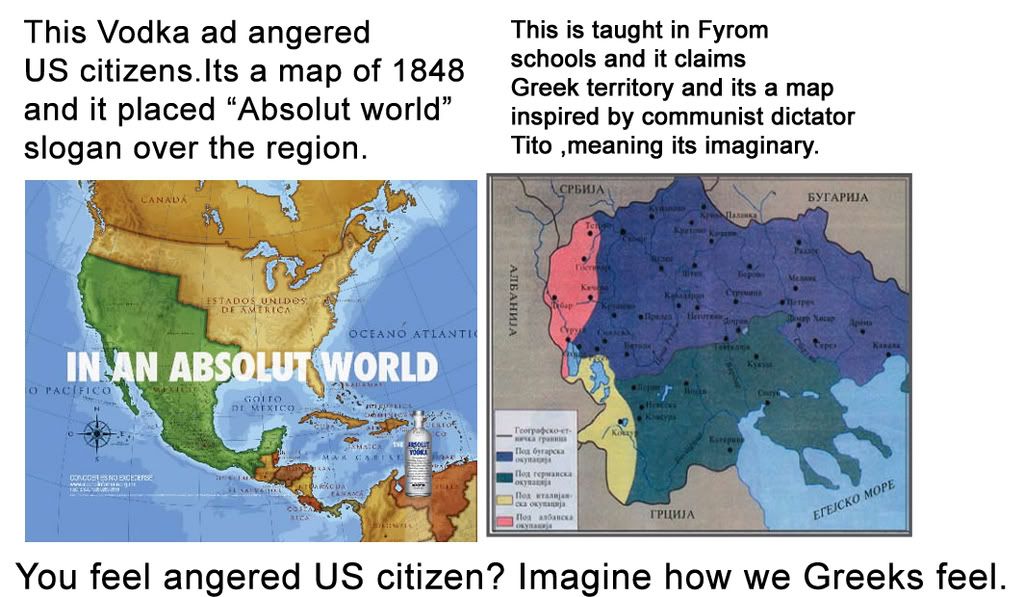
Absolut Truth exposing US Hypocrisy


Greece has been often ridiculed for its insistence that its Slavic neighbors abandon the name 'Macedonia'.

"What is the big deal?" many have asked.
Yet, when an Absolut Vodka ad appeared depicting an early 19th century map showing chunks of the United States as Mexican, most Americans got so upset to the point to boycott the popular drink. If Absolut Vodka has brought such an insult to the USA for a less than 2 centuries old issue, imagine the audacity of FYROM for plagiarizing Greek history and national identity that has stood for over 2000 years.

The Vodka ad was nothing more than a marketing ploy. FYROM, by adapting the name Macedonia, not only have they taken a name that does not reflect their origins, history, or identity but have used the name as a basis to claim parts of Greece as theirs.

The Macedonia issue is not a marketing ploy for Greece to sell products. It is part of its history and identity for over 2000 years and it will not be sold to anyone to accommodate their special interests and malign intentions.

Maybe now the State Department and Ms. Rice can understand why Greece is so adamant about the issue of the name of Macedonia.

source:

Monday, April 07, 2008

Hello Skopje: Who told you the road to NATO always runs through Washington?


7 April 2008 - Issue : 776
(Airgram No. 1)
April 2-4 NATO Summit at Bucharest covered many issues, and much of the world would reasonably argue that the broader discussion of NATO missile defense options, expanded troop deployments to Afghanistan, and NATO's eventual admission of Ukraine and Georgia -- in view of Russian objections -- were far more important that adding three new Balkan members that have been in the pipeline for some time: Albania, Croatia and the Former Yugoslav Republic of Macedonia (FYROM).
Nevertheless, the failure of NATO to agree on FYROM's accession this time around grabbed a few headlines/editorials, while the equally significant admission of Croatia and Albania got almost no attention.Readers have no doubt seen extensive commentary on Greece's leading role in blocking FYROM's accession before its name dispute with Greece has been resolved. It had help of course from other European allies, most notably France. Well done.
Under the smokescreen of competing nationalisms regarding the name issue (which have filled Balkan blog space for nearly as long as it has existed), a key question has surfaced in the last month about why the U.S. has so forcefully led the charge for FYROM's admission. Was the name issue with Greece resolved? Was there a realistic chance for progress?
Were a few hundred Macedonian troops in Afghanistan in Iraq all that were needed to buy a NATO admission chit in Washington? Was FYROM really at the NATO standard in terms of domestic reform? (There is substantial debate about whether FYROM is treating its large Albanian component fairly and allowing equal participation in state and military institutions. Try and find anybody in western FYROM who would argue that these criteria have been met).
From this desk one can conclude that the Bush Administration ignored those issues and focused exclusively on the "L" word. - Legacy. Damn the torpedoes; NATO in its present form exists to deliver a foreign policy "success" for the Bush team, at any cost. We are left with the impression that the callousness of this approach to NATO ally Greece's sensitivities is proof that "business as usual" is the name of the game in the White House and the rapidly emptying State Department.
The Global War on Terror is the only ticket that Skopje believed it had to punch, leaving unresolved its dispute with Greece, since Washington was going to miraculously bully Athens into compliance. Nice try. Did someone forget to tell Skopje about NATO consensus rules?
For the record, it might be useful to quote the text of the key U.S. Government "Airgram" laying out Washington's initial views regarding rumors about a new Macedonian state at he end of WWII (usually longer documents, used alongside telegrams until the 1980's, to circulate policy statements and or reports to/from U.S. embassies abroad).
Haps Borgen


"The Department has noted increasing propaganda rumors and semi-official statements in favor of an autonomous Macedonia, emanating principally from Bulgaria, but also from YugoslavPartisan and other sources, with the implication that Greek territory would be included in the projected state.
This Government (of USA) considers talk of Macedonian "nation", Macedonian "Fatherland", or Macedonian "national consciousness" to be unjustified demagoguery representing no ethnic, nor political reality, and sees in its present revival a possible cloak for aggressive intentions against Greece.
The approved policy of this Government is to oppose any revival of the Macedonian issue as related to Greece. The Greek section of Macedonia is largely inhabited by Greeks, and the Greek people are almost unanimously opposed to the creation of a Macedonian state.
Allegations of serious Greek participation in any such agitation can be assumed to be false.
This Government (of USA) would regard as responsible any Government or group of Gonernments tolerating or encouraging menacing or aggressive acts of "Macedonian forces" against Greece".

STETTINIUS U

Friday, April 04, 2008

Jewish community slams Greek flag insult


The historic Jewish community of Thessaloniki on Thursday issued a statement sharply condemning the recent defacing of the Greek flag in billboards put up in the city of Skopje -- the white Cross on the flag was replaced with a Swastika -- as well as a local magazine's caricature of Greek Prime Minister Costas Karamanlis' dressed as an SS officer.
"The defacing of the national symbol and the attempt to depict the Greek prime minister to a Nazi officer constitute unacceptable actions and an insult to the Greek people as a whole including members of the Jewish Community of Thessaloniki," the statement reads, days after the billboard posters appeared -- and subsequently disappeared -- in the capital of the Former Yugoslav Republic of Macedonia (FYROM).
The statement adds that these actions become more heinous because Greece was among the first countries in Europe to clash with the tide fascism and the first to defeat Axis Forces on the battlefield in WWII, referring to the Albanian front (1940-1941), "where Jewish and Christian Greeks fought side by side."
"Furthermore, the use -- for the sake of creating impressions -- of symbols that are directly linked with the period of the worst crimes committed against humanity is an insult to the memory of the six million victims of the Holocaust and those who survived the horror of the Nazi concentration camps," the statement reads.
"Our Community welcomes the stance adopted by French President Nicolas Sarkozy, a descendant of the Mallah family from Thessaloniki, who backed Greece's positions on the self-evident Greekness of Macedonia," the statement concludes.

Thursday, April 03, 2008

FYROM should not be invited to join NATO


The crucial dinner of NATO member-state leaders has ended in Bucharest. Greek Prime Minister presented the Greek arguments, as per which FYROM should not be invited to join NATO. Meanwhile, as per Reuters, NATO leaders will postpone inviting FYROM (Former Yugoslav Republic of Macedonia) to join NATO. The leaders, who attended today’s dinner concluded that FYROM cannot be invited to join NATO in the present phase as Greece cannot consent to its entry unless the name issue is resolved first.


For your information during the crucial dinner of NATO member-state leaders the NATO members France, Spain, Portugal, Italy, Bulgaria, Luxemburg, Iceland and Germany stand close beside to the Greek position as real NATO allies when ....
USA and Canada followed the Bush dogma “You’re either with us or against us".
Bush administration divide with his policy and the NATO alliance.


Media news sources in Greek
Greece vetoes invitation to FYROM for NATO entry

Greek Prime Minsiter Costas Karamanlis on Wednesday night vetoed a NATO invitation to the Former Yugoslav Republic of Macedonia (FYROM) to join, during an alliance crucial summit in Bucharest.

Addressing the leaders' dinner, which signaled the opening of the summit, Karamanlis outlined Greece's positions on the isuue, underlining that it cannot consent to a FYROM NATO entry invitation if the "name issue" of the former Yugoslav republic is not resolved first.

France, Italy, Spain, Iceland and Luxembourg expressed their support to Greece's positions, while Hungary, Slovakia, Belgium, the Netherlands and Germany viewed with understanding the Greek arguments.

Opposing the Greek position and supporting an invitation without conditions to FYROM, were Turkey, Slovenia, the Czech Republic, Estonia, and Lithuania.

Denmark, Bulgaria, and Norway, although moving in the same direction, were less enthousiastic. Canada, Great Britain and Portugal refrained from taking a stand.

French President Nicolas Sarkozy was the wormest supporter of the Greek positions, who said in his address that "We stand in solidarity with Greeks, we believe that a solution must be found. I have Hungarian roots, but I also have Greek roots and I fully assume them."

During a reception preceding the official dinner, Premier Karamanlis held a brief conversation with U.S. President George W. Bush.

In a related development, NATO spokesman James Appathurai told reporters in Brussels after the end of the Bucharest dinner, that Greece made clear that despite the fact that it wants to see FYROM joining NATO the soonest possible, it is not possible to give its consent as long as the neighbouring republic's "name issue" remains unresolved.

According to an ANA-MPA dispatch from the Belgian capital, Appathurai added that, given Greece's position, efforts for resolving the "name issue" should continue, noting at the same time that all NATO member-states wish for a compromise solution as soon as possible, without this meaning that concrete timeframes have been set.
source:ana-mpa

Tuesday, April 01, 2008

So what if the US gets mad?


By Alexis Papachelas


I must admit to being surprised at US Secretary of State Condoleezza Rice’s recent statement regarding the Macedonia name dispute: “It would be a pity if something that has to do with antiquity were to get in the way of what I think is a very important step for Macedonia and NATO.” It was not the reference to antiquity that surprised me, for I have often heard foreigners being sarcastic about it when discussion turns to the Macedonia dispute, and especially Americans, who detest history and adore simple, practical solutions to diplomatic problems, who break out in hives if you ever try to explain something that is more than five or 10 years old.


What surprised me was Rice’s complete lack of diplomatic tact. After thinking about it for a while, though, I came to the conclusion that it made sense in a way. Greece could depend on Washington’s support provided at least one of three things were true: 1) Washington considered Greece a close partner; 2) The USA really needed Greece to be on its side or shuddered at the thought of more anti-American sentiment being expressed in the country; and 3) The White House was coming under pressure from a very strong lobby.
A sober look at he facts tells us, first of all, that Washington does not feel it has much to gain from Greece. In contrast, it sees Athens playing its own game with Russia and disagreeing with Washington on every open front of international politics.
If the dogma “You’re either with us or against us” is anything to go by, then Greece certainly is not a member of the small USA fan club. The Americans do not need Greece for anything and any rise in anti-American sentiment in Greece is dismissed as being rather silly, even inane.
As far as the lobby is concerned, unfortunately that disappeared years ago. The present-day American archbishop, a wise and respectable man, bore the brunt of President George W. Bush’s sarcasm in the past when he brought up the name dispute. The lobby no longer exists and it poses a threat to no one.
When the Greek government decided to persist in its efforts to link a settlement of the name dispute with FYROM’s NATO bid, some said that Washington would eventually support Greece’s position, but that has not happened.
Greece must finally come to terms with the fact that America is not, in cold geopolitical terms, “our friend” in the name dispute. It is, in fact, very likely that at the summit in Bucharest the Greek prime minister will be facing a tough adversary in the US. And this will be when we will all have to reflect upon the other aspect of Greek-American relations, the one in which Greece, a European country with its own interests, has nothing to fear from American displeasure. Just as they don’t need us, so we don’t need to worry about them getting angry.
source: ekathimerini