Saturday, May 25, 2013


Thursday, April 25, 2013
Why Austerity Is a Dangerous Idea

The current debt
and deficit panic is nothing new. It’s been a staple of American politics since
the Republic’s inception. But this season it has taken a new turn. Congress, the fiscal arm of the government,
is engaged in asymmetric siege warfare. On one side the Republicans want only
cuts, on the other the Democrats want both cuts and tax increases. Both agree
however that cuts are absolutely necessary; the only question is the timing and
magnitude involved. Unfortunately, budget cuts are exactly the wrong thing to
do at this moment. And before anyone throws up their hands and says “Keynesian
claptrap,” there is nothing necessarily Keynesian in what I am about to say.
Simple logic and arithmetic will suffice.
Austerity, the policy of cutting state
spending to solve debt and growth problems, sells itself to us through a
strange combination of morality and seduction. Its moral claim lies in the love
of parsimony over prodigality that characterizes economic thought from Adam
Smith onward. In this morality play, saving leads to....
Saturday, March 16, 2013
TWIN EXPLOSION: The Current Debt System has Reached it’s Expiration Date

Surplus countries of the Euro-zone do not seem willing to either limit their excessive surpluses (by increasing the wages of their employees, so that domestic demand will increase), or to transfer «resources» to the members running a deficit, nor are they willing to «mutualize» public debt, or allow the transformation of the ECB into an actual central bank of the Euro-zone (Euro-bonds, direct purchasing of bonds from member states etc.).
As a result, the vicious cycle of banks «rescuing» states and, later on, states rescuing banks will perpetuate – thereby....
Monday, January 14, 2013
The Advent of Berlin (Part 2 of 2)

NEO-MERCANTILISM
Mercantilism was ultimately
rejected by the liberal and British Adam Smith, who also refused to wade into
monetary policy – believing that products, people and institutions constitute
the foundations, on which general well-being can be built on peacefully, and
under conditions of freedom and democracy.However, many economists believed
that mercantilism, in some cases, is not erroneous.
The most important among
them was J.M. Keynes, who incorporated some elements of mercantilism in his
theory – stating that the money supply, the foreign trade balance and prime
interest rates are very important for an economy (believes that where later
used to set the grounds for modern monetarism).
Adam Smith rejected the sole
focus on production mercantilists thought to be the key – believing that
consumption is the only way to develop an economy. In contrast, Keynes
considered both the production and the consumption as being equally important
for economic growth – recognizing also, that...
Friday, December 28, 2012
The Advent of Berlin (Part 1 of 2)

‘’In broad terms, the swift attack against a nation and the instantaneous prevalence, keeps the environment under control and paralyzes or overwhelms the opponent’s senses, affecting one’s ability to understand the facts. The purpose of the method «shock and awe», is to make the opponent completely unable to function – let alone resist’’.
‘’Mercantilism is a centralized, systematic economic policy, where government revenues are necessary for the maintenance of a costly state power, and the functioning of its expansionistic character. Its key elements are:
Monday, November 26, 2012
EXCEPTIONAL REASONING

To vote on austerity measures equal to 11.5 Billion, while taking on
bank debts of 49 Billion Euros is rather silly – although silence is what
justifies the collective submission of a nation that was once proud.
“Exploding debt in 2012 at 340.6 Billion Euros,
compared to an initial estimation of 316 Billion Euros; these numbers where revealed by the Greek Statistical Authority
(ELSTAT) and the General Accounting Office to Eurostat, during the interim
Excessive Deficit Procedure.
The same data show that the deficit for the year 2012
is expected to be around 13.4 Billion Euros, a target level that will most likely be achieved through heavy public
spending cuts. Specifically, from a central government perspective, the
deficit target is set at 11.4 Billion Euros.
GDP is also projected to decline to 194.7 Billion
Euros, from approximately 232 Billion Euros (the GDP before the ΄΄invasion΄΄ of the IMF in
Greece).
Furthermore, according to data of.....
Tuesday, November 06, 2012
Greece flirts with tyranny and Europe looks away

Nick Cohen
Tuesday, October 02, 2012
Austerity has never worked
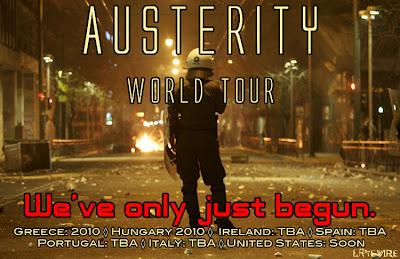
Last week saw a string of bad economic news reports. The eurozone leaders seem unwilling or unable to change from their austerity policies, even as Greece and Spain fall apart and the core eurozone economies contract. Britain watches on as its economy is heading for the third consecutive quarter of contraction, with an unexpectedly sharp fall in manufacturing. Last week's jobs figures confirmed that the US recovery is stuttering. The largest developing economies that have so far provided some support for world demand levels – especially India and Brazil but even China – are slowing down too. Four years after the financial crisis began, many...
Wednesday, May 30, 2012
Money's Troika goes to the Banks and not to Greece!!!
 Its membership in the
euro currency union hanging in the
balance, Greece continues to receive billions of euros in emergency assistance
from a so-called troika of lenders overseeing its bailout.
Its membership in the
euro currency union hanging in the
balance, Greece continues to receive billions of euros in emergency assistance
from a so-called troika of lenders overseeing its bailout.But almost none of the money is going to the Greek government to pay for vital public services. Instead, it is flowing directly back into the troika’s pockets.
The European bailout of 130 billion euros ($163.4 billion) that was supposed to buy time for Greece is mainly servicing only the interest on the country’s debt — while the Greek economy continues to struggle.
More in the NYT.
Thursday, May 10, 2012
How a Radical Greek Rescue Plan Fell Short

10 May 2010
WSJ
ATHENS—Two years after Europe bailed Greece out to protect the euro, the rescue has become a debacle that threatens to unravel the common currency.
After Greece's May 6 elections left pro-bailout parties too weakened to govern the country, more elections are likely in June, with no guarantee a stable government will emerge. By next month, Athens must identify €11.5 billion, or $15 billion, in fresh spending cuts or face suspension of the international loans it needs to pay pensions and run schools. If it doesn't get the money, it would eventually have to print its own.
Greece's growing turmoil is the culmination of a radical austerity experiment and botched economic overhaul that have pushed the nation to the brink of social and political breakdown. The story of the ill-fated bailout suggests that forcing deep austerity on individual member states won't save the euro and may worsen its crisis.
Above all, Greece's example illustrates the...
Wednesday, May 09, 2012
Those Revolting Europeans

By PAUL KRUGMAN
The French are revolting. The Greeks, too. And it’s
about time.
Both countries held elections Sunday that were in effect referendums on the current
European economic strategy, and in both countries voters turned two thumbs
down. It’s far from clear how soon the votes will lead to changes in actual
policy, but time is clearly running out for the strategy of recovery through
austerity — and that’s a good thing.
Needless to say, that’s not what you heard from the usual
suspects in the run-up to the elections. It was actually kind of funny to see
the apostles of orthodoxy trying to portray the cautious, mild-mannered François Hollande as
a figure of menace. He is “rather dangerous,” declared The Economist, which
observed that...
Tuesday, April 24, 2012
Monday, April 02, 2012
Resistance to austerity stirs in southern Europe

An unexpectedly broad general strike in Spain on Thursday and mounting opposition to Prime Minister Mario Monti in Italy are among indicators that resistance is growing in a region at the center of concerns about a resurgence of the euro zone debt crisis.
Portugal remains very subdued for the moment and even Greece, scene of repeated violent street protests, has quietened recently. But there are signals that political leaders will soon be directly in the firing line across Europe, especially if more cuts are required to reduce sovereign debt.
The atmosphere seems a combination of two opposite tendencies - acceptance of the message that deep cuts are the only way to save their countries from economic catastrophe, and a mounting feeling that greater pain cannot be borne by populations suffering deprivation and misery.
The problem for politicians like...
Thursday, March 22, 2012

Wednesday, March 14, 2012
Save the Greeks from their Saviors!
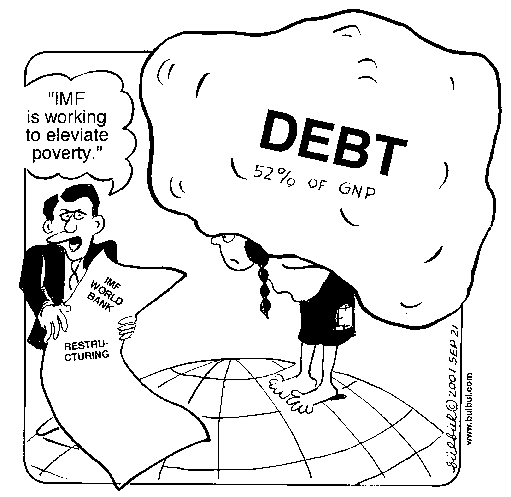
by Alain Badiou, Jean-Christophe Bailly, Étienne Balibar, Claire Denis, Jean-Luc Nancy, Jacques Ranciere, Avital Ronell
At a time when one Greek youth out of two is unemployed. Where 25,000 homeless wander the streets of Athens. Where 30% of the population has fallen under the poverty line and where millions of families are forced to place their children in the care of someone else in order for them not to die of hunger or cold, where refugees and the new poor compete for trashcans at the public dump, the “saviors” of Greece, under the pretext that “Greece is not trying hard enough”, impose a new aid plan that doubles the lethal administered dose. A plan that abolishes the right to work and reduces the poor to the most extreme misery, at the same time as it makes the middle class disappear.
The goal is not about “saving” Greece. All economists worthy of this name agree on this point. It’s about gaining time in order to save the creditors at the same time it leads the country into deferred collapse. Above all it’s about making a...
Friday, March 09, 2012
Social and Human Costs from the Troika program

One of the biggest and worst social costs of the current program is the enormous loss of jobs. As noted above, unemployment hit a record 20.9 percent in November.[At the present the record is 21%] By 2016 it is still projected to be at 17 percent, far above the 7.7 percent pre-crisis level, and a level that is generally seen as a national tragedy.[10]
Another way to see these losses is to look at employment. Figure 3 [see the picture on the left] shows employment as a percentage of the working age population. By 2011 it had fallen to below its level of 1994, almost six percentage points below its 2008 peak.
The government has committed to cut 150,000 jobs from public employment for 2010-2015, about 22 percent of public employment. The IMF notes that:
Tuesday, February 28, 2012
You can blame the Greeks – but they have been betrayed by their leaders
Shocking examples of kleptocracy by the political elite explain the ferocity of the reaction. And it is this which has repercussions for the rest of Europe.
Thieves! Thieves!" cry the protesters outside the Greek parliament in Syntagma Square, although thief is not the most colourful allegation being levelled at the Greek ruling class.
The scenes are now familiar to TV viewers across the world: the angry banners, the scuffles or sometimes more serious violence, the petrol bombs and tear gas, the world's media, including battle-tested war reporters, descending.
The latest wave of Hellenic protesters call itself Aganaktismenoi, in the spirit of the Spanish indignados, a broad-based and non-party-political movement. The silent majority is, at last, finding a voice. Around me, in Athens, the fear, outrage, despair are palpable. But there is also a profound sense of bewilderment at a situation from which there appears no escape, and to which the only response is a call for more economic pain made by some of the same people who created the fiasco.
How did it come to this? How fair is this charge of "Thieves"? Did Greek politicians simply loot their own country, and EU taxpayers, for personal gain? There is truth in this tale, but...
Sunday, February 19, 2012
Liberal Democracy dying in Greece and in EU

Today, Greek society is suffering both from the crisis and the responses to it, which have reached a dead-end. Major social and political institutions that were created with enormous struggles and sacrifices in post-War Greece – social security, the public health care system, public education, public transport, the natural and urban environment, the right to live a safe existence, and various elemental goods and services that underwrite the very existence of an already curtailed and devalued Greek state – are all being utterly dismantled so that Greek society is now dying of asphyxiation.
Troika(IMF, ECB and German EU leadership "Frau Nein" Angela Merkel and "Baron Austerity" Wolfgang Schäuble), are the main architects of Europe’s disastrous mismanagement of the euro-zone debt crisis, can keep pretending that harsher doses of fiscal austerity will restore Greece and Europe’s other troubled debtors to economic health. These dead-end responses rest on the blackmailing dilemma: austerity or hard default? Yet, this is hardly a dilemma – it is rather a negative aggregate: both austerity and hard default. The tri-monthly threat to expel Greece from the Eurozone constitutes an ethical alienation and an economic catastrophe, precisely because it strengthens the profound recession, turning the whole of Europe into an agent of uncertainty, financial instability, and...
Friday, February 17, 2012
What Europe loses if Greece is forced out
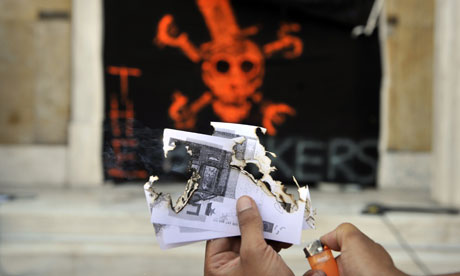
Guardian UK/Kathimerini GR
Germany should look to its past and ensure that Greece does not face a humiliating exit from the eurozone.
Many in Europe – particularly in Germany – wonder why they should continue providing financial support to a country that has failed to honour its commitments to its partners; a state which is an international laggard in all major indicators, including competitiveness, innovation and transparency. Such objections are understandable but mistaken. Europe stands to lose as much as Greece itself from an exit of the latter from the eurozone.
It is not just the spreading of the virus of uncertainty to the other countries of Europe's southern periphery, the repercussions on the northern European economies and the impact on...
Wednesday, February 15, 2012
German Twin: "Frau Nein" and "Baron Austerity"

"Frau Nein" and "Baron Austerity", are the main architect of Europe’s disastrous mismanagement of the euro-zone debt crisis, can keep pretending that harsher doses of fiscal austerity will restore Greece and Europe’s other troubled debtors to economic health. They can recognize that only a combination of greater fiscal breathing room and pro-growth reforms — like opening up closed labor markets, breaking up state monopolies and streamlining bureaucracies — can achieve the desired result. But slashing wages, jobs and public spending across the board, as Europe demands, will only deepen recession.
The irony is that the leading architect of the austerity programme in Greece, the IMF senior employee Poul Thomsen has admitted that...
Subscribe to:
Posts (Atom)