Monday, December 08, 2008

COMMUNISM’s PIVOTAL ROLE IN THE “MACEDONIAN” ETHNOGENESIS

by  George C. Papavizas

When I was thirteen years old I asked my grandfather Constantine why he had joined the Greek andartes (freedom fighters) in Macedonia in 1904-1908 during the Macedonian Struggle and fought against the armed Slavic bands (komitadjides, committee men) of the clandestine Bulgarian Komitet " Internal Macedonian Revolutionary Organization" (IMRO) (Vatreshna Makedonska Revolutsionna Organizacija, VMRO in Skopje). Looking at me straight in the eyes for a long time in silence, twirling his long moustache, his sixty-year-old weather-beaten face furrowed in deep pain because of the distortion of historical facts on Macedonia emanating from the Slavic north, he said softly: "To make certain that after the Turks, our Macedonia remains Hellenic and my children and grandchildren enjoy freedom as Hellinomakedones"(Greek Macedonians). He died of pneumonia at sixty, leaving behind a deep feeling of patriotism for all and an indelible, life-long Hellenic Macedonian legacy that has had a major impact on me, his first grandson.

Sixty years later I was at my son´s house for Thanksgiving dinner. Before I sat down, my eight-year-old grandson, Aidan, ran to me and brandished the Scholastic Atlas of the World, published by Miles Kelly Publishing Ltd. in England. He proudly demonstrated his geography skills by naming several countries around the world, leaving his best at the end, the map of Greece. He looked at it for a few seconds, placed his finger on the word "Macedonia," looked at me with his intelligent blue eyes, and said: Here Papou (grandfather); I know where Macedonia is, where you were born." Suddenly, he looked at me again and said disappointed: "But you told me you were born in Macedonia, Greece."

I was not surprised that the word "Macedonia" was not on Hellenic Macedonia, but on Vardarska Banovina (also known as Vardar Province, or South Serbia), a small country beyond Greece´s northern frontier. It was not the first time that my Macedonia, the only one that existed when I was born, was not shown on the map. The publisher did not bother to place the word "Macedonia" on Hellenic Macedonia, which occupies 75% of King Philip´s historic Macedonia. I left by son´s house angry with myself for having become apathetic to my Hellenic Macedonian legacy bequeathed to me by my grandfather, suddenly revived by my grandson. Because I have learned all my life to attribute the written word with more weight than the spoken one (verba volant, scripta manent), I decided there and then to write about a plundered Macedonian legacy; how the international community has been ensnared in clever political-historical inaccuracies on the Macedonian issue, emanated or broadcast from capitals behind the Iron Curtain in the past; from free capitals north of the Greek frontier now; and how Greece´s northern neighbors, have been striving to convince the world to recognize their small break-away republic with a name that belongs to my children´s and grandchildren´s Macedonian legacy.

Why is the name "Macedonia" so important?

Because it carries along important derivatives, far beyond what it says: history, identity, heritage, culture, heroes, customs, traditions, etc. It carries "Ghosts or real historical demons. Perhaps war or peace. Nothing and everything," wrote Leslie H. Gelb in The New York Times June 12, 1992. The name, of course, is Macedonia, the land of Philip, Alexander and Aristotle; the beautiful land with Mount Olympus and the Greek Gods. The rich land east and west of the bustling city of Thessaloniki with the archaeological sites of an age long gone, the Hellenic Macedonian age: Pella, Vergina (Aegae), Dion, Amphipolis, Methone, Pydna, Olynthos, Orestis, Appolonia, Philippi, Potidaea, Stagira (Aristotle´s birthplace), Thessaloniki. Do any of these historical city names sound Slavic to the reader?

Because people around the world, after communism was entrenched in the Balkans, dispute the Hellenism of the ancient Macedonians who lived in these cities; and because the words "Macedonia" and "Macedonians" are both perceived and used nowadays as propulsive forces to create and sustain — with heavy-handedness — a new ethnic model with the name "Macedonia", forcefully embedded within the glorious Macedonian past, it is important that we understand the meaning of the so-called Macedonian Question (and the struggle for Macedonia). What was the Macedonian Question? From 1870 to 1918, it was the problem of who had the historical, cultural, ethnic, and demographic rights to rule Macedonia following the simmering demise of the Ottoman Empire. The problem triggered a political and military struggle under the Turks between Hellenism and Bulgarism, two ideas — and two forces that fought embodied as Greeks and Bulgarians — not as Greeks and "Macedonians". From 1870 to 1943, Bulgarism represented Slavism, not Macedonianism. The Slavic Macedonianism was not known as an independent ethnic concept. It was borne in the early 1940s. Bulgaria lost the struggle because it disregarded Hellenism´s deep roots in Macedonia.

With the onset of communism in the Balkans, the Macedonian Question — and the struggle for Macedonia — took on a different meaning and dangerous new dimensions. At the risk of being considered a polemic anticommunist, I must now lay considerable stress on international communism being greatly responsible for the revival and perpetuation of the Macedonian controversy since the early 1920s. And here is how and why: As early as 1921, the Soviets had inaugurated a policy, conceived by Leon Trotsky and commissar Dimitri Manuilski, to accomplish a Balkan fragmentation. The Sixth Congress of the Balkan Communist Federation under the leadership of the Bulgarian communist Kolarov and the Fifth Congress of Comintern (Communist International), an adjunct of the Soviet foreign policy, held concurrently in Moscow in 1923, voted for the formation of an "Autonomous and Independent Macedonia and Thrace."

The pre-Tito Yugoslav communist leaders, who voted against the Soviet plan, were not ready to embrace the idea of a separate Macedonian nation, insisting that the inhabitants of the Vardar Province "lacked a clearly defined national Macedonian character of their own." Ironically, it was Tito later who used the label "Macedonian" to create the new nationality, contrasting his "Macedonians" with the Greeks, Serbs, and Bulgarians.

The communist state-controlled "Macedonian" ethnogenesis began in earnest on August 1, 1941 with Comintern, Stalin´s right-hand-instrument, dispatching the following directive to the Bulgarian and Yugoslav communist leaders (from Tsola Dragojceva, 1979): Macedonia must be attached to Yugoslavia for practical reasons and for the sake of expediency. The two parties must take up the stand of the self-determination of the Macedonian people." Ignoring Greece, Comintern decisively shifted the burden and responsibility of how to contact the struggle for Macedonia from Bulgaria to Yugoslavia and ruled for an "Independent Macedonia and Thrace" under Yugoslav hegemony. But it is doubtful that the Yugoslav and Bulgarian communists ever deluded themselves into believing they were fighting on history´s right side.

It was the Comintern directive that signaled the second phase of the Macedonian Question. For the 1940s, it was the competing claims by Greece´s communist neighbors for Hellenic Macedonia. The Bulgarians first, and the Yugoslavs later, have used every means available to them to violate the Treaty of Bucharest (signed in 1913): seditious propaganda, distortion of history, anthropological and historical studies of dubious or prejudiced nature that never considered the existence of millions of Greek Macedonians; and, indirectly, civil war (aiding the Greek communists during the civil war of 1946-1949). Greek Macedonia was ravaged during the civil war, fomented and fueled by communist Albania, communist Bulgaria and especially communist Yugoslavia to which Skopje belonged.

It was not a coincidence that the revival of the Macedonian controversy went hand in hand with communism´s genesis in the Balkans. Any doubts concerning communism´s forceful involvement with the problem would have been dissipated early in the game were it known that Comintern was involved from its early inception with the Macedonian Question.

In spite of overwhelming evidence of international communism´s involvement with the Greek Civil War of 1946-1949, most historians disregard altogether the important connection of the civil war´s destinies with those of Macedonia´s fate. Most of the modern authors who write in English do not even mention the Greek Civil War. They also neglect to mention how the Macedonian controversy was exploited by Soviet-sponsored communism to propel into the world the unhistorical concept that the Slavs, Albanians, and Bulgarians of Tito´s Socialist Republic of Macedonia were the only legitimate "Macedonians." The connection of the two issues did not escape the attention of the historian Evangelos Kofos (1995) who wrote: ". . . . the fate of Macedonia and the course of the [communist] revolution in Greece — would converge, interact, and shape the destinies of both."

My new book, CLAIMING MACEDONIA: The Struggle for the Heritage, Territory and Name of the Historic Hellenic Land, is a debate about the Macedonian history and legacy, and its plundering by the early dynamism and the theoretical base of international communism, with the Soviet Union looming awesome behind the scenes. It is the "antidote to historical illiteracy" (from TIME, July 2006) on Macedonia, especially during the period from the early 1920s to the late 1940s. Specifically, it shows the misconceptions pertaining to the fabricated legacy of Macedonia´s past, as promulgated by international communism; analyzes communism´s pivotal role in fueling the Greek Civil War and the Macedonian controversy; and emphasizes the infrastructure of the Macedonian controversy and the part of Macedonian history that now lies in dead communism´s shadow and in Tito´s defunct socialist imperialism. The critical role played by Yugoslav communism in the struggle for Macedonia, especially during the Greek Civil War, did not escape the attention of Ivo Banak, professor of history at Yale, who wrote in 1992: "only communism could provide the theoretical base and the necessary force to push for a separate "Macedonian nation."

Looking now at this backdrop from a cool historical perspective, we must ask: How did Tito and Yugoslavia manage to create a new ethnicity from a polyglot conglomerate of Slavs, Bulgarians, Albanians, Romanians, gypsies, Turks, and others and convince the world that his methods and reasons for forging a new nationality were internationally sanctionable?

The answer to these questions is simple: Using Stalin´s advice (or directive?) how to form a new nation, Tito created a "Macedonian nation" in three steps and in such a clever way that the world, including Greece next door, did not question the deeds of the World War II hero while the war was going on in Europe: First, Tito converted a part of Vardar Province to People´s Republic of Macedonia within the Yugoslav federation, using the geographic name "Macedonia" as an ethnic name; second, he created an artificial nationality by transforming the Slavs of the new republic to "Macedonians." and third, he gave the people in the new republic a new language by modifying their Bulgarian dialect and calling it "Macedonian;"

In contrast to Alexander´s language which had a Greek alphabet, the language spoken in Skopje did not have an alphabet before 1945. Tito commissioned the linguist Blaze Koneski who modified the Serbian version of the Cyrillic alphabet and called it "Macedonian alphabet." He then cleansed the language of specific Bulgarian glossic elements betraying their Bulgarian origin, replacing them by "Macedonian" neologisms; and fabricated the lexicon of the new language from a mixture of words from the Bulgarian, Serb, Croat, Slovenian and other Slavonic languages. The new artificial mixture is now called "Macedonian language."

With the Germans still in Yugoslavia, the first Anti-Fascist Assembly of National Liberation of Macedonia (ASNOM) at the monastery of Prohor Pcinjsky gave the final thrust to Tito´s grandiose plans for a unified Macedonia under Yugoslavia´s hegemony by proclaiming "Macedonia as a federated state in the Democratic Federation of Yugoslavia" and declaring: 
"You [the "Macedonians"] will succeed to unite all parts of Macedonia that the Balkan imperialists [Bulgarians, Greek, Serbs] occupied in 1913 and 1918." With these words, the Macedonian Question was revived stronger than ever, with the struggle for Macedonia assuming dangerous dimensions for the stability of the Balkans."

Let us now talk briefly about the crude communist manipulations to achieve the conversion. Ethnologically, the new republic was always a fluid country inhabited by several ideologically contentious groups with ties to Albania, Bulgaria, or Serbia. The 1940 official Yugoslav census recognized only two ethnic groups in the Vardar Province, Slavs at 66 percent and Muslims at 31 percent. In 1946, three years after the formation of the People´s Republic of Macedonia, the Slavs magically disappeared from the census that showed 66 percent "Macedonians." Was this remarkable transformation process a massive genetic mutation of the Slavic population or a census falsification?

Giorgi Dimitrov, the Bulgarian communist leader, upset with Tito´s manipulations and imperialism, wrote in his diary:
 "Are we talking about a Macedonian nation or a Macedonian population made up of Bulgarians, Greeks, and Serbs? Does a Macedonian nation exist, and if so, where and how? Can Macedonia exist as a separate state or find freedom and statehood within the South Slav federation, regardless of the ethnic conglomerate of which it is composed" ? 
(Kouzinopoulos 1999, from Dimitrov´s secret Diary, p. 21)

Dimitrov wrote on the same page: 
"Tito´s interest and the interest of the [Skopjan] chauvinists focuses not only on Pirin Macedonia . . . . but also on the Aegean Macedonia, i.e., Greek Macedonia, and the Aegean Sea."

Now, let us return to Stalin. What was his advice (or I should say directive?) on how to create a "Macedonian Nation?" Stalin met with Soviet, Yugoslav and Bulgarian leaders. When Dimitrov expressed additional doubts on the Macedonianism of the Vardar Province´s inhabitants, Stalin rushed to explain to him how state building—even if it is a fabrication—leads to acceptable nation building. His remarks to Dimitrov on nation building were revealing indeed:

Pirin Macedonia must become autonomous within a South Slav Federation.¼ Whether there is a Macedonian nation or not, and whether its population has not yet developed a Macedonian consciousness, makes no difference. Such consciousness did not exist in Byelorussia either when, after the October revolution, we proclaimed it as a Soviet republic.

In spite of Stalin´s admiration for Tito (before the split), the Soviet leader became enraged with the Yugoslav leadership´s irredentist plans. On January 10, 1945, Stalin characterized as ill-advised Tito´s efforts to incorporate into Yugoslavia not only the Greek Macedonia, but also Albania, and slices from Austria and Hungary. "I do not like their [Yugoslav] behavior . . . . they do not understand in Belgrade." (Dimitrov´s Diary, p. 22).

I have now a few serious conceptual questions on the history of the Slavic society lying in the shadow of Tito´s dead imperialism and in Comintern´s manipulations and intrigue. First, what characteristics (historical, cultural, genetic, linguistic, ethnic, or anthropological) do the people of the Socialist Republic of Macedonia (now FYROM) possess to be described as "Macedonians by communist first?" Second, if the slavophones in the Socialist Republic of Macedonia were really Macedonians, why did they not assert their Macedonian identity before a communist dictator officially transformed them to "Macedonians?" And third, what are the indigenous Greek-speaking inhabitants of Greek Macedonia whose forebears always lived in Macedonia, and whose Macedonian history, civilization, culture, myths, heroes, language, all go back for countless generations? Or to put it in a different context: Which of the two groups, Hellenes or Slavs in Macedonia, is historically, culturally, linguistically, and ethnically more likely to be identified as Macedonian?

To put the state-controlled "Macedonian" ethnogenesis in proper perspective, we also need to go back to 1870 and trace the origin and sentiments of the FYROM slavophones. They underwent several transformations before their final ethnic conversion to "Macedonians": They were Bulgarians from 1870 to 1913; South Slavs or serbianized Slavs from 1913 till the German army occupied Yugoslavia in 1941; Bulgarians again proudly brandishing Bulgarian flags during the occupation of South Serbia by the fascist Bulgarian army (a Hitler gift to Bulgaria for joining Nazi Germany during World War II); Yugoslav communist partisans during the occupation; and then communist "Macedonians" by 1943 with new roots, history and language;

Upon the passing of Tito´s epoch, centered as it was on the "inherent megalomaniac charisma of a single man," they finally became reformed communist "Macedonians" in FYROM, harboring irredentist aspirations at their neighbors´ expense; hanging maps on school walls depicting Greek Macedonia occupied by Greece, a powerful irredentist stimulus and a violation of the Interim Accord; inculcating in the young´s minds the idea to hate the Greeks; revising their original constitution to include an appeal to the slavophones of Greece to continue their struggle for union with Skopje, an inclusion implying a camouflaged threat against Greece´s territorial integrity; circulating in FYROM and abroad maps depicting "Greater Macedonia" with slices of eastern Albania, southwestern Bulgaria, and northern Greece (equal to 1/4 of the Greek mainland, including Thessaloniki); or demanding on the Internet that Greek Macedonia be returned to its proper owner! The post-1991 situation in FYROM with the school maps and other pronouncements has created dangerous nationalistic ideas in young generations that have been exposed to the education system established by the reformed communist leaders following FYROM´s independence in 1991.

Considering all the facts, including the ethnic transformations, and the aggressive propaganda by Skopje and the Slavic diaspora, history has now reached the absurd and untenable points where a small mountainous enclave calling itself "Republic of Macedonia" may not only demand — by the power of its apprehended name— to be a Macedonia, but the only Macedonia; and its Slavic people may not only demand — by the power granted to them by a dictator — to be some Macedonians, but the only Macedonians.

After all these happenings, the Macedonian Question is no longer seen as a question. It has become a clever and deliberate attempt to absorb slowly, but surely, everything that belongs to a neighbor: a complete sweep of historical and archaeological values and a destruction of the neighbor´s identity and pride.

Calling the inhabitants of FYROM "Macedonians," complying with their unhistorical demands, will automatically deprive three million Hellenic Macedonians, half of whom are indigenous Hellenic Macedonians, of their Macedonian name and identity. This serious argument has nothing to do with the glorious Macedonian kings, the ancient Macedonian Hellenism, the 3,000 years of Macedonian history, or the Hellenistic Era. It has to do with the fact that the FYROM Slavs monopolize a name that people next door are using for ages. It has a lot to do with the Hellenic Macedonian´s identity arbitrarily being transferred to the FYROM Slavs fifteen years ago. It has also to do with the fact that a country (FYROM) that forms a small part of a larger whole country — less than15% of Philip´s historic Macedonia — portrays itself as representing the entire Macedonia. To quote a phrase from the book Macedonia, a Greek Term in Modern Usage (published in 2005 by the Museum of the Macedonian Struggle Foundation), "At a time when regions in Europe are searching for and pushing their distinctive identities to the fore, how can it be possible for the Greek Macedonians to lose theirs?" The Greek people must realize, if they have not done so already, that manipulations in politics, domestic and foreign, weigh heavier than the glorious historical pages of the Macedonian history and the Hellenic Macedonian romantic nationalism.

FYROM´s dogma proclaims now on all levels — political, scientific, educational, diplomatic, media — that the entire geographic area of Macedonia, down to Mount Olympus, constitutes "ethnic Macedonian territory," the homeland of the "Macedonian nation," which was unfairly partitioned in 1913 with the Treaty of Bucharest; and the homeland of the "Macedonian" people who consider the Greeks and Bulgarians as foreigners. Unfortunately, the official Greek side has not cleverly used these arguments to justify the legitimate position why Greece possesses an age-old de facto right on the name "Macedonian" and its derivatives. "Who steals my purse steals trash; but he that filches from me my good name robs of that which not enriches him, and makes me poor indeed."

Why does Skopje insist on maintaining the simple name "Republic of Macedonia," despite the fact it occupies less than 15% of historic Macedonia?
 Why did FYROM reject Matthew Nimetz´s 2005 proposal for the name Republic of Macedonia-Skopje, tentatively accepted by the Greek government as a basis for further negotiations

Nimetz, the U.N. mediator, included the following in his report to the U. N .Council. "... the name "Macedonia" has importance to a long association with the heritage, culture and history of the Hellenic Republic and Hellenic people since antiquity; "Macedonia" is a name commonly used to refer to a region of northern Greece, and that the people of that region, within the Hellenic Republic, customarily are referred to as "Macedonians." . . . Skopje must acknowledge that there is a region in Greece named "Greek Macedonia" [and not "Aegean Macedonia" or Egejska Makedonija)." 

Is it the fact that Nimetz bluntly told the Skopjans of the existence of another, older and larger Macedonia, the Hellenic Macedonia, that forced them to reject his proposed name? 
Or is it because FYROM intends to adhere to a name that does not include restrictive qualifiers which will imply extirpation of Skopje´s dreams for future territorial expansion?

It Greece were to succumb to pressure by friends and foes alike and accept the neighbor with the name "Macedonia," it would automatically condone Skopje´s aspirations, tacitly legitimizing its expansionist dreams, transforming the new state into a future territorial threat to one of Greece´s most precious territories. Granting the name "Macedonia" to Skopje would also imply future rights on the entire geographic Macedonia, thus giving the power to the new state to raise claims on a much wider territory with the name "Macedonia" and all its derivatives. Adoption of the name "Macedonia" by Skopje constitutes another equally serious threat to Greece, a threat to its national identity and cultural heritage. What does that mean? It means that monopolizing the name inadvertently will lead to a Slavic monopoly of everything Macedonian: history, civilization, culture, identity, heroes, customs, symbols, arts, traditions. Failing to preserve the cultural-historical heritage is tantamount for Greece to failing to keep alive what I call in my new book, The power of Hellenic Macedonian ethnic identity, culture, and pride, three tenets (or expression if you will) defining Macedonian Hellenism.

Pushed into a difficult corner in the midst of the international Macedonian controversy, Greece must find it hard to forgive the disappointing stance of its friends and allies, who sanctioned the use of the name "Macedonia" by the small republic. The irony of the U.S. policy is that it assisted Greece to protect its territory in the 1940s, and thwart Tito´s and Stalin´s irredentist aspirations; and then, forgetting the rivers of blood spilled by the Greek people to thwart communism´s advance, turned around and recognized as "Macedonians" the people against whom Greece was fighting with America´s help to preserve its territorial integrity during the Greek Civil War.

Equally paradoxical is the fact that when the political and military pendulum swung in the opposite direction after Greece successfully repulsed Soviet-sponsored communism and prevented it from reaching the Aegean, Greece became the aggressor in the eyes of the West, as if Greece were the guilty party that usurped its neighbor´s name and assumed an identity that belonged to another country; as if Greece were the country that appropriated a foreign emblem to decorate its flag; as if Greece were the country with an irredentist constitution, claiming territories right and left, north and south; as if Greece demanded in its constitution that half of FYROM return to Greece because in the past it belonged to Philip´s and Alexander´s Macedonia.

With these perspectives in mind, the insistence of FYROM Slavs to be called "Macedonians," a name dictatorially established and supported by communism´s brutal force and theoretical base sixty years ago, clashes with the Hellenic Macedonians´ right of always being Macedonians. If FYROM considers itself Macedonia, an audaciously daring step that brings the origin of its Slavic inhabitants close to Philip and Alexander the Great, then the insistence of these contemporary people to be called "Macedonians" clashes head on with the age-old freedom of others to be called "Macedonians." FYROM has the right to survive and prosper, but according to the Academy of Athens, it does not have the right to acquire, by international recognition, an advantage enjoyed by no other state in the world: to use a name which of itself propagandizes territorial aspirations.

The Pan-Macedonian Association of America, Sixty Years of Activity.

Sunday, December 07, 2008

Information Campaign To Stop “UMD and her promoting false historical revisionism" , Now On Friday January 2nd


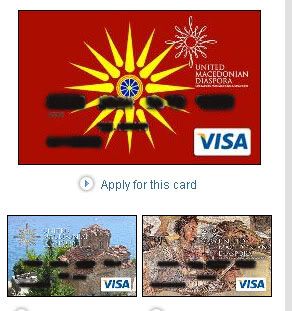
As you may know, the “United Macedonian Diaspora UMD” is a lobby for the irredentist and fascistic Skopje government, and it has mislead CardPartner Inc and CardPartner Visa affinity credit card program into misusing the Star of Vergina that belongs to Greece and is protected by the WIPO (World Intellectual Property Organization) .

We urge you all to mobilize your constituents to attend a national information campaign on January 02, 2009 at 12:00 noon to be held outside the offices of CardPartner, Inc., 37 West 20th St., New York, NY (Between 5th Ave. and 6th Ave)

It is imperative that we send a clear and powerful message to CardPartner Inc. and to all Americans,that we oppose the anti-Hellenic lobby “United Macedonian Diaspora UMD” and its cultural genocide program, its support for false historical revisioniosm, its support of the Skopje government’s threats to destroy the Hellenic people. and its attempts to cover up the Skopje government’s blatant abuse of human rights.

http://stoptheantihelleniclobby.wordpress.com/

Below are the WIPO links that trademark the Vergina Sun as Greek Emblem

16 Star
12 Star

8 Star

The 16-pointed star "Sun of Vergina" as also named re-discovered in excavations as the symbol of the royal Macedonian dynasty of ancient Greece, and which is now being claimed as their own by the FYROM Slavmacedonians, was widely used in Attica during the classical period, long before its adoption by the Macedonian royal house.

The star, identical with the one decorating the larnax discovered in the tomb of Philip II of Macedonia, father of Alexander the Great, at Vergina in Northern Greece, has been found as one of the elements of decoration on at least four temples of the classical era, including two on the Acropolis of Athens.

The 16-ray star as it was designed on the golden larnaka that contained Philippos' remains. That appearance of the 16-ray star is possibly the only appearance on ancient findings.

Saturday, December 06, 2008

Bush administration still blind and deaf to the Greek Issues


1st "blind and deaf" issue is the support of the Albanian PM Berisha to the claim of the Albanian Nazi collaborators.

QUESTION: Albania. Mr. Wood, I raised a question yesterday concerning the personal role of DOS, if any, related to Sali Berisha’s recent comments about his, quote, unquote, “willingness” to resolve issues involving property claims via, quote, unquote, “a legal approach.” I am puzzled to learn that my question was referred to the Holocaust Office. That’s irrelevant to what I asked, and I’m wondering why.

MR. WOOD: We did our best to answer your question, Mr. Lambros. I don’t have anything further for you.

QUESTION: In order to clarify the position, may I repeat – again ask the question?
According to Albanian Prime Minister Sali Berisha, Albania and Greece involved in negotiation at the legal level concerning World War II issues on properties of Albanian Nazi collaborators who escaped Greece. And it was said that Department of State plays a role, and I would like to know what exactly you are doing in this process. This question has nothing to do anything with American citizen claims.

MR. WOOD: Mr. Lambros, I think we addressed the question. I’ll take a look to see if there’s any further thing that we can say about it.

QUESTION: Thank you.


2nd "blind and deaf" issue is the rights of the Greek minorities in FYROM and Albania.


QUESTION: Albania-FYROM. Mr. Wood, according to an interview, Assistant Secretary Matt Bryza made some absolute statements about minorities in the Balkans. When asked about the status and rights of the Greeks in Albania and FYROM, he dismissed the question as irrelevant, quote, “He had nothing to say about them,” unquote, or, quote, “even to hear the term ‘minority,’” unquote. Since that reflects your policy, Mr. Wood, I am wondering is there any particular reason why the Department of State seems allergic to hearing about the rights of the Greeks minority in the Balkans by (inaudible) to extra length to determine even imaginary minorities in Greece?


MR. WOOD: Well, I disagree with the premise of your statement, Mr. Lambros. Again, I have not seen what Matt has said, so it wouldn't be fair for me to comment on it. Our policy with regard to Macedonia is well known, very clear. We have said that many times from the podium.

QUESTION: What about the property and human rights of the Greeks in Albania and FYROM? They have been violated totally by both governments, and I am wondering what do you do as Department of State from the human rights point of view.

MR. WOOD: Look, our position on human rights for minorities around the world is fairly clear, sir. I don’t think I need to say more on that.

QUESTION: Thank you.

MR. WOOD: You’re welcome.


Bush administrationʼs recognition of FYROM as ʽMacedoniaʼ in 2004 (2 days after the presidential election) has put the USA in the untenable position of effectively supporting FYROMʼs irredentism against the north of Greece, an American traditional ally.

Constructiveness may be a useful, at times, approach to international relations, yet it runs the risk of over-extending into relativism, thus making any claim, whether sustainable or not, appear attractive or noble. Eventually it dramatically blurs the dividing line between facts and beliefs, something American officials should comprehend.

The semantics of Skopje rejecting the covertly implied by the Greek government solution enhances suspiciousness in Athens and eventually reveals the real motives behind Macedonianism, a state ideology built on Great Idea inspiration.

I hope to see Obama actions that based in your words as Senator and Presidential Candidate. First of all Obama must fire all the Bush people in the Balkans.

source:http://www.state.gov/r/pa/prs/dpb/2008/112847.htm

Thursday, December 04, 2008

The Role of (Tito's) Macedonia*

ONE of Marshal Tito's major innovations was the setting up of "Free Macedonia" as one of the independent states in Federative Yugoslavia. The five other constituent units are Serbia, Montenegro, Croatia, Slovenia, and Bosnia-Herzegovina. Two of the six units, namely, Slovenia and Macedonia, are involved in very serious international difficulties. The "Macedonian Problem" is one of the most explosive and dangerous in all Europe, implicating not only the small Balkan states, but the Old World's two major empires. Macedonia is the vortex of a whirlpool of bitter conflicts. If Tito could find a way to resolve them he would deserve the gratitude of mankind. But did he achieve this by creating "Free Macedonia"? Perhaps he accentuated the conflicts. Let us see.

The term Macedonia was in common use even before the time of Alexander the Great, also called Alexander the Macedonian. The region embraced by the term may have changed some during the last two thousand years. In any case, it now includes territories incorporated into or claimed by four states, Yugoslavia, Bulgaria, Greece, and Albania. It is inhabited by representatives of those four nations, with some Turks and a few Aroumanians added. The total area is about the size of West Virginia and the population about two million five hundred thousand.

Macedonia passed under Turkish domination more than five hundred years ago and remained a part of the Turkish Empire until 1912, when a military coalition of the small Balkan powers drove the Turks out. During that long period of foreign rule, the various nationalities inhabiting Macedonia became almost inextricably mixed. Greek, Latin, Slav, Turanian, and Albanian lived side by side in the dozen larger towns, while Greek villages lay near Slav villages and Albanian hamlets were found just across the gully or around the mountain from Turkish hamlets. Naturally the claims of the various nationalities egregiously overlapped and ambitious states aggressively backed one or another of the conflicting claims. No similar area has been the center of more irreconcilable, irredentist longings.

The principal modern claimant, or perhaps one should say the most aggressive claimant, was Bulgaria and the Bulgaro-Macedonians. Up until 1912, a majority of the inhabitants of Macedonia were Slavs. The second largest group was Greek. Naturally the Slavs were in conflict with the Greeks. But they were also engaged in a furious internecine Slav fight, because the Bulgars claimed the Slav Macedonians as Bulgarians, while the Serbs claimed them as Serbs. Consequently, there was a fierce, five-cornered struggle among Turks, Albanians, Greeks, Serbs, and Bulgarians, with Bulgarians often pitted against the field, and with Turkey playing one Christian group off against another. And above these bloody combats were the Great Powers, frequently intervening to restore harmony and each trying to protect its own interest. The Teutons and Russians both wanted to dominate Salonika, Macedonia's chief port, while Great Britain and France were determined to prevent them from doing it.

The rival local claimants maintained conspiratorial organizations for the purpose of realizing their aims by force. These organizations and the Balkan states supporting them provoked revolutions, wars and many acts of terror. For fully fifty years Macedonia has been a scene of violence, a classic stage for political murders, plunder, treachery, and the burning of villages. Helpless, homeless peasant refugees have constantly fled across Macedonia, with mothers car rying babies on their backs and with burning homes lighting midnight skies. In 1903 there was a major revolution and during the following decades frequent raids, assassinations, massacres, and bomb outrages. There were wars about Macedonia in 1912, 1913, 1915, 1924, 1941-1945. Wherever Macedonia appears on the pages of history, the word is written in letters of blood.

And the recent cause of much of the blood was Bulgaria. It was the chief aggressor because it believed Macedonia was inhabited by Bulgarians, whom it must free. "Freeing Macedonia" was the main aim of Bulgaria's foreign policy and was considered the holy duty of almost every Bulgarian patriot. Macedonia was imprinted deeply in Bulgarian hearts, it echoed in Bulgarian songs, and gleamed bright or grim from Bulgarian poetry. At one time or another, almost every modern Bulgarian boy has dreamed of being a Macedonian revolutionist or chetnik. "Freeing Macedonia" has also been almost as vital an element in Bulgaria's internal politics as in its external politics. Many a Bulgarian government has been overthrown because of the Macedonian question.

The strongest, bloodiest, ablest, and most famous--or notorious-Macedonian revolutionary society was a Bulgarian creation called the Internal Macedonian Revolutionary Organization or IMRO, which came to be a symbol of terrorism. Its greatest revolutionary act was the uprising of 1903, beginning on August 2, or "Ilin Den." This was a bold attack on the Turks and was accompanied by many brave deeds. However, in the course of a few weeks it was suppressed with characteristic Turkish cruelty, which left burned villages and nameless graves and sent thousands of Macedonian refugees rushing toward Bulgaria. Nevertheless, in spite of all the suffering, frustration, and defeat, Ilin Day came to be an almost holy date among Bulgaro-Macedonians. They consider the leaders of the uprising, especially Gotse Delcheff, the greatest of the great. He is the Macedonian Patrick Henry, while Ilin Day is the Macedonian Fourth of July--which failed.

And the most significant aspect of these vital but sad events, indelibly imprinted in the hearts and spirits of Bulgaria, is that IMRO, Ilin Day, and Gotse Delcheff were Bulgarian. They are part of Bulgaria's drive toward Salonika and beyond. They are a symbol-the most explosive symbol--of Bulgarian expansion and Bulgarian irredentism. They have been synonymous with Bulgarian antipathy toward Serbs and Greeks.

As a result of the wars and revolutions that took place after 1903, Macedonia was repeatedly divided and when Hitler attacked Greece through Bulgaria in 1941, 50 per cent of the area was in Greece, 40 per cent in Serbia or Yugoslavia, and 10 per cent in Bulgaria. Naturally, these were contiguous areas. By that time, because of purges, massacres, and exchanges of populations, most of the inhabitants of Macedonia in Greece were Greeks; all of the inhabitants of Macedonia in Bulgaria were Bulgarians; and most of those in Yugoslav Macedonia were Slavs or Albanians, with some Turks. Until the middle of the 1930's, most Bulgarians claimed the Slavs in Yugoslav Macedonia as Bulgars and IMRO continued to work for their liberation--not from Turkey now, but from Yugoslavia, or more specifically from Serbia. However, IMRO's terrorist activities gradually dwindled and by 1941, the terrible Macedonian problem had been tentatively settled by cutting the Gordian knot. Bayonets had established the borders. The Serbs were coercively making Serbs of the inhabitants of their Macedonia, and the Greeks had settled Greeks in their Macedonia.

I am not pretending that from the ethnological point of view this was the right solution. I have followed Macedonian developments intently and on the spot for a third of a century and believe that in 1912 most of Bulgaria's ethnological claims were just. Most Macedonians were Slavs, most Slav Macedonians were more nearly Bulgars than Serbs. However, vast changes took place during the three decades after 1912 and the forcible solution of the Macedonian problem by Serb and Greek swords, along with the diplomatic de cisions of the Great Powers, had been accepted, even by the Bulgarian government.

Many Bulgarians had grown tired of fighting all their Balkan neighbors because of Macedonia and were inclined to let bygones be bygones, in spite of the great sadness in their hearts. They still sang and talked of Macedonia and they cried and prayed about it. They felt as the Jewish exiles in Babylon and they reverently watched grand Ilin Day processions which were annually held throughout Bulgaria, but by 1941 most Bulgarians did not want to provoke a war for Macedonia any more than Mexico would provoke a war for southern California. The Macedonian question was more nearly closed than it had been for half a century.

But Hitler opened it up again. When he attacked Yugoslavia and Greece in the spring of 1941, he used the Bulgarian state as a base of operations and the Bulgarian nation as an ally. In payment for this help he gave Bulgaria all of Yugoslav Macedonia and much Greek territory. The Bulgarians immediately occupied the areas, formally annexed them, set up civilian administrations, re-established Bulgarian civilians there, and built roads to connect the "liberated provinces," permanently, with the Bulgarian "motherland." When the Germans were expelled from the Balkans late in 1944 and Bulgaria capitulated, Greece and Yugoslavia received back their lost territories. Consequently Macedonia's boundaries were re-established as they had been at the beginning of 1941. Thus, at the beginning of 1945, Macedonia, which had changed hands many times and been the scene of countless battles, was back about where it was in 1918 and the situation appeared once more to have been stabilized.

But that appearance was deceptive because an extremely dynamic new element had entered the situation. It was the creation of "Free Macedonia," a federal unit in Tito's Federative Yugoslavia. This new creation is a political bomb--time bomb, not atomic one. "Free Macedonia covers 10,230 square miles of territory, which makes it a little larger than Massachusetts. It has about one million inhabit ants, most of whom are Slavs, but beside them is a large Albanian minority. Free Macedonia has a government of its own and claims for itself the attributes of a sovereign state. Its capital, the city of Skoplje, or as the Bulgarians call it, Skopie, is rather pleasantly situated on the Vardar River, about one hundred miles from Sofia and two hundred from Belgrade.

In it is a new radio station which is said to be one of the most powerful in the Balkans. And its function is not merely to serve the peasants in the narrow valleys and on the rather barren mountains of Free Macedonia in Yugoslavia but to serve the whole of Macedonia, including both Greek and Bulgarian areas. Indeed, it is to keep all Balkan Slavs daily and nightly aware of Macedonia, its problems and its aims. A daily paper called New Macedonia appears, a university functions with Macedonian professors, schools flourish with new Macedonian textbooks, a Macedonian army fills the barracks, the Macedonian language is in official use, and a rigid control is exercised over all economic activities. Skoplje or Skopie and the Macedonia of which it is said to be the queen, are undergoing a revival unique in the history of that area. A dream has come true. For decades Macedonians have shouted, "Macedonia for the Macedonians," and now at last the vision is a reality. Macedonians run Macedonia--that is, the part in Yugoslavia.

This is an exhilarating sight! One is thrilled to see dreams come true and is inspired to see a people freed. But even in one's exhilaration, he must not fail to study the situation carefully. Who are the Macedonians that now run Macedonia and whither are they directing it? Among them are old revolutionists. They have revived the spirit of IMRO and are trying to complete the old Ilin Day uprising. They are turning Macedonia toward Salonika. They want an integral Free Macedonia. And in this they are backed by the Yugoslav Communists.

Free Macedonia is doubly revolutionary. Its leaders are rabidly nationalistic and fanatically Communistic. This is a mighty com bination. Macedonia offers an unusual opportunity for the study of social dynamics. Its government is a combination of IMRO, Communism, Bulgarian nationalism, Yugoslav expansiveness, and all-Slav solidarity. Every one of those elements is notoriously explosive. Combined, they constitute a political block-buster ever ready to go off.

Note for a moment the IMRO ingredient in this explosive mixture. The President of Free Macedonia, Dimiter Vlahoff, is the most famous old Macedonian revolutionist alive, and a number of his colleagues have also been active Macedonian conspirators, shooting guns and throwing bombs. They consecrated their lives long ago to the liberation of Macedonia in solemn, mysterious night meetings, before a Bible. They signed their oaths with their blood and went into the hills to kill or be killed. They have repeatedly demanded an "integral Macedonia." They have promised the liberation of all Macedonians. They have stressed the necessity of "freeing Macedonian Salonika, of restoring to Macedonia her God-given seaport." And they have often told eager young Macedonian admirers how they once threw bombs and blew up buildings in Salonika. They and their friends have sent Macedonian revolutionary songs tingling down every glade and reverberating through every mountain cluster.

These men are now attempting to complete that old "sacred task." They have made the chief official day of new Macedonia that glorious old "Ilin Den," which they are now determined to avenge --as the American defeat at Bunker Hill was eventually avenged.

The Macedonian State Printing Office in Skoplje is named "Gotse Delcheff," in honor of the famous revolutionist. An army brigade is named "Sandanski" after another noted member of IMRO.

And Macedonia's Communist banners burn as hot and red as its old revolutionary flags. Vlahoff came to his post of President direct from Moscow. He and the "great George Dimitroff," both Bulgarians, worked side by side in Russia for years and they are working side by side now. Practically every member of the Skoplje government is a crusading Communist, as are most members of local city or district governments in Macedonia.

Nowhere in the Balkan Peninsula is Communism more openly, ardently, and proudly proclaimed. Tito has constantly tried to convince the Western world that his regime is liberal-democratic. Tsola Dragoicheva in Bulgaria tries to convince the Bulgarians that she tolerates non-Communists. But the government of Free Macedonia stoops to no such "pussyfooting." They are as outspoken as their Moscow Comrades. They are Communists and glory in it. They have set up a Communist regime and tell the world to take it or leave it. They want Communist officials, Communist teachers, Communist officers, and Communist editors. They pour out Communist words over the radio and send them streaming from their presses. They follow Russia's line and make no apology for it. They consider themselves a Russian outpost, serving Russia's interests, and feel strong in that role. They tell the world that they're with Russia and Russia with them.

They exult in the reforming fury that moved Lenin and Trotsky. Of course, they're going to turn things upside down. That's why they're there. That's what a revolutionist is for. They have put their hands on practically all the little factories, many of the farms, every promising enterprise, and use them for the glory and aggrandizement of their regime. They confiscate what there is to be confiscated and control whomsoever is left to be controlled. They feel that time is short and there is much to be done to get the Communist conflagration spreading from Skoplje.

Also the Bulgarian fire in Macedonia burns very brightly. The official Macedonian language is essentially Bulgarian, not SerboCroatian. The Macedonian radio speaks largely in Bulgarian, the Macedonian papers print largely in Bulgarian, the new schoolbooks are written in the Bulgaro-Macedonian tongue.

The Macedonian army contains many Bulgaro-Macedonians who long lived in Bulgaria and some Bulgaro-Macedonian officers trained in Bulgaria. As a matter of fact, the Bulgarian government officially gave Free Macedonia a fully equipped Macedonian brigade, sent from Sofia. When in Bulgaria in 1945, I saw Bulgaro-Macedonian refugees from Greece returning to Yugoslavia from Bulgaria, whither they had fled in 1944. They told me they were going to Free Macedonia to help in the fight against Greece.

New Macedonia's attitude toward Greece is that of Sofia in its most nationalistic moods, or of IMRO in its moments of greatest revolutionary fervor. Free Macedonia considers Greece an imperialistic Fascist oppressor, crushing the Slav Macedonians in Greece. The Macedonian government cries to the world of Greek terror, just as Sofia long shrieked of Turkish terror. The Skoplje papers report atrocity stories directed against the Greeks, just as Sofia papers for years seethed with stories of atrocities perpetrated by the "unspeakable Turks."

From Skoplje run underground lines of conspiracy into Greece, just as they used to run from Sofia into Turkey. And into Free Macedonia flee Macedonian refugees from Greece, just as Macedonian refugees used to flee into Bulgaria from Greece. Free Macedonia is a Bulgarian revolutionary station for operations against Greece. And not without importance is the fact that the President of Free Macedonia is from Greek Macedonia. This Communist revolutionist is from the very same town as Bulgaria's last Fascist Minister of the Interior. The Fascist Stanisheff was hanged as a war criminal, but the Communist Vlahoff is carrying out Stanisheff's Bulgarian irredentist policy, with Yugoslavia and Russia behind it.

There also functions in Free Macedonia a semi-autonomous Holy Eastern Orthodox church, which is endeavoring to free Macedonia's ecclesiastical activity from the control of Belgrade. That would make cooperation with Sofia easier and would increase Macedonia's prestige and feeling of independence. Such a Macedonian church would strongly appeal to Macedonia Slavs in Greece. It would be an ideal vehicle for Bulgaro-Macedonian irredentism.

Pan-Slavism, also, intensifies Free Macedonia's expansionist ardor. The Macedonian nation is the world's most enraptured Cinderella. It has emerged from a fearfully long sojourn in Turkish and Balkan kitchens and is now given a place of honor beside marshals and rulers. It has been brought into the all-Slav family amid booming cannon, blaring radios, and thunderous applause. Macedonia and Russia sit side by side. Macedonia, Bulgaria, Poland, and Czechia march hand in hand. Macedonia, the Ukraine, and Slovakia dance together, with newly emancipated Macedonia honored as the belle of the ball.

This all-Slav solidarity is a thrilling experience. It makes a Slav feel even stronger than an American or Britisher. Hard-pressed, long-tortured Macedonia no longer fears any big, bad wolf. The domain of its great comrade and champion extends from Port Arthur and Archangel direct to Skoplje. The Russia, "before which America trembles and England bows low, leads Macedonia by the hand!"

When there's a Pan-Slav Congress in Sofia, Macedonia is there. When the Slavs are all called to Moscow, Macedonia is there. Why, the Slavs from Moscow, Warsaw, Prague, Sofia, Zagreb, and Bratislava gather in Skoplje as Macedonia's guests! In all-Slav choruses you hear Macedonia's voice, in all-Slav orchestras you detect Macedonia's violin--even bass drum. Macedonia has no fear from poor little orphan Greece. Free Macedonia feels its soldiers are the vanguards of a stupendous Slav host, directing the sharp point of a gigantic Slav spear.

Naturally, Tito and the Yugoslav government are not indifferent to all this. They realize the dynamic force of Macedonia, its value as an imperial channel and as an instrument for South Slav aggrandizement. Tito joins with Bulgaria in nurturing and strengthening Macedonia's independence and irredentism. In Yugoslav periodicals and papers, Free Macedonia is presented as part of integral Macedonia including Greek territory. And when, because of provocative Bulgaro-Macedonian activity in Greece, the Greeks get rough with Slav Macedonian agents, Tito issues vehement anti-Greek threats over all his senders.

In view of that, the question as to whether Tito Free Macedonia will bring harmony to the Balkans is self-answering. It is already causing constant friction. It may eventually exacerbate Serbo-Bulgarian animosity. It hangs as a Damocles sword over Greece. It is a Soviet dagger directed at an artery of the British Empire. It could be a Croatian instrument in the Croat-Serbian fight. It is a charge of dynamite with many fuses in a very delicately balanced world.

In an ordered Balkans or a Balkans moving toward stability, a Free Macedonia might be an ideal solution of an old and bitter problem. But in the extremely unstable Balkans of the present time, it is an element of disruption.

R. H. Markham, Tito's Imperial Communism (Chapel Hill, NC: Univ. of North Carolina Press, 1947), 220-230.
========================================================

* The word Tito's is my adding in order to understand for what kind of Macedonia we speak and the most important to see the period that written the specific article.

Wednesday, December 03, 2008

Beating Round the Bush

02 December 2008

By taking Greece to the International Court of Justice, Skopje is opting for litigation over dialogue on the name issue.

By George Koumoutsakos in Athens


Words are of singular importance in the Balkans. Unfortunately, they may also be understood in different ways by different people. The term Macedonia, for instance, denotes a geographical region that overlaps the territory of three separate states. Some 51 per cent of it lies in Greece, 38 per cent in the Former Yugoslav Republic of Macedonia, or FYROM, and 11 per cent lies in Bulgaria.

When one of those states put forward an exclusive claim to the name “Macedonia” in the early 1990s, barely veiling its underlying revisionist and irredentist ideology that claims the entire region of Macedonia for itself, there was naturally a reaction; a reaction that was brought before the UN Security Council. This resolved:
a. UN membership would be granted to the new state under the provisional name Former Yugoslav Republic of Macedonia;
b. negotiations would be initiated to resolve the name issue;
c. unresolved, the dispute constitutes a threat to the stability of Southeast Europe.

These initial negotiations culminated in 1995 in an interim accord between Greece and FYROM. Based on this agreement, the two countries established diplomatic relations and agreed to work within the framework of UN-mediated negotiations to quickly resolve the name issue.

Some 14 years have passed since then; 14 years during which Greece – in sincere pursuit of an equitable compromise – has sought a middle ground in which the two sides might realistically discuss a mutually acceptable solution. Meanwhile, a succession of FYROM governments has paid scant heed to the Interim Accord, thus undermining the intent of the relevant UN resolutions. Their strategy, as the country’s current leaders – both the President and the Prime Minister – have stated, has been to prolong the negotiations and gain time in which to achieve their country’s accession to NATO and the EU, at which point they will be able to force their position on Greece.

Late in 2007, in the light of FYROM’s candidacy for NATO membership, the UN Secretary General’s special envoy to the Greece-FYROM talks, Matthew Nimetz, attempted to accelerate the process through more frequent meetings. But when a mutually acceptable solution had still not been found in April 2008, the NATO Summit held that month decided unanimously not to extend a membership invitation to FYROM, given the non-resolution of the issue – ie FYROM’s failure to satisfy the criterion of good neighbourly relations with a NATO member state.

In June 2008, Nimetz put forward a detailed proposal that FYROM rejected out of hand. Nimetz has since drawn up three additional proposals and the FYROM side has rejected all three. Greece responded to all of these proposals with constructive observations and a willingness to engage in dialogue.

FYROM has opted for propaganda over dialogue, mounting a well-prepared, calculated smear campaign against Greece, while also trying to insinuate various non-issues into the negotiations, attempting to turn the talks into a platform for grievances, demands and claims against Greece. FYROM has even tried to reopen World War II issues that European countries have put behind them for good; issues that have no place in our common journey towards ever closer union.

Then, in November 2008, FYROM took its delay tactics to a new level by instituting proceedings against Greece at the International Court of Justice, opting for litigation over dialogue and laying bare its lack of will to pursue a mutually acceptable solution.

Athens was neither surprised nor concerned at this last move. It was to be expected from a government that – with its 19th-century mindset – sees a mutually acceptable solution as defeat. A government that prefers the closed doors of nationalism to the open door of European integration: a door opened by Greece itself at the 2003 Thessaloniki European Council, offering FYROM candidate status.

Greece was expecting this move, and in short order we appointed our ad hoc judge and our legal advisors, setting up support teams and formulating our legal and political strategy. We will neither rush nor dally. We will choose when to move with great care and careful planning. Since FYROM has chosen the judicial route, we will make full use of the ICJ procedures.

Nevertheless, we cannot but note the paradox of these proceedings. After almost two decades of systematically violating UN resolutions and the Interim Accord, while stubbornly persisting in using its constitutional name – which is what the dispute is all about – FYROM has instituted proceedings at the ICJ under its constitutional name in order to keep its provisional name from being sullied in the proceedings – a provisional name it has never accepted and never had any intention of using.

Words are of singular importance in the Balkans, but – unfortunately – they may also be understood differently by different people. Greece believes that problems can be resolved through dialogue, and we have shown this. We believe that all the countries of the Balkans belong to the European family, and we have worked to realise this vision. But in the case of the name issue, we feel we have hit a wall. The other side has abandoned dialogue in favour of propaganda, delay tactics and the cultivation of intolerance. We will have the opportunity to discuss all of this in court.

George Koumoutsakos is the Greek foreign ministry spokesman. Balkan Insight is BIRN`s online publication.

source:balkansight

Greek Macedonia in 1945

Click the map to view it in higher resolution.

[article from the book “Nationalism and Communism in Macedonia by Evangelos Kofos, Institute for Balkan Studies, pages146-153]

The departure of the Germans from Greece in late October 1944 left the entire country in the hands of the EAM/ELAS. Only Athens and the islands were under the control of the Greek Government-in-exile which had returned under strong British military escort. In Macedonia, official representatives of the Athens Government were installed in Thessaloniki, but their authority was subject to the dictates of the local EAM Commit­tee. Remnants of the nationalist partisan units operating in Eastern Mace­donia were annihilated by the ELAS with the help of the Bulgarian Army which, as has been revealed, was delaying its departure from Greece.

Thus, from November 1944 to February 1945—when the Varkiza Agreement terminated the abortive first communist coup—most of the Greek countryside and the entirety of Macedonia was in the hands of the communists. Rumors circulated that during the critical months of Decem­ber and January, the Yugoslavs were advising their Greek comrades to withstand British pressure, promising them military support. Confidential reports had reached the Greek authorities early in January providing evi­dence that the Yugoslavs had offered to assist the Greek communists with troops [1]. Outrageous as this information might have seemed at the time, there is now corroborative evidence pointing to its accuracy. Following the Tito-Cominform break, the Bulgarian communists undoubtedly aiming at reaping propaganda benefits, revealed that just after the withdrawal of the Germans, the Yugoslavs were laying plans for armed intervention on the side of the Greek communists, thus, preparing the ground for the annex- ation of Greek Macedonia.[2] In addition, there is indisputable evidence that during those critical months, pro-Yugoslav "Slav-Macedonians" in Greek border regions were encouraged by the Yugoslavs to increase their secessionist propaganda.[3]

The inability of the communists to achieve a quick coup ended the revolt. On February 12, 1945, an agreement was signed at Varkiza be­tween the Government and the EAM, by which the latter undertook to disband its armed forces in exchange for the promise of an early plebi­scite to decide on the constitutional regime of the country.[4] All over Greece, ELAS units began to disarm. Soon, however, there were charges of communist hypocrisy; that guns and ammunition were hidden; that whole units were crossing the frontier to Yugoslavia and Bulgaria to pre­pare themselves for a "third round.[5] There were also counter charges of Government excesses, terrorism by extreme nationalist bands, and per­secution of minorities. It seems that there was some truth in all of these charges and counter charges.

When the first Government armed forces, the National Guard and the Gendarmerie entered Western Macedonia in April and May 1945, the ill-feeling which had accumulated during the occupation boiled to the sur­face. The National Guard, for its part, was evidently prone to accept al­most all complaints against "Slav-Macedonians" who had committed crimes during the occupation either as collaborators of the Germans and the Bulgarians, or as members of the communist bands of the ELAS and the SNOF. Undoubtedly, innocent suffered along with the criminals, although very few were killed.[6] In fact, the treatment of the Slav minority in Greece never reached the extent of cruel persecution which was reserved, immediately after the war, for national minorities in the communist Bal­kan countries.[7]

By no means were acts of revenge directed solely against the "Slav-Macedonians" as members of an alien minority. On the contrary, the ven­detta which revived with the disarming of the ELAS groups seems to have been aimed at those who had collaborated with the occupation forces and with the communists. If violence seemed directed more toward the "Slav-Macedonians," it was due to the fact that, a large part of the minority under the protection of either the German-Bulgarian occupation authori­ties, or under cover of the communist-led partisan bands, had gone out of its way to terrorize the native Greek population. A foreign observer wrote with regard to this situation:

In Macedonia, where the Greek loyalists suffered atrociously from the Bulgarians and from Slavophones with Bulgarian sympathies, as well as from the Communists, there appears to have been some ad­ministrative terrorism, although without the direct connivance of the central authorities. In 1945 and 1946, when the power of the Communists was at its lowest (although it was still considerable) and loyalist bands were active all over Greece, murders by loyalists became almost as frequent as murders by Communists [8]


Already peace appeared to be returning to the region. Approxima­tely 25,000 "Slav-Macedonians" crossed the border to Bulgaria and Yu­goslavia. [9] Those remaining could be generally grouped into three catego­ries : those fanatically attached to Hellenism who over the years fought against the Bulgarian and communist interests; those who did not have the moral strength or a sufficiently developed national consciousness to resist the tempting offers and terror of Bulgarians and communists and who, thus, shifted their allegiance away from the Greek State; and, those who permitted themselves to be made the agents of Bulgarian and Yugoslav communist designs on Macedonia. The largest number of the Slavophones who remained in Greece after the liberation appeared to belong to the second category.[10].

The "Slav-Macedonians" who went to Bulgaria did not stay there long. The Bulgarian communists, having relinquished the initiative to the Yugoslavs, urged the "Slav-Macedonians" from Greece to go to Yugoslav Macedonia [11] where those able to carry arms were inducted into camps and trained in guerrilla tactics in order to participate in the communist uprising being prepared against Greece.

As later disclosed, the Yugoslavs undertook to assist the preparation of a communist revolt in Greece because they hoped that a communist regime in their southern neighbor would regard their plan for the annex­ation of Greek Macedonia with, at least, less hostility. It is probably for this reason that they paid particular attention to training the "Slav-Ma­cedonian" emigres, because from their ranks they could expect to draw the most loyal elements to support their annexationist plan.

In addition to providing the means of preparation for the rebellion, the Yugoslavs embarked during 1945 on a major campaign to discredit Greece internationally and, thus, provide a more fertile ground for the advancement of their objectives in Macedonia.

Even as early as November 1944—less than a month after the ar­rival in Athens of the Papandreou Government—the Yugoslavs began to accuse the Greek authorities of maltreating the "Macedonians." In his Kolarad speech, delivered on November 7, 1944, Milovan Djilas declared:

... the armed forces under the command of the Papandreou Govern­ment exercise a violent terror against our Macedonian populations without any serious reason. The Macedonians in Greece, who did not have other course but to demand the organization of themselves to fight against the German aggressor, want to speak their own language and exercise their national rights. [12]

Yugoslav statements for a united and independent Macedonian state within federal Yugoslavia had seriously disturbed the Greek Government which had just crushed—December 1944—a serious internal uprising in Athens. Repeatedly the Greek Foreign Ministry asked its Ambassador in Lon­don to secure British support against Yugoslav pretentions in Macedonia. On January 15, 1945, Ambassador Athanasios Aghnides telegraphed his Minister in Athens that the Foreign Office had informed him of the Bri­tish Government's assurances from Marshal Tito to the effect that he planned indeed, to establish a Macedonian state within the framework of the Yugoslav Federation, but without incorporating any part of Greek Macedonia [13]. A little later, Foreign Secretary Anthony Eden brought the issue before a Big Three meeting at the Yalta Conference in an effort to secure guarantees for Greece [14].

However, the Greeks did not feel secure by these assurances, parti­cularly since official Yugoslav pronouncements appeared menacing. On April 4, 1945, Greek Ambassador to Moscow Jean Politis, in a talk with Yugoslav Foreign Minister Ivan Subasic", on the eve of the signing of the Soviet-Yugoslav Pact, brought the discussion around to the Macedonian question and asked the Yugoslav Minister for clarifications of Yugoslav policy with regard to Macedonia. Cabled Politis to his Government:

Subacid answered guardedly that the official Yugoslav view remain­ed the same [that Greek Macedonia will not be incorporated], but added that no one could predict how the situation would develop in Yugoslavia's southern frontiers; he went on to say that even if such a case were to arise, his personal view was that it would be solved in an official way between old allies and friends such as the Greeks and the Yugoslavs [15].

As was to be expected, Subasic' vague statement created more ap­prehension in the Greek capital. It was already becoming clear that Suba-sid had no real authority, inasmuch as in the new Yugoslav Government formed on March 7, 1945, only five of the 28 ministers were not commun­ists. [16] Thus, the Minister's expression of "personal views" that the situ­ation, "if raised," would be solved amicably, increased instead of calming the fears of the Greeks. Weak as they were internally and having trusted their foreign affairs to a socialist who believed that Greece should try to pursue a middle course between Great Britain and the Soviet Union, [17] they tried to adhere to a policy of moderation and non-provocation [18] hoping vainly that still there could be some kind of an accord with Yu­goslavia [19] .

In the meantime, the Yugoslavs were increasing their propaganda against Greece for alleged maltreatment of "Yugoslav populations" resid­ing in Greek Macedonia. In addition to press reports, Belgrade officials were expressing thinly concealed claims over Greek Macedonia. [20] On July 22, serious evidence was produced indicating that no Greek policy of moderation could restrain Yugoslav plans for Macedonia. In a note ad­dressed to the Greek Foreign Ministry, Yugoslavia protested, in language once the accepted harbinger of war, against the alleged "persecution com­mitted against the Macedonians—our co-nationals." [21] The Greek Government rejected the note and, in turn, sent a note of protest to the Allies. The U.S. Ambassador in Athens, Mr. Lincoln MacVeagh, informed on July 31, the Greek Prime Minister Voulgaris, that the Yugoslav Govern­ment had sent a similar note to the U.S. Government. He went on to pro­pose to the Greek Prime Minister that a commission of investigation com­posed of representatives of the U.S., British and Soviet missions in Bel­grade and Athens be appointed to inquire into the issue.[22] Greece accepted the proposal on condition that the commission extend its investigations to Yugoslavia as well [23] After that, the Yugoslavs rarely missed the opportunity of stating publicly their desire to incorporate Greek Macedonia into the People's Re­public of Macedonia. On August 2, 1945, General Vukmanovid declared his Government's policy on the unification issue before a large crowd at Skopje. The speech, promptly reported in that city's press, contained the following paragraph:

Comrades, you know very well that there is a part of the Macedo­nian people which is still enslaved. We must openly state this case. We are not the only ones to do this; there are tens of thousands of Macedonian men and women who suffer and mourn today under the yoke of the Greek monarcho-fascist bands [24]
The most categorical statement on this point was made on October 11, by President Tito himself, again in a speech at Skopje. His remarks, recorded in the Skopje newspapers, were particularly enlightening:

We will never renounce the right of the Macedonian people to be united. This is our principle and we do not abandon our principles for any temporary sympathies. We are not indifferent to the fate of our brothers in Aegean Macedonia and our thoughts are with them. We will steadfastly defend the principle that all Macedonians must be united in their own country. [25]

The causus for Yugoslavia's interference in the Greek communist re­bellion had thus established. In less than six months a major guerrilla war was on throughout Greece; a guerrilla war prepared and fully as­sisted by Yugoslavia in collaboration with Bulgaria and Albania.

At this point, before we proceed with an examination of the conse­quences of the "Guerrilla War"—as it has passed into Greek history—it is necessary to review two major developments supporting the thesis that nationalism had remained one of the major motivating elements in the foreign policy of the newly established communist regimes in Sofia and Belgrade. The first was the peace negotiations (1946-1947) which led to the signing of the Paris Treaty, and the other, the strenuous Yugoslav-Bulgarian negotiations which led to the conclusion of the Bled Agreement of 1947, probably the most ambitious step ever taken in the direction of closely linking the two Balkan Slav states.

=================================================================

Notes

[1]- Report, dated January 9, 1945, GFM A/913/Mac./1945.
[2]- Otelsestven Front, January 15, 1952.
[3]- GFM A/913/Mac./l 945.
[4]- Text of the Varkiza Agreement in Conspiracy, op. cit., pp. 33 – 37
[5]- It has been commonly accepted that the "first round" was the communist takeover of the Resistance movement; the "second round" was the unsuccessful communist coup in December 1944; as it developed later, the "third round" was the large scale guerrilla war (1946-1949).
[6]- McNeil, op. cit., p. 266.
[7]- In Rumania and Yugoslavia the German and Hungarian minorities suffered many deprivations, deportations, internships in labor camps and mass trial executions, all of them justified by the Rumanian and Yugoslav regimes as due punishment for the atrocities committed by these minorities in collaboration with the occupying forces against the local Rumanian and Yugoslav populations. For details: Evangelos Kofos, "Balkan Minorities under Communist Regimes," Balkan Studies, Vol. II, No. 1, 1961, pp. 22-46.
[8]- Fritz August Voigt, The Greek Sedition (London : Hollis and Carter, 1948), pp. 45 - 46.
[9]- Yugoslav Macedonians have accepted the figure 25,000; Nova Makedonija, May 24, 1948. A Soviet spokesman in the United Nations placed it as high as 30,000; Barker op. cit., p. 116. Originally 10,000 went to Bulgaria (Statement by Bulgarian Premier Kimon Georgiev, Agence Anatolia, August 4, 1945), and 15,000 crossed the border to Yugoslavia; Dimitar Vlahov, Govori i Statii, i945- 1947 [Speeches and Articles, 1945- 1947], (Skopje, 1947, p. 100), [Greek trans.] Greek official sources listed the "Slav - Macedonians" who fled to Bulgaria and Yugoslavia after the Var¬kiza Agreement and the departure of the Germans, at 15,000 but apparently their information was not accurate; Memorandum of the Greek Delegate to the United Nations Balkan Investigation Commission, dated April 25, 1950, GFM A/30362 Γ5/ Ba/1950.
[10]- Philippos Dragoumis, Προσοχή στη Βόρειο Ελλάδα : 1945 - 1948 [Watch Northern Greece : 1945 - 1948], (Thessaloniki: Society for Macedonian Studies, 1949), pp. 67- 69.
[11]- The Plovid (Bulgaria) newspaper Otetsestven Glas (April 26, 1945), pub¬lished an announcement of the Bulgarian Ministry of Social Welfare which read as follows :
The Macedonian state of Federal Yugoslavia has begun the concentration of all Macedonians who arrived in Bulgaria as refugees. All Macedonians who are interested in returning to federal Yugoslavia should report to [the listed] office.
[12]- Politika, November 8, 1944.
[13]- Ambassador to London Aghnides to the Ministry of Foreign Affairs; January 15, 1945, GFM Α/388/22894/Γ1/1945.
[14]- Ambassador Aghnides to Ministry of Foreign Affairs; February 14, 1945; GFM A/1593/Mac./1945.
[15]- Ambassador to Moscow Politis to Ministry of Foreign Affairs; April 11, 1945; GFM A/4331/1945.
[16]- Yugoslav Communism, op. cit., p. 117.
[17]- Greek Foreign Minister at the time was George Sofianopoulos. In a secret report from the United Nations Conference in San Franscisco, dated May 7, 1945, addressed to the Regent, he advised that Greece should change its policy "in order to secure the sympathy and the favor of the Soviet Union" (Report No. 125). In another report (No. 71), addressed again to the Regent, referring to talks he had with Mr. Anthony Eden, he stated that he had advised the British Foreign Secretary that :
... the dangers to Greece from her northern neighbors, Hoxda's Albanians, Tito's Yugoslavs, and Fatherland Front Bulgarians were so great that Greece, in addition to Britain's help, was compelled to ask for the good will and support of the Russians.
GFM, File "The Minister's Most Important Talks," 1945.
[18]- Greece repeatedly and categorically turned down specific requests by anti-Titoists to be allowed to organize on Greek soil special forces of Yugoslav emigres whose number could reach 7,000. This request was made in August 1945, at the time when, ironically enough, Yugoslavia had launched its major in¬doctrination and training program of Greek communist emigres in Yugoslavia prepa¬ring to invade Greece.
[19]- Sofianopoulos talking to U.S. Assistant Secretary James C. Dunn, explained that Greece was willing to do her best not to provoke Yugoslavia, to which the American diplomat agreed. Sofianopoulos to Regent, No. 26, April 19, 1945; GFM "The Minister's Most Important Talks" op. cit.
[20]- In a London press conference on June 13, 1945, Yugoslav Ambassador Dr. Ljudo Leontid said that "the settlement of the Bulgarian and Greek portions of Macedonia will be the subject of mutual arrangements." GFM A/21448/1945.
[21]- GFM Α/18583-18481/Γ1/1945; Text of the Yugoslav Note in: Yugoslavia, Office of Information, Book on Greece (Belgrade : Office of Information, 1948), p. 106.
[22]- GFM A/19746/1945
[23]- Ibid. The Greek answer was given to Ambassador MacVeagh by Jean Politis who had replaced Mr. Sofianopoulos in the Foreign Ministry.
[24]- Bulletin (Skopje), August 10, 1945.
[25]- Text in GFM Α/24581/Γ2/1945.


FOR FAIR USE ONLY

Tuesday, December 02, 2008

Nationalism and Communism in Macedonia


Papercover: 252 pages
Publisher: Institute For Balkan Studies, Thessaloniki, 1964
Author: Evangelos Kofos
Status: Rare and Out of print book

Kofos is one the few scholars with a deep knowledge of the Macedonian Question. In a question overloaded by conflicting propagandas this book is a valuable companion to separate the facts from the myths.

This work is a history of Macedonia from the early nineteenth century to 1962. As the title suggests, it concerns the internal and external struggles of the Balkan states and their respective Communist parties for control of the region. His purpose, Kofos tells us, is to correct the "distortions and inaccuracies" of most secondary works by utilizing new sources, especially Greek government archives.

The book's strong points are two: the arguments that western Macedonia was indeed predominantly Greek" and that the Balkan Communist parties have been more nationalistic than Marxist in their Macedonian policies. Actually, neither contention is startlingly original, particularly the latter. Elizabeth Barker's Macedonia (1950) proved this conclusively, and Kofos relies heavily on her work. He has, however, added detailed information, much of which has hitherto been unavailable in English, for example, details of the struggles within the Greek and Yugoslav Communist parties over the Comintern's policy for an autonomous Macedonia.

Another contribution of this book is the introduction of a great body of Greek monographic studies of the last ten or fifteen years dealing with various aspects of Greco-Slavic relations. The existence of such studies is almost completely unknown in the West. In connection with sources, this reviewer feels that a critical bibliograph- ical essay discussing the Greek, Bulgarian, and Yugoslav, as well as the Macedonian sources on the subject would both enhance the value of the study and illuminate some of the problems which a student of Greco-Slavic relations faces. As Kofos admits in his introduction, "Macedonia has suffered from far too extensive a bibliography, one tending to obscure rather than clarify the real issues."

There will be those who will disagree with some of his opinions and certain appellations describing ethnic groups in Macedonia, such as Slavophobes, Greco- mans, Exarchists, etc., but this is unavoidable in treating a topic of this nature. Others will disagree with his concluding remark that as a result of the relative decline of the dispute during the last few years, "the Macedonian question can and should be considered a subject for the student of history rather than an issue for the policymaker." To assume such a possibility is to assume that the age-old conflicts on which this study is based can be removed over night. Such a cherished accomplishment will demand both political maturity and considerable sacrifice of national interests and pride. One wonders if that can be said of any of the Balkan states as yet. In an age when nationalism has proven a most disruptive force, Macedonia may still prove a bone of contention affecting the relations of the Balkan states concerned.

==========================================================

INTRODUCTION(pages 1-6)

For almost a century, the Macedonian Question has occupied a unique position in Balkan politics, unique because it is the most con­troversial issue keeping the Balkan peoples apart.

In Macedonia, as in most highly disputed lands, one hardly feels confident when trying to untangle the strings of confusion. In the endless game of politics, propaganda has been elevated to the rank of scholarship; hopes and national aspirations have assumed the form of rightful demands. A serious student of the problem, or a conscientious diplomat in the field, experiences uncertainty as to what constitutes a fact and what a myth in the Macedonian paradox.

Macedonia has suffered from far too extensive a bibliography, one tending to obscure rather than clarify the real issues. Few have been the true scholarly works. Most of the books, brochures, pamphlets and articles have been written in the heat of passion, prompted by the urge to defend or to project one side over the other. The geographic boundaries of the region, for instance, have been exposed to numerous interpretations and have caused many a scholar and propagandist to devote time and energy arguing on end over seemingly insignificant points. History, always a convenient means for converting past glories into contemporary political claims, has been twisted and recast a hundred times in order to justify individual national views. Worse yet, the analysis of the ethnological structure of Macedonia has been subjected to a savage treatment at the hands of the respective national propagandas, since it was felt, that whoever appeared to command the loyalties of the majority, enjoyed a greater chance of seeing his views enforced.

Today, however, marks a period of relative calm. The revolution­aries—known either as chauvinist comitadjis or communist guerrillas—have been withdrawn from the scene. Though propaganda war is still on, it is now strong and aggressive, now gentle and couched in diplomatic under­tones. In such a tranquil respite this study was undertaken hoping to shed a little more light on a complex issue; weigh a little more soberly the events which shook this part of the world in recent years, and draw — if possible—the proper conclusions in order to better comprehend the elements and motivations which tend to bring the Macedonian issue con­stantly to the foreground.

* * *

The Macedonian Question has been a combination of age-old national antagonisms, messianic ambitions, Great Power politics, racial suspicions, economic considerations and, more recently, conflicting socio-political ideologies.

Initially, it commenced as a typical example of a national awakening of neighboring peoples, only it soon manifested itself in an unbridled urge for territorial expansion, sometimes justified, more often not. At the same time, the geopolitical value of the region attracted the attention of the Great Powers who tended to complicate the issue and accentuate local antagonisms by espousing now one, now the other of the Balkan peoples.

The peace treaties which ended the Balkan wars and the First World War, settled the issue juridically. The population transfers of the first two decades of the 20th century, reduced, to some extend, the importance of the ethnological aspect of the problem. Yet, other considerations con­tinued to keep it alive. Among them were economic interests, as expressed in Bulgarian efforts for a territorial outlet in the Aegean Sea; group pres­sures, like the case of the Bulgarian Macedonian refugees in Bulgaria agitating for return to their native villages in Greek and Yugoslav Macedonia; and ir­responsible actions by the various dictators who had come to power in the Balkan states during the inter-war period and who tended to act impulsively on whatever concerned Macedonia. Finally, the emergence of communism in the Balkans was instrumental in reviving and accentuating the old con­troversy.

* * *

Before anyone proceeds with a study of this problem, it is important that certain bacic facts are well taken into consideration.Macedonia is neither a geographical nor a national entity. For the past fifty years it has remained, above all, a political problem which from time to time, emerges with varied degrees of acuteness. A land of high moun­tains and fertile plains, traversed by wide but unnavigable rivers which follow a general southerly direction, it occupies the most important eco­nomic and strategic location in Southeastern Europe. Its natural and con-fortable harbors of Thessaloniki and Kavala, on the Aegean, can stimu­late the trade of the entire peninsula; they can also provide excellent ac­cess to the interior of the Balkans for military operations and, indeed, theyhave. Its plains which cut the monotony of southern Balkan mountain ranges constitute the granary not only for Macedonia but for the surround­ing regions as well; yet, these same plains have been over the ages the main gateways for invaders coming to pillage and conquer. Valuable com­mercial routes traverse Macedonia linking Greece with Central Europe and the Orient with the West; but, again, these same routes have been an end­less temptation to old and new imperialist-minded powers. In the present international situation, Macedonia constitutes the most tempting — and vul­nerable— region in the North Atlantic defense complex. In the event of a major confrontation between the two blocs it bars a descent of the Soviets toward the Mediterranean, at the same time remaining a valuable forward base for the Western Alliance. Thus, since Macedonia excels in paradoxes, it is no surprise that whatever appears to be a God-sent gift, is frequent­ly an unwarranted anathema.

Today the commonly accepted boundaries of Macedonia follow the administrative divisions of the respective Macedonian provinces in Greece, Yugoslavia and, to some extent, in Bulgaria. In the north, they follow the direction of the Shar Mountains and the hills north of Skopje; in the east they move along the Rila and Rhodope Mountain ranges and, inside Greece, along the Nestos River. The southern limits begin at the mouth of the Nestos, and follow the coastline to the slopes of Mount Olympus and thence, to the edge of the Pindus range. There, they take a sharp northerly direction, forming the western boundary with the lakes of Pres-pa and Ohrid as focal points.The periphery of Macedonia crosses four national boundaries enter­ing only briefly into Albania in the region of the lakes. Greek Macedonia occupies 51.56 per cent of the area, or 34,602,5 square kilometers; Yugo­slav Macedonia 38.32 per cent or 25,713 square kilometers and Bulga­rian Macedonia 10.12 per cent or 6,789,2 square kilometers. [1]

It is fruitless to trace the boundaries of Macedonia throughout the ages. Yugoslavs and Bulgarians generally agree on the delimitation as pre­sented above, although at times, for political reasons, they tend to exclude certain districts of southern Greek Macedonia. The Greeks, on the other hand, do not accept the northern demarcation, contending that it was drawn arbitrarily on the basis of Ottoman administrative divisions rather, than on historical tradition. Instead, they limit the geographical region of Macedonia to the confines of the old Macedonian state of classical times. According to their view, present-day Greek Macedonia, and only certain narrow belts north of the border in Yugoslavia and Bulgaria, can be rightly referred to by the name "Macedonia." Consequently, when the Yugo­slavs talk of a "Macedonian" state in their country —for that matter, a "Macedonian" state of Slavs — the Greeks feel that their neighbors are ma­nipulating arbitrarily a name and a state which rightfully belongs to their own classical heritage.
Today, Greek Macedonia is divided into three geographical regions, i.e. Eastern Macedonia, comprising the towns of Serres, Drama and the port of Kavala, Central Macedonia with Thessaloniki, and Western Ma­cedonia whose major towns are Kastoria, Fiorina, Kozani and Edessa. Administratively, it is divided into twelve nomoi or prefectures, each with a prefect appointed by the Government. Thessaloniki is the capital of Ma­cedonia and the seat of the Minister of Northern Greece who has the rank of a full cabinet minister and whose jurisdiction extends over Thrace as well as Macedonia.Since 1944, Yugoslav Macedonia has been known as the People's Republic of Macedonia, [2] one of the six federative republics of the People's Federal Republic of Yugoslavia. Skopje, a city of approximately 170,000 [3] inhabitants, is the capital of the region and the seat of the local govern­ment and assembly. Administratively it is composed of seven departments,!.e. Bitola (Monastir), Kumanovo, Ohrid, Skopje, Stip, Tetovo and TitovVeles.

At present, the regions which comprise what was traditionally known as Bulgarian "Pirin" Macedonia, are the Prefecture of Blagoevgrad and the district of Kiunstendil in the new (1959) Prefecture of Stanke Dimitrov. The Prefecture of Blagoevgrad comprises six administrative districts: Blagoevgrad, Goce Delcev, Petric\ Razlog and Sandaski. In addition there are the town-districts of Bansko and Melnik.The Macedonian provinces in Greece and Bulgaria are fully integrated in the respective countries with no separate status. Only Yugoslav Mace­donia, for reasons which will be analyzed in due course, has a type of autonomy as a federated component of Yugoslavia. There is no communion between the three parts of Macedonia. In fact, there is more dividing them than uniting them, the only exception being the relationship between Bulgarian and Yugoslav Macedonia whose common historical past and racial kinship tend to bring them together. Yet, even in their case, poli­tical considerations influence their orientation more effectively than his­torical ties.

Today, Greek and Bulgarian Macedonia are ethnically homogeneous regions. In Greek Macedonia, according to the latest official figures, there are 1,700,835 inhabitants of whom 41,017 are classified as Slav-speaking. In Bulgarian Macedonia (Prefecture of Blagoevgrad only), according to the 1956 census there were 281,015 inhabitants of whom 187,789 were classified as ethnic "Macedonians." At present, although the results of the 1961-1962 census have not been published, all inhabitants are con­sidered as ethnic Bulgarians. Yugoslav Macedonia is a different case. Since 1944, a "Macedonian" nationality has been recognized by the com­munist regime, and all the inhabitants of the region —known until that time as Serbs or Bulgarians—are termed "Macedonians." According to 1961 official estimates, the population of Yugoslav Macedonia is 1,404,000. [4]

It is not for this introductory section to try to examine in detail the merits of the argument over the question of the existence of a "Macedo­nian" nationality. It is only hoped that in subsequent pages this point —as well as a score of others —will emerge a little more clearly.

* * *

The present book is divided into two parts. Part One, which is based on secondary sources, has been included mostly as an introduction for the uninitiated reader and as a basis for allowing for intelligent com­parisons. Briefly, it reviews the "old" Macedonian Question, as it devel­oped from the time of its 19th century awakening of nationalities to the Second World War when Bulgaria, allied to Nazi Germany, appeared to have come close to realizing her century-old aspirations of occupying the entire region. Part Two, which is far more extensive and brings to light previously unpublished data, deals with the role of communism in the shaping of the "new" Macedonian Question. It begins with a return to the first decades of this century, when the Bolsheviks began to consider the potentialities of the Macedonian issue for the advancement of their own objectives in the Balkans; it ends at the time of this writing when tensions are considerably low on all sides.

References
[1]-Figures for the Greek and Bulgarian Macedonian regions are taken from Christopher S. Christides, The Macedonian Camouflage in the Light of Facts and Figures (Athens: The Hellenic Publishing Company, 1949), p. 53, and for Yugoslav Macedonia from Petit Manuel de la Yougoslavie, 1962 (Belgrade: Federal Institute of Statistics, 1962), p. 20.
[2]-In April 1963, Yugoslavia and her republics replaced the "People's Repu­blic" by the "Socialist Republic." Since the present book deals with events prior to this change, the old name will be retained.
[3]-Petit Manuel de la Yougoslavie, 1962, op. cit., p. 121.
[4]-4. Ibid., p. 20. The 1953 official statistics gave a more detail breakdown for the population of the " P.R. of Macedonia: "

"Macedonians"...............861,000
Turks ..............................204,000
Skipitars (Albanians) ....163,000
Serbs ..................................35,000
Gypsies ..............................20,000
Vlachs ..................................9,000
Croats ..................................3,000
Montenegrins .....................3,000
Yugoslavs (various) ...........2,000
Greeks .................................1,000
Bulgarians ...........................1,000
Slovenians ...........................1,000
Russians ..............................1,000
Undesignated .....................1,000
Total .............................1,305,000
Source : Federal Statistical Institute : Statistical Year-book of Yugoslavia, 1959 (Belgrade, April 1959), p. 23.
FOR FAIR USE ONLY

Monday, December 01, 2008

Greek Thracians from Πέχτσεβο-(Pehčevo, Пехчево) ,FYROM


In 1923 after the Asia Minor catastrophe their ancestors have started to Kalipolis from Eastern Thrace, for refugees to come to Greece. Arrived in Thessaloniki, but eventually went north to then Serbia, to work in the mines of the mountain range Malesevski. Settled in the village Pechtsevo, currently the headquarters of the homonymous municipality, on the eastern part of FYROM.

The Pechtsevo now has 5517 residents (2002 census) with the overwhelming majority of the population, have Greek origin, to Kalipolis from eastern Thrace. It would not be exaggerating, that will be considered for a clean Greek village in the heart of FYROM.

The residents have full knowledge of Greek origin and have even been set up and cultural club, named «Association of Greeks - Kalipolis - Pechtsevo».


More and more people now speak Greek, since the club operates and Adult Section, to learn the Greek language. Greek teacher from Skopje visited twice a week the small town and teaches Greek at large and small, and not of Greek origin only.

In the census of 2002, few residents were naturalized as to "Greeks". The manipulation resulted be registered as "Macedonians" and most others as Turks.(Specifically: "Macedonians" 4737. Roma 390. Turks 357 and others 33).

The city is isolated and the residents involved mainly in farming and livestock.