Thursday, July 03, 2008

Report Of The Commission Of Investigation Concerning Greek Frontier Incidents(1947)

On May 27, 1947, the Commission of Investigation Concerning Greek Frontier Incidents submitted its report to the Security Council. Appointed under the Security Council resolution of December 19, 1946, the Commission, composed of representatives of the eleven members of the Security Council, held the first of its 113 meetings in Athens on January 30, 1947.

The Commission had a secretariat of 27 persons, rotated the chairmanship weekly among its members, and decided that the liaison officers appointed by Greece, Yugoslavia, Albania and Bulgaria would participate in ail public meetings on the same basis as had the representatives of these countries when the matter was originally before the Security Council.

A total of 256 witnesses or statements were presented, of which 79 were submitted by Greece, 22 by Albania, 33 by Bulgaria and 60 by Yugoslavia. Over 30 field inves­tigations were made in the four countries concerned, by the Commission itself or by one or another of the seven teams appointed by it.

The members of the Com­mission were: Australia, J. D. L. Hood; Belgium, Lt. Gen. Maurice Delvoie; Brazil, Antonio Mendes Vianna; China, Dr. Wunsz King; Colombia, Francisco Urrutia; France, Georges Daux; Poland, Jerzy Putrament; Syria, Ihsan el-Sherif; United Kingdom, R. T. Windle; United States, Mark F. Ethridge; and the Soviet Union, A. A. Lavrischev.

Following the resolution of the Security Council of April 18, 1947, the Commission set up a Subsidiary Group on April 30, with headquarters at Salonika, with its authority limited to

a) investigation of such incidents since March 22, 1947, as might be brought to its attention,

b) refusal to hear evidence which had been or could have been available to the Commission itself, and

c) re­quirement that no investigation would be made except by formal decision.

The report, prepared by two drafting committees under the chairmanship of Dr. Wunsz King (China) and Francisco Urrutia (Colombia), the latter of whom was the Commission's rapporteur, was in four parts. The first two parts, containing the history and organization, plus a survey of the evidence, were accepted by all repre­sentatives, although some minor reservations were entered by the United Kingdom and Soviet members.The conclusions of the Commission, embodied in Part III, were accepted by Aus­tralia, Belgium, Brazil, China, Colombia, Syria, the United Kingdom and the United States.

The general conclusion as about Macedonia issue was as follows:

2) The Yugoslav and Bulgarian Governments themselves revived and promoted a separatist movement among the Slav minorities in Macedonia. In making this finding, the Commission pointed out that some 20,000 Greek citizens had fled to Yugoslavia and some 5,000 to Bulgaria — most of them Slavs — and that the treatment of this group by Greek officials had "provided fertile breeding ground for separatist movements." In Yugoslavia, Macedonian separatism was the special goal of an organization called the NOF (National Labor Front) which had its headquarters in Skoplje and Monastir.

Below you can read the whole section that has as reference the Macedonia issue...


Sources:
International Organization, Vol. 1, No. 3, (Sep., 1947), pp. 494-508
A Decade of American Foreign Policy: Basic Documents, 1941-4,(U.S. Govt. Print. Off), 1950

Wednesday, July 02, 2008

Documents and Macedonia II

U.S STATE DEPARTMENT
Foreign Relations Vol. VIII
Washington D.C.
Circular Airgram
(868.014/26 Dec. 1944)

The Secretary of State to Certain Diplomatic and Consular Officers

The following is for your information and general guidance, but not for any positive action at this time. The Department has noted with considerable apprehension increasing propaganda rumors and semi-official statements in favor of an autonomous Macedonia, emanating principally from Bulgaria, but also from Yugoslav Partisan and other sources, with the implication that Greek territory would be included in the projected state.

This Government considers talk of Macedonian "nation", Macedonian "Fatherland", or Macedonia "national consiousness" to be unjustified demagoguery representing no ethnic nor political reality, and sees in its present revival a possible cloak for aggressive intentions against Greece".

The approved policy of this Government is to oppose any revival of the Macedonian issue as related to Greece. The Greek section of Macedonia is largery inhabited by Greeks, and the Greek people are almost unanimously opposed to the creation of a Macodonian state. Allegations of serious Greek participation in any such agitation can be assumed to be false. This Government would regard as responsible any Government or group of Governments tolerating or encouraging menacing or aggressive acts of "Macedonian Forces" against Greece.

The Department would appreciate any information pertiment to this subject which may come to your attention.

Below the original paper, taken from Nikolaos Martis(EU and the pseudo-Macedonian nation of Skopje, page 33)


The Balkan ghosts of Irredentism

Dr. George Voskopoulos in American Chronicle
July 01, 2008

World politics have been characterised by contending trends. Change and continuity have been the two poles of analysing the world state-centric system. In regional terms we also witness similar trends, yet in the Balkan aspects of continuity and the peoples´ inability to adapt to a new era this is more than an inherent systemic deficiency. It is a structural and national raison d´être.

The dispute between Greece and FYROM is an indicative sign of trends concerning change and continuity. Greece has revised its policy vis-à-vis the name issue and is ready to meet the other side half way. This is a tangible sign of change and realisation that there is no common future in a world where states operate as billiard balls.

The Slav Macedonian side appears to operate on a zero sum framework. The issue has always been a security challenge to the territorial status. Domestic politics and the role of diaspora have always been at the kernel of the issue and orchestrated revisionism from abroad. As noted by H. Poulton “the Slav-Macedonian diaspora tends to be more nationalistic than those in the home country”.[1]

It seems that time has had no healing effect on those who still envisage a greater country. Indicative of this are the two excerpts from the Slav Macedonian diaspora and their aim for a united Macedonia. The semantics, in terms of aims, logic, attitudes and irrationality depicts the realities of the Balkan microcosm of madness. At a time politically advanced societies look into the merits of the post-modern world the argumentation presented in the following lines portrays a pre-modern, politically primitive way of thinking.

In 1970 the advertised aim of the Slav Macedonian diaspora was to establish a united Macedonia. As noted “Brothers Macedonians, we have to learn to judge people not by what they say, but by what they do. This principle should apply to our organization also. We must judge our members not by what they say but by what they do to promote the unity of all Macedonians. We say this because unfortunately a very small group of our members are confused with the principles of the United Macedonians Organization and the Macedonian national organization. As Macedonians we like to see all of Macedonia free and independent…The responsibility of doing the job and bringing about a complete and fully independent Macedonia belongs to the Macedo-nian people who now live in Aegean, Pirin, and especially of the people of the People´s Republic of Macedonia”.[2]

Thirty years later (2000) the same aim sets the continuity axis of propaganda and revisionism against neigboring states, namely Bulgaria, Greece, Serbia and Albania. Eventually the speech made by a leading figure of Slav Macedonian diaspora brings us back to the Byzantine era.
As he underpins, “we are coming at the end of this millennium. With it, our Organization is concluding the year in which we celebrated the 40th Anniversary of the United Macedonians. As this millennium concludes, our Macedonian nation finds itself at the same stage as the last millennium.

Namely, we left the last millennium with a free Macedonian state, King Samuel’s Macedonian kingdom (although, a lot bigger state than the present one). At the same time, the Macedonian state under King Samuel found itself under a permanent attack from the Visantians and the internal enemies. The present Republic of Macedonia finds itself under similar constant pressure of the neighbouring countries and the internal enemies of the Macedonian people and state. It is obvious that we will also enter the new millennium as we did the last one - with a Macedonian state under permanent attack or pressure from outside and inside forces. We have to be very vigilant in order to secure a long lasting existence for the present Macedonian state, as opposed to the state at the beginning of the present millennium, which was crashed in 1018. We have to be especially vigilant here, in Canada and the United States of America,…we have the responsibility to be the conscience and backbone of the Macedonians everywhere, especially the Macedonians in the free Republic of Macedonia and in the occupied territories under Albania (Mala -Little- Prespa and Golo Brdo), Bulgaria (Pirin part of Macedonia), Greece (Aegean part of Macedonia) and Yugoslavia - Serbia (Gora in Kosovo and St. Prohor Pchinski monastery complex with the sur-rounding forests)”.[3]

Evidently the text “borrows” parts of Bulgarian history thus eliminating important chapters of Bulgarian past. Bulgarians are fully aware of that, including young Bulgarians of today. Their constructive attitudes towards grievances and wrongdoings of the past constitute a promise for a better future. By contrast some others find it handy to construct their history a la carte. They choose whatever serves their outdated purpose. They justify today´s policies on historical events that took place centuries ago under circumstances none of us should be proud of. This is what constitutes the politics of madness and the major hurdle to the rehabilitation of the region in the eyes of outsiders.

=================================================================

[1] Hugh Poulton, Who are the Macedonians?, Hurst & Company, London, 1995, p.16
[2] 1st UM Convention in Review - Toronto, 1970,
[3] http://www.unitedmacedonians.org/newspaper/jan2000/eng_president.html, Janu-ary 2000

Tuesday, July 01, 2008

US Senators block the nomination of the ambassador Philip Reeker designate to FYROM


Two U.S. Senators block the nomination of the ambassador designate to Skopje.

A move is seen as a warning from Greek Lobby, while FYROMʼs leadership speaks about a “Macedonian minority” in Greece

Washington, D.C. By Apostolos Zoupaniotis

The nomination process of the ambassador designate to Skopje Philip Reeker was put on hold on Wednesday by two members of the Senate who decided to stay anonymous. The move is seen as a strong message from the Greek Lobby to Bush administration, to change position in the dispute of Greece and FYROM over the name issue, but also be positive in other issues of major concern for the community.

Greek News had pointed out last week that Philip Reekerʼs testimony before the Foreign Relations Committee didnʼt satisfy many of its members.

Reeker had said “We do not consider that the dispute between Athens and Skopje over Macedoniaʼs name should have prevented Macedonia from receiving an invitation”.

He has also refused to offer his comments on some of the provocations of the leadership of Skopje, such as the renaming of their airport “Alexander the Great”.

The hold placed by the two senators will delay his confirmation for after the 9th of July and possibly after the end of August.

Greek American leaders such as Andy Manatos of the Coordinating Effort of Hellenes, and Tasos Zambas, Alternate president of PSEKA, were working last week informing members of Congress on the issue.

Greek News was unable to receive any official statement on the issue.

“We do not know who has a hold, it is each Senatorʼs purview to decide whether they want to publicize holds” , a senior aide to a U.S. Senator told us.

In the months followed the Greek veto in Bucharest, both the U.S. – Greek relations and the relations between the two foreign ministers remain strained.

“We do want to send a clear message to Bush administration, to change its policy vis-à-vis Greece an Cyprus. We hope the same for the McCain campaign”, a Greek American involved with lobby told Greek News.

Greek American community felt betrayed when President Bush decided to recognize Skopje as the “Republic of Macedonia” four days after the 2004 presidential election.

Saturday, June 28, 2008

Skopje Contributes to its own Instability

By Marcus A. Templar

Regional Stability

Stability in a country can be the result of internal or external causes which are all sociologically rooted. Whether we classify stability as political, social, or economic it undeniably contributes to a country's uninterrupted function, otherwise the country's uneven operation could lead to either political troubles, collapse of the government, or in multi-national societies it can even proceed to the country's demise. In addition to their expected contributions to the normal operation of a society, multiethnic societies have an extra burden. In a multiethnic nation good racial relations have to be maintained in order for the country to prosper. Ethnic infighting in a country increases the possibility for social, economic and political hazardous undertakings, with devastating results.

It has become a usual phenomenon for a society to be susceptible to corrupt governments, implement unrealistic economic strategies, intransigent foreign policies, domestic laws that phenomenally protect citizens. Bad laws in the name of respect and equality could be used to suppress freedoms and human dignity, which could be detrimental to the country and the region. Furthermore local, or across the board unemployment and heavy reliance of the country on foreign investments, produce foundations for domestic upheavals. Truly democratic societies produce governments that care about their people in a real sense and do anything for the welfare of their people.

Balkan countries, with the exception of Greece, have discovered that although under communist rule doctrinal education was essential in the survival of a regime, albeit the gap between theory and practice was great, in a democratic society it is the only practice. As former communist countries attempt to reconcile their societies' gradual transcendence to democracy it is evident that their understanding of how democracy works is absent. The majority of the citizens in the former communist countries of the Balkans are content with their undeniable right to vote, while some of their governments care to offer more democratic institutions than just voting. However, successive governments of the FYROM are very concerned that with real democracy the spirit of Macedonism would be a thing of the past bringing such social instability that no government would be able to withstand. Macedonism is the concept that keeps the Slavs together. Without it, not only the country will lose the Albanian inhabited lands, but also it will create havoc to its inhabitants seeking their identity, thus destabilizing the region.

For Greece, stability in the Balkans is of paramount consideration. But stability in the region cannot be achieved, unless all Balkan countries cooperate to accomplish it. When one of the region’s countries promotes violence in a row of absolute nationalism, advocating an identity, which one could argue, is the result of euphoric recalls considering that in the last century their alleged identity changed four times, then the results of such activities can only be negative. The education in history of the Slavic children of the FYROM does just that, it has brought the most unproductive nationalism into its youth.


Slavic Nationalism

The probability of instability in the FYROM because of the name issue is very real, albeit the government in Skopje purposely ignores the root of the potential domestic social instability, with evident political and economic consequences. Feeding ethnic tensions against the Albanian nationalism could have dire consequences taking into account that Albanians are about 35% of the FYROM's population. As if the internal problems are not enough, Skopje exports domestic genetic engineering and homemade cultural anthropology to its neighboring countries, "Macedonizing" anyone and anything that could be used by their propaganda machine in their effort to build a past that never was. Glosses scientifically proven Greek, pertaining to Macedonia have been re-invented as part of a vocabulary of an ancient “Macedonian” language that by the admission of FYROM’s former Prime Minister Lubco Georgievski never existed, adding that there is no connection between the ancient Macedonian dialect to the modern language of the FYROM. Instead of addressing the issue with seriousness and responsibility, Skopje domestically perpetuates the plague in a gradual but steady upgraded degree, while externally it plays the victim card in an attempt to gain international sympathy and support, rallying uninformed individuals and political sympathizers to their corner.

Given the fact that the Slavic population of the FYROM has changed its national identity four times during the 20th century, wavering from Bulgarian to Serbian to Bulgarian to "Macedonian," the insistence of Skopje not to give up its "Macedonian" identity feeds increasingly Athens' suspicions that Skopje's end goal is the eventual claim of all Macedonian territories (Greece, Bulgaria, and Albania). For more than 18 years Skopje has done all possible to maintain its "Macedonian" identity and increasingly forces the issue through speeches or deeds of its governments, blaming Greece for all the ills of the FYROM society, as if it is a spoiled child in a tantrum.

The federalization of the FYROM is eminent and the dissolution of that country could be close, unless the Slavs come to terms as to who they actually are, leaving away wishful thinking. Skopjan nationalism increased as the years passed resulting of the encouragement they received from NATO and EU countries which were disinterested in Greece's rights, promoting interests or sensitivities of their own agendas. Greece's veto was a rude awakening not only to Skopje, but also to all those behind the scheme. Sociological maturity is normally a matter of time and although the shock of the veto could wake the Slavs up bringing them closer to reality, it practically made them increasingly negative, attacking Greece in any way possible. At the end, Skopje attributes its instability to Greece instead of its own revanchist, nationalistic, irredentist, and expansionistic education. Greece's national interests counter the FYROM's plans, and that is why Greece has to do what it has to do to protect, if not its rights, at least protect its interests.


Nation and Nationality

The system of narod (nation), narodnost (nationality), and malčinstvo (minority) worked during Tito's leadership. The Yugoslav Communist League accredited Tito with the liberation of the country and the defeat of Draža Mihajlović's "fascist" forces, giving a dictator credit which he did not deserve. Due to the communist fascination on promoting minority rights in order to keep groups separate in the name of "brotherhood and unity," communist policies emphasized, rather than downplayed, ethnic consciousness.

The communist party of Yugoslavia gave a new meaning to words nation and nationality which was interesting and complex. In a simplistic way, any of the six constituent peoples of Yugoslavia i.e. Serbs, Croats, Slovenes, Montenegrins, "Macedonians" and Muslims constituted narod or nation. If the mother country of a people of a certain ethnic group, regardless of their population size was outside the borders of Yugoslavia, that group was considered narodnost or nationality. Under this definition, Albanians being more numerous that the "Macedonians" within SFRJ, they were a nationality, but the Slavs of Skopje were a nation. Based on the above logic Skopje became the center, the mother "country of all "Macedonians," having the inherent right to demand union with all Macedonian lands under Skopje's leadership.


The Albanian Factor

Albanian nationalism has exacerbated an already inflamed situation in the region. Albanian diaspora enlisted all possible means and took advantage of every opportunity they could to make a point that no government would be able to push them around. This kind of thinking goes back to the former Yugoslavia, as a result of Tito's internal policies explained above, who played ethnicities against each other, granting specific rights and increasing autonomies to minorities to ensure the state's slogan, "brotherhood and unity." In fact the system had long-term effects of enmity of perceived weak ethic groups toward alleged privileged ones.

Albanians claim territories from Montenegro (Malesia), the FYROM (Ilirida), Greece Tsameria, and they have arguably achieved independence for Kosovo bringing the unity of their lands in agreement with their national goal. Due to Albania's defunct system it is expected that its neighboring territories will be more advanced if they will achieve either direct independence or union with the neighboring Albanian inhabited lands before achieving independence. Since Kosovo is considered independent, next in line will be Ilirida which will be achieved through federation with the Slavic part of the FYROM in a couple of years from now.

Given the fact that Albanians form about 35% of the population in the FYROM they resent the name malčinstvo or minority, pinned by the Slav government of Skopje. The rise of Albanian nationalism found an unprecedented appeal among young Albanians who went far into ancient history in order to consolidate their roots to something more concrete than new rootless ethnocentric nationalism with expansionistic tendencies. Albanian nationalists content that their ancestors are Deukalion and Pyrrha, parents of Hellen, Illyrus, etc. appropriating even ancient Macedonian History, declaring Myrtale a.k.a. Olympias, Philip and Alexander the Great as their own.

Despite the fact that Albanian consanguinity and direct lineage to the ancient Illyrians is greatly questionable, lacking archeological evidence. Albanians believe in their Illyrian ancestry. The fact that the ancient Illyrian language belonged to the centum branch of the Indo-European group of families, while modem Albanian belongs to the satem branch without any linguistic or archeological evidence, connecting the two languages, it is absolutely inconsequential to young Albanians. Great grammatical differences exist between the two Indo-European branches while absence of archeological data and linguistic continuity deprives linguists’ scientific arguments which would connect even remotely the languages of the FYROM Slavic to the ancient Macedonian. The difference is the same between Modern Albanian and ancient Illyrian providing both groups ground only to speculations, assumptions, and hypotheses driven to the extreme by imagination, wishful thinking, and definitely megalomania.

Thus the FYROM is inhabited mainly by two peoples ethnocentrically nationalistic and expansionistic who due to falsified education, both claim same or related ancestry, whilst speaking satem languages versus the centum of their imagined ancestry and additionally a Slavic government fueling its own nationalism, antagonizing the Albanian administration which is fueled by political patrons who hope they will benefit from the result.


Greece’s Right to Veto.

One could assess that this whole situation against the neighboring state it is not Skopje's fault altogether, but Greece's partisan irrationality and political inconsistency. Had consecutive Greek governments checked Skopje's moves from the beginning and had Greece established a sound national policy, remaining consistent in her policy towards Skopje, Greece would not have found herself in the diplomatic quagmire that she is in today. Greek politicians having as their first priority their self-indulgence, second their political party's interest and Greece's benefits in the backburner, they created an inconsistent stage on which various actors played their role as they wished with Greece being the only spectator, watching Skopje pulling the strings, setting the agenda and imposing its terms. One should add that Skopje's efforts are indirectly funded by EU and the Greek taxpayer. For a nation that keeps stating that it has no claims on Bulgarian or Greek Macedonian territories, it spends a lot of time, effort and definitely Greek money to consolidate what it is not theirs, the epithet Macedonian. It appears that Skopje waits for the right moment to legally deprive the epithet Macedonian from its neighbors, especially the Greeks, exercising the inherent by that time right, to anything Macedonian.

According to the FYROM and its friends, Greece did not have the right to veto FYROM’s membership to NATO and the EU because of the Interim Agreement that both countries signed in 1995. Nevertheless, the government of The FYROM has already chosen its country’s own fate. Looking back to the FYROM’s behavior we realize that right from the very beginning there were continuous actions of rejecting their provisional name. The FYROM and its friends did anything possible not only to maintain the name “Republic of Macedonia,” but also spread it through half-truths and schemes, demanding recognition under that name from any who wanted to do business with Skopje. In October 2007 the President of the FYROM declared from the podium of the UN that the name of his country is “Macedonia” renouncing the provisional name and denouncing any country that calls it The FYROM. The official websites of their government do the same. These are indicators that the FYROM has abolished its right to expect to join any organization under the name The FYROM when it suits its agenda and interests. The FYROM and their friends must understand that their name is either “Republic of Macedonia” staying out of any organization, or it is “The FYROM,” receiving membership. The rejection of the name “The FYROM” by its own president, not only meant an official rejection of the provisional name that his country joined the UN, but also the violation of Article 11 of the Interim Agreement which refers to the UNSC resolution 817 of 1993 that "this State [The FYROM] being provisionally referred to for all purposes within the United Nations as ‘former Yugoslav Republic of Macedonia’ pending settlement of the difference that has arisen over the name of the State." The expression “within the UN” has much broader meaning than the building of the UN. It means the institution for whatever it stands, consequently all organizations, countries, etc., including treaties, conventions, protocols, correspondence, and activities connected with the UN which includes recognitions of countries, alliances, etc.

Regarding the argument that the FYROM’s stability is in danger, all people, countries and organizations concerned should be talking to the FYROM, not to Greece because it is up to the FYROM government to correct the problem. Nevertheless, the day that the "Republic of Macedonia" signed the military co-operation agreement with the US recently, the agreement vacated any danger and possibility of destabilization of the country and the region. The United States by guaranteeing the FYROM's survival and security has vacated all danger phobia and fear mongering surrounding Greece’s veto, which means that Greece does not have to rush to solve a problem that Skopje should have taken care of by changing their faulty education. Its rationale, under which all of Skopje’s friends pressure Greece, does not exist anymore. Another fact that nobody can refute is that both the FYROM government, the schismatic FYROM Church and their diaspora declared very openly their strategic goal; making Thessaloniki their Capital. What country would be suicidal to accept such open aggression supporting and accepting Skopje as an ally?

Although it has already succeeded in its external goals due to Athens' consistent diplomatic ineptness, low-tone policies, and political indolence, Skopje has conscripted its diaspora and employs three (thus far) Public Relations firms to accentuate its so-called victimization. Athens did not complain about Skopje's perpetual violation of articles 7 and 11 of the Interim Agreement, unless the Greeks of the diaspora alerted the Greek press. But the path Greece chose seems very strange to all those with simple common sense. In their eagerness to satisfy persons in charge of Greece’s foreign policy, i.e. foreign interests, successive Greek governments from 1991, followed an accommodating bargaining strategy, while they disregarded the Greek people’s sentiment on the Macedonia name issue. Furthermore, exerting overconfidence for the success of their positions and believing that the solution was near, they did not bother to prepare the Greek public for a long delay. Greece set low expectations in the negotiations with Skopje and that is why the result of these negotiations will be negative for Greece and positive for Skopje. Greece should have set high standards, so that it would have space to maneuver; now it has no place to go. The chart below demonstrates what the political establishment of Greece has done to the country.


Conclusion

The reality of Kosovo’s independence and the new reality in the Balkans nurture danger for the territorial integrity of the FYROM, since the Albanians of that country will be called one day to test their loyalty to the State. Which state they will choose is very clear.
Questions being raised include, but not limited to ‘what is it going to happen to the FYROM’s Slavic areas?’
‘Which country or countries will fill the void?’
Are the Slavs preparing the ground to claim Greek Macedonia?’ ‘If so, why is Greece assisting their claim by offering a compromise which means offering the name Macedonia?’
These politically destabilizing factors, along with high unemployment, corruption, heavy dependence on foreign investment, an education founded on baseless megalomania creates greater instability. If the FYROM needs a lie to exist, its existence is redundant!

source: panmacedonian

Thursday, June 26, 2008

Redefining US foreign policy and interests in south-eastern Europe

phantis.com
Wednesday 25 June 2008,
by Dr. George Voskopoulos, PhD

For almost half a century of Cold War antagonism US foreign policy played a catalytic role in keeping allies together and providing sound and much required leadership. Joseph Nye rightly suggested that for “almost five decades, the containment of Soviet power provided a North Star to guide American foreign policy”. Washington was the provider of military means, organization patterns and operational structure in order to safeguard what was conventionally termed western values. The transatlantic axis was built on common values, democracy, market economy and provision of a reliable casus foederis vis-a-vis NATO members.

The existence of the Soviet Union made it easy for the US to overlay a number of national interests of its allies, as was the case with Greece and its objections to the establishment of the Socialist Republic of Macedonia by Tito. The common goal of deterring the Soviet Union became the first priority of the Atlantic Alliance and as a result Greek foreign policy was formulated within procrustean logic under the impact of groupthink practices. In effect Greece sacrificed its national interest and jeopardized its security by not externalizing its objections to the creation of a state-nation. That is a state, bureaucracy and a political apparatus that meant to be the womb of the construction of a nation.

American foreign policy in south-eastern Europe has been centered on democratization, inclusion and incorporation strategies. Under this spectrum EU and NATO membership became national goals of local players wishing to join the euro-Atlantic core. This goal had to overlay a number of inherent systemic deficiencies of the Balkan subordinate system.

The Balkan Peninsula has been an immature security sub-system dominated by historical suspiciousness, irredentist claims and the Great Idea. Eventually the Balkans have operated as a Hobbesian microcosm of eternal conflict and threats to the territorial status quo.

During the early transitional phase US interests focused on supporting democracy, market economy and eventually integration of those countries that qualified into the euro-Atlantic core. This was a noble policy on the part of a leader. Yet, at times, US foreign policy choices were considered a non-facilitating factor in rehabilitating intra-Balkan relations. Above all it externalized the gap between values, commitments and adopted policies. In practice the adopted US foreign policy in the region deconstructed the normative, regulatory logic of American involvement and US operating as a stability parameter providing eufunctional policies. Current policies are characterized by inconsistency with macrostrategic aims.

In the case of the Greece-FYROM dispute American policy appears to endorse the view that post-Cold War Balkan nationalism has been defined “new and legitimate”. Yet the problem with this conceptual, even idealistic approach to nationalism is that is fails to provide a “ceiling” of legitimacy that would allow analysts and foreign policy-makers to draw a line between “legitimate” and “non-legitimate” nationalism [1]. Practically this demands a distinction between aggressive, revisionist and defensive nationalism. Again in the case of the Greece-FYROM dispute the international behavior of both sides was labeled “nationalistic” thus failing to provide the real motives behind this clash of national interests. Such a conceptual approach overlays the fact that nationalism may arise “from the desire of a group of people to transform even to create a national identity, when such is not developed or even non-existent.” [2]

The second issue regarding the value-adopted policy gap refers to the application of the very basics of democracy and the application of the rule of law. Recent elections in FYROM dramatically exposed this lag, a fact nominally and practically acknowledged by American officials. In essence the Greece-FYROM dispute concerns a conflict between a democracy (Greece), which, despite deficiencies characterising western liberal democracies (corruption, accountability, transparency) is qualitatively distinct from lees mature democracies (FYROM).

Under the above spectrum US foreign policy should focus on the democratization process of FYROM and the support of those who envisage inter-state relations outside the outdated zero-sum policy prism. This should be the first priority of the next American administration, the nominal and essential aim of next American president. However, democratic consolidation and transition cannot take place under the impact of deadlines. Eventually such a policy would limit the margins of policy adjustment of the next administration and commit it to a pseudo-conflict resolution framework.

Today’s decisions should not undermine future policies and set a “fait accomplit”, as perpetuation of irredentist claims endangers the security of a NATO ally and turn the Balkans into a dysfunctional and unstable state system. The power gap between Greece and FYROM is by no means a defining criterion of choosing sides. S. Economides rightly pointed out “the unacceptability, in modern international relations, of any form of irredentist claim irrespective of the relative power positions of the states involved”. [3]

In the case of the Greek-FYROM dispute the above depicts the popular notion and the over-simplifying conventional wisdom of a number of State Department officials. Weakness should not become the means of legitimizing expansionist goals, even if they arise from the longing of a nation to establish its own national identity.

A cautious policy on the part of the US should set clear targets. First, support of the territorial status quo, second marginalization of centrifugal political and nationalistic forces operating as systemic destabilizers and third formulation of policy choices based on the allies’ security needs.
NATO and the EU have set clear membership prerequisites that have to be applied unconditionally. Prospective members need to adjust to these normative rules of inter-state relations or set alternative national goals. This is a matter of a cost-gain ratio analysis on the part of political elites trying to solve the national interest equation.

============================================================

Footnotes
[1] See Pettifer James, “Greek political culture and foreign policy”, in Featherstone K. & Ifantis K. (eds.), Europe in Change, Greece in a Changing Europe, Manchester University Press, (Manchester, 1996), p. 21
[2] See George Voskopoulos, English-Greek Armed Forced Glossary of Strategic & Military Terms, Mediapress, Athens, 1998, pp. 88-89. Definition drawn from William M., International Relations in the Twentieth Century, A Reader, Macmillan, (London, 1989.)
[3] See S. Economides, “The Balkan Agenda: Security and regionalism in the New Europe”, Centre for Defence Studies, Brassey’s, 1992, p.107.

Wednesday, June 25, 2008

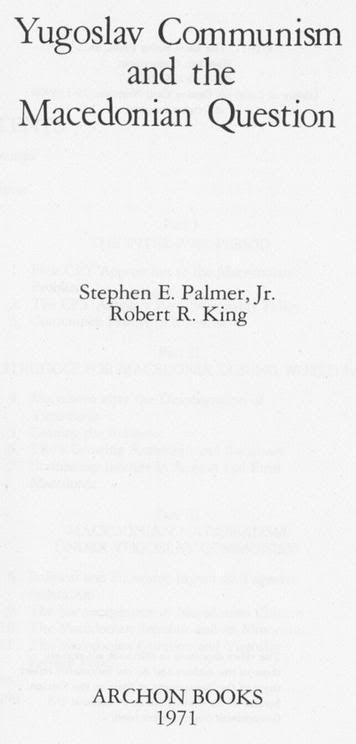
Yugoslav Communism and the Macedonian Question


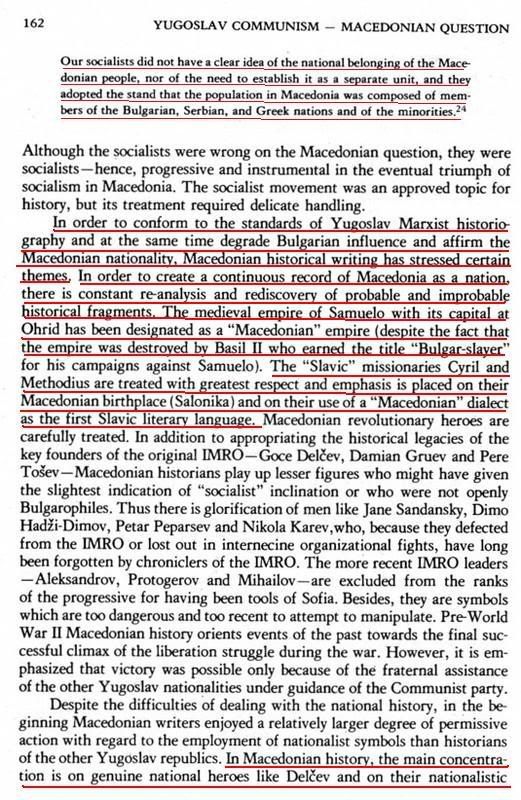
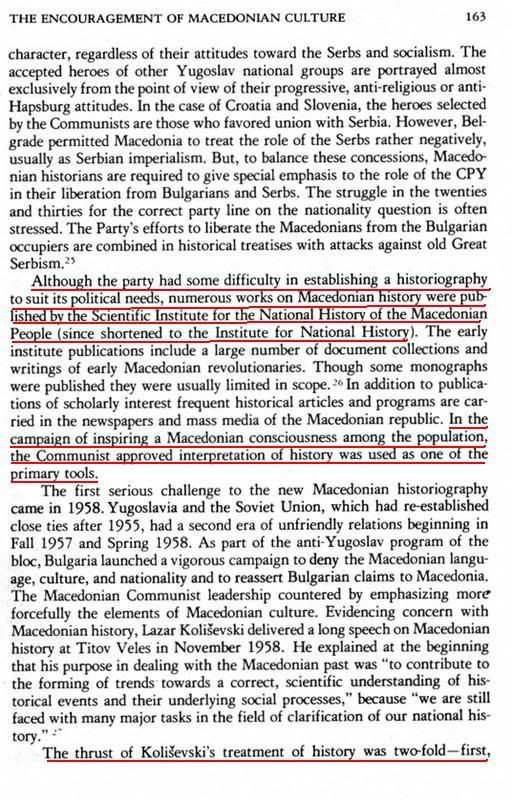
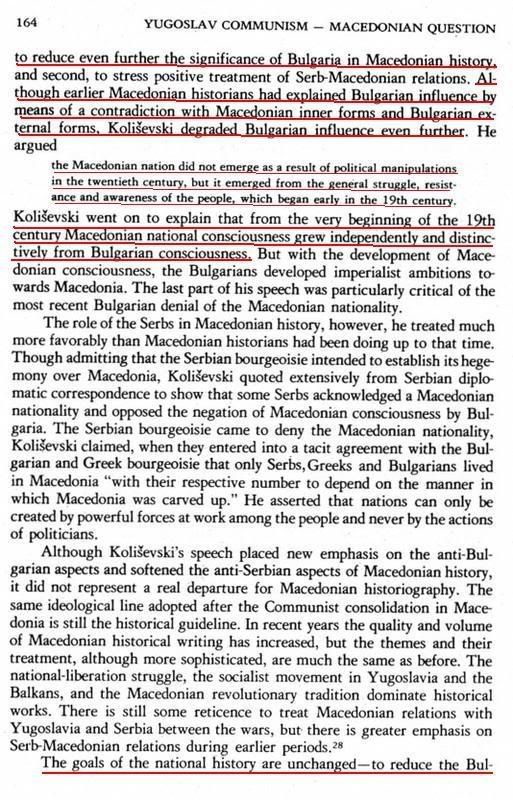
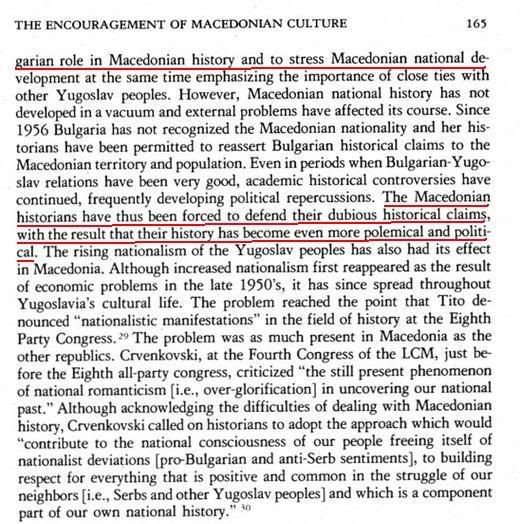
Nationalists from the Former Yugoslav Republic of Macedonia (F.Y.R.O.M) and her diaspora exert great efforts in promoting an "ethnic Macedonian" historiography which encompasses a genealogical and cultural continuity that literally spans thousands of years. In reality practically every objective and qualified scholar who has studied the history of the region describes the "Macedonian" ethno/national identity as being a mid to late 19th century construct.
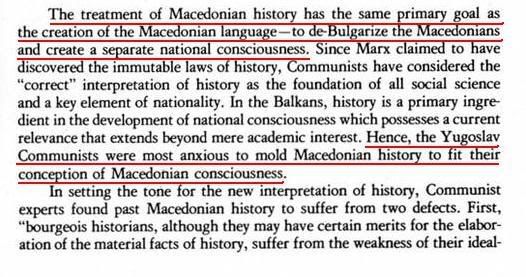
The concoction of a "Macedonian" historiography has been an ongoing process largely instigated and influenced by the Yugoslav communists during the years immediately following World War II. Tito and the Yugoslav communists capitalized on the late 19th/early 20th century politically motivated notion that the South Balkan Slavs were a distinct ethnic group by developing the Socialist Republic of Macedonia and the so called "Macedonian" ethnicity for political purposes including the pretense for future territorial expansion. By fostering a "Macedonian" consciousness amongst the largely illiterate and peasant populace the communists could secure their territory from the Bulgarians and set their sight on the Greek region of Macedonia due to their implicit implication that Macedonia should belong to the "Macedonians".
The Yugoslav communists developed and imposed numerous cultural measures in order to de-Bulgarize the region and to foster a "Macedonian" consciousness amongst the populace. An excellent book describing these cultural implementations is "Yugoslav Communism and the Macedonian Question" authored by Palmer and King. This is an important source because it was written by non-Greeks during the late 60's and published in 1971.
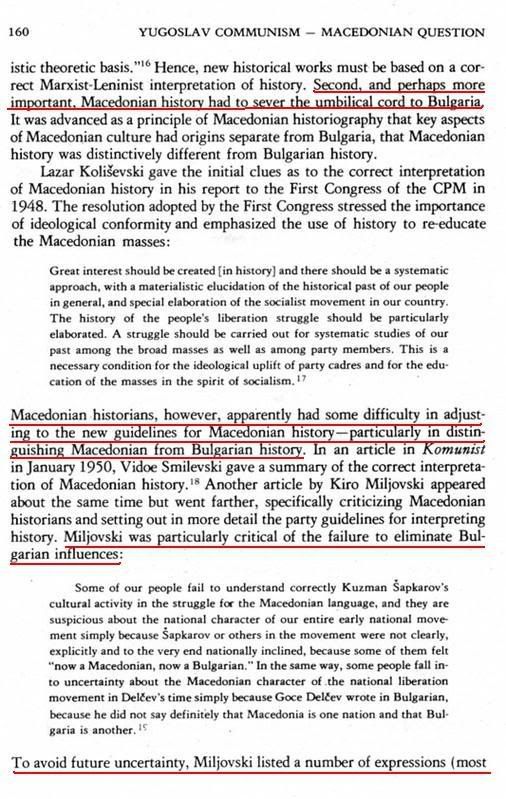
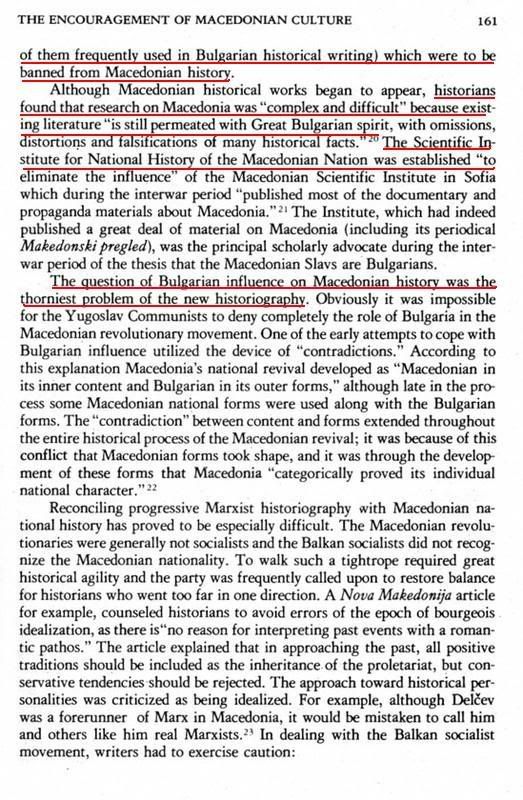
The following are excerpts from the book that describe the process in which the Yugoslav communists sanatized and manufactured "Macedonian" historiography in order to lend the "Macedonian nation" a historical legitimacy that was distinct from the Bulgarian nation.
It is important to note that the communist architects behind the "Macedonian" historiography argued that the "Macedonian" nation diverged from the Bulgarian populace as the result of a 'natural' process that unfolded during the 19th century. They were not so bold and so unrealist to claim that the "Macedonian" nation is rooted in ancient Macedonia! The mythical historiography encompassing ancient Macedonia was largely developed by F.Y.R.O.M nationalists, mostly from the diaspora, during the past 25 years.
While you read these excerpts ask yourself this: if the "Macedonian" ethnicity is over 2000 years old and is the product of natural processes why would the communists have to sanatize the history of the region and why wouldn't they include the history of ancient Macedonia when they were developing the "correct interpretation" of history for the "Macedonian nation"?


by Chris Philipou in maktruth.blogspot.com

Tuesday, June 24, 2008

Bakoyannis, Rice meeting in Berlin

Greek Foreign Minister Dora Bakaoyannis held talks "in a very friendly atmosphere," as she said, with her U.S. counterpart Condoleezza Rice in Berlin on Tuesday, focusing on the course of negotiations on the issue of the name of the Former Yugoslav Republic of Macedonia (FYROM), the issue of Cyprus, Greek-Turkish relations and the so-called "Visa Waiver," the exemption of Greek citizens from the process of entry visas to the United States.

The talks were held on the sidelines of an International Donors Conference on boosting law and order in the Palestinian territory that took place in Berlin. Briefing Greek reporters after her meeting with Rice, Bakoyannis clarified that on the name issue there is no ground for resolving the problem by July 9 and that such an issue was not even raised by the American side.

The character of the discussion in this respect was an "informative" one, the minister also said in light of the arrival of special envoy Matthew Nimetz in Athens on Thursday and afterwards in FYROM.

"I expressed the hope that these negotiations will have an auspicious conclusion, also hoping that the side of FYROM will also abandon pre-election rhetoric and will enter the essence of the negotiations," Bakoyannis said.

Replying to a question on what was Rice's contribution during the discussion, the minister said that "Mrs. Rice is well aware of the issue of the name (of FYROM) and of the Cyprus issue, which we also discussed... She is well aware of the issues, she has involved herself a great deal and, as you know, she is an experienced minister who is also aware of the essence of the problems."

Bakoyannis, who has already departed for Athens, concluded by saying that "the discussion was sincere and, as you know, Greek-American relations are good and are based on strong foundations."

Tuesday, June 24, 2008. ANA-MPA / A. DOUKAS.

Monday, June 16, 2008

Andrew Rossos Revisited 1

As you know the Slavmacedonians worldwide contribute several articles of Professor Andrew Rossos. These articles focus in the period of 1941-1949.
I have observe many mistakes to his articles, and I will try to explain step by step what Mr Rossos forget.
Before I start I want the help of the Greek-Canadians.
What they know for him.
Is a Greek or another one crypto-Slavmacedonian that use a Greek name in order to spread his articles.

I will start with the known article ....British Officer Report 1944. In this article Rossos try to explain the Evans Report.

There is a section that named(copy from Evans report title only), as.......

4. BULGAR INFLUENCE AMONG THE MACEDONIANS

This has been considerable during the past three years.
The BULGARS maintained propaganda offices in FLORINA, KASTORIA and I believe, VASSILEIAS [ZAGORICANI] 5944. The most active propagandists were GELEFF and the more notorious KALTCHEF (GREEK born, educated in BULGARIA and a fanatic).

Arms were supplied for a number of villages by the GERMANS and ITALIANS, whose purpose was to weaken guerilla resistance by dividing the population and also to create a deep protective ring round [KASTORIA and a string of garrisons along the road] KASTORIA - AMYNTAION. This effected a considerable economy in troops.
Most armed villages seemed to have contained a few fanatics and a large number of indifferent people who would have much rather not taken sides against anybody. Some villages, e.g. ASPROYIA [SREBRENO] 6350, were forced by brutal methods to take arms. Probably the most pro-BULGAR village was VASSILEIAS, which contains a small number of GREEK refugee families but is mostly SLAV.
Several families there have relatives who emigrated to BULGARIA and made good, one even becoming a General in the BULGARIAN Army.
As far back as 1938, the inhabitants used to boast of their village as 'Little Sofia'. Besides arming villages the BULGARS also tried to get people to have themselves registered as BULGARIAN citizens.
An old man in TRIVOUNON [TRSJE] 5065 told me that only six families there, besides his own, insisted in remaining GREEK. [43]
MACEDONIANS as a whole do not seem to be really attracted to BULGARIA, and some were actually afraid that she would have treated them as an inferior minority, as the SERBS and GREEKS already do. If the area i am acquainted with had been genuinely pro-BULGAR, all the villages in it would probably be armed, whereas the only ones that did take arms were those situated on the low ground on the fringes of the VITSI mountain pass. The mountain area proper was always free of armed villages, though not of informers who would betray Andartes and British personnel to the GERMANS.
Those of the inhabitants who were not pro-GREEK - that is to say, the majority - were either uneasily neutral or else filled with a rather vague aspiration towards a free MACEDONIA run on Left Wing lines. Thus, when in May the Andartes of VAPSORI sent a long-winded letter to SIDHEROKHORI [SESTEOVO] telling them to come over to ELAS and the Allies, SIDHEROKHORI replied: 'If you (ELAS) were real Allies you would wear a Red Star on your caps'.

[43] Bulgarian policies and the activities of Bulgarian supported bands in Aegean Macedonia during the Second World War have not been adequately investigated.

As you see Rossos forget to post any comment for this part of Evans report.

The second and critical as about the specific era is the Akronauplia Case that Andrew Rossos forget to mention.

Akronauplia was a known jail with Metaxas anti-dictarship prisoners. A lot of them was Communists and among of them were Slavmacedonians. Naturally, most Slavmacedonians who had been deported by the Greek authorities were only too glad to declare their Bulgarian nationality in order to return home.

Some communists maintained, for the same reason, that they had been deported or imprisoned because they were Bulgars.Even more ominous for the troubles to come, twenty-seven high-ranking conmunistc adres were released by the Germans in June 1941 from the Akronauplia prison camp, where they were under detention by the Greek authorities, they owed their release to the intervention of the Bulgarian embassy in Athens.

They too declared Bulgarian nationality, although a few like Andrcas Tzimas or Samariniotis who later played a key role in political developments, were not Slav Macedonian.

Most of them came from the districts of Kastoria and Florina, and included some of the protagonists in the events to be described below:

-Lazaros Adamopoulos or Danios of Oinoi (Kastoria)
-Lazaros Zisiadis or Trpovski of Dendrochori (Kastoria)
-Zisis Kallimanis of Kalochori (Kastoria)
-Theodoros Euthynuadis of Kastoria
-Anastasios Karatzas of Dendrochori
-Zisis Delios or Batzios of Kalochori-Kyriakos Pylnis of Xynon Neron (Flonna)
-Lanipros Moschos ofDendrochori-Lampros Roukas of Ieropig (Kastoria)-Dianlantis Tsistinas or Dalis of KastoriaAndreas Tsipas of Agios Pannteleimon (Florina) and
-Lazaros Bozinis of Aposkepos (Kastoria)...........to name the most prominent

The number of those who declared Bulgarian nationality in the region for these and other reasons is not known. It seems that many more Slavmacedonians did so in order to secure food rations in the winter of 1941 -2, during the worst fanline experienced by the country in modern tirnes. The Bulgarian Club of Thessaloniki pursued a systematic policy of literally buying such declarations from the famished population of northern Greece, and in exchange for signing it Slav Macedonians received, along with a Bulgarian identity card, bread or flour as well as scarce items such as sugar and soap.

By 1944 declarations of Bulgarian nationality for the expected betiefits were estimated by the Greek authorities, on the basis of monthly returns, to have reached 16,000 in the districts of German-occupie Greek Macedonia.

Sources
1-Plundered Loyalties by John S. Koliopoulos
2-Spuridon Sfetas,Opseis tou Makedonikou Zhthmatos
3-Crysochoou,H Katoxh sthn Makedonia.
4-Woodhouse,The Struggle of Greece 1941-1949

Saturday, June 14, 2008

Denying Ethnic Identity: The "Macedonians" of Greece!

The below article is an answer to the one-side report as about the Slavmacedonians that live in Greece and contributed from the Human Rights Watch/Helsinki in 1994. It written from Phaedon John Kozyris and publish in the Journal of Modern Greek Studies (Volume 14, Number 2, October 1996, pp. 358-361). The name of the report is......Denying Ethnic Identity: The Macedonians of Greece.

Keeping watch on governments and calling them to account for human rights is a top priority in the international arena, and the mission of Helsinki Watch, past and future, in ferreting out violations should be commended and supported. Focusing on the treatment of "Macedonians" in Greece is an appropriate subject for investigation, but it does require special care, a historical perspective, and sensitivity to the national security concerns that, regrettably, are largely missing from this report.

To be sure, Greece over time, concerned about the loyalty of some of its citizens who spoke a Slavic dialect or language that resembled Bulgarian, discouraged activities that may have been connected to the various movements and ideologies that aimed to detach Greek Macedonia from Greece and to annex it either to Bulgaria or to a Greater Slavic Macedonia. Elementary familiarity with the history of the region, and with the bloody wars that were fought there until very recently, would suggest that these fears of Greece about "activity contrary to . . . its territorial integrity and political independence" (Article 8 of the Declaration) were anything but imaginary.

The job of Helsinki Watch was to check the facts, identify any related Greek measures in reliable ways, place them in context, and evaluate their compatibility with any legitimate security concerns. This job was done poorly regarding the facts and almost not at all regarding context and compatibility. To begin with, the report most often uses FYROM's terminology--"Aegean Macedonia"--for Greek Macedonia. It also refers to the repression of "the Macedonians in Greece" without qualification, which not only generates confusion but also gives the impression that members of this small minority constitute the only or true Macedonians in the region. With all due concern for the excesses of Greek nationalism, to attribute the name and the identity of Macedonia to a certain group within a certain minority in this geographical area is not only naïve but shows gross partiality. In a vacuum, any one or any group may adopt any name they want. When, however, at least two groups claim the same name in the same location, and there has been a lot of history and bad blood regarding that location, Human Rights Watch should be careful about how it uses the name. Besides, there are also the (different?) Macedonians of FYROM. For example, I myself was born a Greek and a Macedonian and my "ethnic identity has not been denied." Furthermore, many of the Macedonians who speak or are familiar with that Slavic language also speak Greek as their primary or secondary language and do not associate with the separatist elements. They are the "dopii," a Greek word meaning "locals," distinguishing them from the refugees from Asia Minor, whom the report confuses with its own Macedonians. Indeed, these Macedonian Slavs--called "Grecomans" because they refused to join the Bulgarian Exarchate and remained faithful to Constantinople--associate with Greece, and many fought on the Greek side during the Macedonian wars.

Even more seriously, the report should be faulted for creating questionable impressions about the twentieth-century demographics in the region.

Let me cite a few examples.

The report suggests that "most of the inhabitants" (italics added) of the geographic region may be "a distinct Macedonian ethnic group."
This cannot be true.
Next, and in the same vein, it states, using a recycled FYROM source, that in 1912 in "Aegean" Macedonia there were 326,426 Macedonians and 240,019 Greeks.
This also cannot be accurate, and not only because at that time the statistics did not recognize a "Macedonian" nationality and there was no distinct Aegean Macedonia. As reported by Loring Danforth, if at that time the "Slavic-speaking Christians in [greater] Macedonia were pressed to state their national identity, some of them would have said that they were Serbs, many of them would have said that they were Greeks, but the majority of them would undoubtedly have said they were Bulgarians" ("Competing Claims to Macedonian Identity: The Macedonian Question and the Breakup of Yugoslavia," Anthropology Today 9/4 [August 1993], p. 7). An early Turkish statistic (Hilmi Pasha, 1904) had counted for the Vilayets of Thessaloniki and Monastir (now mostly in Greek Macedonia) 634,510 Greeks and 385,729 Bulgarians. The maps prepared and published by the Istituto Geografico de Agostini in Rome in the early 1900s, showing the schools and churches of the same Vilayets, corroborate the major presence of the Greek element in the area. According to statistics compiled under the auspices of the League of Nations in connection with the resettlement of the Greek refugees, in 1912 there were 513,000 Greeks and 119,000 Bulgarians (Exarchists) in the region, and by 1926, following the exchange of populations with Turkey and Bulgaria, the numbers changed into 1,341,000 Greeks and 77,000 Bulgarians. The Greek census of 1928 shows 81,984 persons speaking the Macedonian Bulgarian dialect and 16,775 the Sophia Bulgarian dialect. More recently, following the Greek civil war of 1946-1949, when the Left, supported from the north, not only pursued the communist ideology but also included a secessionist component, the size of the remaining Slavic population was significantly reduced. Those who had associated with Slavic ethnic causes left or were pushed beyond the Greek borders. The 1951 figure for that linguistic group of 41,017 reflects this change. While all figures about demographics in contested areas tend to be biased, and these figures may underrepresent at the various times the size of the population that spoke exclusively or knew the Slavomacedonian tongue because many identified themselves as Greek, this is probably a more dependable picture of dimensions and loyalties. Now the numbers are small by any count. In the last European election, the total vote of the related movement, together with splinter communist candidates, was about 7,200 nationwide. The population of Greek Macedonia alone exceeds two million. When, however, the report refers to current numbers, while it does not take a position, it still cites with a straight face and on equal footing with the other sources the statements by its Macedonian witnesses and FYROM that today in Greek Macedonia there are between 230,000 and 1,000,000 (half the population) "Macedonians," without charging this incongruity to the credibility of the same witnesses regarding other issues. Thank God that the report also gives the State Department's figures of "well under 10,000 to nearly 50,000 . . . Greek citizens who are descended from speakers of a Slavic dialect . . . some [of whom] still speak it and a few [of whom] identify themselves as 'Macedonians'" (italics added).

All this background, when added to the failure to emphasize the recent creation of a "Macedonian" national identity or that identity's crass promotion by Tito in pursuit of communist expansionist aims, shows the report's lack of sensitivity to context and also undermines its claim of neutrality.

Turning now to the claims of repression, the informational basis of the report consisted mostly of a few oral interviews with victims of discrimination, often vague and sometimes anonymous or hearsay, and a few citations from publicly available records.
Any official statements were discounted.
While the nature of the investigation justifies the use of that kind of oral testimony and while government responses tend to be self-serving, this does not dispense with the necessity for some overall evaluation. One of the weaknesses of the report relates to the dimensions of time and proportion. In the aftermath of the civil war of 1946-1949, the Greek measures were harsh and were not narrow enough to strike only at treasonous activities. Now, however, they are minimal. In the recent elections, for example, those who associated with the "Macedonian" ideology were able to express their views, nominate candidates, and participate. The report itself cites a "Macedonian" source to the effect that in Florina 40% of the public employees are "Macedonians" in a purported population of 70%, and states that there is nobody in prison for reasons of expression. But the report is not very clear about where the past ended and the present began.

The report selects two kinds of Greek action for special comment.

First, the change in the names of villages from Slavic to Greek. There is no question that the official names of most villages and towns are now Greek. This, of course, does not necessarily mean that they were changed into Greek, as implied in the report. Under Turkish rule, many villages had Turkish, Greek and/or Slavic names, depending on which community was talking. Following the division of the Macedonian region among Bulgaria, Greece, and Yugoslavia after the bloody wars of the 1910s, and with the major movements of populations, each nation made official its own ethnic toponymics and also did change a considerable number of the foreign ones, often translating them into its own language. All the Greek toponymics, most of them ancient and consecrated like Monastir and Philippoupolis, disappeared from the neighboring nations. Most of this action took place in the 1920s and was meant to convey a clear, important, and major message: there must be no more irredentist wars in the region, the current borders are permanent, and the local populations must be loyal to the nations where they live. The occupation of Eastern Macedonia by Bulgaria under the Nazis, the participation of certain "Macedonian" elements in the Greek civil war, and the secessionist rhetoric from many sources in FYROM were inconsistent with this understanding, whereas Greece is not chargeable with anything comparable. Not only is the reversal of this name strategy now practically impossible, but it could help unglue whatever hard-earned peace reigns in the region. The recent events in former Yugoslavia, especially Bosnia, suggest that ancient rivalries and hatreds run deep, that they do not amount merely to cultural differences, and that the price of peace is dear.

The same Article 8 considerations of territorial integrity and security affect the second kind of action, which relates to the refusal of Greece to give equal rights of repatriation, return, or visitation to Greece to those "Macedonians" who left Greece after defeat in the civil war and acquired foreign citizenship, and to those few who even now propagate the cause of a secessionist Great Macedonia abroad. To assume that these categories of persons are only "culturally" Slav Macedonian and not associated with the irredentist cause, when the recent and devastating civil war in which they participated almost succeeded in detaching Macedonia from Greece, and especially now that FYROM has revived the ancient issues, requires a leap of faith. In this context, and given the discretion of nations under international law in establishing their citizenship and residence rules, I believe that we should be slow in second-guessing Greece's judgments on the dangers and on whether and when some further liberalization is indicated.

In conclusion, the report, however well intentioned, breathes rarefied air. Accepting or propagating the FYROM-Macedonian vocabulary and statistics, outside time, space, and context, not distinguishing between cultural repression, on the one hand, and defense against subversion of territorial integrity, on the other, it has some value but only in an eyewitness, candid-camera, raw-news kind of way. Incidentally, for those purposes the United States State Department's annual reports are more carefully drawn and more informative. This is not to say that everything Greece does is totally proper. But it does say that Greece, which has walked the mile of liberalization, should not be criticized on the basis of exaggerated reports and, more importantly, without taking into consideration its legitimate concerns. Before we conclude that Greece has overreacted to a particular threat, the risk must be evaluated according to its magnitude and probability, especially in light of recent history. The same standard should apply to other situations nearby.

For example, it would seem that currently there is some legitimate reason for concern about the aspirations and activities of Albanians in Kossovo, of Greeks in Albania, of Kurds in Turkey, of some Muslims in Greece but not of Greeks in Istanbul, and not of Vlachs and Gypsies anywhere. In other words, it is a fact of life that human rights for minorities sometimes come into conflict with the majorities' commitment to preserve the national state, and that international law requires only some sort of balance and accommodation.

Thus, the conclusions and recommendations of the Helsinki Human Rights Watch report should be taken with many grains of salt.

for fair use only

Friday, June 13, 2008

The real hurdles to FYROM´s NATO and EU membership

Dr. George Voskopoulos in American Chronicle
June 12, 2008

The recent elections in FYROM brought to the surface the issue of the rule of law in terms of electoral practices and democratic consolidation. According to the Organization for Security and Cooperation in Europe and its international election observation mission for the parliamentary elections in the former Yugoslav Republic of Macedonia "key international standards were not met in the elections, as organized attempts to violently disrupt the electoral process in parts of the ethnic Albanian areas made it impossible for voters in many places to freely express their will".

Although in procedural terms there were no breaches "the law was only enforced selectively and the authorities failed to prevent violence and intimidation in ethnically Albanian areas". OSCE observers noted that "the largest opposition party had its campaign manipulated through the activities of a party with similarly named candidates. The media generally enabled voters to make an informed choice, although public broadcasters showed bias in favor of the governing parties".

According to Mevlut Cavusoglu, Head of the PACE delegation "while technically the elections were well organized in the greater part of the country, it is most unfortunate that a sizable proportion of the electorate was deprived of the right to express its will in these elections due to the irresponsible, violent and destructive actions of activists of the two major Albanian parties. Such actions are not conducive to the democratic process and the integration of this country in European and transatlantic structures".

US Ambassador Robert Barry, Head of the OSCE/ODIHR election observation mission [1] stated that "we were concerned from the outset that these elections could be marred by violence in some areas. Unfortunately, the lack of response to the numerous violations reported during the campaign did little to prevent the serious incidents of violence that took place on election day. The OSCE will monitor whether the authorities seriously address the violations and take remedial steps, and we will observe reruns". Commenting on the electoral process stated that, "the government had offered very little in the way of response or preventive action" while focusing on an "atmosphere of impunity." [2]

In its turn the head of the delegation of Canada to the OSCE issued a statement on 5 June 2008 with which expressed its disappointment to the "preliminary findings" of the OSCE. As pointed out, "Canada is concerned by the organized violence and in-timidation that prevailed in some ethnic Albanian areas before and during voting day, and which resulted in the death of one person. This has led international election ob-servers to conclude that in many places it was impossible for voters to express freely their will. Other problems identified included the selective enforcement of the law, ballot box stuffing and serious irregularities during vote counting. The international election observation mission has indicated that its overall assessment will depend on whether government authorities will investigate thoroughly the serious violations of the law and take remedial steps. In this context, Canada hopes that a rerun of the vote in areas where irregularities took place will demonstrate the government´s capacity and will to conduct elections that meet international standards and further the country´s EU and NATO aspirations. The expectations for this election were high, given the FYROM´s perspective for greater Euro-Atlantic integration…Canada urges the authorities to take immediate measures to address the concerns raised by interna-tional observers and others, to bring those responsible for acts of violence and other violations to account, and to implement effectively OSCE/ODIHR recommendations".

In his turn EU Enlargement Commissioner Olli Rehn pointed out that "holding free and fair elections is an essential part of the political criteria of the EU accession process". At the same time Erwan Fouere, head of the European Union office in FYROM expressed his deep concern over "the many ... corroborated reports of not only acts of intimidation, but also blatant violence, shooting, injuries to innocent people…It would be very important for the country to pass the test if it were to get a recommendation ... for opening (EU) negotiations". [3]. The statement set a framework of democratic evaluation for the country´s mapping process towards NATO and EU accession.

President Branko Crvenkovski was the first to have appealed for calm suggesting that, "the violence blackened Macedonia's name in the world". As he underlined, "the first step on the road to the EU and NATO is to have peaceful, fair and democratic elec-tions" [4]. Eventually he was the only one who prioritize the country´s accession criteria yet, the political landscape was not receptive to modesty and compromise.

However, recent electoral violence and nationalistic mood are not the only worrying signs. A second major problem is the suppression and long persecution of Bulgarian-Macedonians in the country, a policy that causes unrest in Bulgaria, although the Bul-garian government has made efforts to keep a low profile with a view to avoiding American reactions.

The coming election reruns will not certainly change the political landscape in the country, since the parliamentary balance of power is given. Yet, the current configuration of power in domestic politics is by far the most unpromising one during the last years, while the mood reminds of Greece in the early 1990s.

It is obvious that the current political situation in Skopje leaves only marginal space for conflict resolution since nationalism is the driving force behind domestic politics. The dominant role of ultra-nationalists led to the political marginalization of those modest voices inside the country that could operate as facilitating factors in the name dispute.

The Greek side has adopted a wait-and-see policy keeping a low profile. At this time and under the circumstances conflict resolution will depend on a number of qualitative criteria. First, the ability of Prime Minister Gruevski to adopt a revised policy accepting the implied by the Greek government offer for a compound name with a geo-graphical definition that includes the term Macedonia. Second the ability of the politi-cal system to accommodate contending views on the issue and third the ability of me-diators to deepen into the roots of the conflict and assist in practice the territorial status quo in the region.

The US government is pushing for a quick solution but this lies in Skopje. Pre-electoral commitments of N. Gruevski and extreme language consist the main hurdles and define in essence the margins of potential policy adjustment and his accommodat-ing capacity. The name dispute is only the tip of the iceberg but its resolution will as-sist the formulation of a positive climate in the process of overall resolution of the issue.

Just a few months ago Greek Foreign Ministry spokesman George Koumoutsakos laid down once again the overall Greek strategy for the region. He emphatically stated that "we supported and support the European prospects of all our neighbouring states be-cause we believe that this leads to a future of stability, peace and growth. But, at the same time, in order to build the future on firm foundations there must first be a set-tlement of outstanding issues that create negative repercussions for the region. One of the issues of particular interest to Greece is that of [FYROM´s] name, which has been combined for some time on the part of Skopje - beyond its intransigency during the negotiating process in itself - with a policy of historically inaccurate references and actions with an irredentist mentality".

Despite acknowledged weaknesses, wrong choices of the past and misunderstandings Greece operates as a systemic stabiliser in the region for a number of reasons not understood by everyone: First, it expresses no irredentist claims against neighbor-ing states. Thus it constitutes a supporter of the territorial status quo that has been challenged diachronically by local actors. Second, it aims at regional cooperation and intra-Balkan cooperation. Yet, this should be realised on the application of clear, un-compromised principles without deadlines set under the impact of diplomatic rush or urgency parameters stemming from Skopje. The post-Cold War Greek-Bulgarian axis of cooperation prior and after Bulgaria´s accession to the EU provides a tangible case of successful healing process.

=================================================================

[1] The international election observation mission is a joint undertaking of the OSCE Office for Democratic Institutions and Human Rights, the OSCE Parliamentary Assembly and the Parliamentary Assembly of the Council of Europe
[2] «Conservatives win Macedonia vote, EU rues violence», Washington Post, June 2, 2008.
[3] "Macedonia's prime minister declares victory", Washington Post, June 1, 2008
[4] "Macedonians vote in shadow of violence", Washington Post, June 1, 2008

Monday, June 09, 2008

The Greece-FYROM 1995 Interim Accord

Dr. George Voskopoulos in phantis.com
Sunday 8 June 2008

The Agreement was signed in New York on 13 September 1995 and was the fruit of an internationally guided mediation to establish tangible confidence-building measures (CBMs), in order to facilitate the process towards a final agreement to be reached at a later stage. It consisted of 23 articles, aiming at setting the groundwork and political framework for a definite settlement of the name issue. The most important articles of the Agreement aimed at:
  1. Having both parties declare that they did not have any territorial claims whatsoever and that the existing borders between the signatories were recognised as permanent and undisputed (Article 2) [1].
  2. Committing both signatories to respect the territorial integrity of one another (Article 3).
    Ensuring that both signatories would refrain from using violence or the threat of using violence in resolving their differences, thus respecting the dictates of the United Nations Charter (Article 3).
  3. Having both signatories proceed with their talks, under the auspices of the United Nations General Secretary, towards a final agreement, concerning the name of the newly-established state.
  4. Having the first signatory (FYROM) declare officially that its Constitution (particularly Article 3) can in no way be interpreted in such a way that could raise any territorial claims against the second signatory (Greece) [2].
  5. Having the first signatory (FYROM) declare officially that its Constitution as a whole, and Article 49 in particular (as it has been modified), sets no basis for any irredentist claims whatsoever (Article 6).
  6. Having FYROM remove all symbols (i.e. the Vergina star, the White Tower in Thessaloniki) from its flag and declare that it would not interfere in Greek domestic affairs.
An interpretation of the aforementioned articles illustrates that a number of Greek worries and security considerations were indeed taken into account through the imposed constitutional changes. Article 1 aimed primarily at verifying the existing territorial status and containing Slav-Macedonian irredentism, as Greece had never expressed any aspirations towards expanding to the North, which is a region of limited strategic importance to the country. The vitality of FYROM rests today almost exclusively on the economic and trade fields since Greece is the main provider of Foreign Direct Investment (FDI).

Article 2 aimed at safeguarding the territorial status, too, but this remained mainly a rhetoric wish, as the vision for a united Slav-Macedonia was only indirectly dealt with. The long and continuous dream of uniting geographical Macedonia still remains the fundamental national cause of the neighboring country, an aim supported by the Diaspora in Canada and Australia.

Article 3 set the institutional and conflict resolution framework within which both states had to operate to resolve the dispute. Use of violence of threat of use of violence was eradicated, at least verbally, as a means of conflict resolution, although neither signatories had in the past expressed any violent trends.

The fourth aim of the Interim Accord may be interpreted as an effort to set the conflict resolution process within commonly acceptable, official channels, under the mediation of the UN Secretary General. However, what the Interim Accord failed to set a time ceiling in the conflict resolution process, a fact that allowed both parties to procrastinate. Skopje adopted an uncompromising policy and supported Macedonianism in order to support irredentism. The political elite in FYROM had no reasons to compromise, even on a compound name bearing a clear geographical definition, which could accommodate both sides. This hardened FYROM’s positions, as there was practically no obligation whatsoever to put an end to interminable talks.
Eventually the Greek side overlaid the political commitment of its original decision not to accept the use of the term “Macedonia” and made a critical step towards conflict resolution. In the process the Greek side adopted a drastically revised policy and today appears willing to adopt a name that does not exclude the term “Macedonia”. However, the proposed name should have a clear geographical definition to distinguish it from Greek Macedonia, the diachronic target of nationalists in FYROM.

The link between the term “Macedonia” and Greek Macedonia is important to nationalistic propaganda in Skopje and this explains the rejection of any ethnic link with the clearly Slavic element of FYROM. Purging national identity from its Slavic past became the second line of propaganda in the hands of nationalists in FYROM. Under this spectrum, the use of the term Slav was evaluated as a “derogatory” term, an “insult” or a sign of “racism”. The view was publicly advertised with a letter to the editor of The Economist [3], which eventually constituted an affront to Slavs. There is logic behind this conscious choice of de-linking national identity from its Slavic origins. A distinguished, “pure” Macedonian identity along with historical claims facilitates irredentist propaganda against Greek Macedonia.

Despite the resolution framework set by the Interim Agreement, the name issue was not regulated in a way that provided ways of finding a mutually acceptable solution within sensible time limits. The Agreement lacked “carrots”, a fact that allowed signatories to procrastinate to reach a definite solution of the issue.

With the Interim Accord, the Greek side managed to have FYROM’s Constitution interpreted in a way that does not, at least verbally, challenge the territorial status. Yet, the Agreement did not regulate nor controlled the irredentist activities of political parties in the country, individuals or NGOs conducted from Skopje or abroad.

Regarding the use of symbols, the Accord provided for the removal of those symbols associated with Greek history and Greek territorial sovereignty, such as the Vergina Star, that implied association of Slav-Macedonians with Greek territory, namely Greek Macedonia. For Slav Macedonians these were negotiable issues that could be given away in order to support the main cause of the dispute, that is the name.

On the practical level both nations need to accommodate the dispute through a win-win approach. There are no superior or blessed nations in the region. The sociologically-oriented approach to national identity issues as recently publicised by an America researcher is highly problematic since it is formulated in a vacuum of scrutinizing political expediency, political aims and above all security implications. These views mainly stem from clear ideological and idiosyncratic beliefs of those who try to balance Slav Macedonian irredentism with a process of questioning Greek national identity. At times the role of intellectuals or alleged intellectuals has been non-facilitating. According to Maria Todorova “the role and record of Southeast European intellectuals vis-a-vis intra-Balkan cooperation has been diverse, complex and contradictory”.

There are nations and political milieu haunted by outdated great idea, expansionist beliefs that destabilize the Balkans. These fall within the ontological and epistemological scope of an international relations scholar. Unfortunately they have been exploited by intruding actors in order to serve their geopolitical expedience and great power antagonism. The issue at hand is not history but stability. History is just a means to an end, that is revisionism.

In 2002 I asked professor Maria Todorova, one of the leading Bulgarian historians of the region and a great scholar of high calibre to make a comment on my long-established view that the Balkans and their peoples have been used as a political guinea pig by the great powers of the past. Her answer was “yes and yes. Southeastern Europe has been more often than not a subject of power plays completely extraneous to the interests of its inhabitants rather than an agent of its own fate, and there is overwhelming evidence to support that. The whole historiography dealing with Southeastern Europe from the Eastern Question until today illustrates this abundantly and unambiguously, no matter whether it is written by Balkan nationals or outsiders. The issue is not in doubting these propositions but in how to deal with this predicament in the most flexible way and how to articulate it so as to avoid at least two disastrous consequences.”

When the political establishment in Skopje manages to turn this view into the axis of the country’s international mode of behavior, the Balkans will be safer from foreign interference. Yet, this security premium presupposes the existence of a functioning democracy and an advanced political system as well as the application of the rule of law.

The recent elections in FYROM illustrated blatantly that Greece and its operating as a defender of the territorial status is not the only “hurdle” in FYROM’s course to EU and NATO membership. The most critical issue is the democratization of the political system in FYROM. The EU, the European Parliament and the Organization for Security and Cooperation in Europe sent worrying signals on the recent electoral process. It is clear that emancipation from past practices is the first prerequisite for entering NATO and the EU.

Plato and his writings may provide a useful base of analysis of the current situation in the region. The social evils he described depicted the problems of the time, namely disunity, incompetence and violence. He wrote about society and the state looking for principles. Political elites in FYROM could learn a lot from Plato’s writings by focusing on their prescriptive basis. Yet, it seems that time and the healing process has had no effect on the views of a limited core of political vampires that jeopardize the very survival of their country and lead their people to isolation. These are the Balkan ghosts of the past we all need to ostracize in the same way ancient Greeks did. This is an act of valor, a process of immunizing local societies against self-destructing policies and incompetent leaders. It is a fundamental prerequisite for stability, peace, development and inter-Balkan cooperation.

====================================================================
Footnotes
[1] This was in line with the EU decisions taken ever since 1991
[2] This term satisfied one of the first Greek demands set in 1991 by the inter-party conference.
[3] See “Slav or not?”, The Economist, August 2001, p. 22. See also the analysis in George Voskopoulos, Greek Foreign Policy, from the 20th to the 21st Century, Papazisis publishers, Athens, 2005 (publication in Greek).

Saturday, June 07, 2008

Nicolas Sarkozy lays down alliance terms of engagement

Dr. George Voskopoulos in American Chronicle
June 06, 2008
During his visit to Athens the French President Nicolas Sarkozy gave lessons on solidarity among alliance partners. He was clear about alliance obligations, something that other Greek allies have not honored, although they request the political and logistical support of Athens. Yet, this should not be a surprise to anyone, at least for those of us who have received a French education and are parts of le monde francophone.
The charismatic French leader made some explicit remarks on the Greece-FYROM name dispute as he is amongst those who do not find Greek worries "absurd". As he pointed out referring to the Greece-FYROM name dispute, "we have chosen to support Greece and we will not change our position. Greece and France wish to see FYROM get closer to NATO and the EU, yet, the name dispute will have to be settled first. The solidarity of France towards Greece is a fact and it will go on in the future. The Greek position is justified, responsible and open to a dialogue…".
This is one single statement never heard from American officials investing in the op-portunistic Atlanticism of Slav Macedonian government. Actually the State Depart-ment has invested a lot in a continuous, outdated act of cannibalizing history and has overlaid NATO´s commitment to the defence of one of its members.
American policy in the issue has been dominated by inflexibility. Ever since 1996 there was hard evidence that the US undermined the name issue and Greek security and dealt with it as if it were a "name game". A. Mallias, Head of the first Mission in FYROM in the mid-1990s, was one of the first diplomats who sensed US determination to proceed with recognition of FYROM with its constitutional name. In mid-June 1996 he was the one who alerted the then Greek Foreign Minister on US non-facilitating policy [1]. Evidently current American policy is not just a temporary deviation from alliance commitments, a fact that clearly sets a number of priorities for the next American president.


The last time an American leader felt apologetic for America´s policy vis-à-vis Greece was B. Clinton. While visiting Athens he expressed his apologies for the US not standing by the Greek side and the democratic forces crashed under the military might of a handful of low-rank military officers. We should have been more careful with our Greek allies…we should have done more to prevent the expression of the military coup in Greece in 1967…we focused exclusively on the Soviet Union and forgot our obligations to our ally, B. Clinton said. It takes a charismatic leader to ac-knowledge mistakes of the past and Bill Clinton was one of those.
That was probably the first and last moral support Greece got from an ally that has de jure served ever since 1952. Still too many in Greece think that this is not enough. N. Sarkozy made this feeling more acute and exposed American inability to accommo-date the institutionally-derived expectations and security considerations of an allied country.
Nicolas Sarkozy was more than explicit in setting the framework that should deter-mine relations between allies. "The Greek people can count on us and we can count on them", he said. It is sad enough that very few people in Greece could ever picture an American official saying the same thing today. Nikolas Sarkozy gave alliances a raison d´ être and a meaning something urgently expected form the next American administration.
[1] See Greek weekly Ependitis, 15-16/6/1996, p. 18.