Sunday, May 11, 2008

Decoding policy choices and motives in the Greece-FYROM name dispute

Dr. George Voskopoulos in American Chronicle
May 11, 2008

The Balkans have been an immature subordinate system ever since the demise of the Ottoman empire. The "Macedonian Issue", the time-proof dispute in the Balkans, first emerged as a side-effect of the evolutionary stages of the "Eastern Question" and the liberation of the Ottoman conquests, namely the Balkan peoples, who gradually rose against their conqueror and attempted to set up their territorial bases with a view to forming nation-states.

The "Macedonian Question" emerged as a result of antagonism among Balkan nation-states that wished to get the lion´s share from the disintegration of the Ottoman Empire. Yet, the course to liberation had hardly finished when Balkan peoples turned against each other, in order to secure a greater territorial chunk out of the Balkan Peninsula, a policy that led contending Balkan nationalisms to clash.

In the post Second World War era, the dispute was rooted in the rivalry over control of geographical Macedonia and annexation of Greece´s northern province Macedonia. Greek Macedonia has been the diachronic target of irredentist activities on the part not only of Bulgaria but also Yugoslavia. In the summer of 1945 Marshal Tito articulated a verbal assault on Greece and eventually verified its policy of annexing Greek Macedonia [1]. C. L. Sulzberger reporting for The New York Times on November 17, 1946 is more than clear: "Yugoslav foreign policy has two major revisionist objec-tives--Trieste and Salonika--and one minor one-- Klagenfurt, in Austria. At the mo-ment the emphasis is still on Trieste…". [2]

This very policy alarmed Greece, which, assisted by the US, internationalized the issue. In March 1947 "Mark Ethridge, American representative on the United Nations Balkans Commission of Inquiry, has moved to extract from representatives of Yugoslavia and Bulgaria a clear answer to Greek charges that their countries are waging an undeclared war to detach the Greek Province of Macedonia" [3].

A month later the US confirms these irredentist activities, presenting hard evidence in favour of Greek positions. I quote W.H. Lawrence reporting from Geneva for The New York Times: "The United States circulated among the ten other members of the United Nations Balkan investigating commission today a proposed summary of the evidence on the Macedonian issue. This summary tends to prove that Yugoslavia and Bulgaria interfered in Greek internal affairs so as to win Greek Macedonia for Yugo-slavia and western Thrace for Bulgaria". [4]

During the Greek Civil War Slav inhabitants of the wider geographical area of Macedonia joined Greek left forces in the struggle against government units. According to the report, "about 600 purported representatives of communities in Greek, Yugoslav and Bulgarian Macedonia met this week in a small village in the Vitsi mountain area of north-western Greece near the Albanian border, according to a rebel radio broad-cast heard today in Salonika". [5] The promise repeatedly made to them was that should left wing forces in Greece prevail Slav Macedonians would be allowed to annex Greek Macedonia and establish a Macedonian state.

The above constitute indicative only historical evidence of how the Macedonian issue had been formulated under the then political and social conditions. A sensible question would probably concern the relation between today´s situation and the then con-ditions. First, the events described set clearly the long-established historical frame-work of irredentist activities against Greek Macedonia. Second, they eliminate the conceptual basis of Greece being part of an instability chain that tars the image of the Balkans and the Greek people of being victims of a certain national paranoia and obsession with history. Foreign policies are driven by national interests and the need for survival, particularly in zones of turmoil, characterized by territorial fluidity and Great Idea syndromes.

Greece operates on the same motives despite incoherent policies adopted during the last decades. It is a pro-status quo country as indicated by its will to endorse the 1995 Interim Agreement with FYROM. The evident advantage of the Agreement was that it allowed both countries to provide a very general framework of coexistence. Actually it was an act of support of FYROM since it allowed it to use the name "Macedonia" although irredentist activities continued to tar bilateral relations. This very fact constitutes a breach of the Agreement itself. Yet, this temporary arrangement created further problems to the Greek side as it allowed FYROM to build its strategy on the state-stemming ideology of "Macedonianism".

Originally (1920s) the issue was formulated on a Marxist basis and the aim of establishing a Balkan Communist Federation. Yet, in the post-Cold War era the issue cen-tered around the need of the neophyte state FYROM to support its national identity and distance itself politically, culturally and institutionally from dissolving Yugoslavia and Belgrade operating as the eminence grise of former Yugoslav Republics.

The dispute that emerged over the name of the newly-founded state, was considered by Greek administrations and the Greek people to be a substantial actual not potential non-military threat, in a fluid security environment, diachronically dominated by un-predictability, irredentist claims (covertly or overtly expressed), lack of internal cohesion and warring conflicts among Balkan states over the control of the geographical region of "Macedonia", which appears to be one of the most disputed areas of Europe.

The ethnically-orientated use of the name "Macedonia", along with the use of historic symbols, associated with Greek territorial sovereignty over Greek Macedonia, provoked Greek national sentiment, since it was regarded as the cornerstone of a long-standing irredentist policy against Greece. The inference of the name "Macedonia", a name of tantamount importance for those familiar with Balkan politics and history brought back to memory Tito´s plans for the creation of a communist federation in the Balkans and the eventual annexation of Greek Macedonia, that was meant to become part of a united Macedonia, under a Communist leadership.

Greek officials estimated that the emergence of the neophyte state would be followed by an attempt, on the part of Slav-Macedonians, to enhance independence and cultural autonomy, by means of legitimisation through "historical proof", which was eventu-ally used as an unfortunate means of applying the undeniable right of a small nation for self-determination and self-rule.

To the Greek policy-makers eyes, the "Macedonian issue" emerged as a double threat.
First, it was the revival of Balkan antagonism for domination over geographical Ma-cedonia and more particularly Greek Macedonia, which is the oldest and biggest part of the geographical region Macedonia and the part with the most strategic importance, since it provides an outlet to the Aegean Sea.
Second, it was a threat to Greek national identity and cultural heritage, a notion that triggered the massive demonstrations in Thessaloniki in February 1994, the biggest ever in Greece.

The signifier of these mas-sive activation of Greek public opinion is that, although Greece was and still is a Bal-kan state not nurturing irredentist aims against FYROM, it was the local actor that most heatedly objected to its recognition under the name Macedonia, since, the con-notation "Macedonia" has been solely associated with the Greek northern province and "denotes an exclusive and integral part" history and culture of the Greek people.

For FYROM, it was a matter of survival in an unstable Balkan security environment, as the country was facing direct military threats from Yugoslavia, the ultra-nationalists in Albania and the danger of self-dissolution, stemming from the exis-tence of contending ethnic minorities, the most substantial of which was the ethnic Albanians, who, after long years of suppression, wished to have their cultural identity acknowledged. At the same time, there was a need to silence elements of Bulgaro-philia domestically, a fact that led to suppressive policies against those in FYROM who identified themselves as Bulgarian-Macedonians.

Within the wider context of the Communist establishment and ideology, national identities had to be overlaid. Emphasis was given to class associations and class struggle since ethnicity was a "bourgeois feature". As a consequence, the enhance-ment of a different ethnic identity, different from the artificial "Yugoslav identity", was of a sine quo non prerequisite for the political and cultural autonomy of the neo-phyte state, as well as for the social cohesion and domestic balance of the emerging political entity. Yet, this very need gave birth to the falsification of Greek history, which was used as a means of emancipating the Slav-Macedonian identity and FY-ROM´s independence from Belgrade´s suppressive ethnic policy.

In their quest for international support and political emancipation from Belgrade, the post-Cold War administrations of the country became trapped in the dictates of popu-lism and nationalism, as expressed by the diaspora, something I personally witnessed as a young student in Canada in the early 1980s.

Evidently, the early Marxist and ideological platform of the Macedonian issue had turned into a matter of survival for a small and weak country that struggled for inde-pendence. These are noble aims supported by all of us who envisage a free democratic world. Yet, the early euphoria triggered by the demise of the Communist establish-ment led to a major mistake at least in terms of priorities. That is overlaying the secu-rity implications of independence and the unconditional support for self-determination. The tendency to overlay the security aspects of the adopted policy by Skopje took place under the pressure of the emerging warring conflict in dissolving Yugoslavia

Greece´s primary aim in the "Macedonian Question" has been the containment of irredentist activities against Greek Macedonia, as well as the ethnic implications of the name "Macedonia" used by FYROM, since the Post-Second World War name "Re-public of Macedonia", devised by Tito coincided with the Greek province Macedonia.

The name issue would be of minor importance to Greece if it did not imply that FYROM claimed for itself a wider geographical area, consisting of the historic Mace-donia and kingdom of ancient Makedon, 90% of which lies within Greek territory. This served practical purposes as well as claims on historical continuity. In its turn this very claim aimed at "legitimizing" irredentist claims on the basis of alleged his-torical ties with Greek Macedonia. Yet, the very name itself set a clear and evident irredentist claim, as the geographical interpretation of it, gives it an ethnic character. It wrongly implies that there used to be a single, united Macedonian state partitioned by means of military force.

Of course the main issue here is that young people in FYROM and across the world grow up with the dream of "liberating" Greek Macedonia, a task "imposed" to them by history. Na-tional identity is not an issue to be dissolved with a political decision not even an honourable compromise. Beliefs are far stronger than political decisions.

The major and catalytic drawback of Greek foreign policy ever since the early post-Cold War emergence of the Macedonian issue was its inability to underline the secu-rity dimensions of the issue [6]. History, despite inconsistent, contending narratives and explanation of motives of the parts involved, has been a tool in the hands of na-tionalists not a goal in itself. It has been used simultaneously as a means of question-ing (FYROM) and supporting the territorial status quo (GREECE). Under this spec-trum any policy and solution that leaves space for future misunderstanding is totally unacceptable. Actually it happened in the past and led to an impasse. The current Greek administration has been more than explicit on that and I certainly hope that it will support its views with stern zeal.

In the case of our neighbours it is now clear that partnerships can only be built on common goals supported by common institutions and values (EU) or alliance mem-bership (NATO) that provides a casus foederis to the participants. Greek policy is an act of defense of the status quo, not a hostile act against FYROM. I am afraid there is an inherent inability, related to populism, that prevents political leadership in Skopje to realize who the real danger is to the country´s survival. Under this spectrum the name issue is not related to the political survival of the country but to the megaloma-nia of a certain political milieu. The issue is not a question of race purity but of acknowledging that the mistakes and impasses of the past can teach us a lot about our common future.

notes

[1] "Tito´s New Issue", The New York Times, July 10, 1945
[2] "Yugoslavs Eye Salonica, Macedonia and Klagenfurt. Also Objectives--Soviet Helps to Build Up Tito's Army", The New York Times, November 17, 1946.
[3] "Sofia, Belgrade asked for Policy; American on U.N. Commission Wants Reply to Charges of Interference With Greece", The New York Times, March 16, 1947.
[4] "U.S. Report for Balkan Mission Indicts Yugoslavia and Bulgaria; Summary of U.N. Inquiry Evidence Points to Intervention in Greece -- Set-Up of Permanent Bor-der Board Likely", The New York Times, April 22, 1947.
[5] "Slav Macedonians Join Greek Rebels; Balkan Communist Radio Says Bulgarian, Albanian Reds Will Take Active Role", The New York Times, March 31, 1949.
[6] See George Voskopoulos, Greece, Common Foreign and Security Policy and the European Union: Interaction Within and Between a Zone of Peace and a Zone of Turmoil as an Explanatory Factor, PhD Thesis, Exeter University (UK), Centre for European Studies, 2001.

Saturday, May 10, 2008

Population Exchange in Greek Macedonia: The Rural Settlement of Refugees, 1922-1930


Hardcover: 396 pages , 978-0199278961
Publisher: Oxford University Press, USA (August 17, 2006)

Author: Elisabeth Kontogiorgi, Researcher, Research Centre for the Study of Modern Greek History, Academy of Athens
Language: English
The book...
  • Examines the effects on Greece of the settlement of over 1.2 million refugees during the inter-war period
  • Charts the transformation of the character of Greek Macedonia
  • Examines Greek state policy and the role of the Refugee Settlement Commission
Following the defeat of the Greek Army in 1922 by nationalist Turkish forces, the Convention of Lausanne in 1923 specified the first compulsory exchange of populations ratified by an international organization. The arrival in Greece of over 1.2 million refugees and their settlement proved to be a watershed with far-reaching consequences for the country.
Dr Kontogiorgi examines the exchange of populations and the agricultural settlement in Greek Macedonia of hundreds of thousands of refugees from Asia Minor and the Pontus, Eastern Thrace, the Caucasus, and Bulgaria during the inter-war period. She examines Greek state policy and the role of the Refugee Settlement Commission which, under the auspices of the League of Nations, carried out the refugee resettlement project. Macedonia, a multilingual and ethnically diverse society, experienced a transformation so dramatic that it literally changed its character. Kontogiorgi charts that change and attempts to provide the means of understanding it. The consequences of the settlement of refugees for the ethnological composition of the population, and its political, social, demographic, and economic implications are treated in the light of new archival material. Reality is separated from myth in examining the factors involved in the process of integration of the newcomers and assimilation of the inhabitants - both refugees and indigenous - of the New Lands into the nation-state. Kontogiorgi examines the impact of the agrarian reforms and land distribution and makes an effort to convert the climate of the rural society of Macedonia during the inter-war period. The antagonisms between Slavophone and Vlach-speaking natives and refugee newcomers regarding the reallocation of former Muslim properties had significant ramifications for the political events in the region in the years to come.
Other recurring themes in the book include the geographical distribution of the refugees, changing patterns of settlement and toponyms, the organisation of health services in the countryside, as well as the execution of irrigation and drainage works in marshlands. Kontogiorgi also throws light upon and analyses the puzzling mixture of achievement and failure which characterizes the history of the region during this transitional period. As the first successful refugee resettlement project of its kind, the 'refugee experiment' in Macedonia could provide a template for similar projects involving refugee movements in many parts of the world today.
You can read a sample of the book here.

Sunday, May 04, 2008

American faulty policy in the Greek-FYROM name dispute


Dr. George Voskopoulos in American Chronicle
May 02, 2008

Alexis de Toqueville wrote one of the most comprehensive works on American Democracy titled Democracy in America. His critique was based among other things on the American political establishment and its operating mode. I do not mean to en-dorse his critique as a whole but I will agree that Americans do not really appreciate criticism. In essence my views here reflect certain aspects of its evaluation judgments based on the State Department´s policy and mediating strategy in the Greek-FYROM dispute.

American active and rather biased involvement in the negotiations between FYROM and Greece was evident in the late phases of negotiations under the auspices of the UN. The dead-end was not a surprise and this may be attributed not only to the clash of non-negotiable national interests of Athens and Skopje but also Washington´s policy. A number of issues may be pinpointed as non-facilitating factors in resolving the issue. They directly and indirectly relate to the formulation of Greek and Slav-Macedonian positions and the lack of understanding or ignorance on the part of the State Department.

First, President Bush has obviously underestimated the importance of the issue for Greece and consistently used the term "Macedonia" when referring to FYROM. In terms of semantics this is a direct support to Skopje a fact not appreciated by Greek public opinion and political elite. When in 2004 US government decided to recognize FYROM under its constitutional name "Republic of Macedonia" it was done as a means to avoid further destabilization of the country. At least this was the explanation provided by the State Department. Greek worries were not just overlaid but rather treated as a symptom of national paranoia, a technicality and not an issue of direct or indirect threat to territorial status and a non-military threat to a NATO ally.

Second, the overt support of the State Department to FYROM hardened the positions of the nationalists in the Slav-Macedonian government. Eventually they gave them false signs since the State Department treated FYROM as a protégé. For the Greek side it was obvious that the real interlocutors during the bargaining process were the US and its NATO ally Greece. Athens was treated as a de facto minor ally whose le-gitimate security interests had to be sacrificed in order to cement south-eastern Europe from Russian policy built on establishing oil and natural gas pipelines.

This clearly illustrates a stark change of mood on the part of Washington. During the Cold War, Greece was the only NATO ally and EC/EU member whose interests had to be taken into consideration. The lack of alternatives made Washington more care-ful in the articulation of ideas and evaluations towards the so called Macedonian is-sue. After the end of the Cold War American foreign policy established a network of allies in the region that eliminated in part Greece´s advantage of being the sole NATO member in the region.

When the name issue emerged de jure in the early 1990s American officials dealt with it as if it were a technicality, although Greece had kept silent ever since the es-tablishment of the Socialist Republic of Macedonia by Tito in mid-1940s. In fact today Greece is "punished" for not upsetting American policy and western strategy of sup-port to a non-aligned Yugoslavia. This is an affront to Greek public opinion and his-tory and a fact that enhances dramatically anti-American feelings in the country.

Third, the reaction of the State Department to the insults to the Greek Prime Minister K. Karamanlis (see his portrayal dressed as a Nazi as presented by a magazine pub-lished in Skopje) and the Greek flag decorated with Nazi symbols was unsatisfactory. The same applies to the use of maps of Greater and united Macedonia circulated in recent demonstrations in Skopje and the aim of uniting geographical Macedonia. They constituted hard evidence of what the Greek side had always rejected, that is Slav-Macedonian irredentist or pseudo-irredentist claims. Playing deaf is not always a sound policy particularly vis-à-vis an ally that has offered so much in the struggle for democracy and freedom in the region.

The same people who today support "liberation" of Greek Macedonia (to Slav-Macedonians nationalists "Aegean Macedonia") propagated in favor of a world com-munist order a few decades ago. The State Department seems to have forgotten a number of facts associated with history, diplomacy and loyalty to allies. Of course power, especially structural power, allows arrogance to overlay ethical issues not as-sociated with the conduct of foreign policy. Political realists reject ethical motives when materializing foreign policy goals. Yet, this ethical foundation has been Amer-ica´s most powerful weapon in leading what American presidents used to call the "free world".

On January 21, 1994 a New York Times columnist made the obvious mistake of eliminating the security aspects of the issue and failed to recognize the epitome of the problem. He wrote that "ever since the breakup of Yugoslavia, Greece has been fighting and gradually losing the battle to prevent the world from recognizing the for-mer Communist wedge of land on its northern border by the name it has chosen for itself -- Macedonia. It is an issue that boils with nationalist passion. Yet, as some Greeks slowly seem to be acknowledging, it is an issue that cannot be won…".

Evidently he himself made a number of blatant oversimplifications. The first refers to the right of a state to use a name of its own choice. Actually this is not happening even in the world of modern trade since brand names are protected trademarks and copyright protected. As I have previously suggested history is a powerful tool in the hands of nationalists. FYROM has propagated the existence of a "Macedonian na-tion" although its existence cannot be established throughout history. Actually it was Tito who "provided the occasion to develop a specifically Macedonian history which was clearly differentiated from its neighbours" [1].


Fourth, American mediating effort was built on putting pressure on the Greek side and bullying the Greek government allowing Skopje to operate under the impact of protégé euphoria since Washington has become a shield against Greek policies. This relationship between great powers and protégés has formulated the conceptual an-ticipations of the hardliners in FYROM. In mid-1940s B, Newman pinpointed that "many Balkan states were little more than puppets in the finger of protecting powers".

Fifth, the State Department has dramatically undermined the catalytic role of Slav-Macedonian irredentist claims to Greek Macedonia. Ignorance of geopolitical expedi-ence is not an excuse in ignoring the obvious that is the long battle over control of Greek Macedonia, 90% of which matches the borders of the kingdom of ancient Ma-cedonia. Evidently younger generations of American diplomats have not learned their history lessons. Tito was the man who created the Macedonian issue by constructing the "Macedonian" ethnicity and language with a view to dealing with Bulgarophilia and annexing Greek Macedonia. He was the one who openly set territorial claims on what he called "Aegean Macedonia" [2] and at times he turned the issue into a key dispute of the Cold War.

However, his dream was not a means of advancing the Soviet and Cominform-supported aim of establishing a Balkan Communist Federation but rather a policy of setting the foundations for the annexation of Greek Macedonia [3]. Despite internal divisions, the pro-Soviet Greek Communist Party endorsed this policy under the threat of being ex-communicated by Cominform. On March 4, 1949 A. C. Sedgwick reporting for The New York Times confirms the pressure on Greek Communists: «The Communist Information Bureau (Cominform) has ordered the Communist party of Greece to declare itself unequivocally in favor of an autonomous Macedonia and henceforth to work toward the creation and organization of such a state…» [4].

Actually this has been the basis of the critique against Greek Communists who were engaged in an ideologically-related struggle, built on a Marxist basis, against Ameri-can and British supported government forces [5]. Post-Second World War south-eastern history is well-known and I do not have the time to include thousands of bib-liographical references from American and British sources to make myself under-stood. I do not mean to give young American diplomats lessons of history although I am tempted to do so.

However, I have to remind them that it is this very policy that has alienated the US from its allies [6] and led them to support ephemeral alliances with those who sup-ported a communist world order. I need to remind them that bullying an ally is an op-tion provided by the multiple means of power disposed by the US, yet, it is not an honorable policy. I need to remind them that Slav-Mecedonians and Bulgarians need no interpreter when engaged in a conversation. Finally, I need to remind them that the issue is not a choice between an EU member - a NATO ally (Greece) and a weak country (FYROM) but a choice between a status quo country and a revisionist state. Greece is the most pro-status quo country in the region and has made substantial compromises in the issue. Obviously the will to compromise was taken as a sign of weakness. This clearly shows an inability to formulate sound evaluative judgments.

Evidently late American foreign policy has been built on supporting revisionist states, which again, exposes the advertised ethics of exporting democracy. It is also evident that the State Department would like to set hurdles to the current Greek administra-tion. In the eyes of a small number of State Department officials this is the overt or covert price Greece has to pay for its support to the Russian energy expansion in the region. The issue here is that Greece has not shifted its loyalty. On the contrary, the current Republican administration has shifted its loyalty and wishes to sacrifice the national interest of its allies, a policy that voids the security guarantees provided by NATO. It wishes to dictate strategic choices in the domain of foreign policy, and jeopardize the security of an ally, a policy that above all violates the very meaning and collective security character of the Atlantic Alliance.

Ex-President Clinton's view was that "American activism guarantees international stability", yet this seems to have been forgotten, although American foreign policy is characterised by a substantial degree of continuity. It is time the State Department rediscovered its long-supported values and honored its allies.

Our neighbours need to understand that stability can not be built on irredentism. This is very basic for the return of the whole region into development orbit. At the same time the State Department should stop taking advantage of disputes that destabilize the region. These are the fundamental components of a real stabilizing activism.

1] S. Lefebvre, "The FYROM: Where to?", European Security, vol.3, n.4, Winter 1994, p.711

2] "Tito held moving to win Macedonia"; Backing for Aegean Minority's Unity Re-garded as Notice to Greece of Yugoslav Claim", New York Times, October 14, 1945.

3] "Cominform Strikes at Tito And Athens Via Macedonia; Ancient Region of Battles in the Balkans A Key to 'Cold War' on the Greek Front", The New York Times, April 3, 1949.

4] «Greek Communist Shift to 'Free' Macedonia Points to Party Purge on Cominform Orders», The New York Times, March 4, 1949.

5] This aspect is scrutinized in George Voskopoulos, Greek Foreign Policy, from the 20TH to the 21st Century, Papazisis, Athens, 2005 (published in Greek)

6] This view is scrutinised in George Voskopoulos (ed.), Transatlantic Relations and European Integration, realities and dilemmas, ICFAI University Press, Hydera-bad, 2006.

"for fair use only"

FYROM gives pensions to Ohrana/SNOF/NOF autonomists

Law on Insurance for Pensioners and the Disabled. Though there have repeatedly been amendment to the Law, the provision in question, dating from 1993, is still today in force.


‘Pensions for combatants in the National Liberation Army who took part in the National Liberation Movement in the Aegean Part of Macedonia, and their families, if in being before the date when this Law came into force, are, by virtue of the Law on fundamental rights of insurance for Pensioners and the Disabled, the Law for those who have received the 1941 Partisan Commemorative Award, and the Law on Pensioners and the Disabled, through-insured even after the date upon which the present Law came into force, as broadly and as deeply as laid down by the previous provisions, on condition that pensions of this kind will amount to no more than the figure of the highest pension laid down by the present Law’.

FYROM Government Newspaper, No.80 (30 December 1993), Article 196.

From the book Macedonism, FYROM'S Expansionist Designs against Greece, 1944-2006.

Many Bulgarian komitadjides and members of the fascist Ohrana , afraid they might be punished after the war, suddenly became "Macedonians" and joined the Yugoslav partisans, their motivation surely being the desire to dissociate themselves from the crimes they had committed and the treasonous acts perpetrated against their country. Many escaped to Yugoslavia and joined the armed bands of the Bulgarian fascist Vancho Mihailov of IMRO. Some joined the Yugoslav partisans, whose leadership did not care whether they were komitadjides or Ochranists. ELAS make huge mistake as George Papavisas (Claiming Macedonia,2004, page 142) remarks :

It allowed formation of the "Slavomacedonian Battalion," with Gotse as its political commissar, to absorb the komitadjides defecting from the Germans. In less than a month, the battalion doubled its strength, incorporating many German or Bulgarian collaborators. The battalion became the salvation for many desperate individuals attempting to avoid reprisals at war's end: komitadjides, Ochranists, Siavomacedonian adventurers, Bulgarian and Yugoslav agents, and autonomists guided by communists freed from Akronafplia by the Germans, struggling to bury their Bulgarian past. The journey from Bulgaria to SNOF, to western Macedonia, and then to Yugoslavia was completed. Gotse had assumed four nationalities: Greek, Bulgarian, Slavomacedonian, and finally communist Yugoslavian; were he alive today, he would certainly have been "Macedonian" in FYROM, a direct blood connection to Alexander the Great!

This is the story of a "Bulgarian" that transformed in "Macedonian" and now take pensions from the FYROM.

More for the SNOF-NOF here

Saturday, May 03, 2008

This is the BBC today....

BBC apologized to the ultra-nationalists....


  • a media "hostage" of political Slavmacedonian propagandists

  • a media with editors that ignored its history and past
  • a media that is "collaborated" with Slavmacedonists like Boroski


Tuesday, April 29, 2008

In the name of a common future


By Dora Bakoyannis
April 29, 2008
In the aftermath of the NATO Bucharest Summit, a meeting of highest importance for regional and international security, as well as unprecedented in terms of attendance, a significant issue remains unresolved: that is, the invitation to the Former Yugoslav Republic of Macedonia (FYROM) to join the trans-Atlantic family.

All members of NATO, including Greece, look forward to the day that an invitation is extended to FYROM, as we believe this will further strengthen regional security. Such an outcome is particularly important to Greece, considering the geographic proximity, the traditional ties and the links between our peoples.

During this summit, however, the Alliance made it abundantly clear that accession is contingent upon respect for NATO shared values and principles; that alliances and partnerships can be forged among countries only when there is good will, mutual trust and good neighborly relations. So FYROM's aspiration to join NATO came to an inevitable halt, as it failed to take steps toward normalizing relations with Greece — a neighbor, major foreign investor and future ally.

Greece has been a NATO member since 1952, ranking high in defense expenditure, reaching almost 2.67 percent of the nation's gross domestic product, participating with numerous personnel, means and capabilities in all major NATO missions and operations, and providing critical facilities. At the same time, it is committed to regional dialogue and stability, using soft and smart power to bring countries closer together. Greece is not only a major investor in its region, but it has also actively supported development in Southeastern Europe through developmental assistance, building of infrastructure and other projects financed by a special fund.

For many, a name expresses little more than a right to self-determination. This, I am afraid, is an oversimplification, as this is a complex issue, interwoven with a rich historical background — as is always the case in our part of the world — and with the sensitivities of the peoples living in the area.

The term "Macedonia" defines a wider geographic region, only a part of which is in FYROM. One might wonder whether FYROM has territorial claims to the entire region. Its leaders claim they have no such plans, and we want to believe them.

Yet, we wonder why official FYROM maps and other state documents depict the region of Macedonia in Greece — which they call "Aegean Macedonia" — as "occupied" territory belonging to FYROM that will one day be "liberated."

And why are such maps and documents widely used?
Why are these geographic and historical inaccuracies found in their school textbooks, propagating a distorted reality?
At the very least, such actions — which emanate from the state — "poison" the political climate of our bilateral ties and, even worse, the ties between our peoples.
Let us remember that the name resonates not only for the people of FYROM, but for the Greek people as well.

Greece has taken bold steps toward a solution. In an unprecedented turn, we have come to negotiations prepared to accept a composite name, with a geographical qualifier for the term "Macedonia." All we ask of the other side is that they meet us half way.

We are not alone in our expectations of FYROM. In the U.S. Congress, 116 members, both Republicans and Democrats, recently co-sponsored House Resolution 356, which expresses the "sense of the House of Representatives that FYROM should stop hostile activities and propaganda against Greece, and should work with the United Nations and Greece to find a mutually acceptable official name." Sens. Robert Menendez, Olympia Snowe, Barack Obama, Carl Levin and Debbie Stabenow have introduced a similar resolution in the Senate.
On the fresh momentum of the NATO Summit aftermath, with our expressed readiness to resume negotiations immediately under United Nations auspices, I would like to send a clear and unequivocal message to FYROM: Our will to find a mutually acceptable solution is firm.

Greece invites FYROM anew to display the resolve and political spirit that will secure its accession to NATO and, if all requirements are met, to the European Union tomorrow. FYROM's future lies in its own hands.

The name issue is not a game of skill. It is one of common sense, where fair is fair for all, and rules apply to all. This was made unanimously clear to both NATO members and aspirants in Bucharest.

Dora Bakoyannis is the foreign affairs minister of Greece.

Sunday, April 27, 2008

FYROM pseudo-macedonism and Afrocentrism, brotherhood extreme ideologies

Importunely Afrocentrism is a big issue as about the Hellenic heritage. FYROM propaganda and some net-historians (Stefou or Stefov) adopted and contribute some points of the Afrocentric theory.

FYROM Diaspora propaganda (Chris Stefou) recently touches the Bernal Theories and the supposing connection of the ancient Hellenic Heritage and the African. When Bernal said African mean Egyptian. But when Stefou mean African mean African by skin colour. To the extent that Stefou (and his writers) has contributed to the provision of an apparently respectable underpinning for Afrocentric fantasies, he must be held culpable, even if his intentions are honourable and his motives are sincere. But not even he has dealt with the racial issue squarely.

Here some examples that post it from Chris Stefou (aka Risto Stefov) in maknews web site (Lubi Uzunovski) ……

http://www.maknews.com/html/articles/stefov/digest_15.html
http://www.maknews.com/html/articles/stefov/stefov75.html

Some crucial points is the meaning of the Afrocentrist and Slavmacedonist.

Afrocentrists are extreme diffusionists who argue that black Egypt—and sometimes black Africa—was the sole intellec­tual catalyst for the development of most subsequent civilizations, no matter how geographically remote the latter may have been. Virtually all Afrocentrists are black, although there are a few white contributors such as Martin Bernal.
Slavmacedonists are extreme diffusionists Slavmacedonians who argue that the Slavonic people of the geographical Macedonia are the descents of the ancient Macedonians. Slavmacedonists attempt is to discredit the ancient Macedonians’ ethnicity, break the connection between present-day Greek Macedonians and the Greek Macedonians of antiquity, and establish a connection between FYROM’s Slavs with ancient Macedonia. The historically, linguistically and archaeologically incorrect challenge is that Macedonia was never part of Greece and the Macedonians were barbarians who spoke a language in comprehensible to the other Greeks.

Slavmacedonist view of "blacks" and the similar Afrocentric outlook appear with increasing frequency in current discussions of university curricula and internet forums, proposals for the revision of courses of study for elementary and secondary schools, and the popular press. I have space here to illustrate only a few of the consequences resulting from the Slavmacedonist -Afrocentrist approach to blacks in the ancient Mediterranean world. Not the least of these outcomes has been a failure of many Afrocentrists to give proper attention to Nubians and their experience in Egypt, Greece, and Italy, although Nubians were the only Africans whose physical characteristics, according to the ancient evidence, most closely resembled those of peoples described as blacks or Negroes in modern usage.

Slavmacedonists lately (as Afrocentrists long time) maintained that the history of blacks has been distorted or neglected in traditional curricula. Many historians and educators have agreed that this has often been the case, and specialists have pointed to "omissions and errors which have passed for the truth".


Many Slavmacedonists as Stefov, Uzunovski, and Boris Soposki however, continue to reject valid criticisms of their inaccuracies and denounce their critics as Eurocentric racists if they are white and as dupes of white scholarship and traitors to their race if they are black. It is neither racist nor traitorous, however, to insist upon truth, scholarly rigor, and objectivity in the treatment of the history of blacks.

The purpose of history as Arthur Schlesinger says is to promote not group self-esteem, but understanding of the world and the past, dispassionate analysis, judgment and perspective, respect for divergent cultures and traditions, and unflinching protection for those unifying ideas of tolerance, democracy, and human rights that make free historical inquiry possible.

But we the Greeks what must we do in order to protect our history and heritage from the Slavmacedonists and Afrocentrists?

One strategy is to ignore the geographer (Stefou) who teaches (Propaganda books and Internet) that the earth is flat (the Slav the continue of the Macedonia heritage) .

Of course, teaching false information about Alexander and Aristotle will not put anyone in immediate physical danger. But nonetheless these untruths do injustice, not only our Heritage ancestors (ancient Greeks) who have been falsely maligned, but and us, the modern Greeks.

Why deprive the Greeks of their heritage, particularly if the charges against the ancient Greeks can decisively be shown to be wrong? Why encourage hostility toward any ethnic group? Haven't we seen enough examples in this century of the horrific results of teaching hostile propaganda?
Probably Stefou forgot that skin colour and ethnicity are two different thinks. But what did the ancient Greeks look like? From portraits on seal-rings, paintings on vases, and sculptures in clay and stone, it is possible to get a good sense of how they saw themselves. Written texts describe a variety of hair color, ranging from brown to black, and skin color ranging from light to dark. Vase paintings, because of the limited colors available to the potters, give a more schematic impression. Women are usually portrayed with white faces. If the background of the vase is black, the men have black faces; if the background is the color of the clay from which the vase is made, men have reddish-brown faces. They distinguish themselves clearly from Egyptians and Ethiopian peoples in their art and literature. The Africans have flat noses, curly hair, and thick lips; their skin color is portrayed with black glaze or, on occasion, plain unglazed terra-cotta.

They regularly speak of the Egyptians' dark skin, and sometimes of their curly hair. Herodotus supposed that the Colchians (a people who lived on the eastern coast of the Black Sea were Egyptian because they were dark-skinned and curly-haired. He identifies a pair of doves as Egyptian in origin because they are "dark".

Slavmacedonists of course avoid cruising with Afrocentrists claims when the latter speaks for "black" Cleopatra theory and the stolen legacy of Aristotle .

In summary, despite abundant textual and iconographic evidence to the contrary, many Slavmacedonists have used "black," "Egyptian," and "African" interchangeably as the equivalents of blacks/Negroes in modern usage. According to this misinterpretation, ancient Greeks were blacks, and their civilization, an important part of the world heritage has been "covered up" by white racists.

Focusing on "black" Egypt, Slavmacedonists as also and the Afrocentrists have given insufficient attention to the Nubians, the black southern neighbours of Egypt, and their experience in various parts of the Mediterranean world.

It is unfortunate that Slavmacedonists fail to realize the serious consequences of their distortions, inaccuracies, and omissions, and the extent to which the phil-Afrocentrist approach to ancient Egypt has motivated many blacks to stir up anti-white hostility.

Substituting fiction for fact is a disservice to blacks. 20th century has already seen sufficient proof of the dangers of inventing history. What will be the effect on future generations, black and white alike, if the present "mythologizing" Slavmacedonist-Afrocentrist trend continues, and if the historical record is not rectified?

The time has come for scholars and educators to insist upon truth, scholarly rigor, and accuracy in the reconstruction of the history of blacks and whites in the ancient Mediterranean world.

What will be the effect on future generations, black and white alike, Slavs ,Greeks, Albanians, Turks e.t.c. if the present "mythologizing" Slavmacedonists trend continues, and if the historical record is not rectified?

The time has come for scholars , educators , common people like us to insist upon truth, scholarly rigor, and accuracy in the reconstruction of the history of Slavmacedonists like Stefou(Risto Stefov) and Afrocentrists like Bernal, in the ancient Mediterranean world and not only.


Greeks had demonstrated their own originality and creativity in the several sciences, philoso­phy, and mathematics, and that they had not stolen it all from some chimera of an Egyptian Mystery System, which has existed more in the fevered imaginations of Afrocentrists and Slavmacedonists than it has in physical and intellectual reality.

references

  1. Macedonism
  2. Black Athena Revisited, edited by Mary Lefkovitz & Guy Maclean Rogers
  3. White Athena: The Afrocentrist Theft of Greek Civilization by Walter Slack
  4. Macedonianism : FYROM'S Expansionist Designs against Greece, 1944-2006.

Wednesday, April 23, 2008

Fundamentally Freund: It's Greek to me

Fundamentally Freund: It's Greek to me
Once upon a time, and it seems like it was truly a very long time ago, Israel knew how to stand on principle.
Attacks on our citizens were met with swift and forceful retaliation. Talk of surrender alluded to our foes, rather than to official Israeli government policy, and we didn't hesitate to defy the world when necessary in order to defend ourselves.
The spirit of Entebbe, Osirak and yes, the Six Day War, sparked our imagination, filling us with pride at the valor and heroism of the modern-day Jewish warrior. Our lives had meaning, our society had a purpose, and the nation's overriding goal was to build the land, rather than withdraw from it.
But all that appears to have changed. Our leadership's infatuation with retreat has become an obsession. Yesterday's trial balloons have become today's diplomatic agenda, and what was once considered unthinkable, such as the division of Jerusalem, is now suddenly looming over the horizon.
How did we reach this point?
How could we sink so low so swiftly? Well, you might be saying to yourself, we don't have a choice. We're a small country, with limited resources.
What else can we do?
Do you really think we can stand up to the rest of the world?
Heck yes.
If you think this is naïve, just take a look at Greece, which recently stared down the entire Western alliance over an issue of semantics.
EARLIER THIS month, at a NATO summit in Bucharest, Greece singlehandedly caused a major diplomatic imbroglio, scuttling the expansion of NATO and defying the will of nearly all of its friends and allies, for the simple reason that it objected to the name of its neighbor, Macedonia. Macedonia, which used to be part of Yugoslavia, had been hoping to receive a formal invitation to join the trans-Atlantic coalition, as a means of further deepening its integration into the West.
"But Athens blocked the invitation," the Associated Press reported on Monday, "to protest Macedonia's name, saying it implies a claim to a northern region of Greece also called Macedonia." As the Greek Foreign Ministry Web site explains, "The choice of the name Macedonia directly raises the issue of usurpation of the cultural heritage of a neighboring country. The name constitutes the basis for staking an exclusive rights claim over the entire geographical area of Macedonia."
In other words, Greece is willing to risk the wrath of the United States, Britain and the rest of the NATO coalition, merely because they believe that Macedonia's choice of name masks expansionist ambitions that threaten to undermine their sovereignty and territorial integrity.
The boldness of Athens's position becomes even more apparent when one considers that over 100 countries formally recognize Macedonia as Macedonia. Nonetheless, Greece stubbornly continues to insist that it be referred to as the "Former Yugoslav Republic of Macedonia," or FYROM.
There are those who will look at the Greek position with raised eyebrows, wondering what all the fuss is about. After all, who cares about names?
But I applaud their resolute determination to stand firm and defend what they consider to be their national interests, even at the risk of international opprobrium.
Indeed, Greek Foreign Minister Dora Bakoyannis didn't hesitate to announce publicly in March that "as regards the Former Yugoslav Republic of Macedonia… the policy followed by our neighboring country in its relations with Greece, on the one side with intransigence and on the other with a logic of nationalist and irredentist actions tightly connected with the naming issue, does not allow us to maintain a positive stance."
"As long as there is no such solution," she added, "Greece will remain an insuperable obstacle to the European and Euro-Atlantic ambition of FYROM."
Imagine that. A country that is prepared to stand up for itself and proudly declare its willingness to be "an insuperable obstacle" over a matter of principle!
If only Israel and its leadership would learn from Greece's example.
Instead, we are being led by the nose inexorably towards catastrophe, unwilling to buck international pressure even when it threatens to undermine our very existence.
There is, of course, an expression that something "looks like Greek to me" when we can not begin to fathom what it says.
But this is one case where Israel would do well to start deciphering the words. And fast.

Tuesday, April 22, 2008

To FYROM Slavmacedonian citizens....your politicians say lies !!!

Today in the media news we read that Slavmacedonian President of the FYROM State Crvenkovski in a letter that sent to the UN Secretary General Ban Ki-moon accused Greece that violated the Interim Accord by the recent blatant breach of Article 11 when it vetoed “Macedonia's” membership in NATO at the Bucharest Summit.

Slavmacedonian President of the FYROM Crvenkovski claim also that Article 11 of the Interim Accord, pursuant to which Greece shell not block “Macedonia's” admittance in international organizations if the country is named under the temporary reference.

Evidence 1
Let’ see what article 11 mentions……

Article 11
1. Upon entry into force of this Interim Accord, The Party of the First Part (Greece) agrees not to object to the application by or the membership of the Party of the Second Part (FYROM) in international, multilateral and regional organizations and institutions of which the Party of the First Part is a member; however, the Party of the First Part reserves the right to object to any membership referred to above if and to the extent of the Party of the Second Part is to be referred to in such organization or institution differently than in paragraph 2 of the United Nations Security Council resolution 817 (1993).

2. The Parties agree that the ongoing economic development of the Party of the Second Part should be supported through international cooperation, as far as possible by a close relationship of the Party of the Second Part with the European Economic Area and the European Union.

source:
macedonia-heritage.gr

My question is......
Did FYROM applicated as "Macedonia" or as FYROM ?
because according your Slavmacedonian President Greece block “Macedonia's” admittance and according the Interim Accord , Greece has the right to do.


Evidence 2
Let’ see what Bucharest NATO Summit Declaration mentions……


22
We recognise the hard work and the commitment demonstrated by the former Yugoslav Republic of Macedonia to NATO values and Alliance operations. We commend them for their efforts to build a multi-ethnic society. Within the framework of the UN, many actors have worked hard to resolve the name issue, but the Alliance has noted with regret that these talks have not produced a successful outcome. Therefore we agreed that an invitation to the former Yugoslav Republic of Macedonia will be extended as soon as a mutually acceptable solution to the name issue has been reached. We encourage the negotiations to be resumed without delay and expect them to be concluded as soon as possible.


source:
nato.int

My question is........
Did NATO Summit Declaration mention that Greece vetoed “former Yugoslav Republic of Macedonia's” admittance in order to accused her that violated the Interim Accord ?
because nowhere mention that Greece done this action.

Monday, April 21, 2008

Chris Woodhouse on Macedonia Issue

from the book Plundered Loyalties by John S. Koliopoulos ........

Long ago, in the evil days of Hitler, the British Prime Minister, Neville Chamberlain, described Czechoslovakia as 'a far-away country'of whose people 'we know nothing'. The same tragic error might easily be made today concering Macedonia.

How well known is it in the West that there are two Macedonias, separated by a commonfrontier?

How many know that the northem mini-Macedonia, known officially at the time of writing as the Former Yugoslav Republic of Macedonia, has a seat at the United Nations, whereas the southern mega-Macedonia does not, because it is not a 'nation- state' but only a province ofGreece? How many have noticed that the acronym FYROM is already relapsing into 'Macedonia' tout court, so that its representative in New York will soon sit behind a tablet simply inscribed 'Macedonia', thus implying that his state alone can rightly claim a Macedonian identity?

This upstart mini-Macedonia is a product ofthe terrible conflict which is described here by Professor John Koliopoulos. It did not appear as Macedonia on any map before the Second World War. It is a landlocked area with no natural boundaries. Its population, apart from the usual Balkan niinorities, is mainly Slavonic and Albanian. As 'Macedonia' it was a creation of Tito, to provide a launching-pad from which to invade and take over the real Macedonia in northern Greece. The real Macedonia, on the other hand, has a history of at least three millennia: it was the homeland of Alexander the Great; the first country in Europe to which St Paul was invited to 'come over and help us'; the mainstay of-the Allied defence against Mussolini in 1940, when (as we chose to put it) Britain 'stood alone'; and the birthplace ofmodem Greece's outstanding Prime Minister, Constantine Karamanlis.

Greek Macedonia, however, also included small minorities in unexpected numbers. It was these, rather than Communist ideology, that helped to fuel the agony of the 1940s - although of course the Communist parties both at home and abroad did their utmost to add to the fuel. It is to these minorities rather than to the distant thunder of Stalin and Tito that Professor Koliopoulos gives his closest and most objective attention. To me this is particularly impressive, because I knew many oftheir leading spirits personally, which Professor Koliopoulos, belonging to a different generation, cannot have done. He portrays them with a psychological intuition in which I can find no fault. For a Greek born in Macedonia and now a Professor at the University of Thessaloniki - the capital of Macedonia, and the 'second capital' of Greece - that is no easy achievement.

It is worth quoting a single example. Andreas Tzimas, who is prominent in the first part of Professor Koliopoulos's work, was a Vlach born in Greek Macedonia. He had a first-class brain and a sense of humour. He spoke many languages, but not English. He was a member of the Central Committee of the Greek Communist Party (from which, of course, he was ultimately expelled as a 'deviationist' like so many others). lowed my life to him once, when I was nearly trapped in Athens by the Sicherheitsdienst.

from his book "The Struggle for Greece 1941-1949" and page 67........

Most of the Slavophone inhabitants in all parts of divided Macedonia perhaps a million and a half in all - felt themselves to be Bulgarians at the beginning of the Occupation; and most Bulgarians, whether they supported the Communists, IMRO, or the collaborating government, assumed that all Macedonia would fall to Bulgaria after the war. Tito was determined that this should not happen. The first Congress of AVNOJ in November 1942 had paranteed equal rights to all the 'peoples of Yugoslavia', and specified the Macedonians among them. By inplication, the guarantee could be extended to Pirin (Bulgarian) Macedonia and Aegean (Greek) Macedonia. The Communist Party of Macedonia, which had passed through a troubled time, first under a pro-Bulgarian leadership and then under pro-Yugoslav Macedonians, was taken in hand early in 1943 by Tempo, who formed a new Central Committee and informed it that it was now an integral part of the Yugoslav CP.

After suitable re-indoctrination, the Macedonian CP issued a pro-Yugoslav 'Ilinden Manifesto' on 2 August, the anniversary of a national rising in 1903. Tempo told them that they could look forward to unification and autonomy within a Yugoslav Federation. This prospect was confirmed by resolutions passed at the second Congress of AVNOJ, held at Jajce at the end of November. It was said to have the approval of Moscow, but this was untrue. Stalin expressed indignation, and so did the Fatherland Front of Bulgaria (including, but not yet dominated by, the Communists), which urged a rival policy of 'an integral, free and independent Macedonia'. Tito in turn repudiated this policy in a message to Dimitrov on 24 January 1944.

Saturday, April 19, 2008

Why doesn't the Greek government recognize the "Macedonian" minority?

In Greece Slavmacedonians have theirs political party. In a modern European democracy with absolutely free elections, like Greece, political views are judged according to the response they receive from citizens. In this particular instance judgement has been passed.
Rainbow failed.
They speak for 6.600 votes.Consider two thinks when we read this number
  • Rainbow coloborated in the past with the extreme communist party OAKKE
  • Rainbow votes in Macedonia were only 3000 (with OAKKE) .

Greeks have been sending their children to Macedonian schools for years, expecting them to learn Greek, not Bulgarian. Macedonian people (Greeks) are already a majority in Greece, with Macedonian churches, schools and cultural centers teaching Greek and regional dances and songs.Greek government can neither recognize a minority with the same name, as the majority, nor build non-Greek schools and churches with the same name. Greek courts have offered to open cultural centers for their minority, under a different name (than Macedonian). They have refused for obvious reasons since rhey think that they are the only Macedonians in the planet Earth.

As long as they use the term "Macedonian" to describe their nationality, their minority in Greece cannot be recognized since the same name is used by the Greeks of Macedonia to describe themsleves for much longer that the written history of any slavic tribe.

I am a Macedonian, however I am in no way identified with or related to the newly formed independent state referred to as “the former Yugoslav Republic of Macedonia” ; I am instead insulted by the fact that I cannot be known as a Macedonian without being identified by others as related to FYROM.

My identity has been usurped. “Where is the justice ?”, to paraphrase their own words

Saturday, April 12, 2008

FYROM : A challenge for regional stability

Why is the Macedonian question so delicate and complex ?

The term "Macedonia" is not exclusively related to a specific state. Rather, it has always been used to delineate a wider geographical area, approximately 51 % of which is part of Greece, 37% is in the Former Yugoslav Republic of Macedonia, 11 % in Bulgaria and 1 % in Albania The choice of one state alone to monopolize the name "Macedonia" - the largest part of which lies outside its borders - neither reflects geographical and political reality, nor contributes to stability in the Balkans.


Why does Greece oppose the name "Republic of Macedonia"?

"Republic of Macedonia", or just "Macedonia", fails to solve the problem, as it does not distinguish this new country from the Northern Greek region of Macedonia, or from the parts of the wider Macedonia, which are also in Bulgaria and Albania. Furthermore, it is associated with the argument for the unification of "Greater Macedonia" - a policy conceived by Stalin and Tito and pursued by the leadership in FYROM to the present day. The name is therefore linked with an ongoing policy that foresees territorial claims to a part of Greek territory, that has had a Greek identity for more than three millennia, and is associated with immense pain and suffering by the peoples in the region.


Why does Greece favor a compound name?

Greece unlike FYROM has made great strides to try to resolve the name issue under U.N. auspices and has gone more than half-way to find a solution. It has sat at the negotiating table since 1995 and has shown willingness to consider a compound name such as "North Macedonia", which includes the term "Macedonia" but attaches an adjective to it to distinguish it from the Greek province with the same name. This is sensible, reasonable and fair for both sides. A win-win solution.


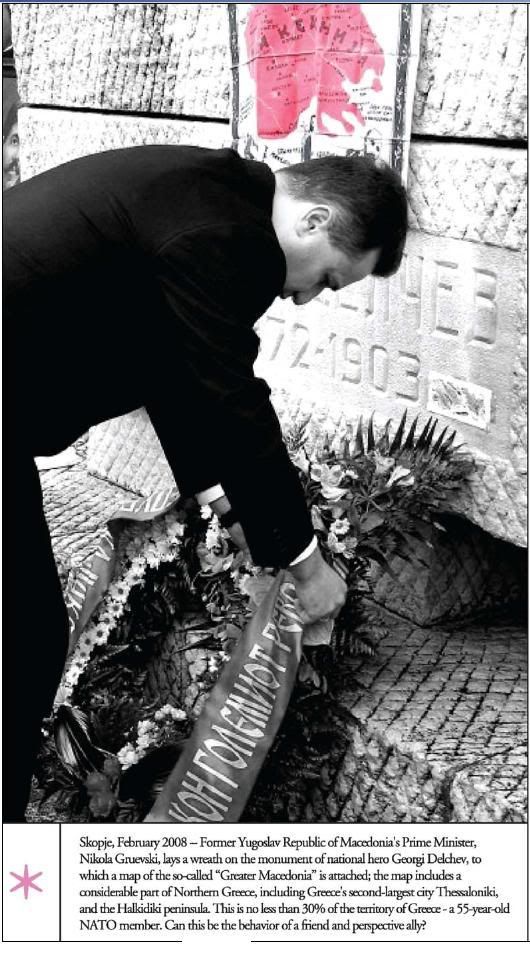
Skopje, Febrary 2008 - Former Yugoslav Republic of Macedonia's Prime Minister, Nikola Gruevski, lays a wreath on the monument of national hero Georgi Delchev, to which a map of the so-called "Greater Macedonia" is attached; the map includes a considerable part of Northern Greece, including Greece's second-largest city Thessaloniki, and the Halkidiki peninsula. This is no less than 30% of the territory of Greece - a 55-year-old NATO member. Can this be the behavior of a friend and perspective ally?


Why is it time to end the debate?

Today, the conditions for achieving a breakthrough are better than ever. Greece is the single largest investor in the Former Yugoslav Republic of Macedonia (FYROM). Athens supports FYROM's bids for NATO and EU membership, but this crucial issue must be resolved first Alliances and partnerships can only be fostered among countries if there is good will, mutual trust and good neighbourly relations.

source:.sae.gr

Absolut Truth exposing US Hypocrisy


Greece has been often ridiculed for its insistence that its Slavic neighbors abandon the name 'Macedonia'.

"What is the big deal?" many have asked.
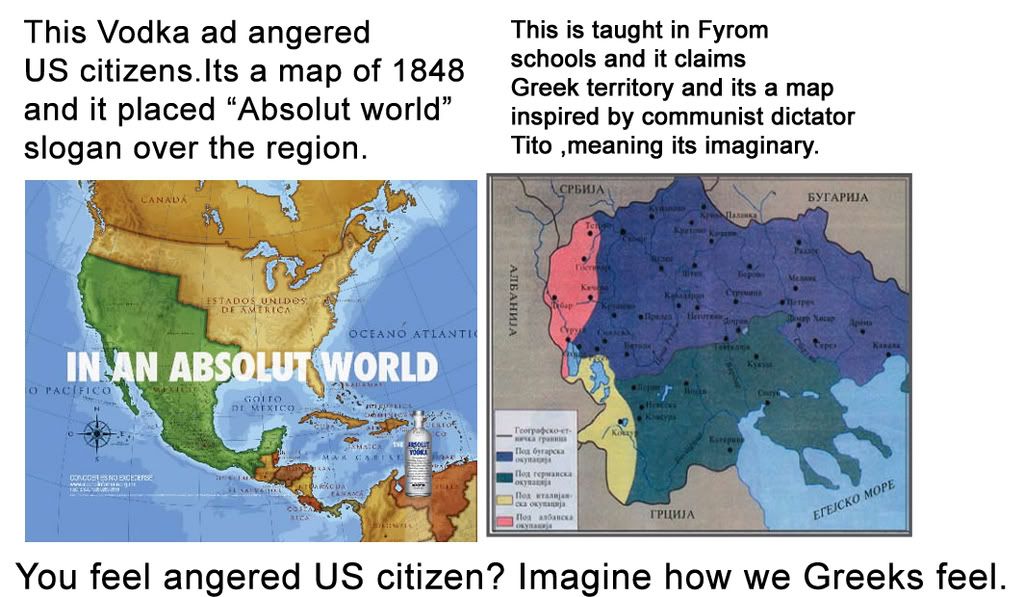
Yet, when an Absolut Vodka ad appeared depicting an early 19th century map showing chunks of the United States as Mexican, most Americans got so upset to the point to boycott the popular drink. If Absolut Vodka has brought such an insult to the USA for a less than 2 centuries old issue, imagine the audacity of FYROM for plagiarizing Greek history and national identity that has stood for over 2000 years.

The Vodka ad was nothing more than a marketing ploy. FYROM, by adapting the name Macedonia, not only have they taken a name that does not reflect their origins, history, or identity but have used the name as a basis to claim parts of Greece as theirs.

The Macedonia issue is not a marketing ploy for Greece to sell products. It is part of its history and identity for over 2000 years and it will not be sold to anyone to accommodate their special interests and malign intentions.

Maybe now the State Department and Ms. Rice can understand why Greece is so adamant about the issue of the name of Macedonia.

source:

Monday, April 07, 2008

Hello Skopje: Who told you the road to NATO always runs through Washington?


7 April 2008 - Issue : 776
(Airgram No. 1)
April 2-4 NATO Summit at Bucharest covered many issues, and much of the world would reasonably argue that the broader discussion of NATO missile defense options, expanded troop deployments to Afghanistan, and NATO's eventual admission of Ukraine and Georgia -- in view of Russian objections -- were far more important that adding three new Balkan members that have been in the pipeline for some time: Albania, Croatia and the Former Yugoslav Republic of Macedonia (FYROM).
Nevertheless, the failure of NATO to agree on FYROM's accession this time around grabbed a few headlines/editorials, while the equally significant admission of Croatia and Albania got almost no attention.Readers have no doubt seen extensive commentary on Greece's leading role in blocking FYROM's accession before its name dispute with Greece has been resolved. It had help of course from other European allies, most notably France. Well done.
Under the smokescreen of competing nationalisms regarding the name issue (which have filled Balkan blog space for nearly as long as it has existed), a key question has surfaced in the last month about why the U.S. has so forcefully led the charge for FYROM's admission. Was the name issue with Greece resolved? Was there a realistic chance for progress?
Were a few hundred Macedonian troops in Afghanistan in Iraq all that were needed to buy a NATO admission chit in Washington? Was FYROM really at the NATO standard in terms of domestic reform? (There is substantial debate about whether FYROM is treating its large Albanian component fairly and allowing equal participation in state and military institutions. Try and find anybody in western FYROM who would argue that these criteria have been met).
From this desk one can conclude that the Bush Administration ignored those issues and focused exclusively on the "L" word. - Legacy. Damn the torpedoes; NATO in its present form exists to deliver a foreign policy "success" for the Bush team, at any cost. We are left with the impression that the callousness of this approach to NATO ally Greece's sensitivities is proof that "business as usual" is the name of the game in the White House and the rapidly emptying State Department.
The Global War on Terror is the only ticket that Skopje believed it had to punch, leaving unresolved its dispute with Greece, since Washington was going to miraculously bully Athens into compliance. Nice try. Did someone forget to tell Skopje about NATO consensus rules?
For the record, it might be useful to quote the text of the key U.S. Government "Airgram" laying out Washington's initial views regarding rumors about a new Macedonian state at he end of WWII (usually longer documents, used alongside telegrams until the 1980's, to circulate policy statements and or reports to/from U.S. embassies abroad).
Haps Borgen


"The Department has noted increasing propaganda rumors and semi-official statements in favor of an autonomous Macedonia, emanating principally from Bulgaria, but also from YugoslavPartisan and other sources, with the implication that Greek territory would be included in the projected state.
This Government (of USA) considers talk of Macedonian "nation", Macedonian "Fatherland", or Macedonian "national consciousness" to be unjustified demagoguery representing no ethnic, nor political reality, and sees in its present revival a possible cloak for aggressive intentions against Greece.
The approved policy of this Government is to oppose any revival of the Macedonian issue as related to Greece. The Greek section of Macedonia is largely inhabited by Greeks, and the Greek people are almost unanimously opposed to the creation of a Macedonian state.
Allegations of serious Greek participation in any such agitation can be assumed to be false.
This Government (of USA) would regard as responsible any Government or group of Gonernments tolerating or encouraging menacing or aggressive acts of "Macedonian forces" against Greece".

STETTINIUS U

Sunday, April 06, 2008

NATO and EU members is this supposed to be an Ally?

This is the Prime Minister of the Former Yugoslav Republic of Macedonia(F.Y.R.O.M), Nikola Gruevski, during an official state ceremony.
Along with the name dispute irridentist overtures such as the following from F.Y.R.O.M's cultural and governmental institutions resulted in Greece blocking F.Y.R.O.M's NATO invitation.
No further commentary necessary.


Friday, April 04, 2008

Jewish community slams Greek flag insult


The historic Jewish community of Thessaloniki on Thursday issued a statement sharply condemning the recent defacing of the Greek flag in billboards put up in the city of Skopje -- the white Cross on the flag was replaced with a Swastika -- as well as a local magazine's caricature of Greek Prime Minister Costas Karamanlis' dressed as an SS officer.
"The defacing of the national symbol and the attempt to depict the Greek prime minister to a Nazi officer constitute unacceptable actions and an insult to the Greek people as a whole including members of the Jewish Community of Thessaloniki," the statement reads, days after the billboard posters appeared -- and subsequently disappeared -- in the capital of the Former Yugoslav Republic of Macedonia (FYROM).
The statement adds that these actions become more heinous because Greece was among the first countries in Europe to clash with the tide fascism and the first to defeat Axis Forces on the battlefield in WWII, referring to the Albanian front (1940-1941), "where Jewish and Christian Greeks fought side by side."
"Furthermore, the use -- for the sake of creating impressions -- of symbols that are directly linked with the period of the worst crimes committed against humanity is an insult to the memory of the six million victims of the Holocaust and those who survived the horror of the Nazi concentration camps," the statement reads.
"Our Community welcomes the stance adopted by French President Nicolas Sarkozy, a descendant of the Mallah family from Thessaloniki, who backed Greece's positions on the self-evident Greekness of Macedonia," the statement concludes.

The Academy of Athens' public position on the Macedonian Issue


The Academy of Athens, conscious of its scholarly mission, considers that a viable solution to the problem of the name of FYROM is possible only on the basis of an accurate evaluation of the facts. The Academy, therefore, is making public its own well-documented views. It also considers it a felicitous circumstance that scientific truth is consistent with reality and ensures the stability and peacefulness of a region that has suffered grievously both in the remote and in the recent past.
  1. Today, Macedonia forms a geographic zone whose borders extend to more than one of the states of Southeastern Europe. A specific region of modern Greece bears the ancient Greek name "Macedonia". One of the federal states that constituted the former Republic of Yugoslavia functioned under the name "Socialist Republic of Macedonia" (SRM). However, for many centuries in Antiquity, the name Macedonia designated an area about 90% of which is coincident with the modern Greek region of Macedonia. If this name were given to an independent state, without further specification that would clearly reflect these geographic and historical realities, it would entail the danger that the state in question might claim, and even claim exclusively, the use of the term "Macedonia" or its derivatives to describe its history, civilization, everyday political and social life, etc.
  2. Specifically, the ancient Macedonian state of Philip and Alexander the Great extended in the north to the lands of the modern Greek Macedonia, as well as a few kilometers into both the modern FYROM and Bulgaria. Every kind of historical source as well as archaeological finds proves that at the time the ancient Macedonians included their state among the other Greek lands. The first Slavic peoples which, obviously, had no relation whatsoever with the previous inhabitants of the region, entered the Balkans ten centuries later, in the seventh century A.D. Their presence in the area from that point on contributed to the gradual formation of various Slavic ethnicities. During the creation and the first development of the Slavic states of the area in the 19th century (Serbia, Montenegro, Bulgaria), there was no reference to a "Macedonian" nation. It is telling that even in the aftermath of the First World War, neither the representatives of the Balkan states, nor those-Woodrow Wilson being primary among them - who constructed the peace, men who, precisely, held the vision of an international community consisting of nation-states, ever hinted at a "Macedonian" nation. The effort to establish the existence of such a nation dates to the time of Marshal Tito, when he was engaged in creating the new federal republic of Yugoslavia in the aftermath of the Second World War. Indeed, the success of the daring endeavor undertaken since that time, that is, the transformation of the ethnicity of the Slav inhabitants of that particular geographic area, would have been impossible without the propaganda disseminated for almost half a century by a totalitarian regime.
  3. The geographic unit of Macedonia is a reality that is independent of any ethnological, political, or administrative division in the Southern Balkans. During the centuries-long Ottoman rule, the geographic area of "Macedonia" included the vilayets of Thessalonike and Monastir, and part of the vilayet of Kossovo to which belonged the sanjak of Skopje. The extension of the geographic borders of "historic" Macedonia towards the north is connected to the mapping of the region by the first European cartographers, after the Renaissance. These maps were composed on the basis of views that had prevailed in Roman times. However, neither then nor in modern times until the Second World War was there an ethnic content to the characterization of the inhabitants as Macedonian. The fact that, in the second half of the 19th century, Serbs and Bulgarians raised claims upon the lands that were inhabited by a majority of Slavic people is doubtless connected to the ethnic make-up of these specific geographic areas. By the same token, it is obvious that the same principle is also applicable to the larger areas of southern Macedonia that are inhabited by Greeks.
  4. The lessons one can draw from the authoritative analysis of the historical past are congruent with the necessity to achieve a solution that promotes peace and stability in the region. The artificial creation of one single "Macedonia" would necessarily be linked to the revival of outdated expansionist designs. To the contrary, scholarly analysis suggests the adoption of a compound name with a geographic content, and with respect for the distinction between ancient Macedonia and the state of FYROM. That would serve both the truth and the present-day needs of the geographic region and of the larger area surrounding it. The profound interest of the Greeks in the matter does not indicate any desire to contest the rights of their northern neighbors, even those rights that were but recently acquired. The position of the government and of the vast majority of the political forces in Greece is clear on this issue. The Greek interest does indicate the concern of public opinion in the face of intransigent provocations on the part of Skopje that tend-as is evident even in the school textbooks-not only to appropriate but even to monopolise the history, the cultural achievements, the symbols--including the ancient ones--, the monuments, and the personalities that were active in the Macedonian area in the past. It is self-evident that the expression of good will on the part of any Greek government is not sufficient to overcome the fact or the effects of nationalist excesses similar to those that were artfully cultivated during the post-war period.


The findings mentioned above argue for a solution to the problem that should not be unilateral. Greece holds firmly a position that leads to the consolidation of peaceful coexistence and cooperation among the peoples of the southern Balkans. On the contrary, the option to protract the impasse surrounding the name of FYROM not only nourishes designs that continue to be expansionist, but also perpetuates or even exacerbates the more general instability on a broader or narrower regional scale. Thus, privileging the current geographic realities, although it does not always satisfy the demands of history, especially the history of Antiquity, does nevertheless provide the basis for an honorable, final, and henceforth uncontested solution of the problem.

press release 28/3/2008

Thursday, April 03, 2008

FYROM should not be invited to join NATO


The crucial dinner of NATO member-state leaders has ended in Bucharest. Greek Prime Minister presented the Greek arguments, as per which FYROM should not be invited to join NATO. Meanwhile, as per Reuters, NATO leaders will postpone inviting FYROM (Former Yugoslav Republic of Macedonia) to join NATO. The leaders, who attended today’s dinner concluded that FYROM cannot be invited to join NATO in the present phase as Greece cannot consent to its entry unless the name issue is resolved first.


For your information during the crucial dinner of NATO member-state leaders the NATO members France, Spain, Portugal, Italy, Bulgaria, Luxemburg, Iceland and Germany stand close beside to the Greek position as real NATO allies when ....
USA and Canada followed the Bush dogma “You’re either with us or against us".
Bush administration divide with his policy and the NATO alliance.


Media news sources in Greek
Greece vetoes invitation to FYROM for NATO entry

Greek Prime Minsiter Costas Karamanlis on Wednesday night vetoed a NATO invitation to the Former Yugoslav Republic of Macedonia (FYROM) to join, during an alliance crucial summit in Bucharest.

Addressing the leaders' dinner, which signaled the opening of the summit, Karamanlis outlined Greece's positions on the isuue, underlining that it cannot consent to a FYROM NATO entry invitation if the "name issue" of the former Yugoslav republic is not resolved first.

France, Italy, Spain, Iceland and Luxembourg expressed their support to Greece's positions, while Hungary, Slovakia, Belgium, the Netherlands and Germany viewed with understanding the Greek arguments.

Opposing the Greek position and supporting an invitation without conditions to FYROM, were Turkey, Slovenia, the Czech Republic, Estonia, and Lithuania.

Denmark, Bulgaria, and Norway, although moving in the same direction, were less enthousiastic. Canada, Great Britain and Portugal refrained from taking a stand.

French President Nicolas Sarkozy was the wormest supporter of the Greek positions, who said in his address that "We stand in solidarity with Greeks, we believe that a solution must be found. I have Hungarian roots, but I also have Greek roots and I fully assume them."

During a reception preceding the official dinner, Premier Karamanlis held a brief conversation with U.S. President George W. Bush.

In a related development, NATO spokesman James Appathurai told reporters in Brussels after the end of the Bucharest dinner, that Greece made clear that despite the fact that it wants to see FYROM joining NATO the soonest possible, it is not possible to give its consent as long as the neighbouring republic's "name issue" remains unresolved.

According to an ANA-MPA dispatch from the Belgian capital, Appathurai added that, given Greece's position, efforts for resolving the "name issue" should continue, noting at the same time that all NATO member-states wish for a compromise solution as soon as possible, without this meaning that concrete timeframes have been set.
source:ana-mpa

Tuesday, April 01, 2008

So what if the US gets mad?


By Alexis Papachelas


I must admit to being surprised at US Secretary of State Condoleezza Rice’s recent statement regarding the Macedonia name dispute: “It would be a pity if something that has to do with antiquity were to get in the way of what I think is a very important step for Macedonia and NATO.” It was not the reference to antiquity that surprised me, for I have often heard foreigners being sarcastic about it when discussion turns to the Macedonia dispute, and especially Americans, who detest history and adore simple, practical solutions to diplomatic problems, who break out in hives if you ever try to explain something that is more than five or 10 years old.


What surprised me was Rice’s complete lack of diplomatic tact. After thinking about it for a while, though, I came to the conclusion that it made sense in a way. Greece could depend on Washington’s support provided at least one of three things were true: 1) Washington considered Greece a close partner; 2) The USA really needed Greece to be on its side or shuddered at the thought of more anti-American sentiment being expressed in the country; and 3) The White House was coming under pressure from a very strong lobby.
A sober look at he facts tells us, first of all, that Washington does not feel it has much to gain from Greece. In contrast, it sees Athens playing its own game with Russia and disagreeing with Washington on every open front of international politics.
If the dogma “You’re either with us or against us” is anything to go by, then Greece certainly is not a member of the small USA fan club. The Americans do not need Greece for anything and any rise in anti-American sentiment in Greece is dismissed as being rather silly, even inane.
As far as the lobby is concerned, unfortunately that disappeared years ago. The present-day American archbishop, a wise and respectable man, bore the brunt of President George W. Bush’s sarcasm in the past when he brought up the name dispute. The lobby no longer exists and it poses a threat to no one.
When the Greek government decided to persist in its efforts to link a settlement of the name dispute with FYROM’s NATO bid, some said that Washington would eventually support Greece’s position, but that has not happened.
Greece must finally come to terms with the fact that America is not, in cold geopolitical terms, “our friend” in the name dispute. It is, in fact, very likely that at the summit in Bucharest the Greek prime minister will be facing a tough adversary in the US. And this will be when we will all have to reflect upon the other aspect of Greek-American relations, the one in which Greece, a European country with its own interests, has nothing to fear from American displeasure. Just as they don’t need us, so we don’t need to worry about them getting angry.
source: ekathimerini