Sunday, April 27, 2008

FYROM pseudo-macedonism and Afrocentrism, brotherhood extreme ideologies

Importunely Afrocentrism is a big issue as about the Hellenic heritage. FYROM propaganda and some net-historians (Stefou or Stefov) adopted and contribute some points of the Afrocentric theory.

FYROM Diaspora propaganda (Chris Stefou) recently touches the Bernal Theories and the supposing connection of the ancient Hellenic Heritage and the African. When Bernal said African mean Egyptian. But when Stefou mean African mean African by skin colour. To the extent that Stefou (and his writers) has contributed to the provision of an apparently respectable underpinning for Afrocentric fantasies, he must be held culpable, even if his intentions are honourable and his motives are sincere. But not even he has dealt with the racial issue squarely.

Here some examples that post it from Chris Stefou (aka Risto Stefov) in maknews web site (Lubi Uzunovski) ……

http://www.maknews.com/html/articles/stefov/digest_15.html
http://www.maknews.com/html/articles/stefov/stefov75.html

Some crucial points is the meaning of the Afrocentrist and Slavmacedonist.

Afrocentrists are extreme diffusionists who argue that black Egypt—and sometimes black Africa—was the sole intellec­tual catalyst for the development of most subsequent civilizations, no matter how geographically remote the latter may have been. Virtually all Afrocentrists are black, although there are a few white contributors such as Martin Bernal.
Slavmacedonists are extreme diffusionists Slavmacedonians who argue that the Slavonic people of the geographical Macedonia are the descents of the ancient Macedonians. Slavmacedonists attempt is to discredit the ancient Macedonians’ ethnicity, break the connection between present-day Greek Macedonians and the Greek Macedonians of antiquity, and establish a connection between FYROM’s Slavs with ancient Macedonia. The historically, linguistically and archaeologically incorrect challenge is that Macedonia was never part of Greece and the Macedonians were barbarians who spoke a language in comprehensible to the other Greeks.

Slavmacedonist view of "blacks" and the similar Afrocentric outlook appear with increasing frequency in current discussions of university curricula and internet forums, proposals for the revision of courses of study for elementary and secondary schools, and the popular press. I have space here to illustrate only a few of the consequences resulting from the Slavmacedonist -Afrocentrist approach to blacks in the ancient Mediterranean world. Not the least of these outcomes has been a failure of many Afrocentrists to give proper attention to Nubians and their experience in Egypt, Greece, and Italy, although Nubians were the only Africans whose physical characteristics, according to the ancient evidence, most closely resembled those of peoples described as blacks or Negroes in modern usage.

Slavmacedonists lately (as Afrocentrists long time) maintained that the history of blacks has been distorted or neglected in traditional curricula. Many historians and educators have agreed that this has often been the case, and specialists have pointed to "omissions and errors which have passed for the truth".


Many Slavmacedonists as Stefov, Uzunovski, and Boris Soposki however, continue to reject valid criticisms of their inaccuracies and denounce their critics as Eurocentric racists if they are white and as dupes of white scholarship and traitors to their race if they are black. It is neither racist nor traitorous, however, to insist upon truth, scholarly rigor, and objectivity in the treatment of the history of blacks.

The purpose of history as Arthur Schlesinger says is to promote not group self-esteem, but understanding of the world and the past, dispassionate analysis, judgment and perspective, respect for divergent cultures and traditions, and unflinching protection for those unifying ideas of tolerance, democracy, and human rights that make free historical inquiry possible.

But we the Greeks what must we do in order to protect our history and heritage from the Slavmacedonists and Afrocentrists?

One strategy is to ignore the geographer (Stefou) who teaches (Propaganda books and Internet) that the earth is flat (the Slav the continue of the Macedonia heritage) .

Of course, teaching false information about Alexander and Aristotle will not put anyone in immediate physical danger. But nonetheless these untruths do injustice, not only our Heritage ancestors (ancient Greeks) who have been falsely maligned, but and us, the modern Greeks.

Why deprive the Greeks of their heritage, particularly if the charges against the ancient Greeks can decisively be shown to be wrong? Why encourage hostility toward any ethnic group? Haven't we seen enough examples in this century of the horrific results of teaching hostile propaganda?
Probably Stefou forgot that skin colour and ethnicity are two different thinks. But what did the ancient Greeks look like? From portraits on seal-rings, paintings on vases, and sculptures in clay and stone, it is possible to get a good sense of how they saw themselves. Written texts describe a variety of hair color, ranging from brown to black, and skin color ranging from light to dark. Vase paintings, because of the limited colors available to the potters, give a more schematic impression. Women are usually portrayed with white faces. If the background of the vase is black, the men have black faces; if the background is the color of the clay from which the vase is made, men have reddish-brown faces. They distinguish themselves clearly from Egyptians and Ethiopian peoples in their art and literature. The Africans have flat noses, curly hair, and thick lips; their skin color is portrayed with black glaze or, on occasion, plain unglazed terra-cotta.

They regularly speak of the Egyptians' dark skin, and sometimes of their curly hair. Herodotus supposed that the Colchians (a people who lived on the eastern coast of the Black Sea were Egyptian because they were dark-skinned and curly-haired. He identifies a pair of doves as Egyptian in origin because they are "dark".

Slavmacedonists of course avoid cruising with Afrocentrists claims when the latter speaks for "black" Cleopatra theory and the stolen legacy of Aristotle .

In summary, despite abundant textual and iconographic evidence to the contrary, many Slavmacedonists have used "black," "Egyptian," and "African" interchangeably as the equivalents of blacks/Negroes in modern usage. According to this misinterpretation, ancient Greeks were blacks, and their civilization, an important part of the world heritage has been "covered up" by white racists.

Focusing on "black" Egypt, Slavmacedonists as also and the Afrocentrists have given insufficient attention to the Nubians, the black southern neighbours of Egypt, and their experience in various parts of the Mediterranean world.

It is unfortunate that Slavmacedonists fail to realize the serious consequences of their distortions, inaccuracies, and omissions, and the extent to which the phil-Afrocentrist approach to ancient Egypt has motivated many blacks to stir up anti-white hostility.

Substituting fiction for fact is a disservice to blacks. 20th century has already seen sufficient proof of the dangers of inventing history. What will be the effect on future generations, black and white alike, if the present "mythologizing" Slavmacedonist-Afrocentrist trend continues, and if the historical record is not rectified?

The time has come for scholars and educators to insist upon truth, scholarly rigor, and accuracy in the reconstruction of the history of blacks and whites in the ancient Mediterranean world.

What will be the effect on future generations, black and white alike, Slavs ,Greeks, Albanians, Turks e.t.c. if the present "mythologizing" Slavmacedonists trend continues, and if the historical record is not rectified?

The time has come for scholars , educators , common people like us to insist upon truth, scholarly rigor, and accuracy in the reconstruction of the history of Slavmacedonists like Stefou(Risto Stefov) and Afrocentrists like Bernal, in the ancient Mediterranean world and not only.


Greeks had demonstrated their own originality and creativity in the several sciences, philoso­phy, and mathematics, and that they had not stolen it all from some chimera of an Egyptian Mystery System, which has existed more in the fevered imaginations of Afrocentrists and Slavmacedonists than it has in physical and intellectual reality.

references

  1. Macedonism
  2. Black Athena Revisited, edited by Mary Lefkovitz & Guy Maclean Rogers
  3. White Athena: The Afrocentrist Theft of Greek Civilization by Walter Slack
  4. Macedonianism : FYROM'S Expansionist Designs against Greece, 1944-2006.

Wednesday, April 23, 2008

Fundamentally Freund: It's Greek to me

Fundamentally Freund: It's Greek to me
Once upon a time, and it seems like it was truly a very long time ago, Israel knew how to stand on principle.
Attacks on our citizens were met with swift and forceful retaliation. Talk of surrender alluded to our foes, rather than to official Israeli government policy, and we didn't hesitate to defy the world when necessary in order to defend ourselves.
The spirit of Entebbe, Osirak and yes, the Six Day War, sparked our imagination, filling us with pride at the valor and heroism of the modern-day Jewish warrior. Our lives had meaning, our society had a purpose, and the nation's overriding goal was to build the land, rather than withdraw from it.
But all that appears to have changed. Our leadership's infatuation with retreat has become an obsession. Yesterday's trial balloons have become today's diplomatic agenda, and what was once considered unthinkable, such as the division of Jerusalem, is now suddenly looming over the horizon.
How did we reach this point?
How could we sink so low so swiftly? Well, you might be saying to yourself, we don't have a choice. We're a small country, with limited resources.
What else can we do?
Do you really think we can stand up to the rest of the world?
Heck yes.
If you think this is naïve, just take a look at Greece, which recently stared down the entire Western alliance over an issue of semantics.
EARLIER THIS month, at a NATO summit in Bucharest, Greece singlehandedly caused a major diplomatic imbroglio, scuttling the expansion of NATO and defying the will of nearly all of its friends and allies, for the simple reason that it objected to the name of its neighbor, Macedonia. Macedonia, which used to be part of Yugoslavia, had been hoping to receive a formal invitation to join the trans-Atlantic coalition, as a means of further deepening its integration into the West.
"But Athens blocked the invitation," the Associated Press reported on Monday, "to protest Macedonia's name, saying it implies a claim to a northern region of Greece also called Macedonia." As the Greek Foreign Ministry Web site explains, "The choice of the name Macedonia directly raises the issue of usurpation of the cultural heritage of a neighboring country. The name constitutes the basis for staking an exclusive rights claim over the entire geographical area of Macedonia."
In other words, Greece is willing to risk the wrath of the United States, Britain and the rest of the NATO coalition, merely because they believe that Macedonia's choice of name masks expansionist ambitions that threaten to undermine their sovereignty and territorial integrity.
The boldness of Athens's position becomes even more apparent when one considers that over 100 countries formally recognize Macedonia as Macedonia. Nonetheless, Greece stubbornly continues to insist that it be referred to as the "Former Yugoslav Republic of Macedonia," or FYROM.
There are those who will look at the Greek position with raised eyebrows, wondering what all the fuss is about. After all, who cares about names?
But I applaud their resolute determination to stand firm and defend what they consider to be their national interests, even at the risk of international opprobrium.
Indeed, Greek Foreign Minister Dora Bakoyannis didn't hesitate to announce publicly in March that "as regards the Former Yugoslav Republic of Macedonia… the policy followed by our neighboring country in its relations with Greece, on the one side with intransigence and on the other with a logic of nationalist and irredentist actions tightly connected with the naming issue, does not allow us to maintain a positive stance."
"As long as there is no such solution," she added, "Greece will remain an insuperable obstacle to the European and Euro-Atlantic ambition of FYROM."
Imagine that. A country that is prepared to stand up for itself and proudly declare its willingness to be "an insuperable obstacle" over a matter of principle!
If only Israel and its leadership would learn from Greece's example.
Instead, we are being led by the nose inexorably towards catastrophe, unwilling to buck international pressure even when it threatens to undermine our very existence.
There is, of course, an expression that something "looks like Greek to me" when we can not begin to fathom what it says.
But this is one case where Israel would do well to start deciphering the words. And fast.

Tuesday, April 22, 2008

To FYROM Slavmacedonian citizens....your politicians say lies !!!

Today in the media news we read that Slavmacedonian President of the FYROM State Crvenkovski in a letter that sent to the UN Secretary General Ban Ki-moon accused Greece that violated the Interim Accord by the recent blatant breach of Article 11 when it vetoed “Macedonia's” membership in NATO at the Bucharest Summit.

Slavmacedonian President of the FYROM Crvenkovski claim also that Article 11 of the Interim Accord, pursuant to which Greece shell not block “Macedonia's” admittance in international organizations if the country is named under the temporary reference.

Evidence 1
Let’ see what article 11 mentions……

Article 11
1. Upon entry into force of this Interim Accord, The Party of the First Part (Greece) agrees not to object to the application by or the membership of the Party of the Second Part (FYROM) in international, multilateral and regional organizations and institutions of which the Party of the First Part is a member; however, the Party of the First Part reserves the right to object to any membership referred to above if and to the extent of the Party of the Second Part is to be referred to in such organization or institution differently than in paragraph 2 of the United Nations Security Council resolution 817 (1993).

2. The Parties agree that the ongoing economic development of the Party of the Second Part should be supported through international cooperation, as far as possible by a close relationship of the Party of the Second Part with the European Economic Area and the European Union.

source:
macedonia-heritage.gr

My question is......
Did FYROM applicated as "Macedonia" or as FYROM ?
because according your Slavmacedonian President Greece block “Macedonia's” admittance and according the Interim Accord , Greece has the right to do.


Evidence 2
Let’ see what Bucharest NATO Summit Declaration mentions……


22
We recognise the hard work and the commitment demonstrated by the former Yugoslav Republic of Macedonia to NATO values and Alliance operations. We commend them for their efforts to build a multi-ethnic society. Within the framework of the UN, many actors have worked hard to resolve the name issue, but the Alliance has noted with regret that these talks have not produced a successful outcome. Therefore we agreed that an invitation to the former Yugoslav Republic of Macedonia will be extended as soon as a mutually acceptable solution to the name issue has been reached. We encourage the negotiations to be resumed without delay and expect them to be concluded as soon as possible.


source:
nato.int

My question is........
Did NATO Summit Declaration mention that Greece vetoed “former Yugoslav Republic of Macedonia's” admittance in order to accused her that violated the Interim Accord ?
because nowhere mention that Greece done this action.

Monday, April 21, 2008

Chris Woodhouse on Macedonia Issue

from the book Plundered Loyalties by John S. Koliopoulos ........

Long ago, in the evil days of Hitler, the British Prime Minister, Neville Chamberlain, described Czechoslovakia as 'a far-away country'of whose people 'we know nothing'. The same tragic error might easily be made today concering Macedonia.

How well known is it in the West that there are two Macedonias, separated by a commonfrontier?

How many know that the northem mini-Macedonia, known officially at the time of writing as the Former Yugoslav Republic of Macedonia, has a seat at the United Nations, whereas the southern mega-Macedonia does not, because it is not a 'nation- state' but only a province ofGreece? How many have noticed that the acronym FYROM is already relapsing into 'Macedonia' tout court, so that its representative in New York will soon sit behind a tablet simply inscribed 'Macedonia', thus implying that his state alone can rightly claim a Macedonian identity?

This upstart mini-Macedonia is a product ofthe terrible conflict which is described here by Professor John Koliopoulos. It did not appear as Macedonia on any map before the Second World War. It is a landlocked area with no natural boundaries. Its population, apart from the usual Balkan niinorities, is mainly Slavonic and Albanian. As 'Macedonia' it was a creation of Tito, to provide a launching-pad from which to invade and take over the real Macedonia in northern Greece. The real Macedonia, on the other hand, has a history of at least three millennia: it was the homeland of Alexander the Great; the first country in Europe to which St Paul was invited to 'come over and help us'; the mainstay of-the Allied defence against Mussolini in 1940, when (as we chose to put it) Britain 'stood alone'; and the birthplace ofmodem Greece's outstanding Prime Minister, Constantine Karamanlis.

Greek Macedonia, however, also included small minorities in unexpected numbers. It was these, rather than Communist ideology, that helped to fuel the agony of the 1940s - although of course the Communist parties both at home and abroad did their utmost to add to the fuel. It is to these minorities rather than to the distant thunder of Stalin and Tito that Professor Koliopoulos gives his closest and most objective attention. To me this is particularly impressive, because I knew many oftheir leading spirits personally, which Professor Koliopoulos, belonging to a different generation, cannot have done. He portrays them with a psychological intuition in which I can find no fault. For a Greek born in Macedonia and now a Professor at the University of Thessaloniki - the capital of Macedonia, and the 'second capital' of Greece - that is no easy achievement.

It is worth quoting a single example. Andreas Tzimas, who is prominent in the first part of Professor Koliopoulos's work, was a Vlach born in Greek Macedonia. He had a first-class brain and a sense of humour. He spoke many languages, but not English. He was a member of the Central Committee of the Greek Communist Party (from which, of course, he was ultimately expelled as a 'deviationist' like so many others). lowed my life to him once, when I was nearly trapped in Athens by the Sicherheitsdienst.

from his book "The Struggle for Greece 1941-1949" and page 67........

Most of the Slavophone inhabitants in all parts of divided Macedonia perhaps a million and a half in all - felt themselves to be Bulgarians at the beginning of the Occupation; and most Bulgarians, whether they supported the Communists, IMRO, or the collaborating government, assumed that all Macedonia would fall to Bulgaria after the war. Tito was determined that this should not happen. The first Congress of AVNOJ in November 1942 had paranteed equal rights to all the 'peoples of Yugoslavia', and specified the Macedonians among them. By inplication, the guarantee could be extended to Pirin (Bulgarian) Macedonia and Aegean (Greek) Macedonia. The Communist Party of Macedonia, which had passed through a troubled time, first under a pro-Bulgarian leadership and then under pro-Yugoslav Macedonians, was taken in hand early in 1943 by Tempo, who formed a new Central Committee and informed it that it was now an integral part of the Yugoslav CP.

After suitable re-indoctrination, the Macedonian CP issued a pro-Yugoslav 'Ilinden Manifesto' on 2 August, the anniversary of a national rising in 1903. Tempo told them that they could look forward to unification and autonomy within a Yugoslav Federation. This prospect was confirmed by resolutions passed at the second Congress of AVNOJ, held at Jajce at the end of November. It was said to have the approval of Moscow, but this was untrue. Stalin expressed indignation, and so did the Fatherland Front of Bulgaria (including, but not yet dominated by, the Communists), which urged a rival policy of 'an integral, free and independent Macedonia'. Tito in turn repudiated this policy in a message to Dimitrov on 24 January 1944.

Saturday, April 19, 2008

Why doesn't the Greek government recognize the "Macedonian" minority?

In Greece Slavmacedonians have theirs political party. In a modern European democracy with absolutely free elections, like Greece, political views are judged according to the response they receive from citizens. In this particular instance judgement has been passed.
Rainbow failed.
They speak for 6.600 votes.Consider two thinks when we read this number
  • Rainbow coloborated in the past with the extreme communist party OAKKE
  • Rainbow votes in Macedonia were only 3000 (with OAKKE) .

Greeks have been sending their children to Macedonian schools for years, expecting them to learn Greek, not Bulgarian. Macedonian people (Greeks) are already a majority in Greece, with Macedonian churches, schools and cultural centers teaching Greek and regional dances and songs.Greek government can neither recognize a minority with the same name, as the majority, nor build non-Greek schools and churches with the same name. Greek courts have offered to open cultural centers for their minority, under a different name (than Macedonian). They have refused for obvious reasons since rhey think that they are the only Macedonians in the planet Earth.

As long as they use the term "Macedonian" to describe their nationality, their minority in Greece cannot be recognized since the same name is used by the Greeks of Macedonia to describe themsleves for much longer that the written history of any slavic tribe.

I am a Macedonian, however I am in no way identified with or related to the newly formed independent state referred to as “the former Yugoslav Republic of Macedonia” ; I am instead insulted by the fact that I cannot be known as a Macedonian without being identified by others as related to FYROM.

My identity has been usurped. “Where is the justice ?”, to paraphrase their own words

Saturday, April 12, 2008

FYROM : A challenge for regional stability

Why is the Macedonian question so delicate and complex ?

The term "Macedonia" is not exclusively related to a specific state. Rather, it has always been used to delineate a wider geographical area, approximately 51 % of which is part of Greece, 37% is in the Former Yugoslav Republic of Macedonia, 11 % in Bulgaria and 1 % in Albania The choice of one state alone to monopolize the name "Macedonia" - the largest part of which lies outside its borders - neither reflects geographical and political reality, nor contributes to stability in the Balkans.


Why does Greece oppose the name "Republic of Macedonia"?

"Republic of Macedonia", or just "Macedonia", fails to solve the problem, as it does not distinguish this new country from the Northern Greek region of Macedonia, or from the parts of the wider Macedonia, which are also in Bulgaria and Albania. Furthermore, it is associated with the argument for the unification of "Greater Macedonia" - a policy conceived by Stalin and Tito and pursued by the leadership in FYROM to the present day. The name is therefore linked with an ongoing policy that foresees territorial claims to a part of Greek territory, that has had a Greek identity for more than three millennia, and is associated with immense pain and suffering by the peoples in the region.


Why does Greece favor a compound name?

Greece unlike FYROM has made great strides to try to resolve the name issue under U.N. auspices and has gone more than half-way to find a solution. It has sat at the negotiating table since 1995 and has shown willingness to consider a compound name such as "North Macedonia", which includes the term "Macedonia" but attaches an adjective to it to distinguish it from the Greek province with the same name. This is sensible, reasonable and fair for both sides. A win-win solution.


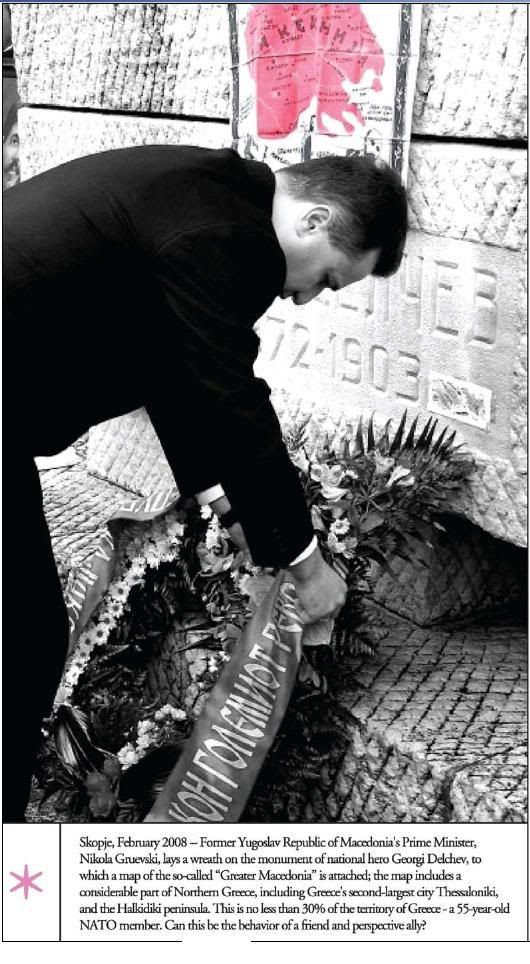
Skopje, Febrary 2008 - Former Yugoslav Republic of Macedonia's Prime Minister, Nikola Gruevski, lays a wreath on the monument of national hero Georgi Delchev, to which a map of the so-called "Greater Macedonia" is attached; the map includes a considerable part of Northern Greece, including Greece's second-largest city Thessaloniki, and the Halkidiki peninsula. This is no less than 30% of the territory of Greece - a 55-year-old NATO member. Can this be the behavior of a friend and perspective ally?


Why is it time to end the debate?

Today, the conditions for achieving a breakthrough are better than ever. Greece is the single largest investor in the Former Yugoslav Republic of Macedonia (FYROM). Athens supports FYROM's bids for NATO and EU membership, but this crucial issue must be resolved first Alliances and partnerships can only be fostered among countries if there is good will, mutual trust and good neighbourly relations.

source:.sae.gr

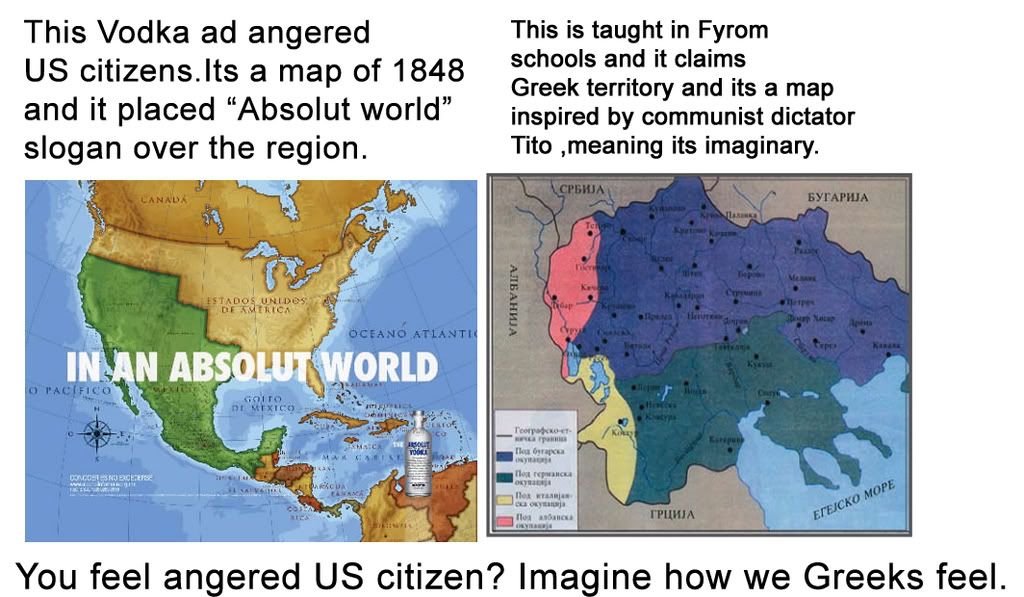
Absolut Truth exposing US Hypocrisy


Greece has been often ridiculed for its insistence that its Slavic neighbors abandon the name 'Macedonia'.

"What is the big deal?" many have asked.
Yet, when an Absolut Vodka ad appeared depicting an early 19th century map showing chunks of the United States as Mexican, most Americans got so upset to the point to boycott the popular drink. If Absolut Vodka has brought such an insult to the USA for a less than 2 centuries old issue, imagine the audacity of FYROM for plagiarizing Greek history and national identity that has stood for over 2000 years.

The Vodka ad was nothing more than a marketing ploy. FYROM, by adapting the name Macedonia, not only have they taken a name that does not reflect their origins, history, or identity but have used the name as a basis to claim parts of Greece as theirs.

The Macedonia issue is not a marketing ploy for Greece to sell products. It is part of its history and identity for over 2000 years and it will not be sold to anyone to accommodate their special interests and malign intentions.

Maybe now the State Department and Ms. Rice can understand why Greece is so adamant about the issue of the name of Macedonia.

source:

Monday, April 07, 2008

Hello Skopje: Who told you the road to NATO always runs through Washington?


7 April 2008 - Issue : 776
(Airgram No. 1)
April 2-4 NATO Summit at Bucharest covered many issues, and much of the world would reasonably argue that the broader discussion of NATO missile defense options, expanded troop deployments to Afghanistan, and NATO's eventual admission of Ukraine and Georgia -- in view of Russian objections -- were far more important that adding three new Balkan members that have been in the pipeline for some time: Albania, Croatia and the Former Yugoslav Republic of Macedonia (FYROM).
Nevertheless, the failure of NATO to agree on FYROM's accession this time around grabbed a few headlines/editorials, while the equally significant admission of Croatia and Albania got almost no attention.Readers have no doubt seen extensive commentary on Greece's leading role in blocking FYROM's accession before its name dispute with Greece has been resolved. It had help of course from other European allies, most notably France. Well done.
Under the smokescreen of competing nationalisms regarding the name issue (which have filled Balkan blog space for nearly as long as it has existed), a key question has surfaced in the last month about why the U.S. has so forcefully led the charge for FYROM's admission. Was the name issue with Greece resolved? Was there a realistic chance for progress?
Were a few hundred Macedonian troops in Afghanistan in Iraq all that were needed to buy a NATO admission chit in Washington? Was FYROM really at the NATO standard in terms of domestic reform? (There is substantial debate about whether FYROM is treating its large Albanian component fairly and allowing equal participation in state and military institutions. Try and find anybody in western FYROM who would argue that these criteria have been met).
From this desk one can conclude that the Bush Administration ignored those issues and focused exclusively on the "L" word. - Legacy. Damn the torpedoes; NATO in its present form exists to deliver a foreign policy "success" for the Bush team, at any cost. We are left with the impression that the callousness of this approach to NATO ally Greece's sensitivities is proof that "business as usual" is the name of the game in the White House and the rapidly emptying State Department.
The Global War on Terror is the only ticket that Skopje believed it had to punch, leaving unresolved its dispute with Greece, since Washington was going to miraculously bully Athens into compliance. Nice try. Did someone forget to tell Skopje about NATO consensus rules?
For the record, it might be useful to quote the text of the key U.S. Government "Airgram" laying out Washington's initial views regarding rumors about a new Macedonian state at he end of WWII (usually longer documents, used alongside telegrams until the 1980's, to circulate policy statements and or reports to/from U.S. embassies abroad).
Haps Borgen


"The Department has noted increasing propaganda rumors and semi-official statements in favor of an autonomous Macedonia, emanating principally from Bulgaria, but also from YugoslavPartisan and other sources, with the implication that Greek territory would be included in the projected state.
This Government (of USA) considers talk of Macedonian "nation", Macedonian "Fatherland", or Macedonian "national consciousness" to be unjustified demagoguery representing no ethnic, nor political reality, and sees in its present revival a possible cloak for aggressive intentions against Greece.
The approved policy of this Government is to oppose any revival of the Macedonian issue as related to Greece. The Greek section of Macedonia is largely inhabited by Greeks, and the Greek people are almost unanimously opposed to the creation of a Macedonian state.
Allegations of serious Greek participation in any such agitation can be assumed to be false.
This Government (of USA) would regard as responsible any Government or group of Gonernments tolerating or encouraging menacing or aggressive acts of "Macedonian forces" against Greece".

STETTINIUS U

Sunday, April 06, 2008

NATO and EU members is this supposed to be an Ally?

This is the Prime Minister of the Former Yugoslav Republic of Macedonia(F.Y.R.O.M), Nikola Gruevski, during an official state ceremony.
Along with the name dispute irridentist overtures such as the following from F.Y.R.O.M's cultural and governmental institutions resulted in Greece blocking F.Y.R.O.M's NATO invitation.
No further commentary necessary.


Friday, April 04, 2008

Jewish community slams Greek flag insult


The historic Jewish community of Thessaloniki on Thursday issued a statement sharply condemning the recent defacing of the Greek flag in billboards put up in the city of Skopje -- the white Cross on the flag was replaced with a Swastika -- as well as a local magazine's caricature of Greek Prime Minister Costas Karamanlis' dressed as an SS officer.
"The defacing of the national symbol and the attempt to depict the Greek prime minister to a Nazi officer constitute unacceptable actions and an insult to the Greek people as a whole including members of the Jewish Community of Thessaloniki," the statement reads, days after the billboard posters appeared -- and subsequently disappeared -- in the capital of the Former Yugoslav Republic of Macedonia (FYROM).
The statement adds that these actions become more heinous because Greece was among the first countries in Europe to clash with the tide fascism and the first to defeat Axis Forces on the battlefield in WWII, referring to the Albanian front (1940-1941), "where Jewish and Christian Greeks fought side by side."
"Furthermore, the use -- for the sake of creating impressions -- of symbols that are directly linked with the period of the worst crimes committed against humanity is an insult to the memory of the six million victims of the Holocaust and those who survived the horror of the Nazi concentration camps," the statement reads.
"Our Community welcomes the stance adopted by French President Nicolas Sarkozy, a descendant of the Mallah family from Thessaloniki, who backed Greece's positions on the self-evident Greekness of Macedonia," the statement concludes.

The Academy of Athens' public position on the Macedonian Issue


The Academy of Athens, conscious of its scholarly mission, considers that a viable solution to the problem of the name of FYROM is possible only on the basis of an accurate evaluation of the facts. The Academy, therefore, is making public its own well-documented views. It also considers it a felicitous circumstance that scientific truth is consistent with reality and ensures the stability and peacefulness of a region that has suffered grievously both in the remote and in the recent past.
  1. Today, Macedonia forms a geographic zone whose borders extend to more than one of the states of Southeastern Europe. A specific region of modern Greece bears the ancient Greek name "Macedonia". One of the federal states that constituted the former Republic of Yugoslavia functioned under the name "Socialist Republic of Macedonia" (SRM). However, for many centuries in Antiquity, the name Macedonia designated an area about 90% of which is coincident with the modern Greek region of Macedonia. If this name were given to an independent state, without further specification that would clearly reflect these geographic and historical realities, it would entail the danger that the state in question might claim, and even claim exclusively, the use of the term "Macedonia" or its derivatives to describe its history, civilization, everyday political and social life, etc.
  2. Specifically, the ancient Macedonian state of Philip and Alexander the Great extended in the north to the lands of the modern Greek Macedonia, as well as a few kilometers into both the modern FYROM and Bulgaria. Every kind of historical source as well as archaeological finds proves that at the time the ancient Macedonians included their state among the other Greek lands. The first Slavic peoples which, obviously, had no relation whatsoever with the previous inhabitants of the region, entered the Balkans ten centuries later, in the seventh century A.D. Their presence in the area from that point on contributed to the gradual formation of various Slavic ethnicities. During the creation and the first development of the Slavic states of the area in the 19th century (Serbia, Montenegro, Bulgaria), there was no reference to a "Macedonian" nation. It is telling that even in the aftermath of the First World War, neither the representatives of the Balkan states, nor those-Woodrow Wilson being primary among them - who constructed the peace, men who, precisely, held the vision of an international community consisting of nation-states, ever hinted at a "Macedonian" nation. The effort to establish the existence of such a nation dates to the time of Marshal Tito, when he was engaged in creating the new federal republic of Yugoslavia in the aftermath of the Second World War. Indeed, the success of the daring endeavor undertaken since that time, that is, the transformation of the ethnicity of the Slav inhabitants of that particular geographic area, would have been impossible without the propaganda disseminated for almost half a century by a totalitarian regime.
  3. The geographic unit of Macedonia is a reality that is independent of any ethnological, political, or administrative division in the Southern Balkans. During the centuries-long Ottoman rule, the geographic area of "Macedonia" included the vilayets of Thessalonike and Monastir, and part of the vilayet of Kossovo to which belonged the sanjak of Skopje. The extension of the geographic borders of "historic" Macedonia towards the north is connected to the mapping of the region by the first European cartographers, after the Renaissance. These maps were composed on the basis of views that had prevailed in Roman times. However, neither then nor in modern times until the Second World War was there an ethnic content to the characterization of the inhabitants as Macedonian. The fact that, in the second half of the 19th century, Serbs and Bulgarians raised claims upon the lands that were inhabited by a majority of Slavic people is doubtless connected to the ethnic make-up of these specific geographic areas. By the same token, it is obvious that the same principle is also applicable to the larger areas of southern Macedonia that are inhabited by Greeks.
  4. The lessons one can draw from the authoritative analysis of the historical past are congruent with the necessity to achieve a solution that promotes peace and stability in the region. The artificial creation of one single "Macedonia" would necessarily be linked to the revival of outdated expansionist designs. To the contrary, scholarly analysis suggests the adoption of a compound name with a geographic content, and with respect for the distinction between ancient Macedonia and the state of FYROM. That would serve both the truth and the present-day needs of the geographic region and of the larger area surrounding it. The profound interest of the Greeks in the matter does not indicate any desire to contest the rights of their northern neighbors, even those rights that were but recently acquired. The position of the government and of the vast majority of the political forces in Greece is clear on this issue. The Greek interest does indicate the concern of public opinion in the face of intransigent provocations on the part of Skopje that tend-as is evident even in the school textbooks-not only to appropriate but even to monopolise the history, the cultural achievements, the symbols--including the ancient ones--, the monuments, and the personalities that were active in the Macedonian area in the past. It is self-evident that the expression of good will on the part of any Greek government is not sufficient to overcome the fact or the effects of nationalist excesses similar to those that were artfully cultivated during the post-war period.


The findings mentioned above argue for a solution to the problem that should not be unilateral. Greece holds firmly a position that leads to the consolidation of peaceful coexistence and cooperation among the peoples of the southern Balkans. On the contrary, the option to protract the impasse surrounding the name of FYROM not only nourishes designs that continue to be expansionist, but also perpetuates or even exacerbates the more general instability on a broader or narrower regional scale. Thus, privileging the current geographic realities, although it does not always satisfy the demands of history, especially the history of Antiquity, does nevertheless provide the basis for an honorable, final, and henceforth uncontested solution of the problem.

press release 28/3/2008

Thursday, April 03, 2008

FYROM should not be invited to join NATO


The crucial dinner of NATO member-state leaders has ended in Bucharest. Greek Prime Minister presented the Greek arguments, as per which FYROM should not be invited to join NATO. Meanwhile, as per Reuters, NATO leaders will postpone inviting FYROM (Former Yugoslav Republic of Macedonia) to join NATO. The leaders, who attended today’s dinner concluded that FYROM cannot be invited to join NATO in the present phase as Greece cannot consent to its entry unless the name issue is resolved first.


For your information during the crucial dinner of NATO member-state leaders the NATO members France, Spain, Portugal, Italy, Bulgaria, Luxemburg, Iceland and Germany stand close beside to the Greek position as real NATO allies when ....
USA and Canada followed the Bush dogma “You’re either with us or against us".
Bush administration divide with his policy and the NATO alliance.


Media news sources in Greek
Greece vetoes invitation to FYROM for NATO entry

Greek Prime Minsiter Costas Karamanlis on Wednesday night vetoed a NATO invitation to the Former Yugoslav Republic of Macedonia (FYROM) to join, during an alliance crucial summit in Bucharest.

Addressing the leaders' dinner, which signaled the opening of the summit, Karamanlis outlined Greece's positions on the isuue, underlining that it cannot consent to a FYROM NATO entry invitation if the "name issue" of the former Yugoslav republic is not resolved first.

France, Italy, Spain, Iceland and Luxembourg expressed their support to Greece's positions, while Hungary, Slovakia, Belgium, the Netherlands and Germany viewed with understanding the Greek arguments.

Opposing the Greek position and supporting an invitation without conditions to FYROM, were Turkey, Slovenia, the Czech Republic, Estonia, and Lithuania.

Denmark, Bulgaria, and Norway, although moving in the same direction, were less enthousiastic. Canada, Great Britain and Portugal refrained from taking a stand.

French President Nicolas Sarkozy was the wormest supporter of the Greek positions, who said in his address that "We stand in solidarity with Greeks, we believe that a solution must be found. I have Hungarian roots, but I also have Greek roots and I fully assume them."

During a reception preceding the official dinner, Premier Karamanlis held a brief conversation with U.S. President George W. Bush.

In a related development, NATO spokesman James Appathurai told reporters in Brussels after the end of the Bucharest dinner, that Greece made clear that despite the fact that it wants to see FYROM joining NATO the soonest possible, it is not possible to give its consent as long as the neighbouring republic's "name issue" remains unresolved.

According to an ANA-MPA dispatch from the Belgian capital, Appathurai added that, given Greece's position, efforts for resolving the "name issue" should continue, noting at the same time that all NATO member-states wish for a compromise solution as soon as possible, without this meaning that concrete timeframes have been set.
source:ana-mpa

Tuesday, April 01, 2008

So what if the US gets mad?


By Alexis Papachelas


I must admit to being surprised at US Secretary of State Condoleezza Rice’s recent statement regarding the Macedonia name dispute: “It would be a pity if something that has to do with antiquity were to get in the way of what I think is a very important step for Macedonia and NATO.” It was not the reference to antiquity that surprised me, for I have often heard foreigners being sarcastic about it when discussion turns to the Macedonia dispute, and especially Americans, who detest history and adore simple, practical solutions to diplomatic problems, who break out in hives if you ever try to explain something that is more than five or 10 years old.


What surprised me was Rice’s complete lack of diplomatic tact. After thinking about it for a while, though, I came to the conclusion that it made sense in a way. Greece could depend on Washington’s support provided at least one of three things were true: 1) Washington considered Greece a close partner; 2) The USA really needed Greece to be on its side or shuddered at the thought of more anti-American sentiment being expressed in the country; and 3) The White House was coming under pressure from a very strong lobby.
A sober look at he facts tells us, first of all, that Washington does not feel it has much to gain from Greece. In contrast, it sees Athens playing its own game with Russia and disagreeing with Washington on every open front of international politics.
If the dogma “You’re either with us or against us” is anything to go by, then Greece certainly is not a member of the small USA fan club. The Americans do not need Greece for anything and any rise in anti-American sentiment in Greece is dismissed as being rather silly, even inane.
As far as the lobby is concerned, unfortunately that disappeared years ago. The present-day American archbishop, a wise and respectable man, bore the brunt of President George W. Bush’s sarcasm in the past when he brought up the name dispute. The lobby no longer exists and it poses a threat to no one.
When the Greek government decided to persist in its efforts to link a settlement of the name dispute with FYROM’s NATO bid, some said that Washington would eventually support Greece’s position, but that has not happened.
Greece must finally come to terms with the fact that America is not, in cold geopolitical terms, “our friend” in the name dispute. It is, in fact, very likely that at the summit in Bucharest the Greek prime minister will be facing a tough adversary in the US. And this will be when we will all have to reflect upon the other aspect of Greek-American relations, the one in which Greece, a European country with its own interests, has nothing to fear from American displeasure. Just as they don’t need us, so we don’t need to worry about them getting angry.
source: ekathimerini


Monday, March 31, 2008

Bakoyannis Interview as regards FYROM issue


The view from Athens

By Dora Bakoyannis Published: March 31, 2008

ATHENS:
Members of NATO are set to meet Wednesday in Bucharest to consider measures to strengthen the alliance, which may include invitations to three Balkan countries -Albania, Croatia and the Former Yugoslav Republic of Macedonia (FYROM) - to join the trans-Atlantic family.

As the region's oldest member of both NATO and the European Union, we feel a heightened sense of responsibility for our neighborhood, an obligation to be constructive, pragmatic and supportive. We will strongly back the inclusion of Albania and Croatia in NATO.

We will not be able to do the same for FYROM, however, as long as its leaders refuse to settle the issue of its name, which they promised the United Nations to do more than 13 years ago. Since then, however, they have refused every compromise suggested by UN mediators - in sharp contrast to Greece, which found promise for a solution in several of the proposals.
The leaders of this new land-locked country of 2 million insist on calling their homeland "Macedonia," even though that is a name that has been a part of Greek history and culture for 3,500 years and is the name of our largest northern province.

Why can't this new country call itself whatever it wants?
Let me explain the problem as Greeks see it.
When Marshal Tito of Yugoslavia changed the name of his country's southern province in 1944 from Vardar Banovina to the Social Republic of Macedonia, he did it to stir up disorder in northern Greece in order to communize the area and to gain an outlet to the Aegean Sea for his country.
This policy was also linked with the Greek civil war that at the time claimed more than 100,000 Greek lives, brought untold destruction to our country, and delayed our post-war reconstruction for a decade.The name "Republic of Macedonia," therefore, is not a phantom fear for us Greeks.

It is linked with the deliberate plan to take over a part of Greek territory that has had a Greek identity for more than three millennia and is associated with immense pain and suffering by the Greek people.

Greeks believed that when Yugoslavia dissolved and FYROM declared its independence in 1991, its leaders would recognize our sensitivity to its use of a name it adopted during the Communist era and change it, as the Soviet Union did, to make a clean break with its past.
Not only did they fail to do that, but for 17 years now, the authorities in the country have continued to try to undermine Greek sovereignty over Greek Macedonia, which they call "Aegean Macedonia," and to portray it as "occupied" territory that will one day be "liberated."
While government leaders declare that they have no designs on Greek territory, they refuse to remove such claims from textbooks, speeches, articles, maps and national documents. In fact, by insisting on the name Tito gave the area, they perpetuate the goal he pursued.
Most distressing for Greeks is that the leaders of FYROM insist that their country use the designation "Macedonia" in their country's name without any qualification - in dramatic contrast to international practice and common sense.

When parts of a historical region fall into two countries, the newer area uses an adjective to distinguish itself from the older one - New Mexico and Mexico are one such example. But the leaders of Skopje have so far rejected all possible designations to do that proposed by current UN mediator, Matthew Nimetz.
Greece does not dispute that a part of historic Macedonia lies within FYROM and we are prepared to accept a compound name. But FYROM insists on being sole claimant to the name of a whole area, the largest part of which lies outside its borders.
This intransigence comes in spite of Greece's efforts to maintain good relations with FYROM and to support it economically. In the past dozen years, Greece has made the biggest investments (more than $1 billion) and created the most jobs (20,000) in FYROM of any country in the world.

Greece has also made great strides to try to resolve the name issue under UN auspices. It has sat at the negotiating table since 1995 and has shown willingness to consider a solution that the UN mediator advocates - a composite name that includes the geographical designation of Macedonia but attaches an adjective to it to distinguish it from the Greek province with the same name. That's sensible, reasonable and fair to both sides.

FYROM leaders declare that this is a bilateral issue with Greece, and it should not affect their country's prospects for NATO membership. But alliances and partnership can only be fostered among countries if there is mutual trust and good will. The best way for FYROM to show both is to settle the name issue now.

Greece has unilaterally gone more than halfway on the issue, closer to two thirds of the way, I would say, and we hoped FYROM would have started moving toward us by now. But they have not budged from their hard line. Not one inch.

We cannot go any farther. As long as the problem persists we cannot and will not endorse FYROM joining NATO or the European Union. No Greek government will ever agree to it. No Greek parliament will ever approve it.


FYROM Provokes once again


Skopje Provokes

NET correspondent Nikos Fragopoulos has reported that the advertising posters in Skopje carry the Greek flag with a fylfot in the corner and a photograph in the centre, depicting alleged Slav-Macedonia political refugees, who had left Greece after the civil war.

George Koumoutakos commented that the poster insults Greece’s national symbol, adding that it is big mistake for some to invest in nationalism and bigotry.

He reiterates once more that Greece believes that good relations among allies is based on solidarity and respect of good neighbourly relations. The Greek Ambassador to FYROM Alexandra Papadopoulou will proceed with a demarche to the FYROM foreign ministry to withdraw the above poster.

source:ert.gr and greece-salonika.blogspot.com


==============================================================

Athens furious over Skopje insult

Greece angrily condemns insult to nat'l symbol on Skopje billboards

Greece reacted angrily on Sunday to an unprecedented provocation in the neighbouring Former Yugoslav Republic of Macedonia (FYROM), as several outdoor billboards in the capital of Skopje depicted an adulterated Greek flag, with the blue Cross morphed into a Swastika.

"This unacceptable poster, which was circulated via a private initiative and raised on Skopje's streets, directly insults our country's national symbol and our struggle against fascism and Nazism," a foreign ministry spokesman tersely said on Sunday afternoon in response to a press question.

"This incident demonstrates the huge mistake made by those that invest in chauvinism and bigotry. It also confirms, yet again, the correctness of Greece's position, namely, that a necessary condition for the establishment of relations of solidarity and relations amongst allies is, in practice, respect of good-neighbourly relations between countries and peoples," spokesman George Koumoutsakos emphasised, speaking days before a NATO summit will consider admission for landlocked FYROM.

The spokesman also announced that Greece's diplomatic representative in the neighbouring one-time Yugoslav state has been instructed to table Athens' severe protest over the provocation to FYROM's foreign ministry as well as to demand the immediate removal of the offensive billboard.

The Swastika imagery on the Greek flag -- in place of the Cross -- was the first item covered by most television news programmes in Greece on Sunday evening, touching on a particularly sensitive nerve, given that the east Mediterranean country sustained monumental damages and loss of life during World War II during successive Italian and German invasions, followed by a triple occupation (1941-1944) by Nazi German, Italian fascist and Bulgarian troops.

According to an ANA-MPA dispatch from Skopje, the controversial billboard ads ostensibly promote a photographic exhibition in the city's cultural centre from April 3 to May 3.

source:ANA-MPA

Sunday, March 30, 2008

PAN-MACEDONIAN ASSOCIATION USA ANSWERS ZLATKO KOVACH’S ALLEGATIONS


We are shocked and appalled that Mr. Kovach was permitted to use the esteemed Hemisphere Institute to promote his unfounded anti-Hellenic agenda and attempt to promote negative feelings against Greece and the people of Greece. We expect and demand an apology by Mr. Kovach to the Hellenic community at large that he so much insulted.

Zlatko Kovach, in his Macedonia: Reaching Out To Win L. American Hearts, proves one more time that he is the product of the continuous brainwashing condition and lies, provided by an education system which emerged from a Balkan nation, under Tito’s and Stalin’s tutelage.

Mr. Kovach begins his elaborations, stating: “Macedonia historically and culturally did transcend the country's current borders. In 1912-13, through two brutal regional wars, Macedonia was forcefully partitioned among Greece, Bulgaria and Serbia. The Macedonians were subject to qualified genocide and many were driven from their land. It is this reality that Greece tirelessly tries to cover up.” Mr. Kovach fails to bring up that during the Ottoman era which lasted for five hundred years and ended in 1912 in that area, there was no use of the term Macedonia (meaning the boundaries of the geographic or ancient Macedonia). Ancient Macedonia was divided in two vilaets, the vilaet of Thessaloniki and the vilaet of Monastiri (Bitola). Skopje was the capital of the Kossovo vilaet and was never included in the so-called geographic Macedonia.

The author of this article is referring to the Slavic element that existed in Macedonia as part of a “Macedonian” nation whose people were wronged and “were subject to qualified genocide and many were driven from their land.” He however fails to explain why there was no “Macedonian ARMY” to fight for the rights of the supposed “ethnic Macedonians” during the Balkan Wars of 1912-1913. In addition during the negotiating talks of the Bucharest Treaty, which determined today’s borders with Greece’s neighbors, there were no representatives of any “Macedonian Nation”. The 1914 Carnegie Report (Report of the International Commission to Report on the Causes and Conduct of the Balkan Wars) not only did not record the existence of a “Macedonian” army, but neither did it record the existence of any “ethnic Macedonian” civilians.

The Slavs did not arrive in the region until the sixth century AD. Until 1944, the area that is now legally referred to as the FYROM was called "Vardarska Banovina" until the Hellenic name of Macedonia was usurped by Marshall Broz Tito. According to Interim Accord (Sept. 13, 1995) and under the aegis of UN (UN Resolutions #817 of April 7 and #845 of June 18) of the year 1993, the temporary name until both countries, Greece and the aforementioned state, reach a permanent solution about this issue, is “the Former Yugoslav Republic of Macedonia”, or simply The FYROM. The Interim Accord was signed by BOTH Greece and The FYROM, and its purpose was to find a name for the aforementioned country.

“…Greece labeled any use of Alexander the Great’s name by Macedonia as hostile propaganda…it was the Macedonian forces of Alexander the Great, led by his father King Philip II of Macedon, that beat the entire Greek army at Chaeronia in338 B.C. and conquered the modern Greeks’ ancestors,” writes Mr. Kovach. The author however, plunged into oblivion that the FYROM propaganda machination has provided for him, does not understand that his government’s actions over the years, such as distortions of geographic maps, revision of textbooks in their schoolbooks, renaming of their airport “Alexander the Great,” create hostility and animosity among their youth which is lacking knowledge to mainstream history. These actions and not Greece’s are the true threats to stability and have become the obstacle to their accession into EU and NATO.

The FYROM is a small country in the southern Balkans with very serious external and internal problems. It is the only country in Europe that succeeded in having open serious conflicts, with no prospect of resolution, with each of its four neighbors. Incredibly however, they have an entirely different type of conflict with each one of these neighbors.

In the north with Serbia who is a member State with The Partnership for Peace and an aspiring new NATO member, they have an open conflict with their schismatic illegal church, the so-called “Macedonian Orthodox Church” and this fact has angered their Serbian northern neighbor.

On the eastern side Bulgaria, a NATO member, does not recognize the so-called “Macedonians” as a distinct nation, nor a “Macedonian” language and accuses the FYROM of stealing its history. Amazingly enough The FYROM currently seems to have claims either linguistically or ethnologically to approximately 20% of the territory of this NATO ally of ours, Bulgaria.

On the west side the citizens of Albania clearly do not consider, and rightfully so, that 25% of the
population of The FYROM should be called “Macedonians.” They consider them their Albanian brethren.

In the south they succeeded in angering Greece, and especially us, the true Macedonians, by using our identity and stealing our glorious history. After all Alexander the Great the Macedonian, spoke Greek, used the Hellenic alphabet, carried Homer’s works with him and spread the Hellenic language and civilization throughout the then known world. He did not speak the Bulgarian dialect that The FYROM people speak; he did not use the Cyrillic alphabet, which had not even appeared till about one thousand years after his death. Alexander the Great is our Abraham Lincoln, as he united the North and the South of the Hellenic World under Hellas.

Mr. Kovach seems to forget something very important. The Greek businesses that exist in his country right now have created over 30.000 jobs in FYROM’s depleted economy. Greece actually is helping its neighboring country to prosper economically and is guiding the FYROM on its way to EU and NATO, under one condition: the Slavs cannot be ethnically, linguistically or culturally Macedonians simply because they did not exist in this area until the 6th century AD, when they descended from Siberia and settled there. The Hellenic name Macedonia, which had always identified the northern area of Greece, preceded the introduction of the majority Slavic population of The FYROM in the Balkans by well over 2000 years. It is therefore of utmost importance that their nationality and language does not include the term “Macedonian.”

The author continuing the myth which he learned in the schooling he received, writes: “Greece is administratively divided into thirteen regions, three of which include the word Macedonia: "Region of Western Macedonia", "Region of Central Macedonia" and "Region of Eastern Macedonia and Thrace", but take notice that none of the regions are named simply "Macedonia." The liberation of present day Greece from the Ottomans did not happen simultaneously in all former Greek territories, but it happened in different stages. In 1912-13, parts of Macedonia and Epirus were liberated. Since then Macedonia has been called as such. In fact, the first administrator in Thessaloniki in 1913 was called “Governor of Macedonia”. The term Northern Greece was ONLY for the Greek Ministry in Thessaloniki, because it included the region of Thrace as well. The Minister of this part of the Greek mainland is therefore called, the Minister of Macedonia and Thrace.

We agree that every country has the right to exist and find a proper name for itself, as long as no other ethnic group had previously rights to the same name. No German would allow a non-German ethnicity to call itself Bavarian. Therefore it is impossible for Greece to allow any non-Greek people identified as Macedonian, because the name implies Greek identity. The same would be true for Peloponnesus/Peloponnesians, Thessaly/Thessalians, etc., all being parts of the Hellenic world and identity for thousands of years. The name Macedonia/Macedonian has been copyrighted by Greece for thousands of years. Greece used the self-determination right first and she named one of her provinces Macedonia, first.

Saturday, March 29, 2008

Prime Minister Kostas Karamanlis is clear as about FYROM Issue.......


Ladies and Gentlemen MPs,

Today, intensive efforts are being made to resolve an issue that has been pending for 17 years regarding FYROM’s name. We have taken timely, courageous, sincere, and constructive decisions. We clearly spoke of a mutually acceptable solution on the basis of a truly compound name, with a clear qualification and valid for everyone. We took a huge step towards meeting the other side. There has been nothing from Skopje but messages of a persisting intransigence that is alien to the European mindset.

Precious time was thus lost. Not because of Greece. These past few months, we have responsibly made it clear that without a mutually acceptable solution the road to NATO cannot be opened for our neighbouring country. It cannot be invited to join. Allied relations cannot be built on pending issues with a negative impact on neighbourly relations. Relations of solidarity cannot be built. Stability and cooperation cannot be founded.

  • The conclusion from the latest meeting between the Personal Envoy of the UN Secretary-General for the Greece-FYROM talks and the representatives of the two countries is that we are some distance from reaching a mutually acceptable solution. The conclusion is that efforts within the framework of the United Nations must continue. We have addressed – and are still addressing – the issue in a responsible and determined manner, which no one can call into question.
  • We stated clearly and responsibly that we are pursuing a solution that cannot serve as a means of support for unacceptable and historically groundless policies; that cannot be used as a vehicle for nationalist and irredentist mindsets; that cannot serve mindsets of instability, mindsets dating back to the Balkans’ worst days, mindsets that do not comply with the European future.
  • We clearly and unequivocally said that we need a solution on the basis of a substantially compound name. We explained that such a solution cannot be restricted to a description of the neighbouring country’s system of government. That is of no concern to us. Nor can we have a solution that is just on paper. There cannot be a false solution. We need a solution that is clear, practical, thorough and feasible in all aspects. A solution that is valid for everyone. A solution for every use. At the same time, we have made it clear that simple statements of agreement do not suffice. A solution is needed that will not permit any violations or retractions. A solution ratified by the UN Security Council. A solution with the “final seal” of the United Nations. The state of affairs and any domestic developments in the neighbouring country cannot serve as an alibi or an excuse. Manoeuvres and political expediencies are not acceptable. A false solution is no solution at all.

Our positions are clear and firm. Our positions are responsible and constructive. Greeks want to have their neighbours as partners and allies. But allied and partner relations cannot be built on serious pending issues. The objectives of stability and progress are not served in this way. This is clear, self-evident, unequivocal.

[Excerpts from Prime Minister Mr. Kostas Karamanlis’ speech on foreign policy before the governing party’s Parliamentary Group]

Friday, March 28, 2008

An unacceptable proposal (from Mr Nimitz)


By Tom Ellis

“Republic of Macedonia (Skopje),” which is the name proposed by UN envoy Matthew Nimetz, is not a mutually acceptable solution and Greece has turned it down. The government in Athens has repeatedly made clear that it wants to become the neighboring country’s strongest political and economic partner. Nevertheless, international mediators should not ignore the fact that Greece is a NATO and EU member and that it has the power to veto FYROM’s accession to both organizations. In fact the very survival of FYROM depends on Athens.

Unless FYROM manages to join the transatlantic alliances, it’s set for a very grim Balkan future. Many commentators have warned that the unity of the state will be at risk. Hence it’s hard to explain why FYROM Prime Minister Nikola Gruevski, a man with very few friends in Washington and Brussels, is making demands on the big powers while issuing warnings to Athens.

From this page we have previously backed several settlement proposals, including the names “Upper Macedonia” and, albeit less enthusiastically, “New Macedonia,” on the grounds that they at least contain some element of differentiation and that they would be used by the international community.

As a name, “Upper Macedonia” contains a clear geographic description that separates FYROM, the part, from the whole, i.e. the entire Macedonia region. It also reflects the fact that FYROM covers some 40 percent of historic Macedonia compared to 50 percent that lies in Greece and Bulgaria’s 10 percent. The name “New Macedonia,” preferably in Slavic (Nova Makedonija), also helps to distinguish the new state from the historic region of Macedonia while being the most user-friendly.

The UN proposal for a “Democracy of Macedonia (Skopje)” does not meet the above requirements.
US officials suggest that there is some room for bargaining. In April 2005, Greek Prime Minister Costas Karamanlis accepted “Republika Makedonija Skopje” as a basis for negotiations. To approximate this latter proposal, the parentheses of Nimetz’s proposal must be removed and the name rendered in its Slavic form. The name would also have to be written as such on passports and used by all at all times, including in FYROM’s bilateral ties with all states.
A UN Security Council recommendation to third countries will not suffice. They might be useful if the proposed name were very different from the constitutional one, which is not the case here.
Finally, the proposal would stand a better chance if the new state were classified under the letter “R” (for Republika) rather than “M” (for Makedonija) and was officially referred to as “Republika Makedonija Skopje” by all and at all times.
source: ekathimerini

Tuesday, March 25, 2008

Risto Stefov Big Lie # 20_The Final Answer in His Lies

The systematic counterfeiting of the history of Macedonia by the Slavmacedonians since 1944 and their attempt to monopolize the "Macedonia" name were considered by the Hellenic people as absurd and unworthy of their attention.

Chris Stefou (aka Risto Stefov) was one from the Slavmacedonians that use lies in order to expose his propaganda. He uses in the net name Risto Stefov but sell books with the name Chris Stefou. This article is an answer in his series book that supposed show Greek lies, produces nationalism and interism and of course has many historical un-accuracies and propaganda guide lines and can you read it here

Chris Stefou(aka Risto Stefov) once more use his Historical revisionism (also but less often in English "negationism"), .This term describes the process that attempts to rewrite history by minimizing, denying or simply ignoring essential facts. Perpetrators of such attempts to distort the historical record often use the term because it allows them to cloak their illegitimate activities with a phrase which has a legitimate. It is sometimes hard for a non-historian to distinguish between a book published by a historian doing peer-reviwed acedemic work, and a bestselling "amateur writer of history".

In the specific article Chris Stefou(aka Risto Stefov) used the most known forms , parts from the most common tactics of the Historical Revisionism-Negationism.
  • The selective use of facts
  • The denial or derision of known facts
  • Argument from ignorance (hence the historian community's emphasis on the importance of historical memory and historical studies)
  • The assumption of unproven facts
  • The fabrication of facts
  • The obfuscation of facts
Of course the above techniques Chris Stefou(aka Risto Stefov) used in the whole net-work and specially in the called "Greek Lies series"
Who is Chris Stefou(aka Risto Stefov)?
He is fun of the so call Macedonism. But what is Macedonism ?
Is the political prevalent in the FYROM advocates revising history in order to project an ethnic group that formed in the 20th century –ethnic Macedonians- in the context of the 19th century and even in the Middle Ages. For example, Bulgarian Tsar Samuil is denied the Bulgarian nature of his kingdom, despite overwhelming evidence supporting it, and is defined as a "Slavic" or "Macedonian" king. Further attempts are made to deny the Hellenic nature of the ancient kingdom of Macedon and to seek connections between present day ethnic Macedonians and the Ancient Macedonians.
But Chris Stefou(aka Risto Stefov) speak for ethnic Macedonians ?
Who are they ?
Loring Danforth quoted that "the history of the construction of a macedonian national identity does not begin with alexander the great in the fourth century b.c. or with saints cyril and methodius in the ninth century a.d., as Macedonian nationalist historians often claim. nor does it begin with tito and the establishment of the people's republic of macedonia in 1944 as greek nationalist historians would have us believe. It begins in the nineteenth century with the first expressions of macedonian ethnic nationalism on the part of a small number of intellectuals in places like thessaloniki, belgrade, sophia, and st.petersburg. this period marks the beginning of the process of "imagining" a macedonian national community, the beginning of the construction of a macedonian national identity and culture."
In the last article Chris Stefou(aka Risto Stefov) put some questions as about the Balkan wars and the Treaty of Bucharest. As Historical propagandists and clever user forget as usual to mention some historical facts.
Mark Mazower in "the Balkan"describes in equal distances the situation. He quoted(page 103)that the "Macedonia was a region with no clear borders and not even a formal existence as an administrative Ottoman entity. A bewildering mix of different peoples, hemmed in by newly created states - Greece to the south, Serbia and Bulgaria to the north - it became the focus for their expansionist ambitions at the century's close. Its ethnography, however, posed a challenge for the most ardent Balkan nationalist and had changed out of all recognition since the days of Alexander the Great. The peasantry of the region were predominantly Orthodox, and mostly Slavs; Greek-speakers fringed coastal areas and inhabited the towns.
Of course Chris Stefou(aka Risto Stefov) as clever politically Historical Revisionist-Negationist abandoned the initial paragraph (the title of his thread) and in the rest of the paragraphs we have a delirium of cutting quotes from ancient and modern writers that describe the diffrneces between the ancient Greeks and Macedonians!!!
This tactic use the
  • The selective use of facts
  • The denial or derision of known facts
  • Association fallacy
  • Hasty generalization
  • The use of attractive or neutral euphemisms to disguise unpleasant facts concerning their own positions
  • The use of unpleasant euphemisms to describe opposing facts
  • The two wrongs make a right fallacy
  • Constant attack against those disputing their views (Ad hominem) (close to slander and libel)
Chris Stefou(aka Risto Stefov) is a part of the Macedonianism System. Their people "These people speak a language understood by both Serbs and Bulgarians. They hate the Serbs because they [the Serbs] treat them as Bulgarians; and they hate the Bulgarians because they draft their sons to the army .... IMRO e.t.c.
Before 1944 Carter-Norris characterized the slavophones of geographical Macedonia as a "shapeless mass of Slavs with no particular ethnicity."One thing, however, is certain: ethnologically, Tito's new "Macedonian" republic was always a fluid country inhabited by six or seven ideologically contentious groups with ties to Albania, Bulgaria, or Serbia .The 1940 official Yugoslav census recognized only two large ethnic groups in Vardar Province, Slavs(some other said Serbs) at 66% and Muslims at 31 percent. In 1945, 3 years after the formation of the People's Republic of Macedonia, the Slavs disappeared from the census which showed 66 % t "Macedonians."
And I am ask you Chris Stefou(aka Risto Stefov).
Was this remarkable transformation process an en lnasse genetic mutation or a census falsification?"
How could a group of people (Bulgarians and Slavs) change ethnicity, becoming "Macedonians" in five years?
Disregarding the shrill campaign about the Macedonianism of the People'sRepublic of Macedonia, who was responsible for the transformation of the Slavs and Bulgarians into "Macedonians" and the appropriation of the Macedonian name belonging to a neighbour?
How did the egregious political decision to create a new Macedonian ethnicity emerge? There are many documents available now leading to an indisputable conclusion.Kofos quoted Tito's ideologically Marxist authoritarian regime was responsible. The Marxist revolutionary theory on ethnic minorities, cleverly adjusted by Lenin and Stalin to compromise communist internationalism with their own nationalist aspirations, was also responsible.
In the question as about the historical rights in the Treaty of Bucharest Chris Stefou(aka Risto Stefov) as Historical Revisionist-Negationist forget to remmeber some historical facts. The British historian Dakin quoted that the trichotomy of Macedonia did not please the British foreign minister, Sir Edward Grey. He proposed revision of the treaty, strongly opposed by Greece, Serbia, and Romania. France and Germany also rejected Grey's proposal. In the end, Russia went along with France and Germany, with Austria-Hungary remaining uncommitted. Finally, England formally recognized the treaty in the spring of 1914. Most analysts of Balkan foreign and military policy of the early twentieth century would agree that the signing of the Treaty of Bucharest was an event of great historical and political significance. Temporarily at least, it settled the differences among the four Balkan allies and pushed the Macedonian Question to obscurity. George papavizas quoted that “it was a great event for Greece because it brought back a large part of Macedonia to Greece, all the way from the Pindus mountain range in the west to the River Nestos in the east. The end of the war and the withdrawal of the Bulgarian troops from sections of eastern Macedonia raised new hopes for cooperation and peace among the tired and devastated Greek Macedonian people, but the dreams were rapidly dashed. Peace was not to come soon in the land.
The Treaty of Bucharest would soon be challenged and undermined by Bulgaria with its great appetite for more Macedonian land and later by the columnists regimes of Yugoslavia and Bulgaria. With support from Austria-Hungary, the Bulgarians would still hold firmly the relay of the struggle for Macedonia, not as Macedonians, but as pure nationalist Bulgarians. Perhaps a final solution of the Macedonian problem could have been achieved if the Treaty of Bucharest had forced an exchange of populations among the three sections of Macedonia as was done later by the Treaty of Lausanne between Greece and Turkey.
George Papavizas make a clever historical quote....After the Balkan Wars and World War I, many leaders, diplomats, groups, parties, and non-governmental organizations (NGOs) became involvedwith the problem, exacerbating it rather than solving it. Finally I quote a Cappeli (Bosnia issue) statement that point out "international recognition by no means necessarily endows a state with legitimacy, especially when the recognition has been granted in such an impetuous manner in the midst of a crisis and if legitimacy is held to have any connection with a common history and a sense of common destiny as characteristics of the state's population, without which no state can surviveâ
Every word of the above statement on Bosnia applies to FYROM .
Of course I have and my finally question to Chris Stefou(aka Risto Stefov).
Why avoid any serious debate as about the Macedonian Question if you have as you claim the historical facts with your side ?
Source:
  1. http://en.wikipedia.org/wiki/Historical_revisionism_(negationism)
  2. Mark Mazower,The Balkans.
  3. Loring Danforth, The Macedonian Conflict: Ethnic Nationalism in a Transnational Word.
  4. Douglas Dakin, The Macedonian Struggle,1966
  5. George Papavizas, Claiming Macedonia, 2004

Monday, March 17, 2008

Compound name for international, constitutional name for internal use

According Greek media news thw name
Upper, New or Republic of Macedonia-Skopje for international use, and the constitutional name for internal use -
is the proposal put forward at today's round of negotiations between Macedonia and Greece, which was held under mediation of Matthew Nimetz.

According to the reports sent Monday afternoon from Vienna, where the meeting took place, Nimetz's latest verbal proposal suggests for the new name to be sought among these three options, while the nationality and the language to be called Macedonian.

This implies calling the national belonging of the country's citizens as Macedonian, same as the language they speak - Macedonian, the media reported.

According to the same sources, Nimetz's proposal was presented as "take it or leave it" and is the last one before the NATO Summit in Bucharest slated for this April.

The mediator announced a new meeting for the next week, once his verbal proposal is reviewed by each state, calling "the domestic authorities for cautiousness."

source:
NaftemprikiIn.gr
In.gr

FYROM’s dilemma over recognition of Kosovo


The current political crisis in Skopje is nothing more than a form of Albanian pressure on the Slav-Macedonian political elite.

This time there have been no overt irredentist tendencies as earlier in the decade. Washington will not allow it, and moreover, this time the Albanian nationalists’ priority is the recognition of Kosovo, and not to open up of a new front.

This time, FYROM’s Albanians used parliamentary institutions to force the government to respect their rights in full and to recognize the independence of Kosovo.

The Slav-Macedonians do not want to upset their relations with Belgrade, but the main reason they have not taken the step is that they themselves feel threatened by growing Albanian nationalism.

On the other hand, they do not have much political margin for not recognizing it, first of all because they are in vital need of Washington.Secondly, if Albanian parties stay outside the government, it will have a destabilizing effect on the unity of FYROM.

Elections will not provide a way out, because the correlation of parliamentary forces will not change radically. In other words, the Slav-Macedonian political leadership has no alternative. So it is likely, sooner or later, to recognize Kosovo.

The cause of the political crisis has nothing to do with the name issue, it means simply that there will be very few chances for reaching an agreement before the NATO summit.

However, this does not affect Greece. Slav-Macedonians are using their instability as a political argument, but it is pure propaganda. The name is their own business, not that of the Albanians.

Therefore, it cannot serve as a rallying point.

Sunday, March 16, 2008

Greek PM: FYROM name must have geographic qualifier


Prime Minister Costas Karamanlis on Friday again reiterated Greece's position regarding the "name issue" with the Former Yugoslav Republic of Macedonia (FYROM), saying that a composite name containing a geographic qualifier could put an end to a nagging problem that has had a negative impact on regional stability and cooperation.
He was speaking during a press conference in Brussels following earlier meetings to discuss the FYROM name issue with French President Nicolas Sarkozy, German Chancellor Angela Merkel and Cyprus President Demetris Christofias on the sidelines of the European Union Summit taking place in the Belgian capital.
The Greek prime minister reiterated that Athens was participating constructively in the UN-sponsored process for finding a mutually acceptable solution to the name issue, pointing out that this was an issue concerning good neighbour relations.
In calling for a composite name containing a geographic qualifier, Karamanlis said such a solution would be "clear and practical", while noting UN Security Council resolutions referring to the negative impact of perpetuating the problem.
He also stressed that the issue affected FYROM's otherwise excellent bilateral relations with Greece, as well its ambitions to join EuroAtlantic structures.
"No solution means no invitation, in other words no accession to NATO," he emphasised, while underlining that the Greek position was clear and unambiguous.
Relations amongst allies and relations of mutual support could not be built on a basis of unresolved issues, the Greek premier added.
"This is the position that it applies today; it will apply tomorrow and will continue to apply until a solution is achieved that is mutually accepted," he stressed.
Questioned about the political crisis now unfolding in Greece's neighbour to the north, Karamanlis expressed hope that this would not be used as an excuse to perpetuate the problem.
"We want to believe and we hope that political developments in the neighbouring country will not be used either as an excuse or as an alibi for perpetuating a 17-year deadlock through a false, compromise settlement. It is evident that such an approach cannot be accepted," the Greek premier said. He also noted that Greece had already "covered a great distance" in order to approach FYROM's positions and that it was now time for the other side to do the same.
Replying to questions about a meeting held on Thursday between Greek Foreign Minister Dora Bakoyannis and FYROM's Prime Minister Nikola Gruevski, the prime minister stressed that there was no need to fear discussion when one has clear positions and that no problem was caused.
"I judged it advisable for the foreign minister to attend the meeting. If such meetings serve the interests of the country, no further answer is needed," he said.
For the same reason, he said he met with the leaders of Greece's partners and allies and had shaken hands with Gruevski the previous day, adding that he would have been more than willing to detail the Greek positions if his FYROM counterpart had chosen to raise the issue.
source :ana-mpa

Saturday, March 15, 2008

The dual name trap


By Stavros Lygeros

The proposal of UN mediator Matthew Nimetz includes five different names for the Former Yugoslav Republic of Macedonia. Four of them are descriptive of the polity (Democratic Republic of Macedonia, Constitutional Republic of Macedonia, Independent Republic of Macedonia and New Republic of Macedonia). Nimetz is thus trying to sweeten the pill. But the fifth alternative, the Republic of Upper Macedonia, is a geographical designation that reflects reality on the ground. If the Slav-Macedonians wish to be a separate nation they have every right to be so. But they cannot portray FYROM as their fragmented homeland. Macedonia is a multiethnic region, not the land of a nonexistent Macedonian nation. The part cannot lay claim to the whole.

Greece accepts the name Upper Macedonia. But there is another crucial issue:
Will the composite name apply in all cases or selectively?
In other words, will the neighboring state have one or two official names?
Nimetz is pushing a two-name solution, keeping the “Republic of Macedonia” as a constitutional name while using the composite name at international organizations.

Initially, Athens wanted a composite name for all uses. Then the Foreign Ministry abandoned this position, without getting anything in return. It asked that the composite name apply only for international use. But Greece also wants the composite name to be used in Skopje’s bilateral relations. And even a Security Council resolution could not ensure this.

Instead of pursuing impossible guarantees and the use of the composite name on passports, Athens should demand a new constitutional name such as the “Republic of Upper Macedonia.”
If Athens agrees to a dual name, it will end up running after third states urging them to adopt the new name in their bilateral ties with Skopje.
The old problem will go. But a new, bigger one will emerge.
--------------------------------------------------------
The danger for Greece does not emanate from the size of Former Yugoslav Republic of Macedonia, but from the combinations of forces that can result in the future. Importance does not only have the relative force of state, but the combinations of force where it can include itself and that can use in order to destabilize a neighbouring country or a entire region.
FYROM does not have the right to acquire, by international recognition, an advantage enjoyed by no other state in the world: to use a name which of itself propagandizes territorial aspirations.

Friday, March 14, 2008

France Backs Greece In Macedonia Row


14 March 2008 Brussels _

French President Nicolas Sarkozy has confirmed he backs Greece in the row over Macedonia’s name.

On the margins of the European Union summit, Sarkozy said it was “the right impression” to conclude that that Paris is on Greek side in the “name” dispute.He also confirmed the issue is always raised during various meetings with Greek Prime Minister Costas Karamanlis.“I always stressed that we support the Greek position in the name issue. Greeks are our friends,” Sarkozy said.“I am confirming to you that we are in solidarity with the position of our Greek friends,” the French president said.


Athens objects Skopje’s use of its constitutional name, “Republic of Macedonia” saying it implies Skopje's territorial claims over Greece's own northern province of Macedonia.
Greece has vowed to veto FYROM’s bid to join NATO at the alliance’s Bucharest Summit at the beginning of April if a solution is not found.
Meanwhile, the European Commission expressed its worry that FYROM's’s government crisis might affect the pace of EU reforms in the country.

Merci Beaucoup Monsieur le President