Thursday, April 30, 2009

The Evolution of FYROM Historiography

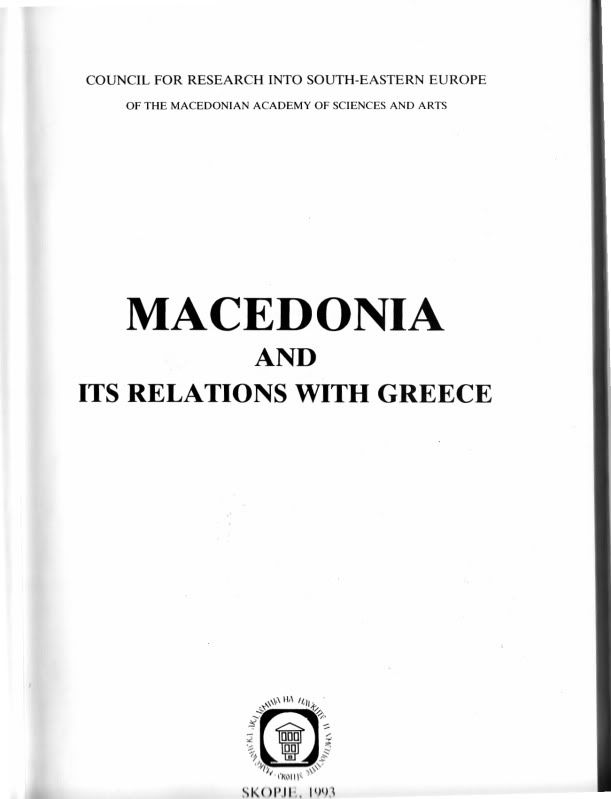
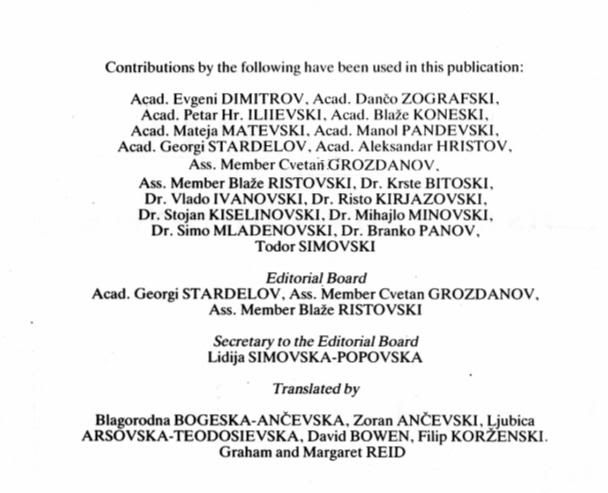
The following excerpts are taken from a propaganda booklet published by the self described "Macedonian Acadamy of Sciences and Arts". The book is full of unsubstantiated claims, exaggerations and even falsifications.

The authors do concede a couple of interesting points:

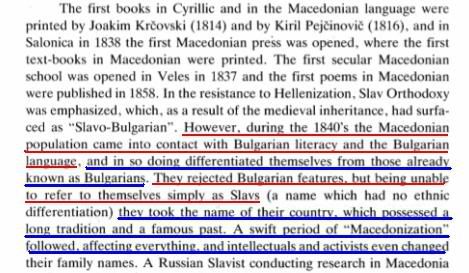
1. The descriptor "Macedonian" took on an ethnic significance only in the 19th century when a certain demographic of the population diverged from a populace that was regarded as BULGARIAN. This statement contradicts the mythical historiography being promoted by the extremist Gruevski administration and the Maknuts lunatics in the diaspora who claim that "Macedonians" have resided in the region, while forming the vast majority, for centuries!

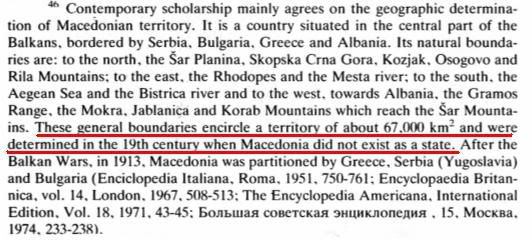
2. The geographic definition of "Macedonia" that the nationalists from FYROM espoused was only established during the 19th century. This is a far cry from the notion that "Macedonia" has existed as they would define it since ancient times.

This is a group of their scholars telling us this. It is important to note how FYROM's historiography has evolved. During the communist era the original doctors of FYROM's historiography were not so bold as to link the Slavic populace of FYROM with ancient Macedonia. Their communist forefathers and the authors of this book, which was published less than 20 years ago, conceded that their population diverged from a population that was regarded as Bulgarian.

Please rub this in their faces at every opportunity. This is their scholar's version of their history from less than 20 years ago. The nutcases of today would call these scholars traitors for making such claims!


Note: This excerpt states that they took on the name "Macedonian" in the 19th century with the implication that their population was UNDIFFERENTIATED from the Bulgarians up until that point:


Note: This excerpt clearly states that their definition of "Macedonia" was only established in the 19th century. Prior to the 19th century, as many of us know, most of the geography of FYROM was not even included in depictions of Macedonia!


My friends, this is their scholars telling us this! This state sponsored book was authored during a period in which the lunatics had not taken power yet.

Make no mistake: the theories in this book are far fetched . Some theories are even based on falsifications. The point is that less than 20 years ago their own scholars were conceding that their population was undifferentiated from the Bulgarians prior to the middle of the 19th century. In reality, no significant population affiliated with their ethnic/national identity until the 20th century.


by Xiotis

Saturday, April 18, 2009

FYROM Travel advise: Don't go to Macedonia and other Greek places

The Ministry of Foreign Affairs of FYROM has advised FYROM citizens to refrain from travelling or stay for longer periods in larger Greek cities.If the journey or stay are necessary, MoFa advises careful behavior, safe parking space if travelling by own vehicle, avoiding city centers and locations used for protests and unrest, as well as avoiding facilities and institutions, which have been the most common targets of violent attacks.MoFA says that Greece has been hit by a wave of internal unrest, violent protests and armed incidents in the past few months, resulting in endangerment to private property and personal safety of many people."

Such incidents, which unfortunately have still not been put under control, occur especially in larger cities (Athens, Thessaloniki etc), demonstrated by attacks with Molotov cocktails at car dealerships and banks, attacks of police patrols and foreign offices, taking over university centers by anarchist groups, bomb threats to churches, as well as protests at main streets and squares that often obtain violent dimensions.

Moreover, dozens of FYROM citizens, especially transporters, have notified competent FYROM authorities in the past few months on problems related to damage to vehicles during their stay or transit in Greece", reads the recommendation.

The Ministry of Foreign Affairs urges FYROM citizens to follow regularly the situation in Greece, as well as contact the Ministry and the country's diplomatic offices in Athens and Thessaloniki (Macedonia).

The Greek foreign ministry spokesman on Wednesday said fYRoM Foreign Minister Antonio Milososki is "obviously confused", when asked about "travel advice" for citizens of the landlocked neighbouring country interested in visiting Greece over during the Orthodox Easter season, advice posted on the fYRoM foreign ministry's website.The foreign ministry in Skopje urged fYRoM citizens to avoid extended stays EU and NATO member-state Greece as well as visits to large urban areas in the country. "

On April 10, Mr. Milososki released a letter toward the (Greek) Foreign Minister [Dora Bakoyannis], in which he requested that we strengthen communication between the two peoples and bilateral tourist cooperation. Five days later, for reasons known only to himself, he deliberately misinforms the citizens of his country and urges them not to visit Greece. Mr. Milososki is obviously confused," Koumoutsakos stated in response to press questions.

"The only serious conclusion that could be drawn from this action was that those governing the neighbouring country had not yet tired of showing their worst selves and had once again damaged relations with Greece," the spokesman added. In a recent announcement, the FYROM foreign ministry warns its citizens to avoid visits to Greece unless this was unavoidable, citing domestic upheavals last December, among others.

It also advised those having to travel to Greece to avoid urban centres and areas where demonstrations might take place and to park their cars in safe places, while claiming that transporters have also had vehicles vandalised.The only verifiable instance of violence directed at tourists occurred in early March 2009 in the lakeside town of Ohrid, in south-western fYRoM, when three tourist coaches carrying Greek tourists had nationalist graffiti written on them, while a handful of local youths also confronted the group of mostly elderly tourists.Athens responded with a verbal protest by its liaison office head in Skopje and issued a travel advisory.

http://www.ana-mpa.gr/anaweb/user/showplain?maindoc=7508521&maindocimg=5313525&service=98

Sunday, April 12, 2009

Antifascist, Anti-VMRO Demonstrations by Liberal Youth in Skoplje [11-IV-2009]

A display of opposition by antifascist youth composed of moderate, centrist, liberal and libertarian intellectuals in defiance of Pseudomacedonian fascist policies of the regime of VMRO-DPMNE.


by Vasko
Словенска Филхеленска Мрежа - Σλαβικό Φιλελληνικό Δίκτυο - Slavic Philhellenic Network

Friday, April 10, 2009

THE RECONSTITUTION OF THE EMPIRE... (letter to Obama that rewarded Turkish barbarism in the name of his democracy)

"At the end of World War I, Turkey could have succumbed to the foreign powers that were trying to claim its territory, or sought to restore an ancient empire. But Turkey chose a different future. You freed yourself from foreign control. And you founded a Republic that commands the respect of the United States and the wider world. There is a simple truth to this story: Turkey’s democracy is your ownachievement. It was not forced upon you by any outside power, nor did it come without struggle and sacrifice" Barack Hussein Obama President of USA at the Turkish national assembly in Ankara.

The fore mentioned statement of the President of USA,besides being ignorant of history, is an insult to the memory of hundreds of thousands slaughtered Greeks, Armenian and other nationalities by the swarm of Attila's descendants, which the USA's consul general in Smyrna, described as "The Blight of Asia" and devastated stated "I sick of being human",watching the horrible and barbaric crimes of Mustafa Kemal...

On the blood of thousands of innocent martyrs the self-proclaimed "Turkish Republic" was founded.

The President of the USA molested upon our ancestors martyrs honored remains...

"Turkey’s democracy is your own achievement"...said, with pompous language, filling the Turks with pride!

A "democracy" built on the remains and the blood of thousands of innocent people.

On the ashes of "infidel" Smyrna...

On the genocides of Greek of Pontus and Armenians...of the Syrian-Chaldaeans and Assyrians..the Greeks of Imvros and Tenedos...of Constantinople...of Cyprus...

On the bodies of penurious Kurds and the ashes of their 4000 villages...

A "democracy" that continues to live on the blood of Alevites, the Kurds and the last Greeks of Pontus...

A "democracy" of ERGENEKON and the GREY WOLVES...

This is Turkey mister Blessed (Hussein)...

It is this state that slaughters are customary tradition and yourancestors described as "The Blight of Asia" you state your respect, adding "and the wider world"...

Our respect mister Obama, you are not entitled to nor deserve to refer to. It is our inalienable right, to pay our respect where we think we owe it to...

You have bowed the knee of your heart, and attributed honor to the disrespectful Turkey...

You rewarded barbarism and tyranny, triggering the Turkish aggressiveness against us...

We were, are and will be HERE...

History has taught us to withstand the slaughters, tortures, ousting, impalements, cremations, refugees, poverty, starvation and destructions, for thousand of years...

We know how to sacrifice ourselves, self willing, and we turn to death for our beloved Motherland... Our Motherland and the mother of Beauty and Civilization...

This is mister Obama the "ancient empire" that you pointed as the enemy of Turkey. You have awakened the primeval and primitive instincts of Turks...But you have also awakened our sentiments... Contemporary history gives all the answers.

Quotes by Nikolaos Plastiras to the Ambassador of Great Britain Lindley.

-"Greece was an honest Ally of England. You have abandoned her but she continued the alone. She witnessed her populations being slaughtered, parts of her land being cut off. She may live on her one. And if she falls we will raise a sing on cape Maleas stating that, once a civilization flourished here, that was destroyed by the Western Forces, with England being the leader. Convey this to your Government. That's all sir. We have nothing else to say. Go!"

http://strategy-geopolitics.blogspot.com/2009/04/reconstitution-of-empire.html

As the blog mention, the above text mail to

-US President
-US Vice President
-US Secretary of State
-US Congress
-Many others US Secretaeries and officials.

In my letter that I sent to Obama mention:

Mr President we like to see from you Presidential actions that based in your words as Senator and Presidential Candidate.

The only that I see from Mr Hussein, is a Bush policy as regards the Greek issues and democratic values (Armenian genocide and Orthodoc Ecumenical Patriarch) and many forgotten past views.

Thursday, April 09, 2009

Bernal's "Black Athena" published in the Former Yugoslav Republic of Macedonia(FYROM)


Anthony Davis, quoted in Lock that” If somebody uses tradition as a way of limiting your choices in away that's as racist as saying you have to sit at the back of the bus.” This quote is suit to Slav Macedonians of the FYROM that adopted Macedonism [1] as ideology and now promote the book of Martin Bernal known as “Black Athena”, a work that contribute the Afrocentrism.[2][3]

Volume 1 from Bernal series has been translated in the Slav Macedonian language and an official presentation take place today in the “Book Affair” at Skopje (FYROM) which will be attended by Slav Macedonians politicians, academics and media personalities and academics. Bernal in his books proposed a radical reinterpretation of the roots of classical civilization, contending that ancient Greek culture derived from Egypt and Phoenicia and that European scholars have been biased against the notion of Egyptian and Phoenician influence on Western Civilization.[4]

In 1990, an issue of the American Journal of Archaeology comprised a number of articles on the book and the questions it raises. The most extended, so far has been the collection of responses and reactions in the book Lefkowitz/Rogers [5]. Several authors and experts in a variety of disciplines, including archaeology and linguistics as well as history and classics, with 20 articles criticize Bernal's views. In the conclusion to the volume, the editors propose an entirely new scholarly framework for understanding the relationship between the cultures of the ancient Near East and Greece and the origins of Western civilization. Also the contributors to this volume argue that Bernal's claims are exaggerated and in many cases unjustified.

Below is a abstract of Von Thomas Shmitz paper with the title “Ex Africa lux? Black Athena and the debate about Afrocentrism in the US” that present the whole history as regards Martin Bernal views and the objections that raised from US academic community. The overwhelming majority of academic responses to Bernal's book, while acknowledging its importance as a catalyst of renewed interest in the questions it raises, pointed out that its main theses were deeply flawed. As Smitz point out what follows is just a selection of the most serious critical objections raised against Black Athena.[6]


— The part of Bernal's arguments that has met with almost unanimous disapproval was his linguistic evidence, especially his Egyptian etymologies for numerous Greek nouns and names. Critics pointed out that his supposed derivations are most often based on nothing but vague resemblances. Even if we admit that (conscious or unconscious) prejudice has led earlier scholars to underestimate the real number of Semitic borrowings and that conclusive proof cannot be attained in the slippery field of etymology, it remains true that Bernal disregards the most elementary rules of linguistic developments. Accordingly, the judgment of trained linguists is harsh: "No effort is made to go beyond the realm of appearances; known and inferable facts about the history of individual forms are systematically ignored, misrepresented, orsuppressed." Bernal's linguistic evidence, which he himself says is a keystone of his argument (Bernal [1987] 62), is thus void.

— Bernal's use of ancient documents, especially of Greek mythological narratives, is deeply flawed. On the one hand, his construction of an "ancient model" of Egyptian colonization and influence in which "the Greeks" are said to have believed, is simplifying to the point of misleading readers unacquainted with the sources. Greek beliefs about the origin of their own culture were various and contradictory, and different authors or groups constructed versions that fit their individual argumentative needs. Bernal's method consists in arbitrarily taking into account only versions that seem to support his thesis and disregarding conflicting ones. This becomes particularly clear in the case of Danaus, whose myth is fundamental to Bernal's argument. Bernal often mentions that "the Greeks" told stories about Danaus's flight from Egypt, his arrival in Argos and his accession to the throne (Bernal [1987] 75-98; 2.137-8, 502-4 and passim). He interprets this myth as preserving memories of a Hyksos colonization of Greece. However, he fails to mention that in these narratives, Danaus is of Greek descent: he is a great-great-grandson of Io, daughter of the Argive king Inachus. In Aeschylus's tragedy The Suppliants, Danaus and his daughters emphasize this Greek origin to support their claim for protection from the king of Argos (274-326, see especially 274-5 "To cut a long story short: we claim to be of Argive extraction"). Bernal's partial summary of the myth is thus deceptive.

— This selective use of ancient documents demonstrates the absurdity of Bernal's polemic against nineteenth-century source criticism, which he often (e.g., Bernal [1987] 118, 377; 2.200, 237, 308, 309) disparages as Besserwissen. Bernal goes so far as to assert that "the cultural, racial and temporal arrogance or Besserwissen of the critical method [.] has been a bane to the writing of history ever since" the early nineteenth century (Bernal [1987] 306). Yet Bernal himself obviously cannot accept the totality of the ancient documents; he has to differentiate between what he deems more or less credible, or, as he would probably say, more orless useful to his argument. He lays strong emphasis on the myth of Danaus, which he interprets as pointing to an Egyptian origin of Greek culture, yet he virtually ignores the myth of Pelops, who was described as coming from Asia minor and would thus symbolize "that Greece was colonized from the northwest corner of the Asiatic seabord." When ancient sources do not fit his argument, Bernal is ready to criticize them in the spirit of Besserwisserei that he usually decries. For instance, the Egyptian historian Manetho is said to have "garbled" and "confused" several pharaohs (Bernal [1991] 196); his account is said to be "internally inconsistent and of only very limited value for this period" (Bernal [1991] 325); the Greek historian Diodorus Siculus is said to have misunderstood Herodotus's account because of its linguistic ambiguity (Bernal [1991] 202)—thus Bernal believes he knows Greek better than a native speaker of the language. Hence, Bernal's critics are indubitably right when they denounce his repudiation of source criticism and historical methodologies as self-contradictory. What his strategy amounts to is a return to the uncritical antiquarianism of earlier historians and a collection of fragments which suit the present purpose while everything else is neglected.

— These flaws are especially prominent in Bernal's treatment of myths as historical sources. In general, he seems entirely convinced that myths can be read as reliable traditions of historical events and social structures, and he is inclined to accept even late sources: e.g., Bernal [1991] 173 a passage in the Greek writer Aelian (second century CE) is said to preserve correct information about a cult of the fourth millennium BCE, an "instructive example of the strength and durability of traditions over this huge expanse of time." When it is more convenient for his argument, however, Bernal dismisses Greek traditions because "the Greeks had no long-term cultural memory" (Bernal [1991] 319). Again, the absence of any historical methodology makes for an ahistorical eclecticism that has only rhetorical value.]

— Bernal's treatment of modern scholarship is as indiscriminate as his use of ancient documents. His sweeping generalizations ignore the discussions, controversies and doubts of historians, philologists, archeologists and philosophers about the origin and originality of Greek culture that had existed at almost every period of European scholarship. Neither was the "Ancient Model" as undisputed before the nineteenth century as Bernal implies, nor did all Europeans after 1800 accept the claims of "racial science" or believe in the inferiority of non-whites. It is certainly true that Bernal's "failure to recognize this variety" is a serious flaw of Black Athena. His own first-hand knowledge of the most important texts of eighteenth- and nineteenth-century European historiography, philosophy and political theory is so meager that his generalizations rest on very shaky ground. Hence, Marchand/Grafton are justified in their harsh judgment about his contribution to the history of scholarship: "Bernal simply has not done enough work to deserve respect or attention as a historian of European thought about the ancient world. The ability to make noise entitles no one to a hearing, and up to now, Bernal has made noise, not historical argument." This is especially true in the field of classical studies. It is simply not true that scholars have been as stubborn in their refusal to acknowledge Oriental influences on Greek culture as Bernal thinks they have been. Suffice it to mention just a few: F. Dornseiff in Germany, W. Burkert in Switzerland and M. L. West in Great Britain have been publishing well-known works about the interrelations between Middle¬and Near-Eastern cultures and Greece for a long time. If these scholars do not see Egypt as a decisive influence on Greece, this is certainly not due to any kind of prejudice, let alone racism, but reflects the evidence of our archeological, historical, and literary documents.

— Lastly, Bernal never states clearly whether his "Aryan Model" is due to a vast, worldwide conspiracy of classicists with the aim of suppressing the truth about the origin of ancient Greek culture or whether earlier scholars were merely influenced by the prejudices and beliefs of their times without actively manipulating the evidence. We will see shortly that Bernal's failure to make this crucial distinction is not coincidental—rather, it amounts to a demagogic manipulation of his readers.
Bernal book was voted one of the worst top 50 books of the 20th century.
Notes
[1]- Macedonism is an attempt by the Slav Macedonians (FYROM and diaspora) to discredit the ancient Macedonians ethnicity, break the connection between present-day Greek Macedonians and the Macedonians of antiquity, and establish a connection between FYROM’s Slavs with ancient Macedonia. The historically, linguistically and archaeologically incorrect challenge is that the historical Macedonia was never part of Greece and the Macedonians were Slavs who spoke a language in comprehensible to the other Greeks and similar to modern Slav Macedonian.
[2]- Symposium by SMK/WMC, 7-9 April 2009, Skopje, FYROM.
[3]- Afrocentrism, is a extreme diffusionist ideology who argue that black Egypt—and sometimes black Africa—was the sole intellec­tual catalyst for the development of most subsequent civilizations, no matter how geographically remote the latter may have been.
[4]- Martin Bernal, Black Athena, The Afroasiatic Roots of Classical Civilization, 4 Volumes.
[5]- Lefkowitz/Rogers, Black Athena Revisited, 1996. Also read the “White Athena” by Walter Slack.
[6]- Bibliography and notes that support these objections located in the paper.

Monday, April 06, 2009

The Cultural Genocide of the Greek Macedonian Identity

The systematic counterfeiting of the history of Macedonia by the Slav Macedonians of the FYROM since 1944 and their attempt to monopolize the "Macedonia" name were considered by the Hellenic people as absurd and unworthy of their attention.

Yugoslav "Macedonia", formed in 1946, consisted of the area previously called "Southern Serbia" or Vardaska Banovina". FYROM's Slav Macedonians began to claim their "Macedonian" ethnicity as a result of the role Tito and communism played in their acquiring a "Macedonian" language, a "Macedonian" nationality, and a "Macedonian" country, ethnic characteristics acquired from 1941 to 1945, an ethnicity built in a remarkably short time. The recycled and indiscriminate usage of the term 'Macedonian' bearing a distinctly non-Greek connotation is liable to hasten the acceptance of the term in the academy, and hence be exploited politically by Slavmacedonian irredentist circles for whom the territories of "Aegean Macedonia" remain unredeemed.[1] The distress and resentment of Greek Macedonians in this regard stems from the fact that this arbitrary nomenclature, which takes into account only the Slav Macedonian nationalist narrative is clearly lopsided and amounts to an unacceptable monopoly of key terms. It is also offensive to 2,5 million Greek Macedonians cultural identity, including the other "ndopioi" such as individuals speaking Vlach- Arvanite- and Slavonic-based idioms residing in the prefectures of Greek Macedonia, who declare resolutely and unambiguously a Greek national identity.

And the question is how you segregate a Greek Macedonian identity with a Slav Macedonian one?

I will begin my analysis with the term "Macedonian" and its meaning: A Macedonian according to several sources [2][3] is a native or inhabitant of the (Ancient or Modern) Macedonian region.

In the Former Yugoslav Republic of Macedonia (FYROM) the noun Macedonians (Makedonci = Makedontsi- in the local Slavic language) identifies, (a) in the legal and civic sense, all citizens of the Republic (including Albanians, Greeks, Roma etc), and (b) in the ethnic/national/cultural sense, a million and a quarter local Slav-speaking population. The Slavic people of this Republic have no connection with the people of ancient Macedonia or their descendants or Cultural Identity. They have Slavic origins — not Greek or ancient Macedonian.

In Greece the noun Macedonians (Μακεδόνες = Makedhones in the Greek language) identifies, in the regional/cultural sense, almost two and a half million ethnic Greeks of the region of Greek Macedonia.

In Bulgaria the same name Macedonians (Makedonci = Makedontsi- in Bulgarian) identifies, in the regional sense, hundreds of thousands of ethnic Bulgarians.

These three variants of the noun ‘Macedonians’ are also in use in diaspora by persons who have emigrated from the three Macedonian regions, namely, Greek Macedonia, FYROM, and the Bulgarian region of Pirin.

To complicate matters further, there is a fourth, historical dimension of the name Macedonians, which refers to the first ‘owners’ of the name, who actually gave their name to the region. They were Greek-speaking people who inhabited roughly the region of present-day Greek Macedonia in classical antiquity identifying themselves as Μακεδόνες (Makedones) in their Greek language.

Peter Mackridge and Eleni Yannakakis define cultural identity as a community's sense of belonging to a group that shares a specific set of values, attitudes and emotions based on a particular view of the local historical past and on a number of assumptions concerning the ethnic and cultural characteristics of the community itself and of the region which it inhabits. [4] Such a cultural identity tends to be constructed partly in opposition to the cultural identities of neighbouring communities or of other communities that share the same space.

Antony D. Smith remarks that there are two main kinds of ethnic extinction in the full sense: genocide and ethnocide, which is sometimes - at times misleadingly — called «cultural genocide». In one sense genocide is a rare and probably modern phenomenon. It includes those cases where we know that mass death of a cultural group was premeditated and the basis of that targeting was exclusively the existence and membership of that cultural group. [5]

The difference over the name ‘Macedonia’, as a state appellation, has been resolved temporarily since 1993 by the adoption of the provisional name ‘the Former Yugoslav Republic of Macedonia’. Nevertheless, there is considerable confusion and ambiguity over the derivatives of that name; more specifically, the noun Macedonians and the adjective Macedonian in their ethnic, regional, cultural, historical and legal (citizenship) variants.

Recent events have shown how strong a sense of Macedonian identity there is among the Greeks, particularly in Greek Macedonia itself, and how vigorously Greeks react to any suspicions of rival claims to what they perceive to be their exclusive historic rights to the territory and the name of Macedonia.

The Macedonian name rooted from the Greek word Makedones, that mean "highlanders" or "the tall ones," related to makednos "long, tall," makros "long, large" [6]. Irredentist leaders are forced to reconcile their nationalist policies with pressures from the international plane. At the same time, irredentist leaders exploit perceived "windows of opportunity" in pursuit of their nationalist goals. So we must examine in depth the past, to understand the present, in order to eliminate possible irredentist projects of tomorrow. Slav Macedonians of the FYROM need to realize that their newly conceived ethnogenetic dogma, extending to classical antiquity, encroaches upon the Hellenic cultural heritage and the identity of their Greek neighbours to the south. As such, it threatens to ignite a clash of identities in the region as a whole.

The use of the Macedonian name as a state appellation in no way confers the right to appropriate everything and anything derived from or pertained to the entire region of Macedonia. This needs to be legally clarified and remain binding erga omnes. The state name needs specifically to refer to and describe the present region of FYROM. It should apply erga omnes in multilateral and bilateral international relations and transactions and should be observed by all organizations, states, and other non-governmental international organizations, including the government and the agencies of FYROM. As Kofos said [7] Greek and FYROM parties should accept the name used by the inhabitants of FYROM for their region of geographical Macedonia, i.e. Vardar Macedonia, or preferably Vardar Makedonija.

It is therefore clear that the appropriation of the name Macedonia by the FYROM, on which they have based all their propaganda and even their national existence, does not even correspond to their own false national identity since their artificially created state does not have any national homogeneity. This appropriation of the Macedonian name goes against every principle of justice and conceals other expediencies which directly insult Greek national and Macedonian Cultural Identities as shows the unchanging nature of their continuous propaganda.

I am a Macedonian, however I am in no way identified with or related to the newly formed independent state referred to as “the former Yugoslav Republic of Macedonia” ; I am instead insulted by the fact that I cannot be known as a Macedonian without being identified by others as related to FYROM. This is a rape of my identity and a continuing cultural genocide.

My cultural identity has been usurped.
Where is the justice ?

References
[1]-'Aegean Macedonia' is a Slav Macedonian irredentist term used to refer to the region of Macedonia in Greece, in the context of a 'United Macedonia'. The origins of the term seem to be rooted in the 1940s but its modern usage is widely considered ambiguous and irredentist. The term has occasionally appeared on maps circulated in the former Yugolsav Republic of Macedonia (FYROM), which envisioned Greek Macedonia (referred to as "Aegean Macedonia") as part of a "Greater Macedonia", and is regarded as a challenge of of the legitimacy of Greek sovereignity over the area. Further reading in http://modern-macedonian-history.blogspot.com/2007/05/aegean-macedoniaa-nationalist-term.html
[2]-http://www.merriam-webster.com/dictionary/Macedonian
[3]- http://www.thefreedictionary.com/macedonian
[4]- Peter Mackridge and Eleni Yannakakis, Ourselves and Others The Development of a Greek Macedonian Cultural Identity, page 2
[5]-Anthony D. Smith, NationaL Identity, Oxford,1991
[6]- http://www.etymonline.com/
[7]-Evagelos Kofos, ELIAMEP, April 2009, The Current Macedonian Issue between Athens and Skopje:Is there an Option for a Breakthrough?
Sunday, April 05, 2009

The Current Macedonian Issue between Athens and Skopje:Is there an Option for a Breakthrough?
by Dr. Evangelos Kofos
Former Consultant on Balkan Affairs at the Greek Ministry of Foreign Affairs, Athens, and Visiting Fellow, Brasenose College, Oxford University (1995-96); currently Senior Advisor – Balkan Area, ELIAMEP, Athens
ekofos@hotmail.com

Summary

The present paper
  • analyses the 16-year old Balkan diplomatic imbroglio over the name issue of "the former Yugoslav Republic of Macedonia" (FYROM), from the UN Security Council resolution 817/1993 calling for the resolution of the issue "in the interest of maintaining peaceful and good-neighbourly relations in the region", to the communiqué of the April 2008 Bucharest NATO Summit specifying that FYROM would be admitted to the Alliance "as soon as a mutually acceptable solution to the name issue has been reached";
  • initiates a discourse with the assessments and proposals of a recent report of the International Crisis Group, Macedonia's Name: Breaking the Deadlock;
  • attempts to clarify current Greek positions and concerns vis-à-vis the various proposals on the state name submitted by UN mediator Matthew Nimetz;
  • submits a comprehensive proposal for dealing, in an international environment, with such sensitive issues as those affecting personal, state, regional and cultural identities.
The diplomatic imbroglio

The diplomatic controversy between Athens and Skopje over the appellation "Macedonia" has entered its 18th year. Back in April 1993 the UN Security Council had issued ....

Thursday, April 02, 2009

Twisting the words of Finlay

Nationalists from the Former Yugoslav Republic of Macedonia (F.Y.R.O.M) and her diaspora frequently promote the following excerpt from George Finlay's "A History of the Greek Revolution" published in 1861:

According to G. Finlay in his 'History of the Greek Revolution volume 1 - 1861: "The Albanian population occupies most of ancient Greece. Albanians now occupy all Attica and Megaris, Boetia and Locris. They occupy the whole of Corinthia and Argolis, extending themselves into the northern part of Ardadia and eastern Achaia..."

Their intent on using the above quote is to imply that the Greek ethno/national identity was manufactured in the 19th century in a region that was dominated by Albanians. In other words they use the above quote to support their theory that most Greeks have Albanian ancestors. Anyone who has read Finlay's book surely knows that:

a) Finlay recorded significant Greek populations and

b) Finlay made absolutely no mention of any "Macedonian" ethnicity or nation even though he spent a significant amount of time in the region of "Macedonia". Is it not amusing that the same nationalists who quote from Finlay and present him as a reliable source completely overlook the fact that Finlay did not record any "Macedonians" in the region where nationalists from F.Y.R.O.M claim that"ethnic Macedonians" dominated the demographics for centuries?


Lets examine Finlay's passages in their context. If no significant Greek populations existed in the geographic region of modern Greece why would Finlay describe 6 Ottoman administrative regions, or Pashaliks, where Greeks formed the majority of the population?

Photobucket


Photobucket

Photobucket

Photobucket

Photobucket

Notice that Finlay, who documented his observations during the early-mid 19th century, made no mention of "Macedonians" in his population descriptions of Turkey's European dominions! Also notice that Finlay states that Greeks formed the majority of the population in the Pashalik of Thessalonica, a region that nationalists from F.Y.R.O.M and her diaspora claim was populated in the majority by "ethnic Macedonians"! As a matter of fact, Finlay is quite explicit in his description of Greeks dominating the population of the Pashalik of Thessalonica:

Photobucket
Finally, in order to clarify Finlay's position regarding the demographics of Albanians vs Greeks we have the following excerpt:

Photobucket
Hence Finlay estimated the number of Albanians in the Greek kingdom to be about 200,000. Recall, from the quote above, that Finlay estimated the number of Greeks in the region to be about 1 million!

This surely puts a pitchfork through the far fetched theory being promoted by radical nationalists from F.Y.R.O.M and her diaspora who use Finlay as supporting evdience to claim that:

a) hardly any Greeks existed during the early-mid 19th century and
b) Albanians formed the vast majority of the population in the region and as a result most modern Greeks have Albanian ancestors!

The excerpts from Finlay demolish these theories! To top it all off: George Finlay's first hand accounts made no mention of any "Macedonian" nation or ethnicity! We might as well add Finlay to the vast number of sources that failed to record any "ethnic Macedonians" prior to the 20th century! Of course this is due to the fact that the "Macedonian" ethno/national identity is a late 19th century construct that was not affiliated to by any significant population until the 20th century!

Wednesday, April 01, 2009

Press Release from Macedonian organizations as regards "Blatant FYROM Propaganda on Greek TV"

Press Release of the Macedonian Studies Center and the Pan-Macedonian Association of USA & Canada

Author: Christos Karatzios M.D.
Communication: Nina Gatzoulis: ninagatz@comcast.net

New York-March 26, 2009

RE: Blatant propaganda on Greek TV
Encouraging message by P. Voskopoulos for “Macedonian” minority action in Greece


“Do not fear! Lift your heads high, we can do this very well!”, is the message that the representative of the so-called “Macedonian” minority, Pavlos Voskopoulos, promoted in a sly manner to the inconspicuous participants of the televised program “Atheatos Kosmos”, on March 10, 2009 on the Greek television station ALTER. During the program representatives of the political party “Rainbow”, Greek politicians, historians, and journalists discussed the recent United Nations report by Ms. Gay McDougall, on the “minority” issue in Greece.

In particular, towards the end of the broadcast, Mr. Voskopoulos, openly addressing the supposedly oppressed “Macedonian minority”, which he calls “Makedonski”, said: “Dosta veќe da se plašete, gorno glavata, možno e, mnogu dobro.” When asked to translate into Greek what he had said, he replied falsely: “this is a matter of pride for us.” Mr. Voskopoulos virtually called for an uprising by members of his political faction in Greece.

We welcome the initiative of ALTER channel to address the critical Macedonian issue. However, expressing the historical concerns of the Diaspora, the Macedonian Studies Center and the Pan-Macedonian Associations of U.S. and Canada, we wish to inform the Greek public about certain inaccuracies during the broadcast.

First, the amiable journalist Mr. Hardavelas, referred to Nicodemus Tsarknias of the sectarian and self-called “Macedonian” Church in Aridaia, Greece saying that the building is incomplete, “as if no one wants to see it.” This statement was unfortunate. The Tsarknias church building was not built back then because it lacked sufficient funds for its completion (and virtually no support from the alleged minority that it was allegedly serving!). Mr. Tsarknias is the one who sent an inflammatory letter to the legitimate Bishops of Kastoria, Florina and Thessaloniki, demanding the keys to their churches, because he believes Greece has occupied “Macedonia” since 1912! During the program it was said that people who make frequent visits are from the FYROM and its Diaspora (Toronto and Australia). Where are the “ethnic Macedonians” from Greece? Unfortunately there was no mention about it during the broadcast.

The “deported Aegean Macedonians” declared to the young journalists, who were sent to FYROM to interview them that they have been grouped into an organization that lists 50,000 people! What kind of organization has 50,000 as members and why is this organization not known throughout the world? The repeated question of the journalists: “Do you feel Greek?” prompted them to declare: “No, I am Macedonian”. Then, they claimed that their ancestors were the owners of properties that were left behind when they fled Greece. They proclaim that the Greek government does not permit them entry to Greece after the Greek Civil War.

During the broadcast a member of the Greek Communist Party (KKE) during the 1940s and then a NOF fighter, who took arms against the Greek government during the Greek Civil War, made certain statements. She concluded that the Greek authorities did not allow her to return to Greece! Her statement was interesting in that her only wish is “to come back in Greece,” in order to see the grave of her mother. A few seconds later, negating her own words, she said that she has already visited Edessa and Florina!

The vast majority of NOF “fighters” initially took weapons against Greece and served Bulgarian interests, under the command of Axis Bulgarian army officers, such as Anton Kaltseff. In the summer of 1944, when the Germans were preparing to retreat from Greece, they were transformed from Bulgarians to “Macedonians”, enlisted in SNOF (Slavomacedonian EAM, or Slavomacedonian National Liberation Front), and fought along side ELAS (Greek People’s Liberation Army) hoping to avoid punishment for their treason against Greece during the Axis occupation of Nazi Germany, Italy, and Bulgaria. In October 1944, after they broke away from ELAS, they left Greek territory and went to Yugoslavia, where they joined Tito’s partisans, bearing the name “The Aegean Shock Brigade.” In the summer of 1946 they returned to the mountains of Greece as NOF (Slavomacedonian National Liberation Front) to fight alongside the communist “Democratic Army of Greece” (DSE), and to exploit Greek divisions during the Greek Civil War. In the summer of 1949, some before and others after the final defeat of the DSE again left Greek territory and eventually settled in Skopje and adopted Slavic names. Many among them including the leaders of the KKE (Communist Party of Greece) returned to Greece. Others did not return, or chose to return only on condition that Greece will accept their changed names, recognizing them as “Macedonians.” Still others did not return, or chose to return only on condition that Greece will recognize them as “fighters of the “Macedonian” Iliden Revolution”.

We should all know about the 28,000 Greek children who were sent to Iron Curtain countries by the communists for “education”, the majority of whom are now middle aged and have been taught that they were expelled. Also, we must have in mind the numerous UN resolutions calling for the return of these children from the Communist countries, especially from former Yugoslavia (UN Resolutions 382 (1950), 517 (1952) and 618 (1952)).


Furthermore, in another interview with a representative of the “ethnic Macedonian minority” from the village of Meliti, Greece there was again an unfortunate mention that “the only wish all these people have is to find work” and one father even claimed that he is “forced” to take care of his adult children (one of his children is 31 years old) because they can not find work in Greece, simply because they are “Macedonian”! In an era where many immigrants (legal and illegal) can find jobs and make a living in Greece, this claim is ludicrous.

It is crucial that Greek TV invites historians and politicians who are knowledgeable in this issue, so that they can rebut the historical inaccuracies, distortions and propaganda. It is also important that individuals who know the language spoken in the FYROM, and the Slavonic idiom used in some Greek border areas (the two are different), be present during such broadcasts, so that Greek television does not promote messages against our national interests.

We also understand the progressive and humanitarian ideas of some of the guests. In addition, we, the Macedonians of the Diaspora, want friendly relations with Greece’s neighbour and wish for an equitable solution to the issue. However, friendship and progressiveness cannot be promoted by ignorance and misrepresentation of historical facts, especially at a time when negotiations for the name of Greece’s northern neighbour are ongoing. This is especially true when intolerant and irredentist behaviour of the FYROM against Greece is ever escalating.

Monday, March 30, 2009

Athens reply to fYRoM FM

Greece on Monday announced that the country's foreign minister again emphasised to her counterpart in the former Yugoslav Republic of Macedonia (fYRoM) that Athens considers the "name issue" as the paramount problem standing in the way of fully normalised bilateral relations.

In her reply, dated March 24, Greek Foreign Dora Bakoyannis reminded that Athens has demonstrated a sincere volition over recent years to develop normal and productive bilateral relations.

"Let me remind you in this respect that Greece has demonstrated, in practice, her willingness and preparedness to settle the issues that divide our two countries, as well as to build good neighbourly relations and to establish close cooperation in all fields with the former Yugoslav Republic of Macedonia," Bakoyannis states.

Moreover, in broaching the eyebrow-raising proposal by fYRoM FM Antonio Milososki earlier this month for the establishment of a bilateral committee to "examine" historical issues, Bakoyannis was crystal clear:

"... I would like to emphasize that history is a science that establishes historical truth through scientific methods. It cannot and should not be subject to political expediency or any other political considerations. In this sense, history is not negotiable. The history of the ancient world has already been written and documented, over the centuries, through laborious scientific research by acclaimed international historians and archaeologists. It cannot be rewritten by a bilateral committee."
In concluding her letter, Bakoyannis focuses directly on the resolution of the 19-year-old "name issue", noting that "...the catalyst for the improvement of the relations between our two countries is the long overdue definitive settlement of the 'name issue', in all its aspects. This would pave the way for the fulfilment of the European and the Euro-Atlantic perspective of your country, in accordance with the collective and unanimous decisions taken by the member-states of NATO and the EU," she said, citing the 2008 Bucharest summit joint communiqué and a European Council decision in June 2008.
Additionally, she said improvement of bilateral relations and increasing bilateral cooperation between the two neighbouring states necessitates "...respect of the fundamental principles on which good neighbourliness is based, as provided by the Interim Agreement."

Moreover, Bakoyannis pointed to the significant level of Greek private sector investments and business activity in the landlocked one-time Yugoslav republic while at the same time decrying what she called "numerous difficulties and obstacles (faced by Greek businesses and entrepreneurs there), including discriminatory and 'red tape' practices, acts of harassment and intimidation, even a boycott against their products..."

source:ANA-MPA

Friday, March 27, 2009

Krste Misirkov : Slav Macedonians identified as "Slavs" and "Macedonians with geographical definition"

Krste Misirkov in his book "On Macedonian matters" (Chapter:Can Macedonia turn itself into a separate ethnographical and political unit? Has it already done so? Is it doing so now?) was clear as about the ethnical identification of the Slav Macedonians and theirs language:

If the formation of the South Slav peoples was a mechanical and political process it would not be impossible that it might recur in present times. Within the South Slav language complex there are several branches outside the Serbian and Bulgarian political units; these are the Macedonian dialects. These branches, since they are closely allied, naturally have some connection linking them more closely with Bulgarian in the east and Serbian in the north.

These branches have been given various names at various times but it was not until the last quarter of the nineteenth century that these names overlapped so much as to displace one another. These various names did not properly catch on, and gradually they began to give way until finally they were replaced by the natural description Slav" with a "Macedonian" reflection from the geographical area in which they were distributed.

The people who spoke these dialects had once been called "Slavs" and later either "Serbs" or "Bulgarians" until the rivalry between these two names made them both alien to the Macedonian Slavs, who started calling themselves after the old geographical name of their country.

The name Macedonian was first used by the Macedonian Slavs as a geographical term to indicate their origin. This name is well known to the Macedonian Slavs and all of them use it to describe themselves. Since the formation of nationalities is a political and mechanical process, all the necessary conditions exist for Macedonia to break off as an independent ethnographic region.


There is not any question as regards theirs identifications.

Thursday, March 26, 2009

OSCE : FYROM has too Many Voters!!!!


“It is impossible for a country of 2 millions to have ,,,,,1.8 million voters. That has to be addressed,” said the Pia Christmas Muller, the Vice-President of the Organization for Security and Cooperation in the Europe Parliamentary Assembly and the Coordinator of short-term observers in FYROM’s local and presidential poll said on Monday, just one day after Sunday’s first round of presidential and local election.
FYROM officials in responce said diffrent comical things such as :
  • this is a 15 year-old issue and we still have not heard a concrete idea about which methodology to apply
  • the problem lies in about 300,000 voters.

More in balkaninsight.com

Tuesday, March 24, 2009

The "Truth" in Footnotes: An Example of "Macedonization" of Primary Sources


"Britanski dokumenti za istorijata na makedonskiot narod" ["British Documents on the History of Macedonian People"], Ed. H. A. Poljanski, Vol. 1, Skopje 1968, p. 197.

The volume one of the book covers the 1797-1839 period. The particular document whose part is presented above is: John Morier to James Fox, a letter from Ioanina, 4-VI-1806.

by Vasko
AMAC Forums

Monday, March 23, 2009

A strong call to Obama Administration from the Greek-Americans as regards the illegal entity in Cyprus’ militarily occupied area.

Posted: March 21, 2009 at 23:15 PM EST (28:15 AM GMT)

Washington.- By Apostolos Zoupaniotis

Greek American Community reacted strongly on reports for a possible meeting between Turkish Cypriot leader Mehmet Ali Talat and the Secretary of State Hillary Clinton, in Washington. Eleven leaders of the National Coordinated Effort of Hellenes (CEH) in a letter sent to President Barack Obama and Vice President Joe Biden issued a strong warning, pointing out that “that certain officials in your Administration are considering actions that are on the verge of extending the Bush Administration doctrine even further by establishing a Cyprus policy that contradicts both of your clearly articulated views on the issue.”.

The Greek American leaders call President Obama and Vice President Biden to “intervene before they cause America problems that will take years to correct”.

Expressing the feelings of the Greek American Community, the ask Obama and Biden to “overturn these misguided actions by people in your Administration. The Greek-American community that has been so committed to your Presidency and Vice Presidency, and the hope that they believed it would bring to the militarily occupied nation of Cyprus, will be devastated.”

The strong warning comes just days before the meeting of the Greek American leadership with President Barack Obama, during the White House celebration of the Greek Independence Day. Archbishop Demetrios who is going to be leading the Greek American delegation is having a meeting on Monday with Secretary of State Hillary Clinton, at the Department of State. In addition to the issues of the religious freedoms and human rights of the Ecumenical Patriarchate that are violated by Turkey, Archbishop Demetrios is expected to raise the objections of the community to a meeting between Hilary Clinton and Mr Talat.

According to Hasan Ercakica, spokesman of Mr Talat, the Turkish Cypriot leader is going to meet Hillary Clinton on March 30. While in Washington, Mr Talat will have meeting with Barack Obama’s National Security Advisor James Jones and leading members of U.S. Congress.

According to Mr Ercakica the meetings were confirmed on Thursday, although State Department spokesman Robert Wood avoided any answers at the briefing.

“I don't have anything for you at this point, whether there will be a meeting or not. I just don't know”, was Mr Wood’s reply to a question by Greek News Washington correspondent Lambros Papandoniou.

Cyprus Government spokesman Stephanos Stephanou said that “we are monitoring the issue and those who must act are acting. As always, he continued, we examine and analyze any developments which in one way or another affect Cyprus”.

Stephanou noted that “it is too early to come to any conclusions, bearing in mind that we have not seen anything yet as regards the crux of the matter.”

On Friday Secretary of State Hillary Clinton held a telephone conversation with Greek Foreign Minister Dora Bakoyannis. According to diplomatic sources Secretary Clinton explained the reason behind her intention to meet with Talat and reassured that there is no change of the U.S. Cyprus policy. According to unconfirmed information a similar call was made to Cypriot Foreign Minister Markos Kyprianou.

“Too little too late”, was the reaction of a Greek American leader asked by Greek News.

According wll informed sources the meeting was suggested by U.S. Embassy in Nicosia as an American helping hand to Mehmet Ali Talt whose Turkish Republican Party trails by some distance the resurging National Unity Party (UBP), headed by hardliner Dervis Eroglu, in the upcoming “elections”.

Turkish Prime Minister Tayyip Erdogan was also pushing for a meeting between Talat and Clinton in an effort to boost his ratings, convincing Hillary to receive him in Washington.

Talat was invited to Washington just after the Greek Cypriot rejection of the Annan Plan in 2004, where the then Secretary of State Colin Powell did his best to make him feel welcome, addressing Talat as “Mr Prime Minister”.

THE LETTER

March 20, 2009
The Honorable Barack Obama
President of the United States
The Honorable Joseph Biden
Vice President of the United States
The White House
Washington, D.C. 20500

Dear President Obama and Vice President Biden:

It has come to our attention that certain officials in your Administration are considering actions that are on the verge of extending the Bush Administration doctrine even further by establishing a Cyprus policy that contradicts both of your clearly articulated views on the issue. Please intervene before they cause America problems that will take years to correct.

Your Administration has not yet held high level contacts with either the President or the Foreign Minister of Cyprus. Thus, we are shocked to learn from a statement by the Turkish-Cypriot spokesman in Cyprus that they are now on the verge of establishing this Administration’s de facto recognition of an illegal entity in Cyprus’ militarily occupied area, while ignoring the internationally recognized Cyprus government. We understand that they plan to do this through high level Administration meetings with the leader of the pseudo-state before meetings with the President or Foreign Minister of the Republic of Cyprus.

You said to us in 2007, Mr. President, that America was “able to rely on Cyprus in the War on Terror and we were able to rely on Cyprus during the Lebanon Crisis.” Cyprus again demonstrated its support for U.S. security efforts by recently stopping an arms shipment from Iran to Hamas at U.S. urging. The last time Cyprus took such an action, Syria retaliated by taking a step toward de facto recognition of the occupied area of Cyprus by establishing ferry boat service to the north. If the people in your Administration follow through with these meetings, particularly before meeting with the government of Cyprus, our country will have punished Cyprus in the same way Syria did, by taking a step toward de facto recognition of the occupied area.

We know that you want, as you said to us, a “solution to the situation in Cyprus…based on the rule of law, not on force, one that is based on UN resolutions passed on the Cyprus issue, and on the very principles and standards of the EU….” Yet, the occupied area of Cyprus, with which your people are aligning you, is an anathema to those principles -- forced into place by more Turkish troops on that little island than America has in Afghanistan. Such de facto recognition will further solidify Turkish insistence on unreasonable Cyprus settlement provisions that virtually all Democrats on the Senate European Affairs Subcommittee objected to and which even a majority of the Republicans on that Subcommittee called “unacceptable to western democracies” in a letter to President Bush.

We understand that the Administration supports Turkey’s eventual accession into the European Union, as does the Republic of Cyprus. Pursuing anything that suggests de facto recognition of the occupation regime would not only be contrary to countless UN Security Council resolutions, but it would perhaps force the Republic of Cyprus to reconsider its stance with regard to Turkey and the EU.

Please overturn these misguided actions by people in your Administration. The Greek-American community that has been so committed to your Presidency and Vice Presidency, and the hope that they believed it would bring to the militarily occupied nation of Cyprus, will be devastated.

Sincerely,

Andrew
A. Athens
Philip Christopher
Andy Manatos
Peter Papanicolaou
Nikos Mouyiaris
George Tsunis
Tasos Zambas
Endy Zemenides
Zenon Christodoulou
George Dovellos
Michael Galanakis


Courtesy of Greek News, a Greek-American weekly newspaper

Sunday, March 22, 2009

Alexander Mania Grips FYROM

The following is an interesting article that describes how the government of the Former Yugoslav Republic of Macedonia (F.Y.R.O.M) is constructing a mythical historiography in order to appeal to the masses. The Gruevski administration is promoting the notions that the Slavic population of F.Y.R.O.M are descendants of the ancient Macedonians and are the originators of the "White Race". The notions being promoted by F.Y.R.O.M's government hint of the ideologies that were exhibited by the likes of Mussolini and Hitler who appealed to ideals involving genealogical lineages and 'pristine' genetic bloodlines. The F.Y.R.O.M government looks akward using the 19th century nation building tactic of promoting a mythical national historiography in the context of 21st century Europe

Read the whole article here: http://www.csmonitor.com/2009/0321/p01s01-wogn.html

Some of the more telling excerpts from the article are:

In an intense media campaign, locals are told that ethnic Macedonians are the proud direct descendants of Alexander, and thus a people responsible for spawning the white race of planet Earth, from the Caucasus "to the seas off Japan," according to a public service spot on national TV.

Even "God" has gotten involved. A nine-minute TV ad starts with a petition from Macedonia to the heavens: "Our neighbors distributed thousands of books across the world, containing false history and portraying a wrong picture about Macedonia. ... Only you know our pain." The Almighty then responds: "From you, Macedonians, descendants of Macedon, I conceived the white race. All that stretches to the seas off Japan is conceived from your genes."


The following is an excerpt from the TV ad that the article describes. This TV ad appeared on state sponsored television. This 1930's style fascist ideology does not belong in 21st century free and progressive Europe.


Beyond theatrics, the program deeply troubles many scholars and intellectuals here– who are being sidelined – for its promulgation of myth as truth. The new taxpayer funded Alexander ideology has no serious texts

Unlike Serbia's Kosovo story, based on centuries of poetry and legend,the Macedonian ideology is being both invented and presented at the same time. There is no outside scholarly consensus, no textual tradition; the result is a kind of history-free history. The top-down, debate-free imposition of the new history is itself seen as illiberal and authoritarian.


by Chris Phillipou in maktruth blog

Saturday, March 21, 2009

FYROM propagandists falsify Thomas Gordon work.

Nationalists from the Former Yugoslav Republic of Macedonia (F.Y.R.O.M) along with their diaspora cohorts constantly inundate internet forums and blogs with obscure references to "Macedonians" in historical texts with the implication that the authors of the texts were referring to 'ethnic Macedonians' akin to those who currently self describe as such.

Prior to the mid to late 19th century the descriptor "Macedonian" had no ethnic significance. It was a geographic descriptor used to describe inhabitants of the region regardless of their ethnicity. Unfortunately, in the minds of nationalists from F.Y.R.O.M and her diaspora, everyone from Alexander the Great to Gotse Delchev was an 'ethnic Macedonian'!

An example of a nationalist who scours historical texts for any references to "Macedonians" and then posts the reference in multiple internet forums as proof for a continuous and archaic "Macedonian" ethnos is an individual who posts under the pseudonym of "Jordan Piperkata". The following is taken from Mr. Piperkata's website where he has taken a quote by Thomas Gordon of out context in order to imply that an "ethnic Macedonian" was spotted during the early 19th century!

Photobucket

To begin with, is it not amusing that the same nationalists who claim that the "Macedonian" ethnicity has existed in continuity for dozen(s) of centuries while dominating the demographics of the region have to resort to posting references to footnotes found in obscure 19th century accounts to support their claim of a constant regional dominance?

A few points regarding this reference:

1. Thomas Gordon goes into great detail describing the races and population groups of European Turkey. Nowhere does he mention a "Macedonian" race or ethnicity. Why would Mr. Gordon, who documented his first hand observations of the region during the early 19th century, not describe what Mr. Piperkata and his compatriots would claim was one of the most significant ethnic groups in the region of European Turkey at the time?

Photobucket

Photobucket

Photobucket

Photobucket

2. Thomas Gordon categorized the revolutionary figures Diamantis, Gazzos and Kara Tassos as "Macedonians". These people were captains of the Armatoles that fought the Ottoman Turks and it is blatently obvious when one reads the extensive descriptions of the various conflicts they were involved in that these people were not "ethnic Macedonians". After all, would Mr. Piperkata et al. be so bold as to claim that individuals with names such as Diamantis, Gazzos and Tassos were 'ethnic Macedonians'?

3. Makedonski, the figure who Mr. Piperkata claims that Thomas Gordon presented as an "ethnic Macedonian", is referred to in other contemporary texts. Since Thomas Gordon does not elaborate on Makedonski's background I will now present an excerpt from a 19th century book called the "The Secret Societies of the European Revolution 1776-1876" by Thomas Frost written in 1876. On page 67 Frost makes Makedonski's background very clear:

Photobucket

Photobucket

From the available evidence taken from the Frost and Gordon books we can safely conclude:

1. Gordon used the term "Macedonian" as a Geographic descriptor. He used it to describe Greek revolutionary leaders such as Diamantis.

2. Makedonski was a Russian of Greek background from Macedonia as Frost tells us.

This is yet another example of a "Loch Ness monster style sighting" of a "Macedonian" in the historical literature that turns out NOT to be an 'ethnic Macedonian' once the subject is put into context and the relevant contemporary literature is examined. The likes of Mr. Piperkata will continue to post references to the most obscure passages in order to lend credence to their far fetched mythical historiography which claims that the "Macedonian" ethnos is centuries old and rooted in ancient Macedon of Alexander's era. If that was the case Mr. Piperkata would certainly not have to resort to posting obscure references to 19th century books' footnotes in order to substantiate his far fetched claims!

by Chris Phillipou

Wednesday, March 18, 2009

RADKO demands crackdown on Macedonism

RADKO, the right-wing Bulgarian organization in FYROM demanded end to the Pseudomacedonism by sending a 28 page petition to the Government, President’s office, Constitutional Court in which a historical and political argument is given.
RADKO demands inclusion of the categories “Bulgarian people” and “Bulgarian language” in Constitution’s preamble.
Vladimir Pankov of RADKO stated: “To us, Bulgarians, a state carrying a name of ‘Republic of Macedonia’ in which Bulgarian population suffers from repression, police observation and maltreatment, discrimination and genocide, is not needed“.

edited by Vasko Gligorijevic

source : kanal5

Monday, March 16, 2009

Risto Stefov´s historical revisionism of the Greek War of Independence in Macedonia

by Tymphaios
in American Chronicle
Historical revisionism is sometimes beneficial. One has to look at new evidence and in its light reinterpret events and challenge previously held beliefs. Historical falsification goes a step further, in that one falsifies original evidence or fabricates "facts" or even acts on personal belief. Though some of the arguments in FYROM, such as the arguments about the Miladinov brothers recording for the first time "Macedonian" folk tales can be considered revisionist and have attracted scholarly debate, reprintings of old ethnological maps with altered labels for the placenames and ethnicities lie firmly in the realm of falsification.

We have been accustomed to claims of Alexander the Great or the ancient Macedonians being not Greek but FYROM-Macedonian. A more recent online diatribe from Risto Stefov gives an account of the FYROM-Macedonian heroes of a 1821-22 uprising in Macedonia: The leaders of the uprising were Marko Bochvaro, Jovan Farmakis, Zafiraki, Anastas Karatasho, Angel Gacho, Dijamandi and the monks of Sveta Gora (http://www.maknews.com/html/articles/stefov/stefov144.html). If you think you do not recognise who these were, Risto Stefov means with these names Markos Botsaris, Ioannis Farmakis, Zafeirakis Theodosiou, Anastasios Karatasos, Angelis Gatsos, Diamantis Nikolaou and the monks of Mt Athos.

His article "Macedonian Struggle for Independence Part 12: Turn of the 19th Century and the Negush Upris" (he means Naousa Uprising) reads like a comedy of errors in which all the Greek names (including placenames) have been changed into FYROM-Macedonian and the heroes of the Greek Independence have led an apparently FYROMian struggle against the Turks, judging from what Stefov writes. One has to use his imagination to try to identify the actual names of the Greek leaders. We are even being told that the leaders of the rebels took an army of Macedonians (he means FYROMians) with them to continue the fight in the Peloponnese when the FYROMian revolution in Macedonia collapsed. So the War of Greek independence, documented in history for nearly two centuries, in which many philhellenes, including Lord Byron died, has turned into a FYROMian uprising against the Turks for FYROMian independence. As if that was not enough of a historical falsification, Stefov refers to an earlier uprising of the Serbs around 1804-1807 in Belgrade and elsewhere, as FYROMian. The Serbian uprising led eventually to independence and the recognition of the new state of Serbia in 1817-1830. Perhaps the European powers made a mistake not to recognize FYROM instead. The European Powers must have also made a mistake to recognize a Greek Kingdom in the conference of London in 1832 and of course the Sultan repeated the same mistake in the Conference of Constantinople of 1832. They should have recognized FYROM, according to Stefov. Greeks of course, and seemingly also Serbs, do not exist for him. They can be turned into FYROMians by the clever trick of writing their names any way he likes.

The Greeks also misled, according to Stefov, European intellectuals such as Percy Byshe Shelley, George Gordon Byron and Johann Wolfgang von Goethe, artists such as Peter von Hess and Eugene Delacroix and the numerous philhellene volunteers who died for the freedom of Greece, to think it was the Greeks who had revolted, rather than the FYROMians. Or elsewhere he accuses the philhellenes for promoting the idea that it was the Greeks who had fought for independence, rather than the FYROMians and Albanians. And yet elsewhere, that the Greeks did not speak Greek but had to learn it from king Otto and his administration, when the Bavarian prince was appointed king of Greece in 1832.

Among the sources currently freely available on the internet, Encyclopaedia Brittanica considers Markos Botsaris a hero of the Greek War of Independence: a Suliot who fled to Corfu in 1803 (http://www.britannica.com/EBchecked/topic/75167/Markos-Botsaris). Encyclopaedia Brittanica also refers to Botsaris as a friend of Lord Byron. Markos's brother Kostas (Constantine) Botsaris, who fought at Karpenisi in a battle that led to the capture of Mustai Pasha and the destruction of his 4000 strong force, lived to become a general and senator in the Greek kingdom. He died in Athens on the 13th of November 1853. Markos' son, Demetrios Botsaris, born in 1813, was three times minister of war during the reigns of Otto of Greece and George I of Greece. He died in Athens on the 17th of August 1870. His daughter, Katerina "Rosa" Botsaris, was in the service of Queen Amalia of Greece.

Aside from contemporary accounts, the Suliotes were considered Greeks even by their enemies. Beli Pasha, son of Ali Pasha, sent letters to his father from April to December 1803 calling the Suliotes "Romans", "Romioi" and "Romegans" (Romegous), that is, ethnic Greeks. Ahmed Moufit, great-grandson of Ali Pasha's sister Siachnisa wrote angrily about how the Suliotes invited Ali Pasha's attack in 1789 because they called themselves Christian Greeks and had become tools of Russia.

Markos Botsaris in any case was an Epirotan. The Macedonian leaders of the revolution were all members of the Philike Etairia, and therefore were fighting by definition for the Greek cause.

Did the Europeans recognize this was a Greek cause? Shelley writes in his preface to Hellas in 1821:
"The modern Greek is the descendant of those glorious beings whom imagination almost refuses to figure to itself as belonging to our kind, and he inherits much of their sensibility, their rapidity of conception, their enthusiasm, and their courage… The flower of their youth returning to their country from the universities of Italy, Germany, and France, have communicated to their fellow-citizens the latest results of that social perfection of which their ancestors were the original source."

Byron who traveled to Greece twice and died in that war, had financed and led a force of Suliots. He wrote:
"Fill high the bowl with Samian wine!

On Suli's rock, and Parga's shore,
Exists the remnant of a line Such as the Doric mothers bore;
And there, perhaps, some seed is sown,
The Heracleidan blood might own."
George Gordon Lord Byron, The Isles of Greece, 1821


Byron in the same poem "dream'd that Greece might still be free". The Macedonians (Greeks) were fighting for the freedom of Greece not for FYROM.

Risto Stefov ought to appreciate that this kind of falsification of European history does not serve his aim to promote the image of FYROM. Stefov may rant as much as he likes about the greatness of the ancient and modern Macedonians, but it does not help when on inspection they turn out to be Greeks. He makes his own cause seem foolish. But it is not just that he himself and his uneducated followers seem foolish, rather it reflects upon his compatriots as a whole. Freedom of speech ought to come together with a certain degree of freedom of education and of social responsibility. FYROM needs to exist in the 21st century not just as an ever more bizarre invention in Risto Stefov´s mind. The men Stefov uses for his self-promoting propaganda sacrificed everything with the highest of ideals in their minds. It is an insult to Greeks and to any civilized person that their names are twisted about and their aims turned upside down, as if they had been victims of some indoctrinating campaign fighting for the enslavement of their people or whatever one is to think from Stefov´s un-history. If it were meant only as historical fiction, then Stefov should point this out to avoid misunderstandings. However, in view of his other writings, writing a piece of fiction was almost certainly not his intention. Stefov and his followers need to appreciate that to exist in modern Europe FYROM needs not falsified history but a respect for modern Europe and modern policies.

Saturday, March 14, 2009

Athens' response to UN report


GENEVA (ANA-MPA) --

Greece's permanent representative to United Nations on Friday responded in detail to a handful of findings listed in recent report by an independent UN expert on minority issues focusing on the EU and NATO member-state, taking the opportunity to again reiterate Athens' standing positions.

Amb. Frangiskos Verros, speaking before the UN's Human Rights Council, first thanked the UN expert, Gay McDougall, for opening the way "to a frank and constructive dialogue on a number of issues concerning the implementation of human rights standards towards minorities (in Greece)", as he noted.

In reference to the Muslim minority in the extreme northeast Greek province of Thrace, Verros reminded that the Greek government "respects the right of every person to self-identify. However, such self-identification should neither be arbitrary nor at the expense of the right of self-identification of other groups."

He was commenting on claims, mostly put forth by successive Turkish governments, to identify the entire Muslim minority as "Turkish", instead of the internationally recognised "Muslim minority" as foreseen in the landmark 1923 Treaty of Lausanne, which refers to a Greek minority in Turkey and a Muslim minority in Greece.

"It is a fact that the Muslim minority in Thrace consists of three distinct groups, those of Turkish, Pomak and Roma (gypsy) origin. Each group has its own distinct spoken language and cultural traditions, which are fully respected. Thus, any attempt to identify the entire Muslim minority in Thrace as 'Turkish' is unacceptable, not only for political reasons, but also because it does not objectively reflect the actual composition of the whole minority," he said, speaking in Geneva.

Verros also charged that any effort by the "Turkish-origin component" of the minority to impose its own cultural characteristics and traditions on the Pomak and Roma communities contravenes modern human rights standards vis-?-vis minority protection.

Moreover, he defended the appointments of muftis, Muslim quasi-judicial officials, as conducted in an absolutely transparent manner, while calling efforts to organise "elections" by certain individuals in the province illegal, pointing to, among others, the exclusion of women and most of the minority's members.

Additionally, he said the Greek government will study possible readjustments with regards to the current and partial application of Sharia law (domestic unions, inheritance etc.) for members of the Muslim minority in Thrace, noting that "Greece takes seriously into account the need to strengthen the substantive review and control by domestic courts of the conformity of muftis' decisions with the Greek constitution and international human rights treaties."

In a separate issue, Verros outlined Greece's categorical and unwavering opposition to any recognition of a "distinct or linguistic minority in Greece by the name 'Macedonian', since the name Macedonian is used in the cultural/regional sense by Greek Macedonians living in the region," Verros' reference to the province of Macedonia, Greece's largest, which more closely approximates to geographical and historical Macedonia.

"Thus, the term 'Macedonian' to denote such an identity in Greece not only fails to respect Hellenic cultural heritage and the identify of 2.5 million Greek Macedonians living there, but also threatens to create a serious confusion or even a potential clash over identities in the whole region," he said, adding:

"Greece believes that references in the report to the name 'Macedonian' to denote an ethnic 'minority' living in the Greek region (province) of Macedonia or a 'language' spoken in this region should have been avoided. These references should not be interpreted as implying a determination that such a minority or language exists in Greece, but claims emanating from the individuals concerned ... Let me add that the political party ("Rainbow" or "Ouranio Toxo"), which claims to represent the so-called 'Macedonian minority', obtained in the Greek parliamentary elections of 1996 a very small number of votes, which further decreased to 1,139 votes in the 2000 elections," Verros said, in reference to the last time the specific political formation stood in national elections.

In concluding, he emphasised that all Greek citizens are free to manifest their traditions and culture, saying festivities and cultural events are regularly held in the Florina region of northwest Greece, where the tiny political party is headquarters.