Sunday, January 15, 2012

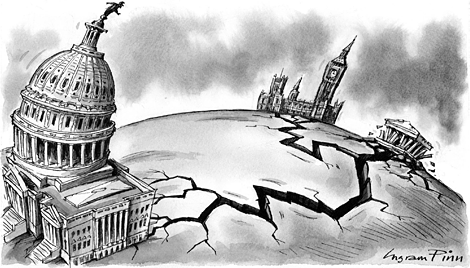
Greece’s PSI is Dead on Arrival: An error in search of a rationale but also a failure that may prove a harbinger for the Modest Proposal

by Pr. Yannis Varoufakis
http://yanisvaroufakis.eu

A brief history of Greece’s PSI


In the beginning there was Wholesale Denial. Then the Denial began to subside under the weight of circumstances. It did so slowly, agonizingly so, with the result that, in the process, Greece lost any capacity it might have had to rebound. It also caused the Crisis to spread like a bushfire throughout the eurozone, turning liquidity problems into unyielding insolvencies first in Ireland, then in Portugal. Still, to this day, Denial is in the air. But it cannot remain intact, without the whole eurosystem crashing and burning. The Greek PSI may be the harbinger of denial’s end. If not, it is hard to see what will stop the juggernaut of the Crisis from destroying the few chances the euro has of survival.

Taking things from the top, the Wholesale Denial began life two years ago when imploding Greece was issued a triple ‘Nein’:...

Monday, November 21, 2011

The Greek Character of Macedonia through the Ages

by Christos Karatzios MD

«ΕΣΤΙΝ ΟΥΝ ΕΛΛΑΣ ΚΑΙ Η ΜΑΚΕΔΟΝΙΑ»
(Estin oun Ellas ke i Makedonia) “Macedonia, is of course a part of Greece”
Strabo, Geography, book 7, Fragment 9 (circa 7 BC – 23 AD)

With this quote, Strabo, the famous ancient Greek historian and geographer described the relation of Macedonia to the rest of Greece when he was describing the known ancient world. The rest of his geographical encyclopedia describes the Macedonians and their lands and is a testament to the Hellenism of Macedonia through the perspective of the ancients [1].

There is overwhelming evidence that the ancient Macedonians, their civilization, their culture, and their history were Greek ever since they settled the lands north of Mt. Olympus about 2,000 BC, and most modern classical scholars and archaeologists agree on these points [2]. As it stands, even historians like Eugene Borza who have not totally supported the fact that the ancient Macedonians were Greek, do state that by the time of Philip II and Alexander the Great, they had been absorbed and assimilated by the Greeks [3]. However, since Borza, more....

Saturday, November 12, 2011

Some Christian Evidences on the Invented Macedonian Question


by Pr. Ioannis N. Kallianiotis
October 2011
http://www.antibaro.gr/node/3467#_ftnref43

Abstract

The purpose of this small paper is to provide some Christian evidences (during the Christianization of Greek-Macedonians in year 50 A.D.) and a scientifically true analysis on the Hellenic (Greek) history and to examine what this information regarding Macedonia means to us and to the uninformed world as a whole. We will offer some thoughts and unshaken Christian events that may help to answer questions concerning today’s conditions in south-eastern Europe, the borders of the “Christendom” (currently, the under decomposition European Union). It is imperative that all scholars, politicians, decision makers, students, and intellectual human beings have this information regarding an artificial state, Skopje, created recently between Greece and Serbia, because we, as educators, are responsible for all young people of this planet and we must tell them the plain truth in simple words, away from any expediency, propaganda, and anti-scientific delusion. This new Albano-Slavic state has unlawfully chosen the Greek name “Macedonia” for its nation and Greece is opposing their aggressiveness and will resist their expansionism. It is historically wrong for them to use Greek names and symbols because they have nothing in common with Ancient Greeks since they came from Dardania and appeared in the region in the 7th century A.D.; their old name was Vardarska. How can they found their new establishing state on an incredible lie? They must know that there is social justice and it will, soon or late, prevail!

Tuesday, November 01, 2011

The Keynes-Hayek Rematch (in the cases of Greece and Eurozone crisis)


LONDON – The Austrian economist Friedrich von Hayek, who died in 1992 at the age of 93, once remarked that to have the last word requires only outliving your opponents. His great good fortune was to outlive Keynes by almost 50 years, and thus to claim a posthumous victory over a rival who had savaged him intellectually while he was alive.
Hayek’s apotheosis came in the 1980’s, when British Prime Minister Margaret Thatcher took to quoting from The Road to Serfdom (1944), his classic attack on central planning. But in economics there are never any final verdicts. While Hayek’s defense of the market system against the gross inefficiency of central planning won increasing assent, Keynes’s view that market systems require continuous stabilization lingered on in finance ministries and central banks.
Both traditions, though, were eclipsed by the Chicago school of “rational expectations,” which has dominated mainstream economics for the last twenty-five years. With economic agents supposedly possessing perfect information about all possible contingencies, systemic crises could never happen except as...


Saturday, October 15, 2011

The Wicked Game


How Greece is being beaten into a pulp to force Europe’s banks to accept capital while keeping Italy et al in awe. 

Reliable sources tell me that the troika has drawn a surprising line on the sand: Either the Greek government agrees to force upon the private sector trades unions an immediate reduction in minimum wages with immediate effect (plus the dismantling of all awards regarding dismissal compensation and limitations), or the next instalment (or tranche) of EU-IMF-ECB loans to Greece will be withheld. Noting that even Mrs Thatcher took years before she could impose her iron will on the trades unions, it is clear that the troika is asking the Greek government to commit to a change that it may be both unwilling and unable to effect. If this is true, two questions arise:

Friday, September 30, 2011

Pan Macedonian Canada Letter to Liberal leader Bob Rae


Tuesday, September 27, 2011

Dear Sir,

On behalf of the members of the PanMacedonian Association of Canada, the largest organization of Canadians of Greek origin from the region of Macedonia in Greece, we are writing to you to express our concern regarding your congratulatory statement to our fellow Canadians from the Former Yugoslav Republic of Macedonia (the FYROM) on September 8, 2011 [1]. This date marked the 20th anniversary since Skopje declared its independence from Belgrade in 1991. Just like you do, we share the same conviction that liberty and freedom should be celebrated, promoted, and congratulated, and we extend our congratulations to our northern neighbours and their diaspora communities. However, in your letter you addressed our fellow Canadians from the FYROM as “Macedonian-Canadians”, and you lauded their contribution to a “harmonious” Canada. The PanMacedonian Associations all around the world have been at the forefront of protecting the Hellenism of Macedonia ever since that...

Sunday, September 18, 2011

Pau Gasol receives Death Threats in his FB page by Ultra-Nationalists from FYROM

Pau Gasol, the famous Spanish Basketball player receives death threats by FYROM’s Ultra-Nationalists in his Facebook Page.
Its surely the most pathetic News Story related to the Eurobasket 2011 of Lithuania. Pau Gasol, the ace of the Spanish National Team and LA Lakers, is receiving numerous abuses and even Death threats by Slavic Ultra-Nationalists of FYROM after commiting the… “crime” to call their country FYROM. In other words, the name that FYROM’s governments have agreed to use in ALL the International Organizations.


The Spanish player published in his FB page last Thursday, the following:

Thursday, September 08, 2011

Slavmacedonians call the Greeks “Freaks of Nature” & “Deranged Bastardly Monsters” and the Australian Court dismiss the racial vilification complaint!!!

AMAC’s racial vilification complaint dismissed
Australian Macedonian Advisory Council (AMAC)
Press Release
8 Sept 2011

The Australian Macedonian Advisory Council (AMAC) would like to express its disappointment at the decision of VCAT Member Noreen Megay to dismiss AMAC’s racial vilification complaint against the ‘Australian Macedonian (sic) Weekly’ (AMW).

Last week Ms. Megay handed down her judgment on the matter which was heard at VCAT on the 3rd and 4th of August 2011. The AMW’s article which was the subject of the AMAC’s complaint was published in May 2009, and Ms. Megay found that the article did not meet the high threshold imposed by Section 7 of the Racial and Religious Tolerance Act 2001 (Vic) for a finding of racial vilification. Section 7 requires that the conduct “incite hatred, serious contempt for, or revulsion or severe ridicule of” a class of persons on the ground of the race of that class of persons.

AMAC’s legal advice was that the disgraceful language used in AMW’s article would likely have fallen foul of Section 7. The article in question was titled ‘Who in this Celestial World (sic) gave the Greeks the right to take away the Macedonian language?’ and AMAC’s complaint was based mainly on the following parts of the article:

Saturday, July 30, 2011

Anti-Turkish Movements in Macedonia before the 1821 Greek Revolution

by Ioannis Hasiotis
Modern and Contemporary Macedonia
Volume 1, pages 436-457

Most of what has been written about anti-Turkish movements in Macedonia during the long period between the consolidation of Ottoman rule in the first half of the 15th century and the outbreak of the 1821 Revolution is largely characterized by oversimplification. The enthusiasm with which idealist and even Marxist historians have projected revolutionary activities in the area has not been based on sufficient evidence. What is more, anachronisms have not always been avoided. Confusion further increases as a result of the geographical identification of present-day Macedonia -both Greek and 'Greater Macedonia', which stretches over parts of three neighbouring countries- with an area which, albeit known under the same name, had an entirely different geographical content during the period of Ottoman domination.
These phenomena should not be ascribed solely to political or ideological expediency influencing the writings of Greeks and foreigners on modern Macedonia....

Tuesday, July 26, 2011

FYROM lobby irked by Bill introduced by U.S House Committee on Foreign Affairs

July 26, 2011
The FYROM (Former Yugoslav Republic of Macedonia) lobby in the US been irked by the content of a Bill which was introduced to the U.S House of Representatives by the House Committee on Foreign Affairs.
The Foreign Relations Authorization Act, Fiscal Year 2012 (H.R. 2583) has proposed a limitation on U.S foreign aid to the FYROM. Further irritating the FYROM lobby, the Bill referred to the FYROM under that name, rather than under the name 'Republic of Macedonia´, as official documents have done since the Bush Administration unilaterally recognised the FYROM as the ´Republic of Macedonia´ name in 2004. The relevant sections of the Bill are as follows:

Monday, July 11, 2011

FYROM Statues: From ethno-cultural nationalism to National Chauvinism

With the collapse of communism in Eastern Europe, the ruling ideology of Marxism-Leninism was replaced by different ideological forces. One of them was nationalism. In FYROM, gradually and with the "withdrawal" of the Socialists in the various state power positions, the far right through the VMRO began to take their places. So we have from the late 90's a gradual transformation of rampant ethno-cultural nationalism, into an explosion of national chauvinism (see Andrew Heynwood, political ideologies, 2007).

The extreme nationalist hysteria that exists on these days between the Slavmacedonians, because of the erection of two statues (one is giant) at the center of Skopje is a typical example. The far-right Prime Minister Gruevski, continuing the "antiquisation policy" of the Slavic population, made the next step and the Slavmacedonism enfold the "national chauvinism".

National chauvinism breeds from a feeling of intense, even hysterical nationalist enthusiasm. The individual as a separate, rational being is swept away on a tide of patriotic emotion, expressed in the desire for aggression, expansion and war. The right-wing French nationalist Charles Maurras (1868-1952) called such intense patriotism “integral nationalism”: individuals and independent groups lose their identity within an all-powerful 'nation', which has an existence and meaning beyond the life of any single individual. (Heynwood:165) Such militant nationalism is often accompanied by...

Tuesday, July 05, 2011

Greek austerity measures could violate human rights, UN expert says

30 June 2011
un.org

– The United Nations independent expert on foreign debt and human rights warned today that the austerity measures and structural reforms proposed to solve Greece’s debt crisis may result in violations of the basic human rights of the country’s people, the Office of the High Commissioner for Human Rights (OHCHR) reported.

The implementation of the second package of austerity measures and structural reforms, which includes a wholesale privatization of state-owned enterprises and assets, is likely to have a serious impact on basic social services and therefore the enjoyment of human rights by the Greek people, particularly the most vulnerable sectors of the population such as the poor, elderly, unemployed and persons with disabilities,” said Cephas Lumina, who reports to the UN Human Rights Council in Geneva.

The rights to food, water, adequate housing and work under fair and equitable conditions should not be compromised by the implementation of austerity measures,” he said, urging the Government to “strike a careful balance between austerity and the realization of human rights, taking into account the primacy of States’ human rights obligations.”

Mr. Lumina also called...

Friday, July 01, 2011

Democracy’s Cradle, Rocking the World

By MARK MAZOWER
Published: June 29, 2011
nytimes.com

YESTERDAY, the whole world was watching Greece as its Parliament voted to pass a divisive package of austerity measures that could have critical ramifications for the global financial system. It may come as a surprise that this tiny tip of the Balkan Peninsula could command such attention. We usually think of Greece as the home of Plato and Pericles, its real importance lying deep in antiquity. But this is hardly the first time that to understand Europe’s future, you need to turn away from the big powers at the center of the continent and look closely at what is happening in Athens. For the past 200 years, Greece has been at the forefront of Europe’s evolution.

In the 1820s, as it waged a war of independence against the Ottoman Empire, Greece became an early symbol of escape from the prison house of empire. For philhellenes, its resurrection represented the...


Wednesday, June 22, 2011

Letter from All Pan-Macedonian Association to UN and EU regarding the Statue of Alexander the Great in Skopje


To: UN Country Members
       Europarliamentarians

We are vehemently opposing the erection of Alexander the Great’s statue in the Skopje Square, in the capital of the FYROM. This act does not only show the usurpation of the Greek history by that country’s Slavs in the strongest terms, but it also portrays their true irredentist ideas such as land expansion. We are not fooled by the name "Warrior on a Horse", as Skopje's ultranationalist government is now clearly breaking the Interim Accord signed by the two countries in 1995.

Under no circumstances should the international community and the international legal system allow this theft of Greece’s most famous persona, Alexander the Great to take place. We, the Macedonians are proud of our Macedonian cultural identity for...

Sunday, June 05, 2011

The Macedonian Identity in 19th century

By Dr  Evangelos Kofos
Historian and Balkan expert

With the establishment of the modern Greek state in 1830, Greek national ideology developed on the basis of national continuity. It stressed classical Greek roots but also traced, from Byzantium, through Turkokratia, to Independence, the survival of the Greek nation, the Greek language, Greek customs and, of course, the Greek Orthodox religion.7 In Macedonia, however, emphasis was focused on two important, specific points. The first centred on the grandeur of ancient Macedonia and the saga of Alexander the Great. The magnetism of the great king, his achievements and the name of the Macedonians had been stimulants of Greek national ideology in Macedonia even before the Greek War of Independence;8 during the period of the Enlightenment, Greeks of Macedonia, both locally and in the diaspora, carried the Macedonian name as an additional testimony of their Greekness.9 As yet there was no challenge to the view that the ancient Macedonians were Greeks, and that the Greek inhabitants of Ottoman-held Macedonia were the only bona fide ethnic group entitled to bear the Macedonian name. These modern Makedones took pride in claiming descent from kings Philip and Alexander, just as eighteenth-century Athenian villagers traced their ’imagined’ lineage from Themistocles and Pericles.

The extraordinary revival of Hellenic names, particularly those of ancient Macedonian origin, which were given to children, to cultural clubs and even to towns (Edessa in lieu of Vodena, Monastir in lieu of Bitola) indicates...

Saturday, May 28, 2011

The Odd Couple; The Stefov – Gandeto connection

by Nick Michael Hodges

In his article “The little Dictionary had no chance”, which was published in the American Chronicle on April 17, 2011, Risto Stefov says that he is wondering why the Greeks are behaving the way they do and he has obviously found somebody by the name J.S.G. Gandeto who has written a book called “The Theft of a King who Stole Alexander” and he uses that book as his, I may say, Gospel to explain the “Greek behavior” as it is presented or described in that book by a man who I think he may be as qualified to do that about the Greeks as Judas might had been asked to do the same thing about Jesus Christ.

I do not know for sure but I would like to think that there are books out there that explain or describe the Greek behavior but J.S.G. Gandeto is writing things about the Greeks and their behavior that Risto Stefov wanted to hear and thus present in his article whatever claptrap he was able to find in J.S.G. Gandeto´s book that was written to allow himself and his fellow South Slavonians Slavs to vent out their passion, hate and malice against ...

Tuesday, May 17, 2011

The Origins of Greece's Policy with Regards to the Current "Macedonian Issue"

by Evangelos Kofos
abstract from the essay “Documenting the Greek-Macedonian Name Controversy”
Sudosteuropa, 58, January 2010, pages 413-435

The original "Macedonian question" emerged in the last decades of the 19th century and covered the two first decades of the 20th. Simply stated, it was a contest between three young Balkan states, vying with each other to inherit the possessions of the crumbling Ottoman Empire. The vaguely defined "Macedo­nian" lands were both the prize and the apple of discord for Bulgarians, Greeks, and Serbs. For the European powers, the treaties of the Balkan Wars (Bucharest 1913) and the First World War (Neuilly 1919 and Lausanne 1923), terminated the armed conflicts in Southeast Europe, rendering the "Macedonian Ques­tion" a challenging subject for historians rather than politicians.[1] Not so for the locals.

Perceptions of an endured "historical injustice", lost homelands for hundreds of thousands of uprooted natives, various types of population exchanges, all followed by suppressive measures for the induction of varied ethnic groups into new unified political environments, kept the issue alive. Out of the peace settle­ments, Greece had emerged as a status quo country, Bulgaria as an irredentist one. Former Serbia, subsequently Yugoslavia, had turned introvert seeking to put its multi-ethnic state entity in order.

Soon, new international actors emerged in the region, intent on plying the murky Macedonian terrain for their own benefit. The first....

Sunday, May 08, 2011

The social and historical parameters of the Greek abducted children (Greek civil war)


By Yannis Tsalouhidis,
Macedonia and the Historical Guilt,
Thessaloniki 1994, p. 76-79

An internationally unprecedented historical crime. The issue of the Greek children who were taken to Yugoslavia and the Eastern Bloc in 1948-1949 is still obscure as an insoluble incident of the Civil War in Greece. The parties involved stopped working on the issue, which is today exploited by the blatant Slavo- "Macedonian " nationalists in Skopje and abroad.
The varied and opposed terms given to the issue are indicative of the contrary opinions that the two sides have: "kidnapped" or "refugees", "Greeks" or "Macedonians", "mass kidnapping " or "exodus ", "genocide " or "rescue ". In order to clarify the issue, it is necessary to find more evidence, since we cannot gain access to the archives of the CP. of Greece, Yugoslavia, Skopje and Bulgaria, neither can we get the protagonists to talk and clear up many obscure parts. Those who brought about the tragic kidnapping ought to talk eventually.
The Greek Government brought the issue of the these children to the U.N. for the first time in March 1948, as soon as it was made known that the Greek Communist guerillas removed great numbers of children, between the ages of...

Monday, May 02, 2011

The Myth of Modern Macedonia - inventing an identity

By Professor John Melville-Jones

Last year I learned that a statue of Alexander the Great was to be erected in Skopje. I knew enough about modern history to be sure that the choice of this subject was not simply, as in some places (for example in Edinburgh), the result of a desire to commemorate a heroic figure of the past. I realised that it was part of an attempt that has been made during the last few generations to create an identity for the Former Yugoslav Republic of Macedonia which can stretch back to distant antiquity. So what we have here is a myth in the making.

A myth is a story which can be told, retold, and modified. It survives because it gives pleasure, or satisfies a human need. It may be based on a fact, but it is not a historical account of something that happened, because even if an event took place that led to the birth of the myth, the story has been so changed for artistic or other reasons that it takes a form that is different from the form that it had when it was born. So a raid that might have been made on a city in Asia Minor by men who sailed from Greece in the second millennium B.C. turns into the story of the abduction of Helen and the Trojan War.

To take another example, among....

Thursday, April 21, 2011

Facts of the Slavmacedonian(FYROM) pseudoscience

The very act of the foundation of the Former Yugoslav Republic of Macedonia (FYROM), together with all its subsequent actions as a political entity from 1944 to the present day, show that "Slavmacedonism" is the basic totalitarian ideological tenet of that state. With this tenet the state and the Slavic component in a population of several different ethnic groups have constructed their existence as a nation and their ‘historical’ mission. Right at the very start, "Slavmacedonism" was proclaimed as a sacred dogma, allowing of no discussion, let alone questioning based in Pseudoscience.  It is therefore useful to consider some of the earmarks of Slavmacedonian(FYROM) pseudoscience. The substitution of fantasy and nonsense for fact leaves behind many different clues and signs that almost anyone can readily detect. Below are listed some of the most common characteristics of Slavmacedonian(FYROM) pseudoscience....